

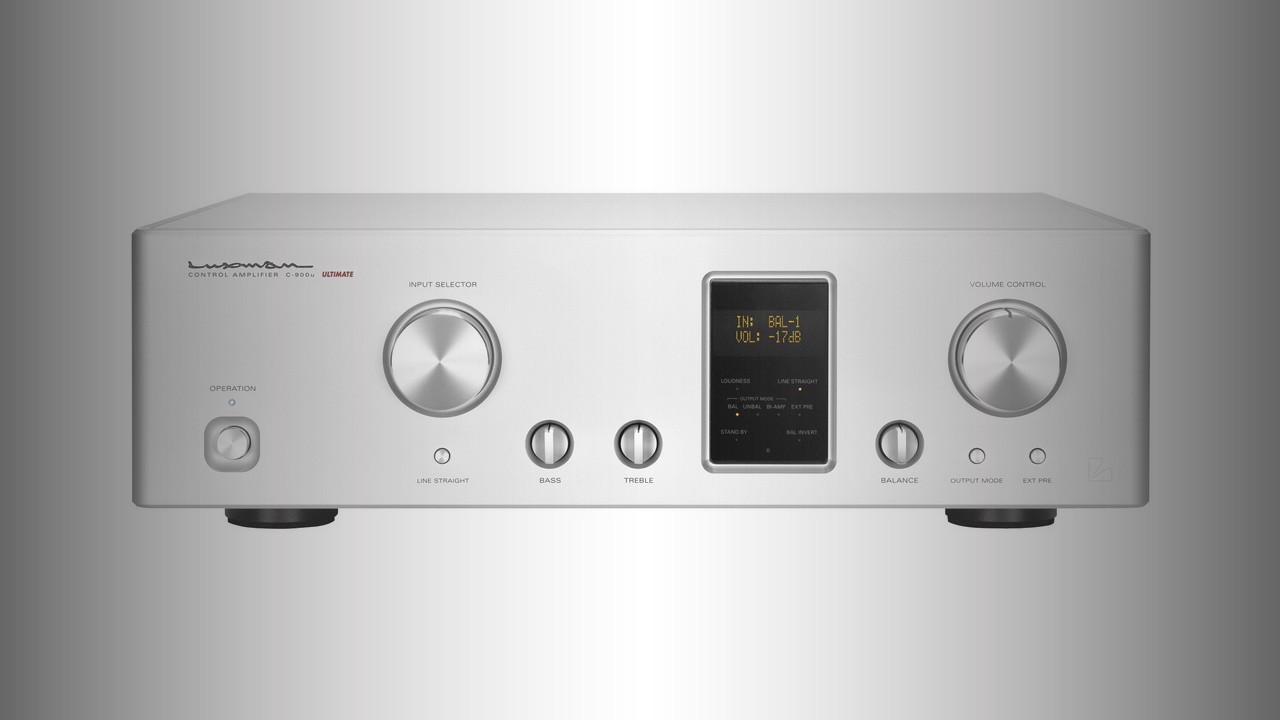
The Luxman C-900u is a statement analog preamplifier designed for systems where the preamp is expected to do more than simply switch sources and set volume. Its appeal lies in the way Luxman combines traditional high-end preamplifier priorities—low noise, stable gain, mechanical rigidity, and careful signal routing—with practical features for modern two-channel systems. Built around a fully balanced, discrete circuit topology and an improved LECUA 1000 precision attenuator, the C-900u is positioned as a serious control component for owners who want a highly specified analog hub with both balanced and unbalanced connectivity.
A Fully Balanced Architecture With Discrete Circuitry
At the center of the Luxman C-900u is a fully balanced circuit topology based on discrete elements. For a preamplifier, this design choice is significant because the unit’s primary role is to preserve, manage, and route low-level signals before they are handed to a power amplifier. A balanced layout can help maintain channel separation and reduce susceptibility to noise when used with compatible sources and amplifiers.
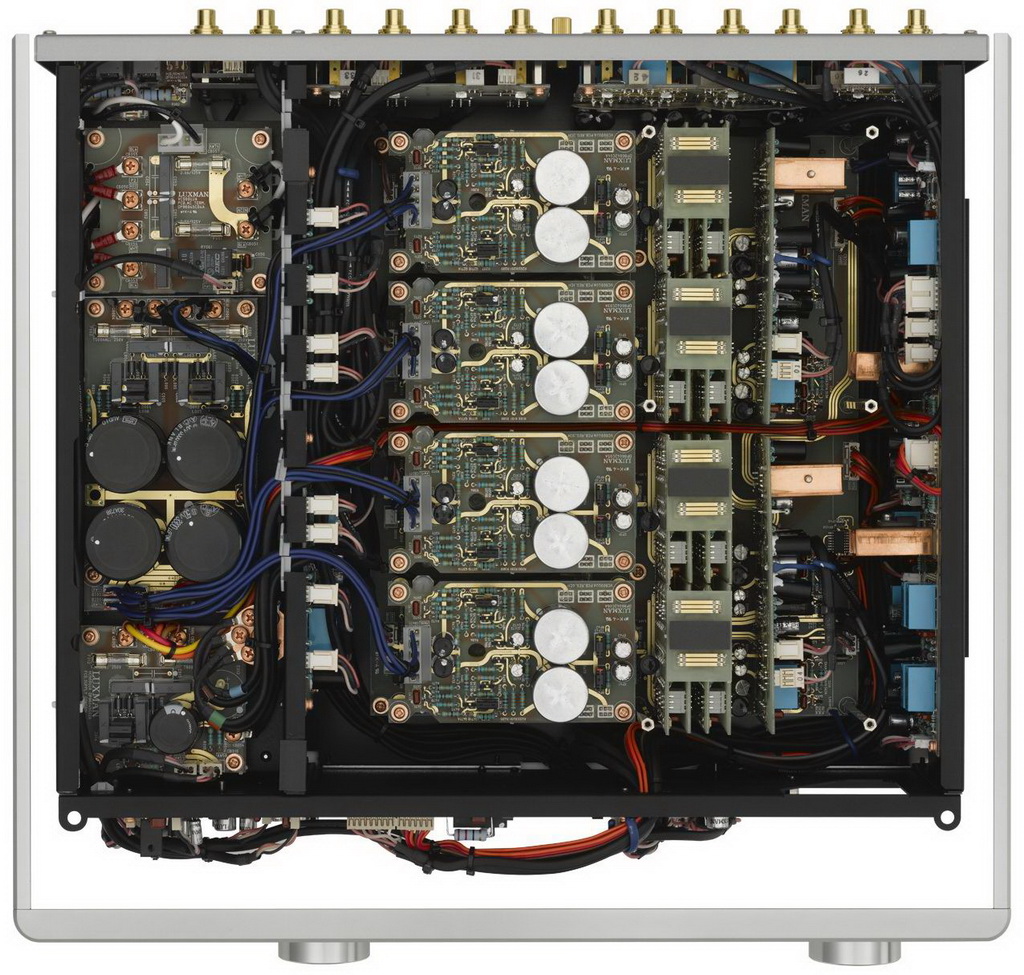
The C-900u uses four balanced amplification modules. This arrangement is intended to provide precise channel separation while reducing noise and interference. In practical system terms, that makes the preamplifier especially relevant for owners who already use balanced XLR sources or power amplifiers, or who are building a system where balanced connections are preferred for longer cable runs or cleaner component integration.
Luxman also specifies a preamp gain of 12 dB, increased from the earlier C-800F’s 9.5 dB. Gain structure is an important but sometimes overlooked part of system matching. A preamplifier with adequate gain can better accommodate a range of source output levels and power amplifier sensitivities, helping the system reach appropriate listening levels without relying on extreme volume settings. The C-900u’s published input sensitivity and impedance figures—255 mV with 43 kΩ for RCA and 255 mV with 86 kΩ for XLR—also indicate broad compatibility with typical line-level source components.
LECUA 1000 Volume Control and Why It Matters
One of the defining features of the Luxman C-900u is its improved version of the LECUA 1000 high-precision attenuator. Volume control is a critical function in any preamplifier because it sits directly in the signal path and is used constantly. Luxman’s approach provides 88 steps of adjustment across a 0 to 87 dB range, offering fine control rather than broad, coarse changes.
The documented benefit of this attenuator is that the C-900u maintains a high signal-to-noise ratio and low distortion at any volume level. That matters because many systems are not always used at high output. Late-night listening, high-sensitivity speakers, and powerful amplifiers can all demand precise low-level volume adjustment. A stepped precision attenuator is attractive in this context because it is designed to deliver repeatable, controlled changes without treating low-level use as an afterthought.
The C-900u’s published signal-to-noise ratio is 123 dB via RCA and 126 dB via XLR, while harmonic distortion is specified at 0.009% for RCA and 0.005% for XLR across 20 Hz to 20 kHz. These figures support the product’s emphasis on quiet operation and careful signal handling, particularly when installed in systems where downstream amplification and loudspeakers are revealing of upstream noise or imbalance.
ODNF 4.0 and Power Supply Design
Luxman equips the C-900u with the latest generation of its ODNF feedback loop, version 4.0, used to suppress high-frequency distortion. This is coupled with a Darlington circuit intended to increase current gain. The purpose of these design choices is not to add processing or coloration, but to support linear, stable amplification within the preamplifier stage.
The power supply is also treated as a major part of the design. The C-900u uses a powerful transformer and four electrolytic capacitors rated at 3300 μF. In a preamplifier, the power supply has a direct relationship with noise control, stability, and the component’s ability to behave consistently under different operating conditions. While a preamp is not asked to drive loudspeakers directly, its circuitry still depends on clean, reliable power rails.
The specified frequency response is 20 Hz to 20 kHz at +0, -0.1 dB, and 5 Hz to 120 kHz at +0, -3 dB. This wideband specification aligns with the C-900u’s role as a high-resolution analog control unit, designed to pass line-level signals with minimal restriction across and beyond the audible band.
Circuit Board Materials and Connector Choices
Luxman’s attention to materials is a notable part of the C-900u story. The circuit boards use thick gold-plated copper foil traces, with conductors coated in a 100 micron layer of gold. According to the supplied technical description, this is intended to increase durability and eliminate dielectric effects in the audio circuits. The preamplifier circuit also uses selected resistors and capacitors associated with higher-grade products.
The input and output RCA connectors use a copper alloy selected to combine the hardness of brass with the conductivity of copper. Connectors are easy to overlook, but they are the physical interface between the preamplifier and the rest of the system. A robust connector material can be valuable in installations where cables may be changed over time or where the preamp is expected to serve as a long-term system anchor.
These details help explain the C-900u’s market position. It is not merely a feature-rich preamp; it is built around an accumulation of small engineering and materials decisions intended to protect signal integrity and long-term reliability. For an owner investing in a dedicated analog control component, those construction choices are part of the appeal.
Substantial Mechanical Construction
The C-900u is a large, solidly built component, measuring 440 x 130 x 430 mm and weighing 19.7 kg. Its all-metal body, smooth corners, and anti-vibration cast iron feet underline its role as a high-end component intended for a serious equipment rack rather than a lightweight desktop installation.
The chassis sits on massive gradient mounts designed to protect the electronics from unwanted vibration. Mechanical vibration control is especially relevant in analog-focused systems, where microphonic effects and physical instability can become concerns. The C-900u’s construction suggests that Luxman treats the enclosure not simply as packaging but as part of the operating environment for the circuitry inside.
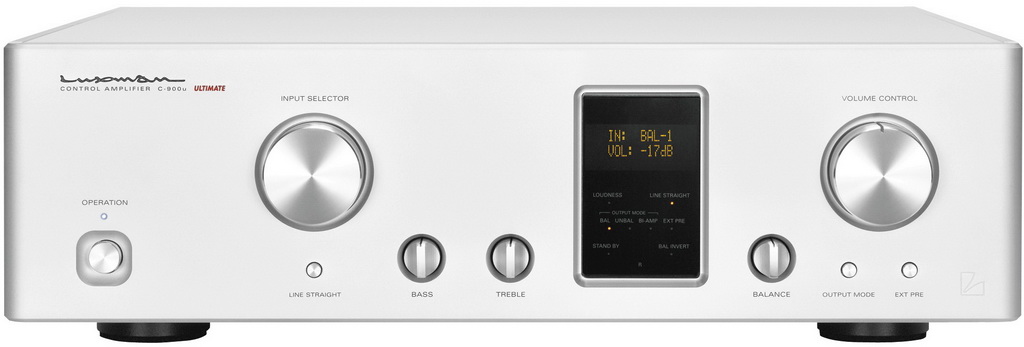
The front panel layout reinforces that sense of purposeful design. It includes an FL display with built-in LED operating mode indicators and clear symbols. The supplied aluminum remote control includes a Zoom button that can increase the symbol size, a useful touch for owners who sit at a distance or prefer a more legible display. This is a small usability feature, but one that shows attention to daily interaction rather than specification alone.
Controls for Purist and Practical Use
The C-900u balances purist signal-path options with practical adjustment tools. On the left side of the front panel are high-frequency and low-frequency tone controls. These provide adjustment when a system, room, or recording benefits from small tonal correction. The specified tone range is ±8 dB for bass at 100 Hz and ±8 dB for treble at 10 kHz.
For users who prefer to bypass tone adjustment entirely, Luxman provides a Line Straight button that removes the tone block from the signal path. This dual approach is useful because it does not force a single operating philosophy. Owners can run the preamplifier in a more direct configuration most of the time, yet still retain tone adjustment when needed.
Other front-panel controls include input selection, standby switching, balance control, a button for switching between balanced and normal outputs, a pass-through activation key for an external AV processor or preamplifier, and the main volume knob. The inclusion of balance control is particularly welcome in high-end analog systems, where room asymmetry, speaker placement, and recording variation can make small channel adjustments useful.
Connectivity for Complex Two-Channel Systems
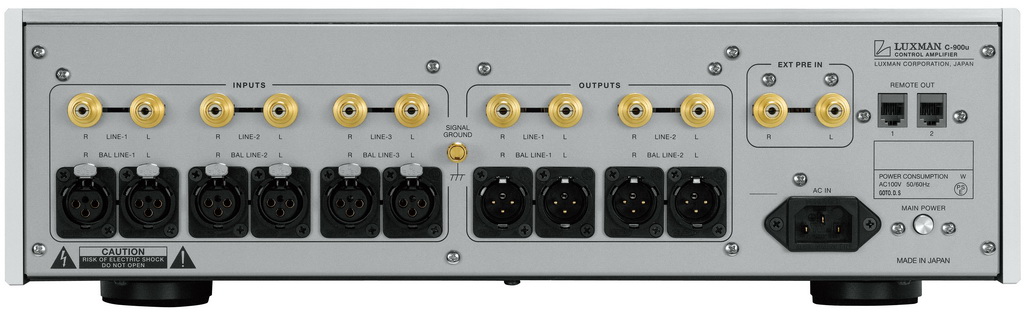
The rear panel gives the C-900u considerable flexibility. Inputs include three balanced XLR connections, three unbalanced RCA line inputs, and an RCA pass-through input for an external AV processor or preamplifier. This makes the unit suitable for systems that combine dedicated stereo listening with broader home entertainment needs, provided the system is configured around compatible line-level components.
Outputs include two RCA pairs and two balanced XLR pairs. The presence of dual outputs is useful for bi-amping arrangements, as documented in the product description, or for systems that need to feed more than one compatible downstream component. The ability to switch between balanced and normal outputs from the front panel adds another layer of installation flexibility.
Additional rear-panel provisions include a power switch, a ground terminal, and two sockets for controlling connected components. Power consumption is listed at 42 W, with standby consumption at 2.2 W. The supplied remote control is the RA-20, and the documentation also notes availability of a network cord with OFC copper conductors. Taken together, the connectivity set positions the C-900u as a capable analog hub rather than a minimalist line stage with only a few inputs.
Conclusion
The Luxman C-900u is most suitable for listeners building a serious analog-centered system around separate source components and power amplification, especially where balanced XLR connectivity, precise volume control, bi-amping options, and integration with an external AV processor are valuable. It will make the most sense for owners who want a substantial, long-term preamplifier with carefully specified circuitry, a robust chassis, flexible input and output options, tone controls that can be bypassed, and Luxman’s LECUA 1000 attenuator at the heart of daily operation. Its strongest documented qualities are its fully balanced discrete architecture, extensive attention to materials and vibration control, precision 88-step volume adjustment, and practical connectivity for sophisticated two-channel systems.



Join the discussion
Share your thoughts, listening impressions or product experience.