NAD C 568 CD Player: A Focused Home for the Disc Collection
The NAD C 568 is a dedicated CD player for listeners who still value physical media, but it adds useful flexibility through digital outputs, USB playback, modern DAC circuitry, and careful attention to power and timing.

The NAD C 568 is an interesting product because it treats the compact disc not as a legacy format to be tolerated, but as a medium still worthy of a dedicated component. Rather than chasing universal-disc compatibility or trying to become a do-everything streamer, it concentrates on CD, CD-R and CD-RW playback, while adding enough digital flexibility to remain useful in a modern two-channel system. Its appeal lies in that balance: a conventional full-width hi-fi CD player with upgraded internal circuitry, practical file support, and connection options that allow it to serve either as a complete player or as a transport feeding an external DAC.
A dedicated CD player with a broader practical remit
At its core, the NAD C 568 is built for standard compact discs and recordable CD media. It plays CDs and CD-R/RW discs, and it can decode MP3 and WMA files recorded to CD-R. That gives it a broader day-to-day role than a strictly Red Book-only machine, especially for listeners who have archived music, radio programs, long playlists, or compressed collections onto recordable discs.
The support for MP3 and WMA on CD-R is not a substitute for lossless disc playback, but it is a useful convenience. The source material notes playback time of up to 10 hours from such discs, which makes the C 568 suitable for extended background listening, long compilations, or casual listening sessions where changing discs frequently would be inconvenient. For many owners, this type of format flexibility is less about audiophile ambition and more about making an existing music library easier to use.
NAD also includes USB playback from external drives, with supported data transfer up to 384 kbps. This further widens the player’s usefulness without turning it into a network device. For someone who wants a simple front-end component rather than an app-driven source, the ability to play from disc and from USB storage keeps operation familiar while adding another way to access files.
Digital architecture aimed at stable playback
One of the more meaningful design points in the C 568 is NAD’s attention to the player’s internal digital platform. The source material identifies a high-precision clock generator intended to minimize jitter. In a CD player, clocking matters because the timing of the digital data stream is fundamental to conversion and output stability. Prospective owners do not need to treat this as a guarantee of a particular sonic character, but it does show that the product is not simply a transport mechanism in a box; NAD revised the internal circuitry around signal handling.
The digital-to-analog conversion stage uses Wolfson DAC chips described as latest generation in the supplied material. Wolfson converters have appeared in many respected audio components, and their inclusion here signals that NAD intended the C 568 to function as a serious standalone analog source, not merely as a disc spinner for an outboard DAC. This matters for system builders who want to connect the player directly to an integrated amplifier through standard RCA analog outputs and keep the system simple.
The output stage also incorporates operational amplifiers associated with NAD’s Masters Series. While that detail should not be overinterpreted, it indicates trickle-down engineering from higher-level NAD products. In practical terms, it supports the C 568’s positioning as a conventional but carefully specified hi-fi source component rather than an entry-level convenience player.
Analog and digital outputs for flexible system matching
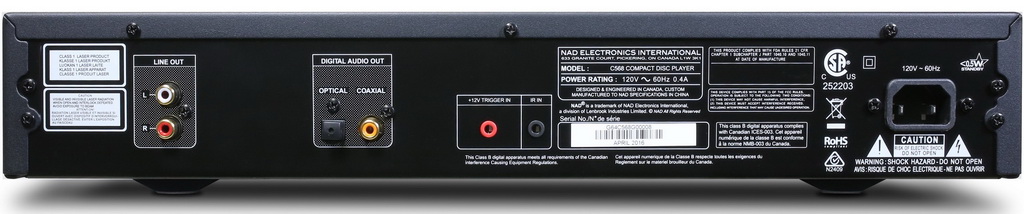
The rear panel connection set is one of the C 568’s strongest practical assets. It provides analog RCA outputs for straightforward connection to an integrated amplifier, preamplifier, receiver, or powered speaker system with line inputs. The specified analog output level is 2.2 ± 0.1 V, which is typical of a modern line-level digital source and should integrate easily into most conventional hi-fi systems.
For users who already own a preferred DAC, or who plan to upgrade the digital side of a system later, the C 568 includes both optical and coaxial digital outputs. This is important because it allows the unit to work as a CD transport. A buyer can use the internal Wolfson-based DAC at first, then route the digital signal to an external converter if the rest of the system evolves.
Having both optical and coaxial outputs also improves compatibility. Optical can be helpful where electrical isolation is desirable, while coaxial is widely used with standalone DACs and digital inputs on integrated amplifiers. NAD’s inclusion of both means the player is not locked into a single upgrade path.
Power supply separation and measured fundamentals
The C 568’s power supply uses separate circuits for the analog and digital sections. In a CD player, this is a sensible engineering choice because digital processing and analog output stages have different demands and different sensitivities. Separation can help reduce unwanted interaction between sections, supporting cleaner signal handling within the design’s intended limits.
The published specifications also suggest a player designed with conventional hi-fi performance priorities in mind. The analog output frequency response is listed as ±0.3 dB from 20 Hz to 1 kHz and ±0.5 dB from 5 kHz to 20 kHz, with total harmonic distortion below 0.01 percent, a signal-to-noise ratio of 118 dB, channel balance of ±0.5 dB, dynamic range of 95 dB, and channel separation greater than 90 dB. These numbers are useful not because they tell the whole story of a component, but because they establish the C 568 as a purpose-built source with documented attention to the basics.
The USB-related specifications include a 2.2 ± 0.2 V output level, frequency response of ±1 dB from 20 Hz to 16 kHz, total harmonic distortion below 0.03 percent, and a signal-to-noise ratio of 118 dB. Again, the significance is practical: NAD did not treat USB playback merely as a decorative feature, but provided defined performance parameters for that mode as well.
Usability that respects the habits of disc listeners
A good CD player is not only about conversion and outputs; it also needs to be pleasant to use. The C 568 includes repeat functions for a track, an entire disc, or a selected fragment of a track. That may sound old-fashioned in an era of streaming queues, but for disc listeners it remains useful. Musicians, students, and attentive listeners may appreciate the ability to repeat a passage, while casual users may simply want to loop a favorite disc.
The player also allows programmed playback with memory for up to 40 tracks. This feature is valuable for anyone who still enjoys building a custom sequence from an album or compilation without creating a file-based playlist. It is a very CD-era function, but that is precisely the point of a dedicated CD player: it makes physical media feel complete rather than compromised.
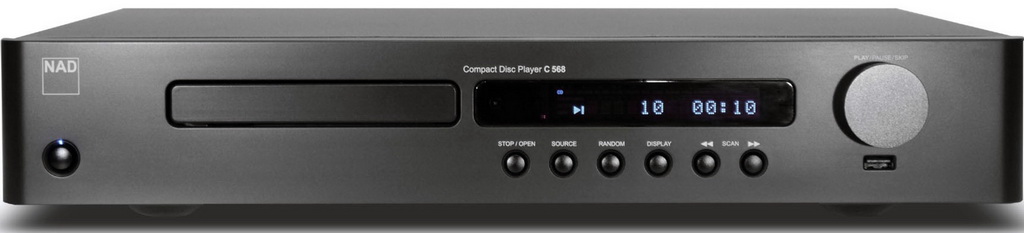
Most functions are accessible from the NAD CD-9 remote control, and the front-panel display provides information about track number and playback time. These are basic details, but they affect everyday satisfaction. A disc player that can be operated from the listening position, and that clearly shows what it is doing, remains easier to live with in a traditional stereo setup.
A design intended to sit naturally in a NAD system
The external design of the C 568 is described as pairing well with the NAD C 368 amplifier. This kind of visual and functional consistency matters for owners who prefer a clean, coordinated equipment stack. A CD player is usually placed in a visible position in a rack or on a console, and matching proportions and styling can make a system feel intentional rather than assembled by accident.
The physical dimensions are 435 x 80 x 306 mm, with a net weight of 4.9 kg. That places the C 568 firmly in standard full-width component territory. It is not a compact desktop source, nor is it presented as a massive statement player. Its size is appropriate for conventional hi-fi furniture and for pairing with integrated amplifiers and other separates.
Standby power consumption is specified at less than 0.5 W, a small but welcome detail for a source component likely to remain connected in a living-room or listening-room system. It reflects modern expectations for domestic electronics without changing the player’s traditional operating style.

Who the NAD C 568 is most suitable for
The C 568 is best suited to listeners who still own and use a meaningful CD collection, and who want a dedicated player rather than relying on a universal player, computer drive, or streaming device. It is especially relevant for owners of two-channel systems who value simple operation, physical media, and the option to connect either through analog RCA outputs or digital outputs.
It also makes sense for NAD users building around components such as the C 368 amplifier, since the styling and system approach are designed to align. However, it is not limited to NAD systems. Its standard outputs and full-width form factor make it broadly compatible with many integrated amplifiers, preamps, DACs, and receivers.
It is less suitable for someone seeking SACD, DVD-Audio, Blu-ray Audio, network streaming, app control, or broad high-resolution file playback from modern storage libraries. The C 568’s documented strengths are focused rather than universal. Its value is in doing the CD-player job with useful additions, not in replacing a full digital hub.
Conclusion
The NAD C 568 stands out as a deliberately focused CD player with practical extensions for real-world music libraries. Its key documented strengths include CD and CD-R/RW playback, MP3 and WMA support, USB drive playback, a high-precision clock generator, Wolfson DAC circuitry, Masters Series-derived operational amplifiers, separated analog and digital power circuits, and both optical and coaxial digital outputs. Add in remote operation, repeat and 40-track programming, a clear display, and styling intended to match NAD’s C-series components, and the result is a source component aimed at listeners who still regard the compact disc as central to their system. It is ideal for prospective owners who want a traditional, easy-to-use disc player with enough connectivity to integrate into either a straightforward analog setup or a more flexible DAC-based system.