Arylic LP100: A Compact Hub for Streaming, Vinyl, TV, and Wireless Audio
The Arylic LP100 is designed for listeners who want one small component to connect modern streaming, vinyl playback, TV audio, and wireless listening without building a stack of separate boxes.

The Arylic LP100 stands out because it addresses a very common modern hi-fi problem: today’s listening habits are no longer limited to one source. A system may need to handle streaming apps, a turntable, TV sound, wireless headphones, local network playback, and voice-controlled convenience, often in the same room and through the same amplifier or powered speakers. Rather than treating those needs as separate jobs for separate components, the LP100 brings many of them into one compact network streamer. Its appeal is not simply that it has a long feature list, but that the feature list reflects how many people actually use their audio systems now.
A streamer built for more than one ecosystem
At its core, the Arylic LP100 is a network streamer, and its platform is notably broad. It supports AirPlay 2, Google Cast, Spotify Connect, Tidal Connect, Roon Ready, DLNA, and UPnP. That matters because the product is not tied to one brand’s preferred way of playing music. An iPhone user can lean on AirPlay 2, an Android or Google Home household can use Google Cast, Spotify and Tidal users can launch playback directly from their familiar apps, and Roon users can bring the LP100 into a more elaborate library and multi-room environment.
This kind of compatibility is useful in shared homes, mixed-device households, and systems that may evolve over time. A streamer that only works elegantly with one platform can become limiting when a family member changes phone operating systems, when a subscription changes, or when a more sophisticated music library setup is added later. By supporting several of the major streaming paths, the LP100 is positioned less as a single-purpose app accessory and more as a flexible digital front end.
Connectivity stability is also addressed through both dual-band Wi-Fi and Ethernet. Wi-Fi is convenient where cabling is difficult, while Ethernet remains valuable for installations where reliability is the priority. For a streamer intended to handle everything from casual app playback to Roon Ready use, having both options is a practical design choice.
Digital architecture with high-resolution support
The LP100 is built around an AKM AK4493SEQ DAC, with an SRC CT5302SL and AKM7735 ADC/DSP also documented as part of its internal audio architecture. The specified PCM support extends up to 24-bit/192 kHz, which gives the unit the necessary handling for common high-resolution digital music files and streams. While specifications alone do not define musical performance, they do indicate that Arylic has not treated the LP100 as merely a convenience adapter.
The inclusion of both DAC and ADC/DSP hardware is especially relevant because the LP100 is not only receiving network audio. It also deals with analog inputs, phono signals, Bluetooth transmission, digital inputs, and TV integration. A product with this range of inputs and outputs needs internal processing and conversion stages capable of managing different signal types. The documented component choices help explain how Arylic has packaged such a broad feature set into a compact chassis.

Bluetooth 5.4 as both input and output
Bluetooth is often included on modern hi-fi products as a quick convenience feature, but the LP100’s implementation is more ambitious. It uses Bluetooth 5.4 and supports two-way operation, meaning it can receive audio from a phone, tablet, or other device, and it can also transmit audio outward to compatible wireless headphones or speakers. This gives the LP100 a role beyond that of a conventional streamer connected only to a stereo system.
The codec list is extensive: SBC, AAC, aptX, aptX HD, aptX Low Latency, aptX Adaptive, LDAC, and LC3 are all stated. For prospective owners, this breadth can matter because Bluetooth performance and compatibility depend heavily on what both devices support. A listener using Android hardware, Apple devices, low-latency applications, or newer LC3-capable equipment may have different requirements. The LP100’s broad codec support increases the chance that it can work sensibly with a range of current and recent devices.
The presence of Bluetooth LE Audio and Auracast is also significant. LE Audio and Auracast are associated with newer Bluetooth use cases, including more efficient wireless audio and broadcast-style sharing to compatible devices. Not every owner will need those functions immediately, but their inclusion suggests the LP100 is designed with emerging wireless listening habits in mind, not just legacy phone-to-speaker streaming.
A phono stage for both MM and MC cartridges
One of the LP100’s most distinctive features is its built-in phono stage with support for both moving-magnet and moving-coil cartridges. Many compact streaming products ignore vinyl entirely, and many integrated phono inputs are limited to MM cartridges. By including MM and MC compatibility, Arylic gives turntable owners a more direct route into a modern digital-capable system without requiring a separate phono preamp.
This is useful for several types of systems. A listener with a modest MM-equipped turntable can connect without adding another small box and another power supply. A listener using an MC cartridge is not automatically excluded. That flexibility is important because vinyl playback tends to invite upgrades over time, and cartridge choice is one of the areas where systems often change.
The built-in phono input also reinforces the LP100’s broader design concept: it is not asking the owner to choose between old and new sources. A record collection, streaming services, Bluetooth devices, and TV audio can all be part of one system. For many living-room installations, that integration is more useful than separating every source into a dedicated component.

HDMI eARC makes it easier to include the TV
HDMI eARC is another key feature because it connects the LP100 to one of the most used audio sources in many homes: the television. With HDMI eARC, the LP100 can serve as a bridge between TV audio and a hi-fi system, allowing movies, games, broadcast content, and streaming video services to play through the same speakers used for music.
The documented HDMI CEC support is just as important for day-to-day usability. CEC can allow volume and power functions to work more naturally with the TV’s controls, reducing the friction that often makes hi-fi systems awkward for non-enthusiasts. A technically capable audio system is less useful if family members need to remember a complicated sequence of remotes, inputs, and volume settings. By supporting HDMI eARC and CEC, the LP100 is better suited to shared living spaces where simplicity matters.
Inputs, outputs, and control options for flexible systems
Beyond streaming, phono, Bluetooth, and HDMI, the LP100 includes analog line inputs, USB inputs, coaxial and optical digital inputs, and a dedicated subwoofer output. That mix lets it sit at the center of different system types. A CD transport or digital source can use optical or coaxial input, a computer or compatible storage path can involve USB, and an analog source can connect through line input. The subwoofer output is useful for systems where compact main speakers need low-frequency support from an external subwoofer.
Control is also intentionally varied. The LP100 can be operated through the Go Control app, an IR remote, Siri, Google Assistant, and TV-linked HDMI CEC behavior. This gives owners multiple ways to interact with the unit depending on context. App control may suit music browsing, voice control may suit quick commands, an IR remote remains straightforward for traditional use, and HDMI CEC helps when the TV is the source.
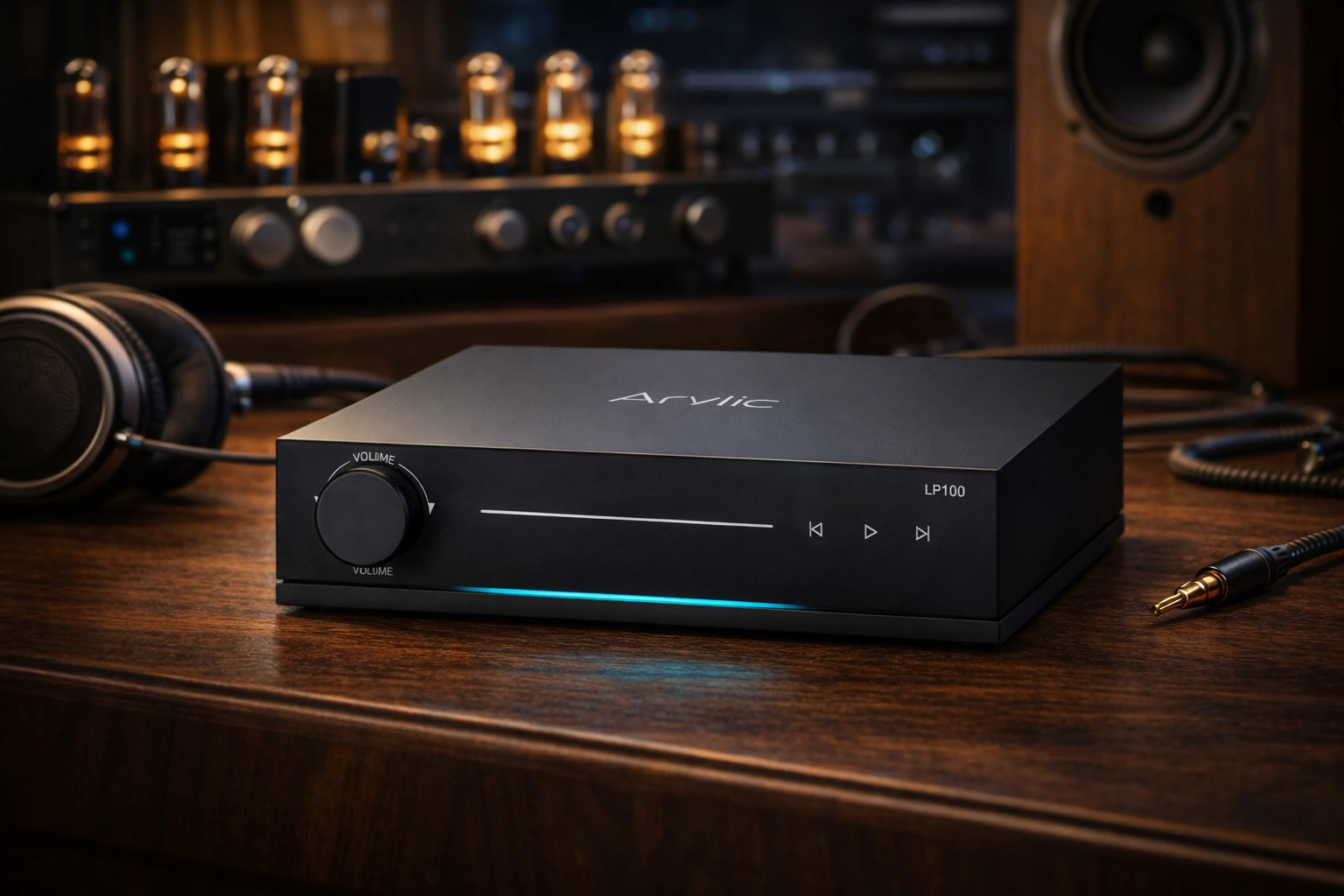
The compact, USB-C-powered design is another practical point. A unit weighing just over half a kilo and powered through USB-C is easier to place than a full-size component, particularly in small racks, media cabinets, desktop systems, or apartments. The LP100’s value is partly in what it may remove from a setup: extra adapters, separate streamers, standalone Bluetooth transmitters, external phono stages, and TV audio workarounds.
Who the Arylic LP100 is most suitable for
The LP100 is best suited to listeners who want a compact control point for several everyday sources rather than a minimalist single-function component. It is especially attractive for people combining streaming subscriptions, vinyl playback, and TV audio in one room. It also makes sense for households where different users prefer different control methods or streaming platforms.
It may also appeal to owners of powered speakers, compact integrated amplifiers, or systems with limited shelf space. The broad input selection and wireless options make it useful where a conventional rack of separate components would be impractical. Bluetooth transmission can be valuable for late-night headphone use, while HDMI eARC can make the system more inviting for daily television watching.
The LP100 is less obviously aimed at purists who prefer every function to be handled by a dedicated standalone component, or at users who need only a simple network endpoint with no interest in phono, HDMI, or Bluetooth transmission. Its strength is integration. Prospective owners should be drawn to the idea of one small hub managing many roles, rather than seeking a product stripped down to one specialist task.
Conclusion
The Arylic LP100’s strongest documented qualities are its breadth of connectivity, compact design, and ability to unite sources that are often kept separate. Network streaming support covers major ecosystems including AirPlay 2, Google Cast, Spotify Connect, Tidal Connect, Roon Ready, DLNA, and UPnP. Its Bluetooth 5.4 implementation adds two-way operation, broad codec support, LE Audio, and Auracast. The inclusion of HDMI eARC with CEC makes it practical for TV integration, while the MM/MC phono stage gives turntable owners a direct path into the same system. For listeners who want a small, modern hi-fi hub that can handle streaming, records, television, digital inputs, wireless headphones, and subwoofer integration without a stack of separate boxes, the LP100 has a clearly defined and genuinely useful role.