Atoll CD200 Signature: A Purpose-Built CD Player for Serious Disc Libraries
The Atoll CD200 Signature is aimed at listeners who still value CD as a dedicated format, combining a precision disc mechanism, substantial power supply design, class A analog stages and optional DAC functionality in a full-width metal chassis.

For listeners with a substantial CD collection, the appeal of a dedicated disc player is not nostalgia alone. A well-considered CD player can offer the mechanical stability, power-supply separation, conversion architecture and simple day-to-day usability that a general-purpose digital source may not prioritize. The Atoll CD200 Signature is built around that idea: it treats CD playback as a serious source component, while also providing enough digital connectivity to fit into a more flexible modern hi-fi system.
A solid chassis with a traditional hi-fi presence
The CD200 Signature follows the established form of a full-width hi-fi component, measuring 440 x 90 x 280 mm and weighing 8 kg. That mass is notable for a CD player, because it points to a construction philosophy centered on rigidity and physical stability rather than minimalism. Its metal chassis and precisely milled aluminum front panel give it the kind of robust enclosure expected of a dedicated source component in a separates system.
This matters because CD replay remains partly mechanical. A player has to spin a disc, read optical data accurately and manage vibration while also protecting sensitive digital and analog circuitry from unwanted interference. A firm enclosure is not a decorative extra in this context; it is part of the product’s overall engineering environment. For owners who prefer components that feel permanent and system-oriented, the CD200 Signature’s physical design is one of its defining attractions.
The front panel layout is also deliberately straightforward. The disc tray is centrally placed, with an OLED display positioned below it. The display supports CD text, which can be useful for discs that include album or track information, and the player includes essential playback controls on the unit itself. That combination keeps the machine familiar and easy to operate without overloading the front panel with secondary functions.
A transport mechanism chosen for CD-Audio playback
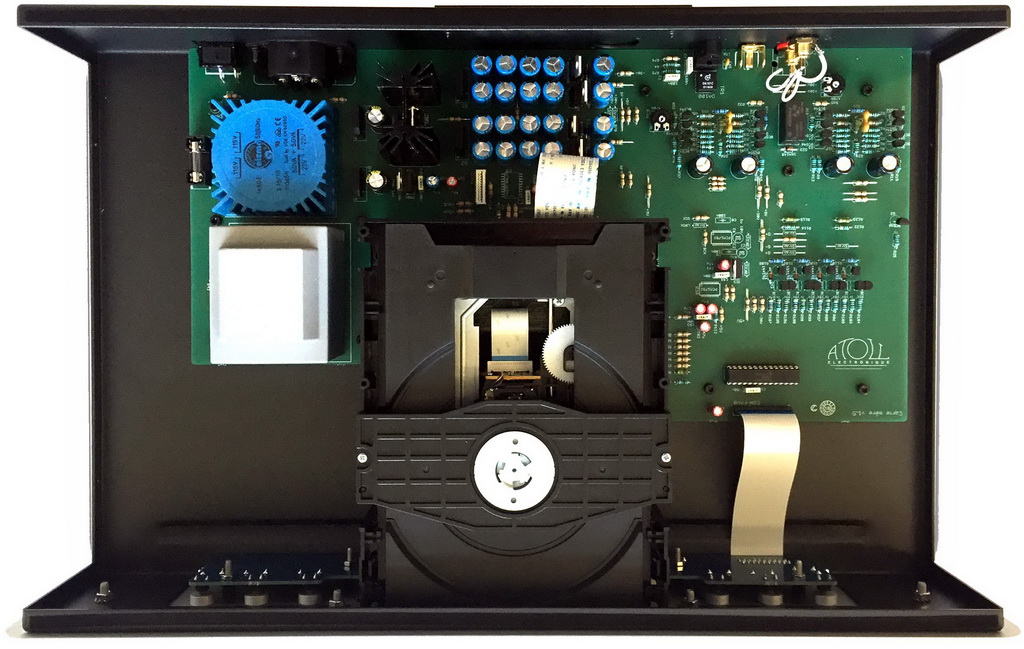
At the heart of the CD200 Signature is a Teac transport mechanism mounted on an anti-vibration base. The source material specifies that this mechanism is optimized for CD-Audio playback and accurate reading of disc information. In practical ownership terms, that emphasis is important: the transport is not simply a slot for discs, but a core part of the player’s role as a dedicated CD source.
A CD player’s digital output ultimately depends on stable disc reading before conversion ever takes place. By using a recognized transport platform and supporting it with an anti-vibration mounting, Atoll is addressing the mechanical side of digital audio directly. Prospective owners who still buy CDs, maintain archived collections, or prefer physical media over streaming are likely to see value in a player designed around the format rather than treating it as an afterthought.
Format support is also broad enough for many real-world disc libraries. The CD200 Signature handles CD-Audio, CD-R and CD-RW, including MP3, WMA and AAC files. That gives it usefulness beyond commercially pressed CDs, particularly for listeners with home-burned compilations, archived recordings or compressed-file discs created over many years.

Burr-Brown conversion and differential analog architecture
The digital-to-analog conversion stage is based on the Burr-Brown PCM1792 DAC, specified at 24-bit/192 kHz. The player also uses digital filtering with eight-times oversampling. These details help define the CD200 Signature as more than a basic transport with analog outputs; it is a complete disc player with a dedicated conversion and output architecture.
The PCM1792 uses a differential current output, and the CD200 Signature’s current-to-voltage conversion is built with bipolar transistors. Its analog output stages are also implemented as a differential circuit and operate in class A. Without making assumptions about sonic results, this is a clear signal of design intent. Differential analog stages are commonly used to manage signal integrity, and class A operation is often selected for output stages where linear behavior is a priority over efficiency.
For a prospective owner, the practical significance is that the CD200 Signature is designed to be used directly into a conventional integrated amplifier, preamplifier or line-level input. Its specified stereo RCA output and 2.5 V output signal level make it a straightforward analog source for a wide variety of systems. This is especially relevant for listeners who do not want to add an external DAC immediately and would rather keep the CD playback chain contained within one component.
Power supply design with attention to separation
The player’s power supply is another documented area of emphasis. The specification lists toroidal power transformers rated at 30 VA + 30 VA, along with a total filter capacitor capacity of 17,000 μF. The design also includes multiple stabilized voltage sources for different functional sections of the machine.
Power supplies are not glamorous features, but they are central to how a source component is engineered. A CD player contains a transport, digital processing, conversion circuitry, display electronics and analog output stages, each with different demands. Using stabilized supplies for separate functional areas can help keep those demands managed within the same chassis.
For system builders, this suggests that Atoll has not treated the CD200 Signature as a lightweight digital accessory. The supply architecture is part of the same full-component approach seen in the chassis, transport mounting and output stage design. The documented signal-to-noise ratio of 129 dB and harmonic distortion figure of less than 0.002% further indicate that the player is specified with serious electrical performance in mind, though those numbers should be understood as manufacturer specifications rather than listening conclusions.

Analog outputs, digital outputs and optional DAC expansion
The CD200 Signature includes stereo RCA analog outputs, plus optical and coaxial digital outputs. That gives it two useful roles. It can operate as a complete CD player using its internal DAC and analog stages, or it can be used as a CD transport feeding an external DAC through a digital connection. This flexibility is valuable in systems that may evolve over time.
The presence of both optical and coaxial digital outputs is particularly useful for owners who already have a favored DAC, digital preamplifier, AV processor or integrated amplifier with digital inputs. It allows the CD200 Signature’s Teac-based disc-reading platform to remain useful even if the owner chooses a different conversion path later.
There is also an optional digital input board, adding optical, coaxial and USB inputs so the player can be used as an external DAC. That option expands the CD200 Signature beyond physical disc playback. With the board installed, it can potentially serve as the digital hub for additional sources, while maintaining the same DAC and analog output architecture used for CD. For listeners who want fewer boxes but still prefer a dedicated disc player, that upgrade path is a meaningful design feature.
Usability for a focused music system
The CD200 Signature’s appeal is partly its clarity of purpose. It does not attempt to be a streamer, server or all-in-one control center in its standard form. Instead, it presents itself as a high-quality CD player with essential controls, a readable OLED display, CD text support and a familiar tray-loading mechanism.
That focus can be attractive in a two-channel system where the owner wants each component to do one job well. A CD is inserted, track information can be shown when available, and playback is handled without app dependence or network configuration. In a market where many digital products are defined by software ecosystems, the CD200 Signature’s conventional operation may be a strength for listeners who value permanence and simplicity.
At the same time, the available digital outputs and optional input board prevent it from being locked into a purely old-school role. It can begin as a straightforward disc player and later function as a transport or DAC-equipped digital source, depending on how the rest of the system develops.
Who the Atoll CD200 Signature is most suitable for
The CD200 Signature is best suited to listeners who already own and regularly play CDs, and who want a dedicated component rather than using a universal player, computer drive or inexpensive disc mechanism. Its build, transport mounting, DAC architecture, class A output stages and substantial power-supply specification all point toward a system in which CD playback remains important.
It will also make sense for owners of traditional stereo systems who want analog RCA output into an integrated amplifier or preamplifier, while keeping digital output options available. Those with an external DAC can use its optical or coaxial outputs, and those interested in reducing box count may find the optional digital input board appealing.
It is less suited to listeners who have fully moved to streaming and no longer maintain a disc library. In its standard form, it should also not be mistaken for a network player or music server. Its strengths are physical-media playback, conventional usability and system integration rather than app-based multiroom convenience.
Conclusion
The Atoll CD200 Signature stands out as a dedicated CD player built around the fundamentals of serious disc replay: a robust metal chassis, milled aluminum front panel, Teac transport on an anti-vibration base, Burr-Brown PCM1792 conversion, differential class A analog stages and a substantial toroidal power-supply arrangement. Its analog outputs make it easy to integrate into a classic stereo system, while optical and coaxial digital outputs—and an optional digital input board—give it room to adapt. For listeners with valued CD collections who want a focused, well-engineered source component rather than a general-purpose digital box, the CD200 Signature’s documented design choices make a strong case.