Musician GEMINI Power Amplifier: Balanced Architecture With Practical Authority
The Musician GEMINI is a fully balanced Class AB stereo power amplifier built around discrete circuitry, a substantial power supply, and specifications aimed at serious two-channel systems.
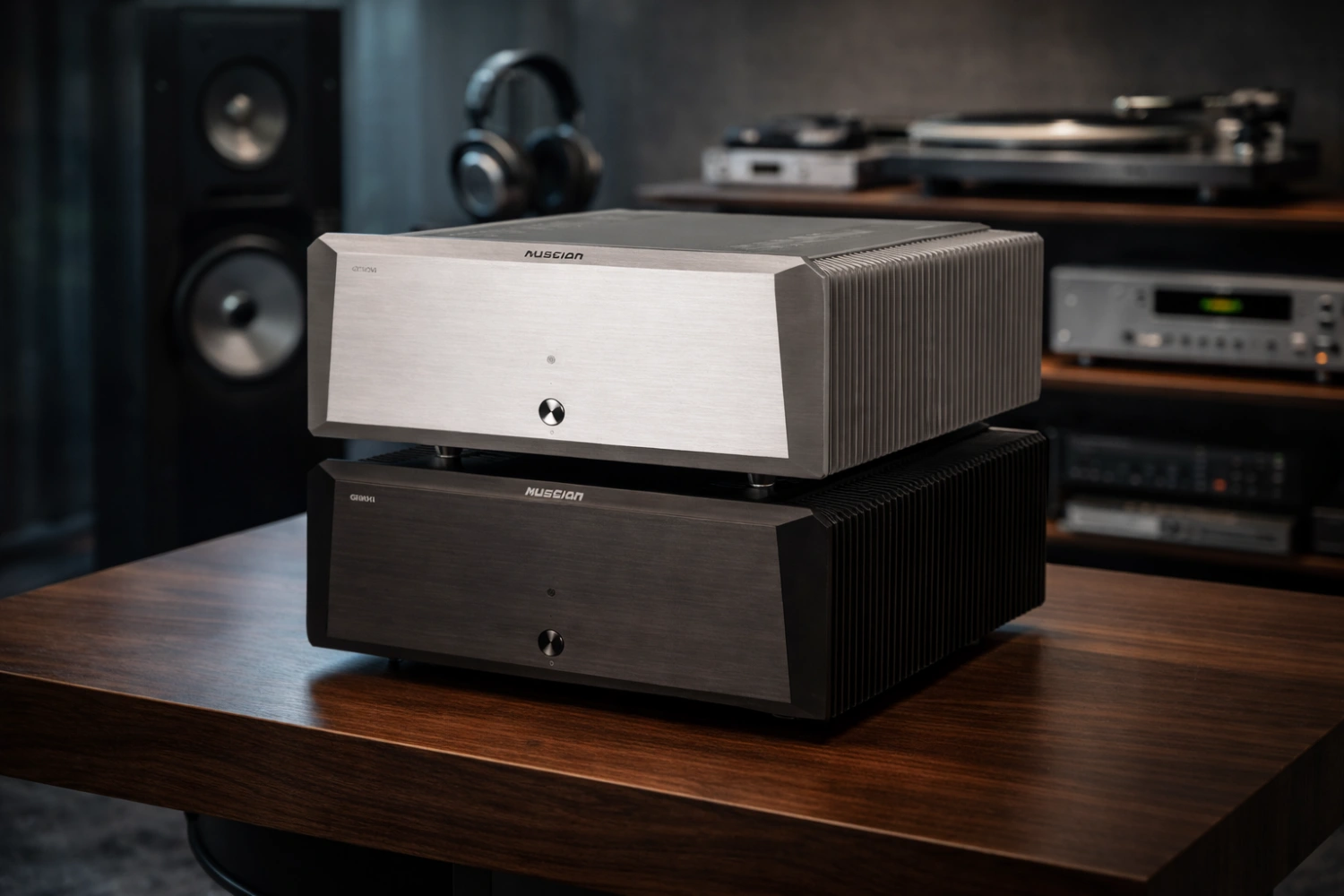
The Musician GEMINI is designed for listeners building a dedicated stereo system around separate components rather than an all-in-one amplifier. As a Class AB stereo power amplifier, it focuses on one job: taking a line-level signal from a preamplifier or source with volume control and driving loudspeakers with stability, low noise, and sufficient current delivery. What makes the GEMINI notable is not a single headline feature, but the way its architecture, power supply, connectivity, and mechanical design all point in the same direction: a conventional high-performance amplifier executed with attention to signal integrity and load control.
A fully balanced foundation
The central design choice in the Musician GEMINI is its fully balanced, discrete architecture. In practical system terms, this means the amplifier is built to handle the positive and negative phases of the audio signal independently rather than treating balanced input as a convenience feature that is converted immediately into a simpler internal circuit. That distinction matters in systems where balanced operation is part of the overall design philosophy, especially when paired with a balanced preamplifier, DAC, or streamer with proper XLR outputs.
Balanced circuitry is valued because it can help reduce common-mode noise picked up along the signal path. In real homes and listening rooms, audio systems often sit near power cables, network hardware, displays, or other electronics. A balanced signal path is not a magic cure for poor setup, but when correctly implemented it gives the system a stronger basis for rejecting interference. The GEMINI’s XLR-only input approach also makes its intended role clear: it is aimed at systems already committed to balanced connectivity rather than users who need every legacy input option.
The amplifier is also described as discrete, which means its amplification stages are built from individual components rather than relying entirely on integrated amplifier chips for the main signal path. Discrete design gives engineers more freedom in how they configure the circuit, manage power delivery, and optimize operating behavior. The benefit to a prospective owner is not automatically better sound in the abstract, but a more purpose-built platform for a dedicated power amplifier.
Class AB power with real-world speaker flexibility
The GEMINI is specified at 120 watts per channel into 8 ohms and 220 watts per channel into 4 ohms. Those figures place it in a useful zone for many serious hi-fi systems: powerful enough for a wide range of floorstanding and standmount loudspeakers, while remaining within the familiar design language of a stereo Class AB amplifier. The near doubling of power into 4 ohms also suggests that the amplifier has been designed with lower-impedance speaker loads in mind rather than only easy, high-sensitivity designs.
For buyers, power ratings are most meaningful when considered alongside the loudspeakers they intend to drive and the size of the room. A speaker with moderate sensitivity, a larger listening space, or music with wide dynamic contrasts can ask more of an amplifier than a compact nearfield setup. The GEMINI’s documented output gives it the flexibility to serve in systems where the owner wants stronger dynamic headroom and grip than a modest integrated amplifier may provide.
The Class AB topology is also a familiar and widely used approach in hi-fi power amplification. It is often chosen as a balance between linear operation and practical efficiency. The GEMINI’s design does not attempt to redefine amplifier categories; instead, it appears to focus on executing a traditional high-current stereo amplifier with a serious power supply, balanced signal routing, and robust output stages.
Power supply design as a core feature
A power amplifier’s supply is not a background detail. It is the reservoir the amplifier draws from when loudspeakers demand current, especially during dynamic musical passages or low-impedance swings. The GEMINI uses a shielded 600VA toroidal transformer, supported by 36 storage capacitors and fast Schottky diodes. These are not merely decorative specifications; they indicate that the amplifier’s design gives substantial attention to stable energy delivery and noise management.
A toroidal transformer is commonly used in audio electronics because it can provide strong current capability in a relatively compact form, while shielding helps limit unwanted electromagnetic interaction with sensitive circuits. The presence of a large capacitor bank supports the amplifier’s ability to supply current quickly when required. Fast Schottky diodes, meanwhile, are associated with efficient rectification and reduced switching behavior compared with slower rectifier choices.
For the owner, the practical attraction is confidence. A power amplifier with an undersized supply may look capable on paper but can struggle when speakers present more demanding conditions. The GEMINI’s documented supply arrangement aligns with its output ratings and its stated emphasis on composure under load.
Output stage and speaker control
Each channel of the GEMINI uses four pairs of high-current output transistors. The output stage is the part of the amplifier that directly interfaces with loudspeakers, and its current capability is central to how well an amplifier can maintain control when speaker impedance drops or music becomes more demanding. Multiple output transistor pairs can help distribute the workload and support higher current delivery, assuming the surrounding circuit and thermal design are properly matched.
This matters because loudspeakers are not fixed resistors. A speaker nominally rated at 8 ohms may dip lower at certain frequencies, and a 4-ohm speaker can be a more difficult electrical load than its basic label suggests. By specifying output into both 8-ohm and 4-ohm loads, and by building each channel around multiple high-current devices, the GEMINI is positioned as a partner for real-world loudspeakers rather than only idealized test conditions.
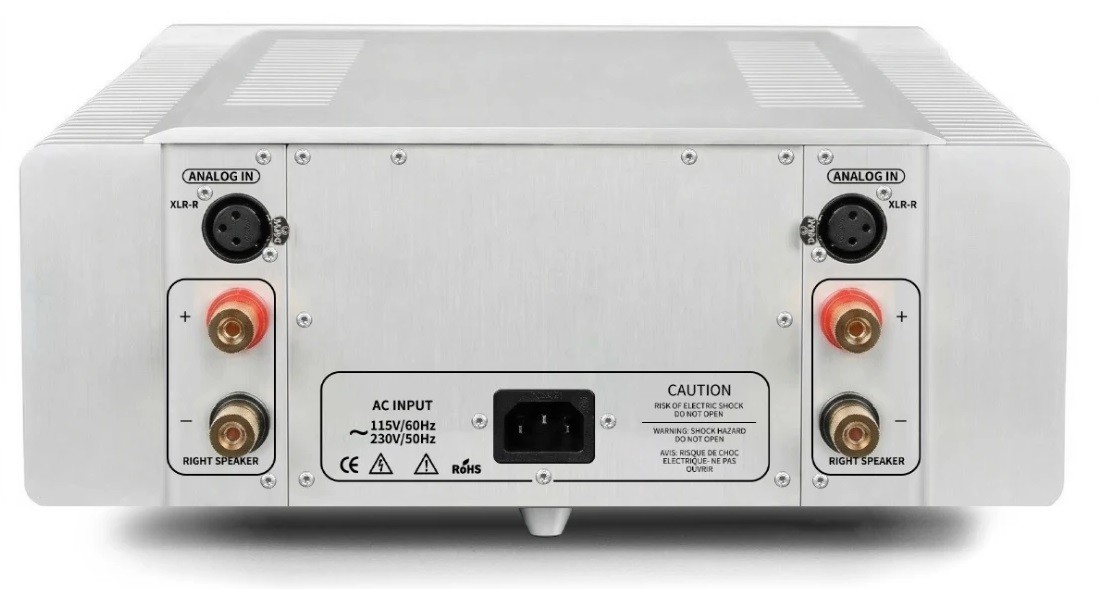
The amplifier’s robust screw-type speaker terminals also reinforce this practical intent. Secure binding posts are important for owners using heavier speaker cables or installing the amplifier in a fixed system where connections should remain stable over time. They are not glamorous, but they are part of good ownership experience.
Measured specifications that support a low-noise brief
The GEMINI’s published specifications include a frequency response of 10 Hz to 80 kHz, THD+N of 0.002%, a signal-to-noise ratio of 118 dB, dynamic range greater than 121 dB, and channel separation of -110 dB. These figures describe an amplifier designed around low distortion, wide bandwidth, and strong separation between the left and right channels.
It is important not to turn specifications into listening impressions without auditioning the product. However, the numbers do help explain the engineering priorities. Low THD+N indicates that distortion and noise are kept to a very low level under the stated measurement conditions. A high signal-to-noise ratio is particularly relevant in systems using revealing loudspeakers or high-resolution sources, where residual hiss or hum would be less acceptable. Strong channel separation supports precise stereo operation by reducing unwanted crosstalk between channels.
The wide frequency response also suggests that the amplifier is not operating near its limits within the audible band. While humans do not hear to 80 kHz, extended bandwidth can be part of a design strategy intended to preserve linear behavior across the audible range. Again, this is not a substitute for system matching, but it adds to the picture of an amplifier engineered for cleanliness and stability.
A chassis built around heat and durability
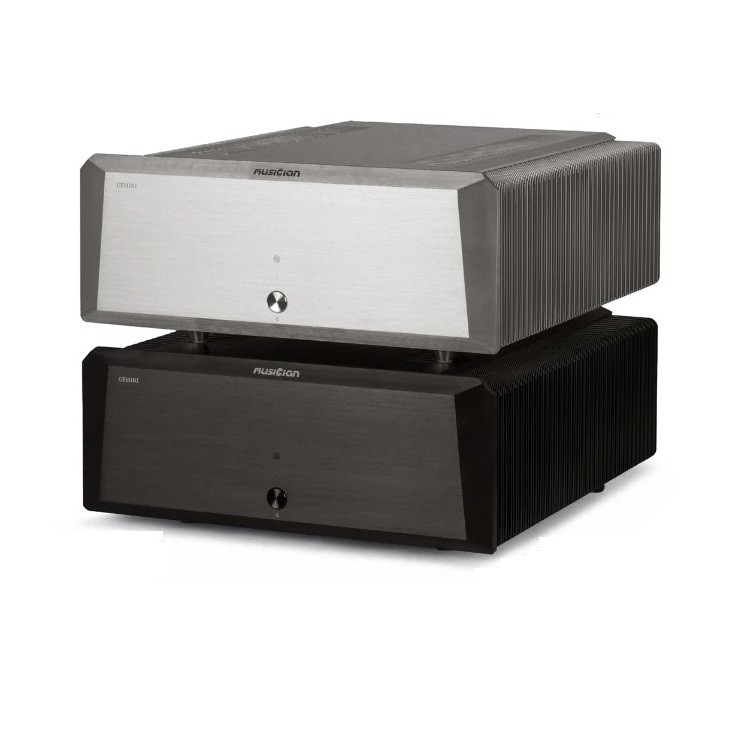
The GEMINI’s physical design is purposeful rather than decorative. It uses a solid aluminum chassis with large integrated heatsinks, an approach that suits a Class AB amplifier expected to dissipate heat during operation. Thermal management is not just a matter of comfort; it contributes to long-term reliability and helps the amplifier maintain stable operating conditions during extended listening sessions.
At 375 × 334 × 124 mm and 16.6 kg, the GEMINI is substantial without being unusually oversized for a serious stereo power amplifier. The weight reflects the internal transformer, heatsinking, chassis, and power supply hardware. Prospective owners should plan for proper ventilation and a sturdy rack or shelf, particularly because Class AB amplifiers require airflow around their heatsinks.
The industrial visual language also has a practical advantage: it communicates function. This is a component designed to sit in a separate hi-fi system and do a demanding electrical job. The exterior design follows that role, emphasizing metalwork, cooling, and connection security rather than ornamental complexity.
Connectivity and system integration
The GEMINI is deliberately simple from an input standpoint: it provides balanced XLR inputs. That makes it a natural match for balanced preamplifiers, DACs with variable output, or streamers feeding a separate power amplifier through XLR. The input sensitivity is specified at 1.8 Vrms and input impedance at 22 kΩ, both relevant details for matching it with upstream components.
Because it is a power amplifier, the GEMINI does not replace the need for source selection or volume control. Owners will need a suitable preamplifier or a source component with appropriate variable output and gain structure. This separates responsibilities within the system: the upstream component manages source and level, while the GEMINI supplies the power needed to drive speakers.
Power consumption is listed at 0.5 W in standby, 35 W at idle, and 365 W maximum. The low standby figure is useful for day-to-day ownership, while the idle and maximum figures are reminders that this is a serious amplifier and should be installed with ventilation and power access appropriate to its role.
Conclusion
The Musician GEMINI is most suitable for listeners building a serious balanced stereo system around separates, especially those who already use or plan to use XLR-equipped source and preamplifier components. It will be less appropriate for users needing RCA inputs, integrated volume control, streaming features, or a compact all-in-one solution. Its strongest documented qualities are its fully balanced discrete architecture, substantial 600VA transformer-based power supply, high-current output stage, secure speaker connections, and low-noise published specifications. For prospective owners who value a dedicated Class AB power amplifier with practical speaker-driving ability and a clear focus on signal integrity, the GEMINI presents a well-defined and technically coherent option.