Siltech Symphony: A Three-Module Statement Loudspeaker Built Around Scale and Control
Siltech’s Symphony is an ambitious full-size floorstanding loudspeaker that applies multi-module construction, very large bass drivers, exotic high-frequency elements, and massive cabinet engineering to a domestic high-end audio format.

Siltech is best known internationally for its cable products, but the Symphony loudspeaker shows the Dutch company working on a much larger physical canvas. This is not a compact tower designed to disappear into a modest room. It is a full-size, three-module floorstanding loudspeaker conceived as a statement system, with substantial driver area, unusually broad claimed frequency extension, and cabinet construction that places rigidity and mechanical separation at the center of the design. For prospective owners, the attraction lies not only in the specifications, but in the way the Symphony’s architecture addresses several long-standing loudspeaker challenges: low-frequency scale, midrange and treble dispersion, mechanical vibration, and phase behavior across a complex driver array.
A loudspeaker designed around physical scale
The first thing to understand about the Siltech Symphony is its scale. At a little under two meters tall and with a stated total weight of 244 kg per loudspeaker, it is conceived as a major piece of audio furniture as much as a transducer. That mass is not incidental. In loudspeaker design, cabinet behavior can have a strong influence on how cleanly drivers are allowed to operate, particularly when large woofers are moving significant volumes of air. Siltech’s emphasis on very high cabinet rigidity suggests a design that aims to reduce unwanted cabinet contribution and keep the driver system working from a stable foundation.
The bass module alone is described as weighing 180 kg, and its form and technology are said to take inspiration from the grand piano. That is an interesting design reference, because a grand piano is both structurally demanding and acoustically complex: it must manage energy, tension, resonance, and projection. In the Symphony, the grand-piano connection appears to be used not as a stylistic flourish, but as a cue for shaping and constructing a massive enclosure intended to support deep-bass reproduction without relying on a lightweight cabinet structure.
Three separated modules with ruby support elements
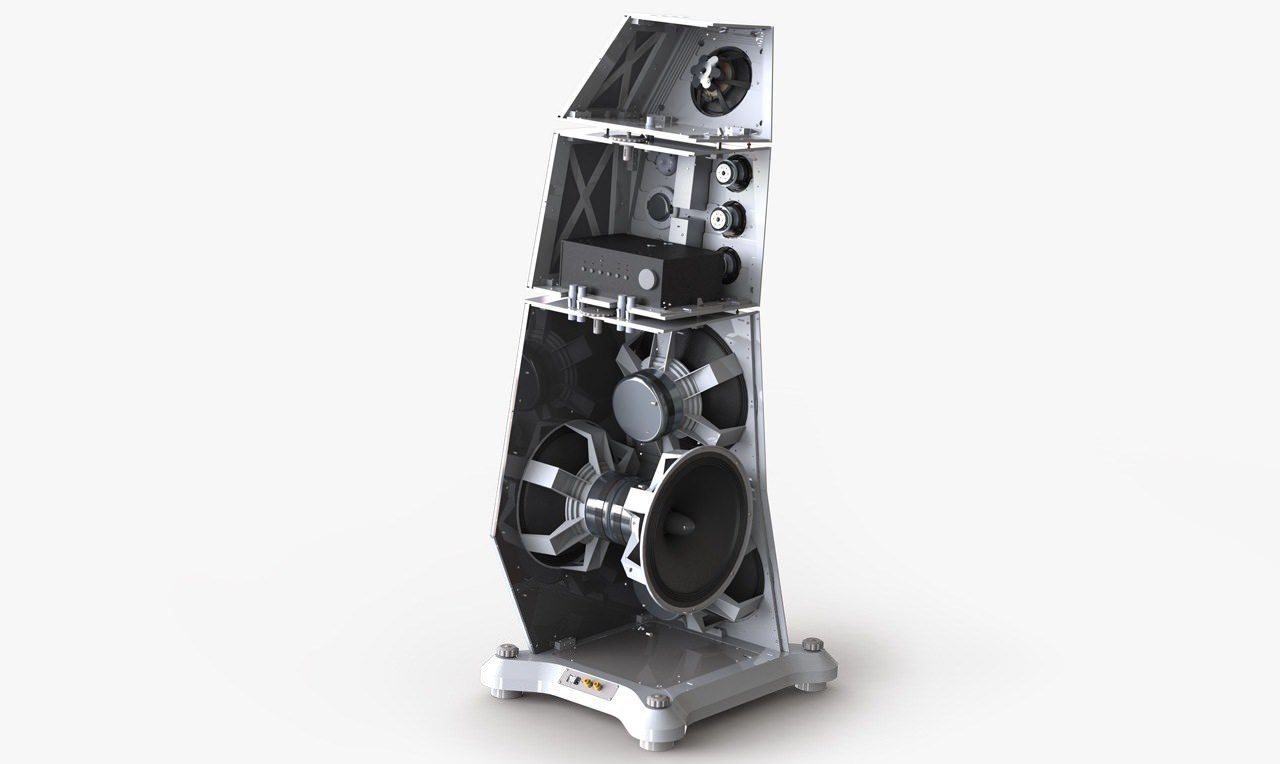
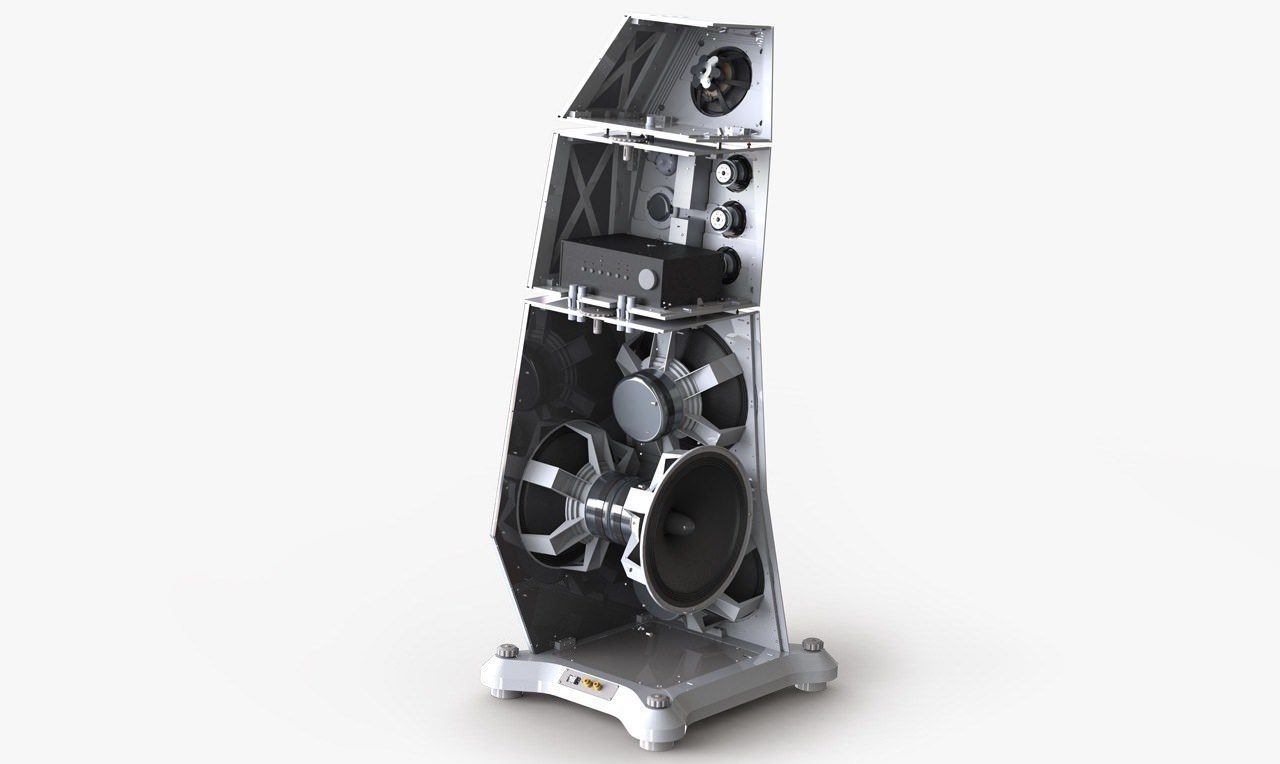
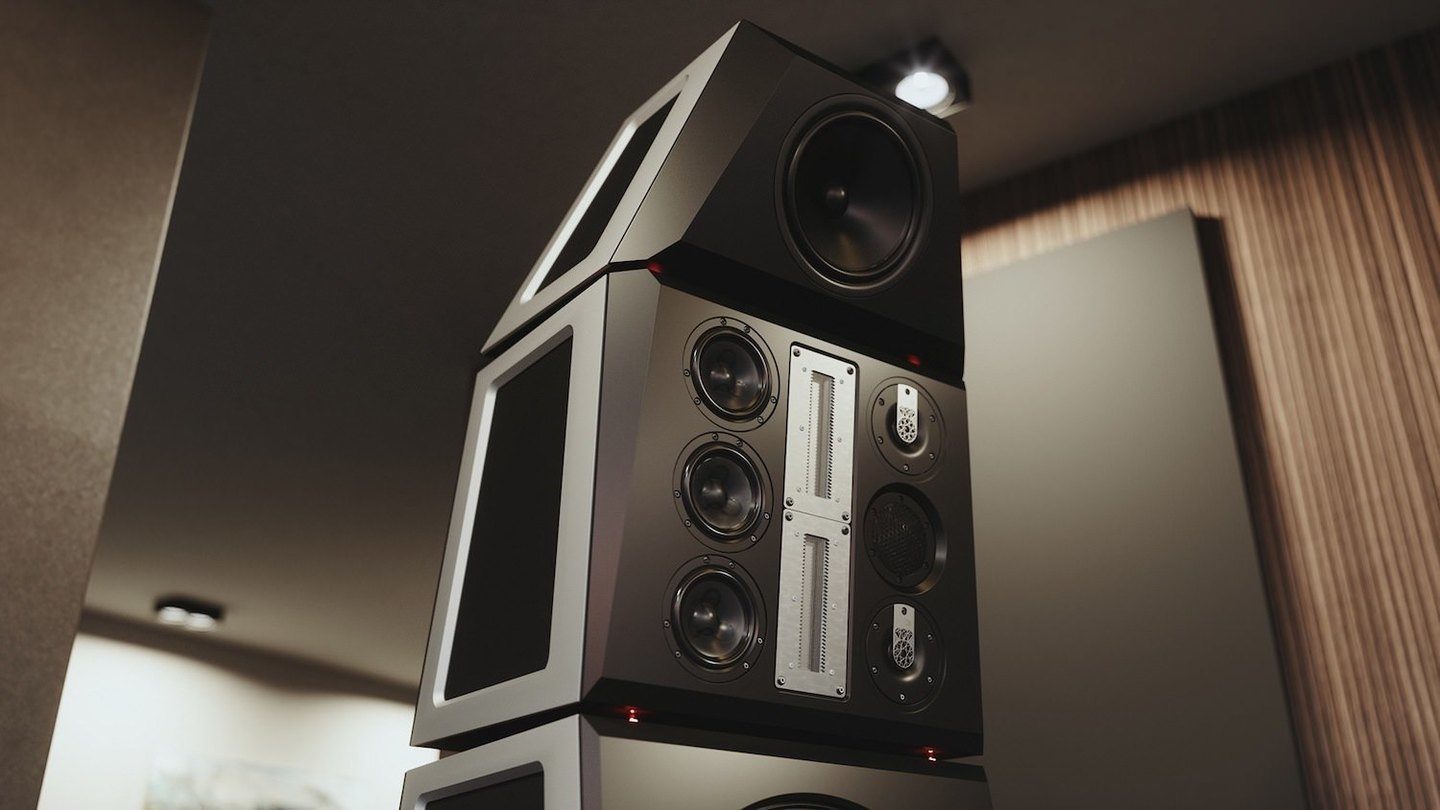
The Symphony uses a three-level arrangement rather than a single uninterrupted cabinet. The lower section is dedicated to bass, the middle section carries the midrange and high-frequency drivers, and the upper section adds another woofer using a special oval voice coil. The three modules are separated by ruby support elements, a distinctive choice that underlines the importance Siltech places on mechanical decoupling and structural precision.
Why might that matter? In a large multi-driver loudspeaker, different parts of the system experience different mechanical stresses. Large bass drivers can introduce substantial vibration into the cabinet, while midrange and treble drivers are responsible for reproducing fine detail at much smaller excursions. Separating modules can help isolate these operating environments, at least in design intent, allowing each frequency band to be housed in a structure more closely suited to its task. Ruby support elements also give the product a visually and technically unusual identity, setting the module boundaries apart from ordinary stacked-box construction.
Large-format bass capability for full-range systems
At the bottom of the Symphony are four 18-inch woofers, a driver caliber rarely seen in domestic loudspeakers. Siltech states low-frequency extension down to 17 Hz, which places the design well below the bottom octave typically associated with conventional full-range speakers. The importance of this is not simply about producing impressive numbers. A loudspeaker with genuine low-frequency reach can reduce the need for separate subwoofers in some systems, while offering the possibility of bass reproduction that is integrated into the main speaker’s architecture from the outset.
Large woofers also suggest a design priority around air-moving capability. Low bass requires displacement, and displacement can be achieved through cone area, excursion, or both. By using multiple large drivers, the Symphony’s bass section is clearly intended to deliver scale without asking a small driver complement to do the work. For listeners assembling a system around orchestral music, electronic music, organ recordings, film soundtracks, or any material with deep low-frequency content, that type of physical bass platform may be one of the product’s most compelling documented qualities.
A complex midrange and treble array
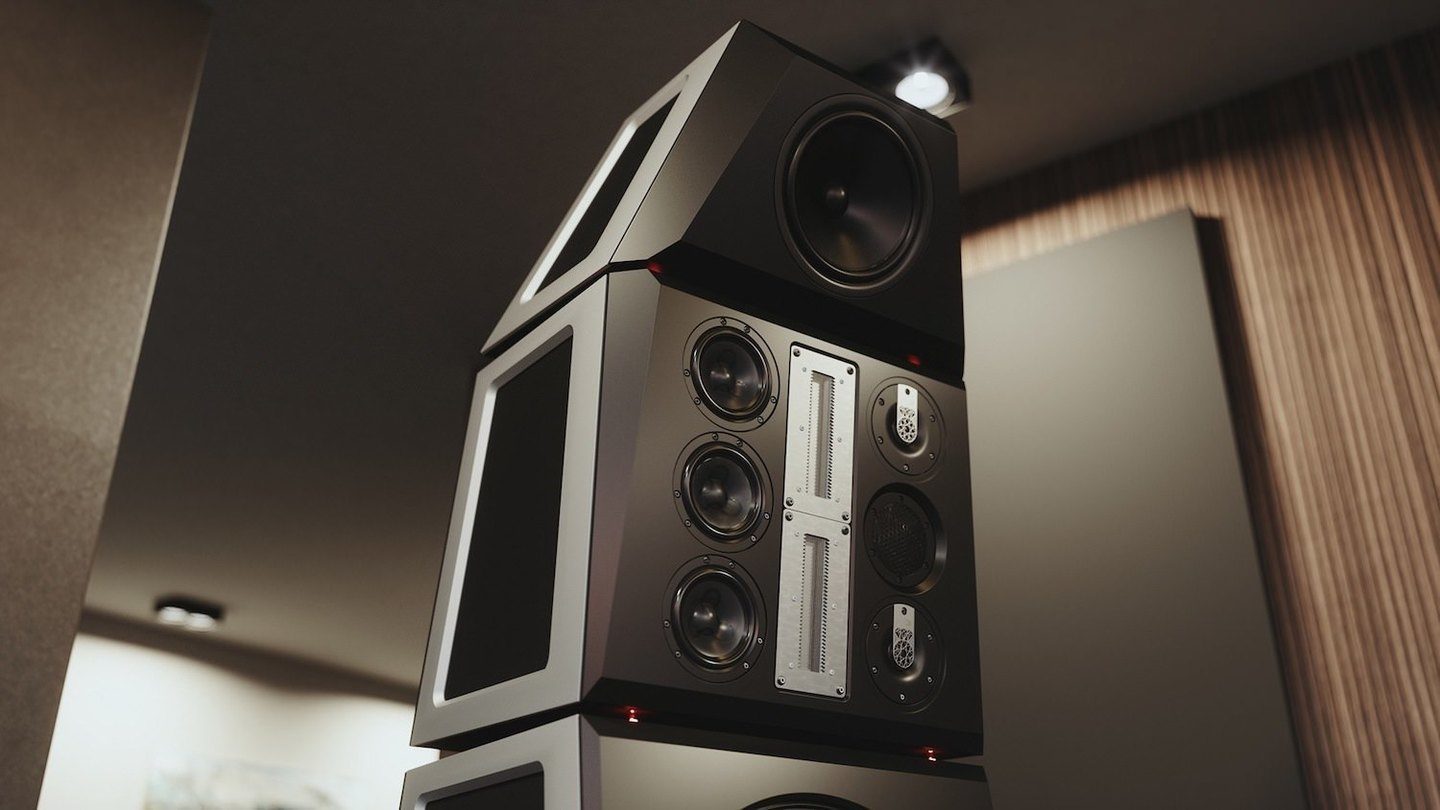
The middle level of the Symphony contains the drivers responsible for the mid-high frequency range. The published description identifies five tweeters and three mid-frequency drivers, including ribbon and dome tweeters with diamond membranes. This combination points to a design that divides the upper spectrum among specialized transducers rather than asking a single tweeter or midrange unit to cover an unusually broad range alone.
Siltech states that the Symphony operates up to 100 kHz at high frequencies. Frequencies above the standard 20 kHz upper limit of human hearing are not usually discussed in the same way as the audible band, but their inclusion in a loudspeaker specification can indicate a design emphasis on extended bandwidth and ultrasonic behavior. More practically, the use of different high-frequency technologies may allow the designer to shape radiation, response, and workload across the treble region. The presence of both ribbon and diamond-membrane dome tweeters also gives the Symphony a distinctive technical identity, because these driver types are often chosen for speed, stiffness, and low moving mass, even though implementation remains the key factor in any finished loudspeaker.
Attention to phase matching and system coherence
Siltech says the Symphony is very accurately phase-matched. That claim is especially relevant because this is not a minimalist loudspeaker. With multiple woofers, mid-frequency drivers, and tweeters distributed across three modules, integration becomes a central engineering task. In any multi-driver design, the listener does not only hear the individual drivers; the listener hears the way their outputs combine through the crossover region and into the room.
Careful phase behavior can matter because it affects the continuity of musical information across frequency bands. If drivers are not well integrated, the result can be a sense that bass, midrange, and treble arrive as separate components rather than as one coherent event. The Symphony’s architecture is ambitious, and Siltech’s stated focus on phase matching acknowledges the complexity of making such a system behave as a unified loudspeaker rather than a collection of impressive parts.

Amplifier matching and usable output
Siltech recommends amplifiers with a minimum power of 20 watts for the Symphony. The company does not state a maximum amplifier power figure in the supplied information, but it does say the speaker can produce 115 dB sound pressure without clipping. That output figure, if treated simply as a documented capability rather than a listening recommendation, indicates that the loudspeaker is intended for systems where dynamic headroom matters.
The relatively low minimum amplifier-power recommendation is also noteworthy. It suggests that the Symphony is not necessarily designed only for very high-powered amplification, although real-world matching would still depend on room size, listening distance, amplifier quality, and the owner’s preferred playback levels. For a buyer considering this type of loudspeaker, the practical message is that system planning should focus on control, compatibility, and overall quality rather than wattage alone.
Low distortion target within the standard audio band
For the conventional 20 Hz to 20 kHz audio range, Siltech states a nonlinear distortion factor of up to 0.25% under nominal conditions. This is a meaningful specification because it addresses the band most commonly associated with music playback, rather than emphasizing only extreme frequency extension. Low distortion figures, when achieved in a complete loudspeaker system, can contribute to cleaner reproduction by reducing unwanted byproducts that are not part of the original signal.
As always, a single distortion number does not fully describe how a loudspeaker will behave in different rooms or at different playback levels. Still, the inclusion of this figure reinforces the Symphony’s positioning as a technically ambitious loudspeaker, not merely a visually imposing one. The documented design combines bandwidth, output potential, and a stated low-distortion target, all of which are relevant to owners seeking a large system with serious engineering intent.
Conclusion
The Siltech Symphony is best suited to prospective owners with the space, system ambition, and installation flexibility required by a very large high-end loudspeaker. Its strongest documented qualities are its three-module construction, massive rigid cabinet approach, ruby-separated sections, four 18-inch bass drivers, extended claimed bandwidth from 17 Hz to 100 kHz, specialized midrange and treble array, stated phase-matching focus, and ability to operate with amplifiers starting from a 20-watt recommendation. It is most compelling for listeners building a full-scale reference-style system around wide bandwidth, deep bass capability, and distinctive mechanical design, rather than for those seeking a compact or understated loudspeaker.