
Speakers designed for mastering rooms, valve amplifiers, home cinemas and battery-powered listening should not be judged by the same criteria.
The products gathered here range from active studio monitors and large passive floorstanders to a self-contained Bluetooth speaker, compact home models and complete ranges for multichannel installations.
System matching starts with the intended role. Sensitivity matters when partnering a low-power tube amplifier, active architecture simplifies a studio signal chain, and matching center and wall-mounted models can be decisive in a home theater. Room size, cabinet dimensions and placement also deserve as much attention as driver technology. This guide therefore organizes each product by the setup it most naturally serves rather than naming a universal winner. Where the supplied source does not include electrical matching information, the recommendation remains limited to the stated design, application and manufacturer specifications.

1. PSI Audio A226-MAIN
The PSI Audio A226-MAIN places two 10-inch woofers symmetrically around a rotatable midrange and high-frequency section.
The A226-MAIN is the clearest fit here for a professional monitoring system.
This all-analog active three-way design was developed for primary studio and mastering duties, with two symmetrically arranged 10-inch woofers surrounding a midrange and tweeter panel that can be rotated to suit installation requirements.
PSI specifies a frequency response of 20 Hz to 23 kHz and a peak output of 112 dB under the AES75 standard. Its active architecture removes the need to select separate power amplifiers, while the reinforced double-MDF cabinet and controlled vertical dispersion address the demands of fixed monitoring environments.
Best for: Primary studio and mastering systems
- Active all-analog three-way design
- Dual 10-inch low-frequency drivers
- Rotatable midrange and tweeter panel
- Specified 20 Hz to 23 kHz response
Verdict: A purpose-built choice for studios needing a large active main monitor with deep specified extension and flexible driver orientation.

2. Eltax Monitor PWR
The walnut-finished Eltax Monitor PWR combines a 15-inch woofer, 6-inch midrange and twin horn-loaded tweeters.
The Monitor PWR stands out as the most obvious partner for a low-power tube amplifier.
Eltax specifies 96 dB sensitivity, an 8-ohm nominal impedance and a 5-ohm minimum, while the driver array combines a 15-inch cellulose bass unit with a 6-inch cellulose midrange and two one-inch tweeters in shallow horns.
Twin bass-reflex ports are located on the front, which the manufacturer presents as an aid to room installation. Large dimensions and vintage-inspired walnut-veneered cabinets make this a deliberate visual presence rather than a discreet floorstander.
Best for: Low-power tube-amplifier systems
- 96 dB specified sensitivity
- 8-ohm nominal impedance
- Large 15-inch cellulose woofer
- Front-facing bass-reflex ports
Verdict: High specified sensitivity and a relatively accommodating impedance make the Eltax a strong match for modestly powered valve amplification.

3. JBL Studio 698
The JBL Studio 698 uses twin 8-inch woofers, a dedicated 6-inch midrange and an HDI horn-loaded compression tweeter.
JBL positions the Studio 698 at the top of its Studio 6 range, and its configuration suits systems shared between two-channel music and movie soundtracks.
The three-way floorstander uses two 8-inch PolyPlas woofers, a 6-inch midrange driver and a one-inch neodymium compression tweeter mounted in a rectangular HDI horn.
The source attributes wide, even dispersion to that horn and describes the composite PolyPlas cones as a means of increasing rigidity while limiting unwanted resonances. No sensitivity or impedance information is supplied, so the case for this model rests on its substantial driver complement and mixed stereo and cinema role rather than a specific amplifier pairing.
Best for: Shared stereo and home-cinema systems
- Three-way driver configuration
- Dual 8-inch PolyPlas woofers
- HDI horn-loaded compression tweeter
- Designed for music and movie soundtracks
Verdict: The Studio 698 is the practical option for listeners seeking one substantial floorstander design for both music and film use.
4. Wharfedale Aura 4
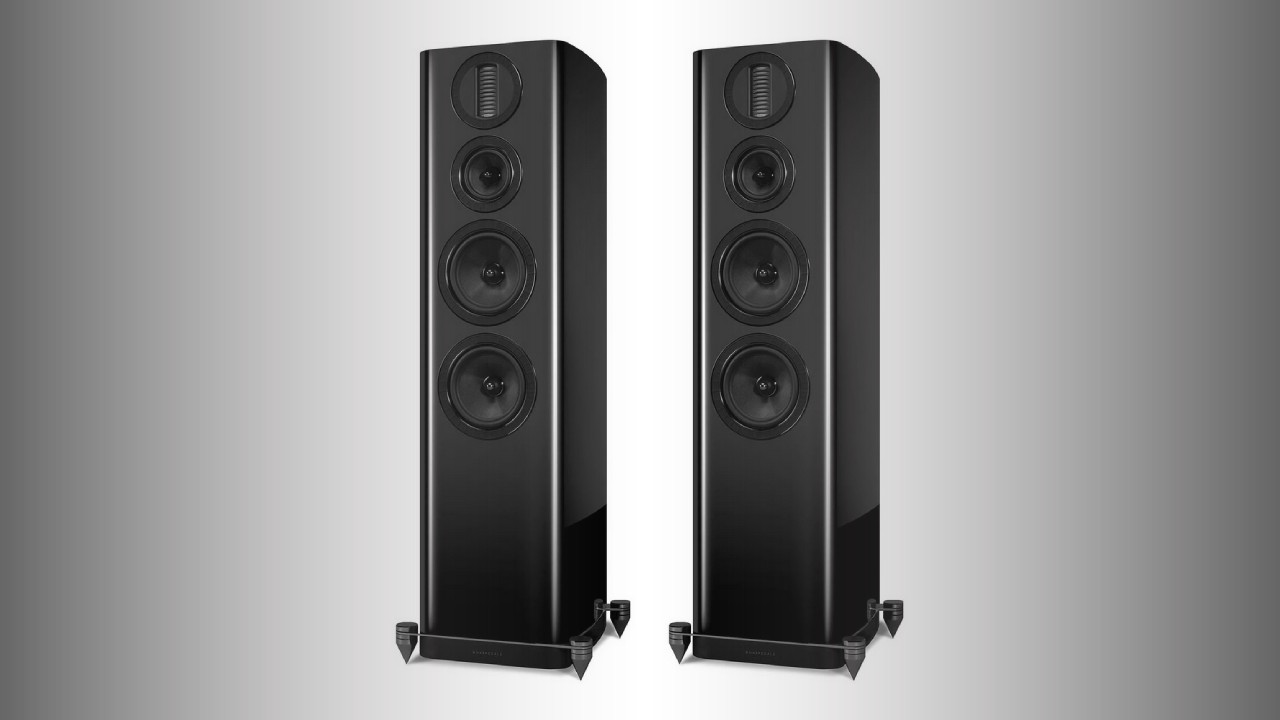
The Wharfedale Aura 4 is a three-way floorstander with twin 150 mm Kevlar bass drivers and a braced, tapered cabinet.
As the largest floorstander in the Aura series, the Aura 4 is explicitly intended for large rooms and can serve in either stereo or home-theater systems.
Two 150 mm Kevlar-cone bass drivers handle low frequencies, supported by wide flexible surrounds, cast baskets and powerful magnetic systems.
Wharfedale uses sloping cabinet sides, internal bracing and damping to control vibration and resonance, while supports extending beyond the base improve stability. The source also presents the speaker as suitable across musical genres, making it the broadest conventional domestic all-rounder in this selection.
Best for: Large-room music and cinema systems
- Designed for large listening rooms
- Suitable for stereo or home theater
- Dual 150 mm Kevlar bass drivers
- Braced and damped nonparallel cabinet
Verdict: The Aura 4 is the versatile large-room choice when stereo performance and home-theater integration carry equal importance.

5. Soundivine Le Magnum
Soundivine Le Magnum houses four drivers, amplification and a rechargeable battery in a reinforced pine enclosure with a leather handle.
Le Magnum belongs in a very different system from the passive floorstanders: it is a self-contained wireless speaker for casual listening and portable use around the home.
Its pine enclosure resembles a magnum wine box and contains two 100 mm aluminum-cone woofers, two 26 mm soft-dome tweeters and a Class D amplifier rated at 2 x 35 watts.
Sources can connect through Bluetooth 5.0 or a 3.5 mm input, and physical controls handle volume, input selection and muting. Mains operation is complemented by a built-in battery with a claimed 12 hours of playback, while a leather handle assists transport.
Best for: Self-contained wireless and portable listening
- Bluetooth 5.0 and 3.5 mm input
- Built-in 2 x 35-watt amplifier
- Claimed 12-hour battery playback
- Integrated leather carrying handle
Verdict: Le Magnum suits listeners who value an all-in-one powered speaker, physical controls and battery operation over a component-based hi-fi system.

6. Top 10 Ultra High-End Speakers to Buy
The ultra-high-end overview contrasts heavy resonance-controlled enclosures with more sensitive designs intended for lower-powered amplification.
This source is a multi-product overview rather than a recommendation for one speaker, so its best use is as an orientation guide for ambitious systems.
The examples show how different the matching requirements can be even at the upper end of the market.
The 111 kg Acora Acoustics SRC-2 is described around its resonance-resistant cabinet, two-and-a-half-way layout and 92.5 dB sensitivity. The Cessaro Opus One instead combines a two-way configuration with stated sensitivity of 97.5 dB and a 6-ohm impedance, and the source specifically identifies it as suitable for a low-power pentode tube amplifier. Those contrasts are more informative than price alone.
Best for: Researching an ultra-high-end system shortlist
- Ten-model ultra-high-end overview
- Includes price and specification context
- Contrasts different cabinet and driver approaches
- Identifies a low-power tube-compatible example
Verdict: This roundup works best as a map of high-end design and amplifier-matching priorities rather than as a single product prescription.

7. Focal Aria 948
The Focal Aria 948 represents the Aria range's use of Flax composite cones, an aluminum-magnesium tweeter and nonparallel cabinet surfaces.
The Aria 948 is the material-focused option for a domestic floorstanding system.
The supplied source concentrates on Focal's Aria-series technology, particularly the Flax cone: natural flax fiber placed between two thin fiberglass layers to combine low mass, rigidity and damping.
High frequencies are handled by an aluminum-magnesium tweeter with a Poron suspension and compact waveguide. The enclosure uses 18 mm and 24 mm wood-fiber panels while avoiding parallel surfaces. Because the source gives no sensitivity or impedance figures, it does not establish the Aria 948 as a specialist match for low-powered amplification; its distinction here is its cone, tweeter and cabinet engineering.
Best for: Floorstanding systems prioritizing driver materials and cabinet design
- Three-layer Flax composite cones
- Aluminum-magnesium tweeter
- Poron tweeter suspension
- Nonparallel wood-fiber cabinet panels
Verdict: The Aria 948 is the relevant choice for listeners drawn to Focal's Flax-cone construction and carefully shaped cabinet architecture.
8. Raidho X2.6
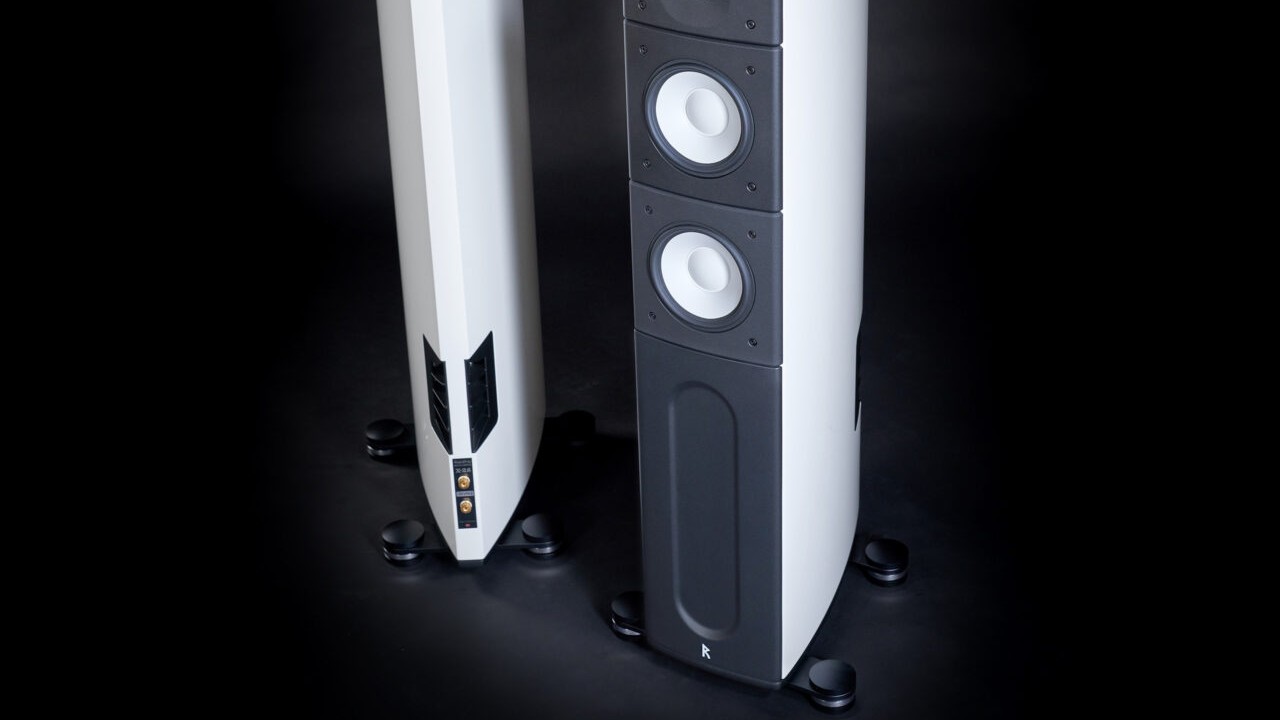
The Raidho X2.6 combines a hand-made planar magnetic tweeter with ceramic-coated aluminum bass drivers in a 2.5-way floorstander.
Raidho's X2.6 is aimed at a premium two-channel system where proprietary driver construction is central to the purchase.
This 2.5-way floorstander is built in Denmark with hand-crafted drive units and uses a planar magnetic tweeter derived from the much more expensive TD6.
Its conductive tracks are applied to an 11-micrometer foil that Raidho says has far less moving mass than a conventional dome. The bass drivers begin with rigid aluminum cones and add a ceramic coating to address the material's inherent sonic character. The source lists the X2.6 at $21,000 per pair, firmly establishing the level of system in which it is intended to compete.
Best for: Premium two-channel systems centered on proprietary driver technology
- Hand-built in Denmark
- Low-mass planar magnetic tweeter
- Ceramic-coated aluminum bass drivers
- 2.5-way floorstanding configuration
Verdict: The X2.6 is a specialist high-end option for systems where low-mass planar treble and hand-crafted driver construction justify the substantial outlay.
9. Dynaudio Evoke 20
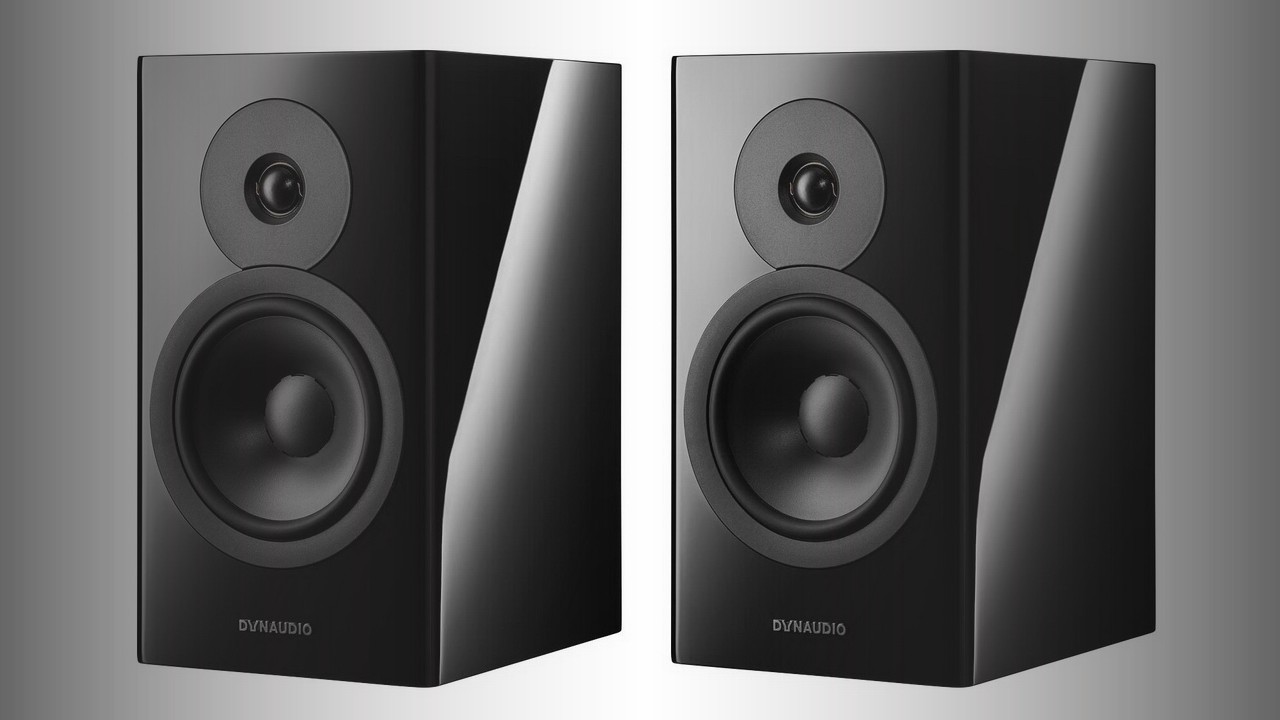
The compact Dynaudio Evoke 20 features a 28 mm Cerotar tweeter with a resonance-controlling Hexis inner dome.
The compact Evoke 20 is the natural fit when a system cannot accommodate the larger floorstanders in this guide but still places a premium on tweeter engineering.
Dynaudio adapted technology from its Contour and Confidence ranges, including the 28 mm Cerotar tweeter and its concave Hexis inner dome.
Positioned behind the impregnated soft outer dome, Hexis is designed to optimize airflow and reduce resonances. Dynaudio also states that the arrangement lowers the tweeter's resonant frequency to 700 Hz, giving its engineers greater control through the crossover region. The supplied source does not include impedance or sensitivity, so no particular amplifier topology can be prescribed from it.
Best for: Compact home systems focused on refined tweeter design
- Compact cabinet format
- 28 mm Cerotar soft-dome tweeter
- Hexis inner dome for resonance control
- Technology adapted from senior Dynaudio ranges
Verdict: The Evoke 20 makes the most sense where space is limited and Dynaudio's resonance-control approach is a higher priority than sheer cabinet scale.

10. MartinLogan Updates Motion and Motion XT Speakers
The MartinLogan Motion and Motion XT ranges cover floorstanding, bookshelf and center-channel roles, with a wall-mounted option in the Motion family.
MartinLogan's redesigned Motion and Motion XT families provide the strongest foundation here for a coordinated multichannel installation.
The standard Motion range includes F10 and F20 floorstanders, the B10 bookshelf model, C10 center speaker and wall-mounted MP10.
Motion XT adds F100 and F200 floorstanders, the B100 bookshelf speaker and C100 center. That breadth allows front, center, surround and wall-mounted roles to remain within related product families. The XT models also introduce second-generation Obsidian Folded Motion tweeters, a Folded Motion Waveguide and Nomex-reinforced Kevlar midrange drivers, with the waveguide intended to broaden useful listening positions while reducing unwanted room reflections.
Best for: Coordinated stereo and multichannel installations
- Floorstanding, bookshelf and center options
- Wall-mounted model in the Motion range
- Second-generation folded tweeter in Motion XT
- Waveguide designed for broad listening coverage
Verdict: The Motion families are the most adaptable choice for building a visually and technically coordinated system across several speaker positions.


Sound Off
0Join the discussion if you have something to add.