
Choosing headphones starts with how and where they will be used.
A premium wireless over-ear model built for travel serves a different listener from a wired in-ear monitor, a bone-conduction design or a closed-back headphone intended for a dedicated hi-fi system.
This selection therefore focuses on suitability rather than treating every entry as a direct rival. The range covers mainstream needs such as active noise cancellation, long battery life and clear calls, alongside more specialised priorities including planar drivers, passive isolation, serviceable construction and distinctive material choices. There is also a Bluetooth cable adapter for listeners who want to retain compatible wired in-ear headphones rather than replace them. Not every source provides the same level of evidence. The Sennheiser HDB 630 is presented through a hands-on review, while several other entries are based primarily on manufacturer announcements and stated design goals. Those distinctions are reflected below, with performance claims attributed or qualified where independent listening evidence was not supplied.

1. Sennheiser HDB 630
The Sennheiser HDB 630 combines oval earcups and a restrained dark-grey finish with a hard travel case and an extensive accessory bundle.
The HDB 630 is aimed at listeners who want Sennheiser’s most ambitious wireless headphone rather than a value-led alternative.
Its restrained dark-grey design avoids visual excess, while the supplied BTD 700 USB-C wireless dongle, analog cable, airplane adapter and substantial fabric-covered case make the package unusually complete.
The source review delivers a strongly positive overall assessment, although the available extract provides more detail about design and accessories than specific aspects of sound.
Best for: Premium wireless listening and well-equipped travel
- Comprehensive wired and wireless accessory set
- BTD 700 USB-C wireless dongle included
- Dense, durable travel case
- Restrained premium design
Verdict: The HDB 630 is a persuasive choice for listeners seeking an understated flagship wireless headphone with a genuinely complete travel package.

2. Sony WH-CH720N and Sony WH-CH520N
The full-size Sony WH-CH720N and on-ear WH-CH520N offer distinct combinations of noise management, fit and battery endurance.
Sony’s two affordable wireless models address different priorities.
The full-size WH-CH720N uses the Integrated Processor V1, two microphones in each cup and Dual Noise Sensor technology for active noise control, with stated battery life of up to 35 hours.
The on-ear WH-CH520 cannot provide the same level of physical noise isolation, but extends stated battery life to 50 hours. Both models include Sony’s Digital Sound Enhancement Engine, while their microphone systems are designed to improve voice clarity during calls.
Best for: Affordable wireless buyers choosing between noise control and battery life
- WH-CH720N includes Dual Noise Sensor technology
- Up to 35 hours from the WH-CH720N
- Up to 50 hours from the WH-CH520N
- Digital Sound Enhancement Engine on both models
Verdict: Choose the WH-CH720N when noise reduction matters most, or the WH-CH520N for a lighter on-ear format and longer stated endurance.

3. Sivga Nightingale
The Sivga Nightingale pairs polished natural-wood faceplates with an aluminium-magnesium alloy body and a detachable 4.4 mm cable.
The Sivga Nightingale is a wired in-ear headphone built around a 14.5 mm flat-form driver with a thin diaphragm and aluminium voice coil.
Its aircraft-grade aluminium driver frame sits within an aluminium and magnesium alloy body, finished with a polished natural-wood outer panel.
A detachable silver-plated copper cable uses 0.78 mm connections and a 4.4 mm termination, while a case and six pairs of ear tips complete the package. The quoted specifications are 100 dB sensitivity and 16-ohm impedance.
Best for: Wired-IEM listeners drawn to unusual drivers and natural materials
- 14.5 mm flat-form driver
- Alloy body with natural-wood outer panels
- Detachable silver-plated copper cable
- Case and six pairs of ear tips included
Verdict: The Nightingale suits listeners who value distinctive driver engineering, a balanced 4.4 mm connection and a carefully finished wood-and-alloy enclosure.

4. BGVP M3
The BGVP M3 adds Bluetooth, a microphone remote and an integrated amplifier to compatible MMCX or 0.78 mm in-ear headphones.
The BGVP M3 is not a headphone but a Bluetooth cable adapter for compatible in-ear monitors.
It is offered with either MMCX or two-pin 0.78 mm connectors and combines copper conductors with a microphone-equipped remote, amplifier and Qualcomm QCC 5144 Bluetooth section.
AAC, SBC and aptX Adaptive are supported, while the 130 mAh battery is rated for up to 26 hours of listening and a 1.5-hour full charge. Amplifier output is specified at 42 mW into 32 ohms.
Best for: Owners converting compatible detachable-cable IEMs to wireless use
- MMCX and 0.78 mm versions available
- AAC, SBC and aptX Adaptive support
- Up to 26 hours of stated playback
- Microphone remote and storage box included
Verdict: The M3 is a practical alternative to replacing wired in-ear headphones, provided their connectors match one of the two available versions.

5. HarmonicDyne Athena
The HarmonicDyne Athena is built around a 50 mm dynamic driver using a thin metal-ceramic composite diaphragm.
HarmonicDyne has centred the Athena around a newly developed 50 mm dynamic driver with a thin metal-ceramic composite diaphragm.
The design also uses an ultra-thin, tightly wound voice coil and a high-flux magnetic assembly intended to drive the diaphragm evenly.
HarmonicDyne attributes improved responsiveness, resolution and dynamic performance to this construction and describes an extensive acoustic-tuning process, but the supplied material does not include independent listening impressions or measurements.
Best for: Full-size headphone buyers interested in diaphragm and motor design
- Large 50 mm dynamic driver
- Metal-ceramic composite diaphragm
- Ultra-thin high-efficiency voice coil
- Dedicated acoustic-tuning process
Verdict: The Athena is a technology-led option for listeners intrigued by its composite driver, though the supplied source supports its construction more clearly than its claimed sonic results.

6. Ikko ITG01
The Ikko ITG01 uses a bone-conduction format with Bluetooth 5.3, physical ear controls and a magnetic charging case.
The Ikko ITG01 takes the specialist bone-conduction route, combining Bluetooth 5.3 with the company’s Directed Sound Anti-Leakage technology and automatic stereo-mode switching.
Its built-in battery is rated for approximately 6.5 hours of music or talk time, while the magnetic charging case has a 350 mAh capacity.
An IPX6 rating adds a defined level of water resistance, and the stated open-space wireless range is at least 10 metres.
Best for: Listeners seeking bone conduction with an IPX6 rating
- Bone-conduction design
- Bluetooth 5.3 connectivity
- IPX6 water-resistance rating
- Magnetic charging case included
Verdict: The ITG01 is a focused wireless option for buyers who specifically prefer bone-conduction listening over conventional earcups or in-ear seals.

7. Breggz Zohn-1
The Breggz Zohn-1 places IMAX Enhanced certification and fit-based physical isolation at the centre of its true-wireless design.
The Breggz Zohn-1 is presented as the first fully wireless in-ear headphone to receive IMAX Enhanced certification.
Its design deliberately omits active noise cancellation, relying instead on the housing and fit to create physical isolation.
That approach is intended to avoid electronic manipulation of the signal and the pressure sensation sometimes associated with ANC. The concept is consequently more specialised than that of a conventional noise-cancelling earbud.
Best for: Film-focused listeners who prefer passive isolation to ANC
- IMAX Enhanced certification
- Fully wireless in-ear format
- Physical isolation rather than ANC processing
Verdict: The Zohn-1 stands out for its IMAX Enhanced positioning and passive-isolation strategy, but it will not suit anyone who specifically requires active noise cancellation.

8. Noble Audio Lu Ban
The Noble Audio Lu Ban combines Cocobolo wood shells with a 3D-printed internal frame and a three-driver planar-dynamic system.
Noble Audio’s Lu Ban combines a 10 mm dynamic driver with a wood-composite diaphragm and two newly developed Super-Magnetic planar drivers in each earpiece.
Cocobolo wood forms the visible enclosure, while a precision 3D-printed resin structure is used internally to control driver placement and acoustic geometry.
Noble quotes sensitivity of 108 dB SPL per milliwatt and impedance of 27 ohms. Its claims concerning bass control, speed and refinement come from the manufacturer rather than an independent audition in the supplied source.
Best for: Hybrid-IEM enthusiasts who value driver architecture and craftsmanship
- Three-driver hybrid configuration
- Two planar drivers per earpiece
- 10 mm wood-composite dynamic driver
- Cocobolo and 3D-printed resin construction
Verdict: The Lu Ban offers an unusual planar-dynamic arrangement and distinctive material execution, although its stated sonic qualities still require independent verification.

9. Denon AH-C830NCW
The Denon AH-C830NCW true-wireless earbuds combine active noise cancellation, transparency mode and a charging case rated for up to 24 hours.
The Denon AH-C830NCW addresses travel, work and everyday wireless use with active noise cancellation and a transparency mode that restores awareness of surrounding sound.
Dual microphones support the noise-cancelling system, while beamforming and an additional microphone are intended to improve voice capture in wind or loud environments.
Battery life is rated at up to six hours per charge and up to 24 hours with the charging case. Google Fast Pair is also included for compatible devices.
Best for: Commuting, work calls and general true-wireless listening
- Active noise cancellation
- Transparency listening mode
- Multi-microphone voice capture
- Up to 24 hours with the charging case
Verdict: The AH-C830NCW is the most conventional all-round true-wireless choice here, combining ANC, transparency, call features and a compact charging case.
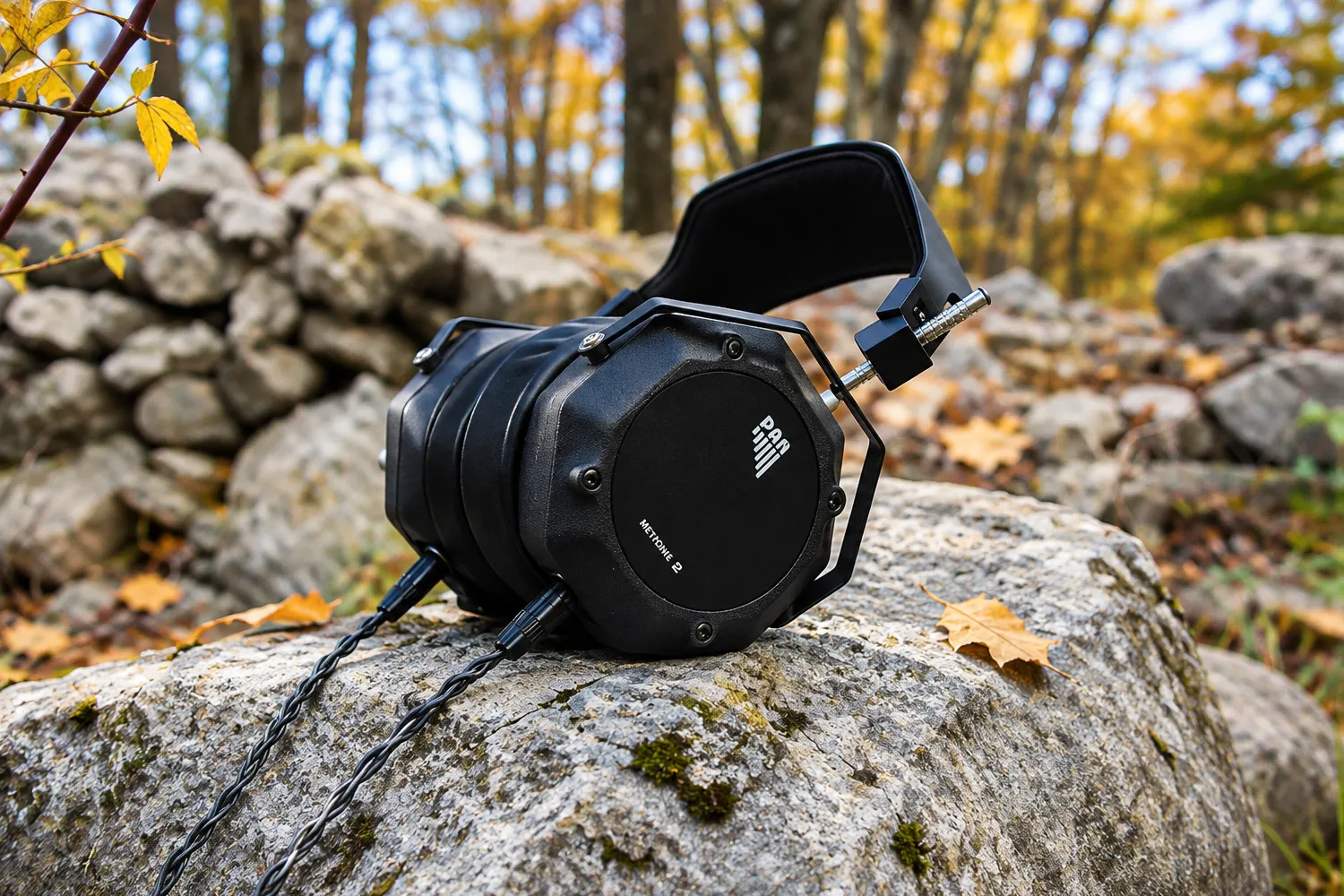
10. Erzetich Pan
The closed-back Erzetich Pan uses two 40 mm dynamic drivers in each earcup, together with a detachable cable and replaceable parts.
The Pan is Erzetich Audio’s first fully closed-back headphone, created for listeners who want greater separation from their surroundings within a dedicated hi-fi design.
Instead of one driver per earcup, it uses two 40 mm dynamic drivers on each side.
A 64-ohm impedance, detachable cable and replaceable parts reinforce its system-oriented, serviceable approach. Erzetich identifies isolation as a design goal, although the supplied information does not provide a measured isolation figure.
Best for: Home hi-fi listeners wanting isolation and long-term serviceability
- Closed-back over-ear construction
- Two 40 mm dynamic drivers per side
- Detachable cable
- Replaceable parts
Verdict: The Pan is a focused closed-back option for listeners attracted to an unusual dual-driver layout, replaceable components and reduced interaction with their surroundings.


Sound Off
0Join the discussion if you have something to add.