
The best amplifier here depends on the system it must serve.
Six of these products are integrated amplifiers, but their priorities range from compact system versatility and television integration to extremely high output or deliberately minimalist, low-power design.
The remaining choices are more specialized: a pairable tube monoblock, a flagship headphone amplifier and two preamplifiers that require separate power amplification. They belong in the wider amplifier category, but they are not interchangeable with an integrated amplifier, so their narrower roles are reflected in the ranking. Positions favor a useful balance of amplification, connectivity, system compatibility and everyday practicality. The supplied sources are largely product introductions rather than comparative laboratory or listening tests, so manufacturer performance claims are identified as such and the ranking avoids unsupported conclusions about sound quality or value.

1. Arcam Radia A25+
The Arcam Radia A25+ integrated amplifier with its illuminated front-panel controls.
The Arcam Radia A25+ takes first place because it offers the most broadly balanced combination of power, connectivity and conventional hi-fi usability in the supplied material.
Its Class G amplifier is rated at 100 watts per channel and is described as operating in Class A for its first 20 watts before transitioning to Class AB operation as more output is required.
An ESS ES9018 DAC, HDMI eARC and an onboard phono stage allow the A25+ to handle digital sources, television audio and vinyl without an assortment of additional boxes. A front headphone output, remote control and substantial illuminated controls reinforce its role as a complete everyday integrated amplifier. It does not have the spectacular output figures of the larger Musical Fidelity or Onkyo models, but its rounded specification makes it the easiest first recommendation for a conventional mixed-source system.
Best for: Balanced mixed-source stereo systems
- 100-watt-per-channel Class G amplification
- ESS ES9018 digital-to-analog converter
- HDMI eARC and an integrated phono stage
- Front-panel headphone output and included remote control
Verdict: The Radia A25+ is the strongest all-round recommendation because it combines useful power, modern digital integration and traditional hi-fi inputs in one approachable amplifier.
2. Musical Fidelity M5xi
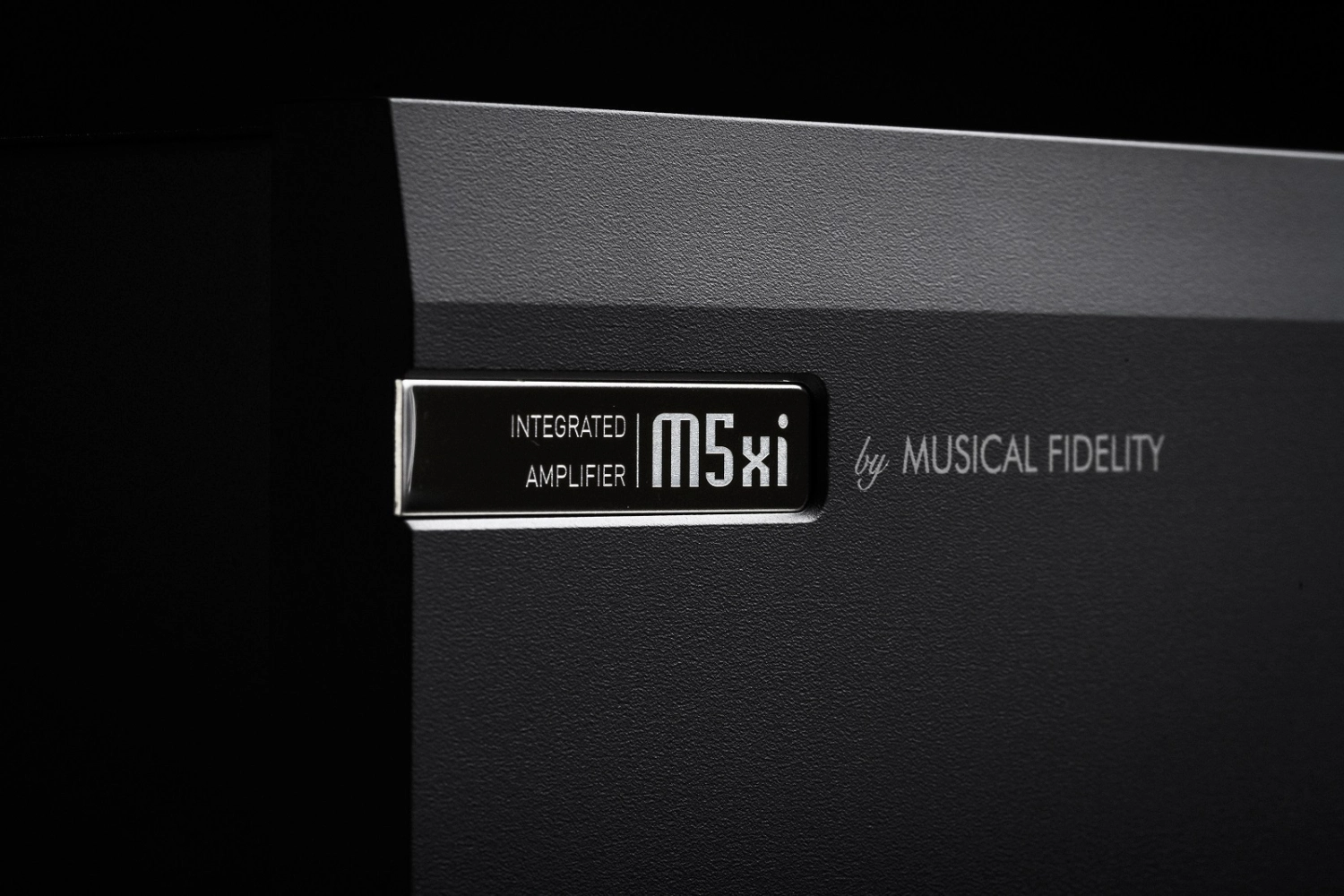
The Musical Fidelity M5xi, a 160-watt integrated amplifier with digital, phono and HDMI eARC connectivity.
The Musical Fidelity M5xi is a compelling alternative for listeners who want considerably more rated power without moving into the physical and electrical extremes of the M8xi.
It is a 160-watt-per-channel Class AB integrated amplifier with analog and digital inputs, HDMI eARC and an updated phono section supporting both moving-magnet and moving-coil cartridges.
Musical Fidelity describes the M5xi as a new design rather than a cosmetic revision of the M5si. Its preamplifier, power amplifier, digital module and phono input have all been reworked, while the main amplifier technology is said to draw inspiration from the flagship Titan. Those claims require independent testing to quantify, but the confirmed combination of substantial output and unusually broad source support gives the M5xi a strong second-place case.
Best for: Powerful all-in-one stereo systems with vinyl and television sources
- 160 watts per channel of Class AB amplification
- HDMI eARC for television integration
- Phono stage supports both MM and MC cartridges
- Combination of analog and digital inputs
Verdict: The M5xi combines substantial Class AB power with the source flexibility needed to anchor a modern stereo system.

3. Onkyo Muse Y-50
The Onkyo Muse Y-50 network integrated amplifier with its 5.46-inch color display.
The Onkyo Muse Y-50 is the most comprehensively connected network amplifier in the group.
Its Axign Class-D output stage is rated at 250 watts per channel into 4 ohms, while the fully digital signal path is joined by Ethernet, Wi-Fi, Spotify Connect, TIDAL Connect, Qobuz Connect, Chromecast and AirPlay 2.
The Y-50 also accommodates more traditional sources through three analog RCA inputs, coaxial digital input, HDMI ARC and an MM/MC phono stage. A subwoofer output and Onkyo Room EQ extend its system flexibility, while the 5.46-inch color display can show album art, metadata and level meters without relying entirely on a phone or tablet. It ranks just below the Arcam and Musical Fidelity models because it represents a more digitally centered proposition, but it is the clear choice when streaming integration is the main priority.
Best for: Streaming-led systems and larger rooms
- 250 watts per channel into 4 ohms
- Extensive integrated network-streaming support
- HDMI ARC and an MM/MC phono stage
- Color display, subwoofer output and Onkyo Room EQ
Verdict: The Muse Y-50 is the list’s most complete streaming amplifier, combining high specified output with unusually extensive source and room-integration features.

4. Musical Fidelity M6xi
The Musical Fidelity M6xi integrated amplifier, designed for extensive digital and system connectivity.
The Musical Fidelity M6xi is designed as a system centerpiece that retains the analog emphasis of the M6si platform while expanding its digital and installation capabilities.
Optical and coaxial inputs are joined by HDMI ARC and USB-C, while a USB-A power output can supply an external streamer.
RS232 control and a home-theater bypass input make the M6xi particularly relevant to custom installations and combined stereo and cinema systems. The source describes increased output power and refinements to the input stage, but it does not supply a final power rating, price or availability details. That uncertainty prevents the M6xi from ranking above products with more fully documented specifications. Even so, its confirmed connectivity and integration features distinguish it from amplifiers that concentrate solely on conventional two-channel sources.
Best for: Flexible hi-fi and home-cinema installations
- Optical, coaxial, HDMI ARC and USB-C digital connectivity
- Home-theater bypass for combined stereo and cinema systems
- RS232 interface for control-system integration
- USB-A power output for an external streamer
Verdict: The M6xi appears exceptionally well prepared for complex modern systems, although incomplete pricing, availability and output information limit a stronger recommendation.

5. Musical Fidelity M8xi
The approximately 40-kilogram Musical Fidelity M8xi high-power integrated amplifier.
The Musical Fidelity M8xi is the brute-force option in this ranking.
Its Class A/B amplifier is specified at 550 watts per channel into 8 ohms and 870 watts per channel into 4 ohms, with up to 1.6 kilowatts available briefly when the load falls to 2 ohms.
Those figures make its intended role clear: supplying substantial current and headroom to demanding loudspeakers rather than merely producing high listening levels. That capability brings major practical compromises. The M8xi weighs approximately 40 kilograms, measures about 40 centimeters deep and may not fit conventional equipment furniture; the source also characterizes it as expensive. Musical Fidelity claims it can drive any speaker on the market, but universal compatibility remains a manufacturer assertion rather than an independently demonstrated fact. It is therefore a formidable but specialized recommendation rather than the default choice for an ordinary room.
Best for: Difficult loudspeakers and high-output reference systems
- 550 watts per channel into 8 ohms
- Specified output rises to 870 watts per channel into 4 ohms
- Traditional Class A/B amplifier architecture
- Designed to provide substantial headroom for demanding speaker loads
Verdict: The M8xi offers extraordinary specified power and load capability, but its size, weight and cost make it sensible only for systems that can exploit them.
6. Rogue Audio M250 Ultra
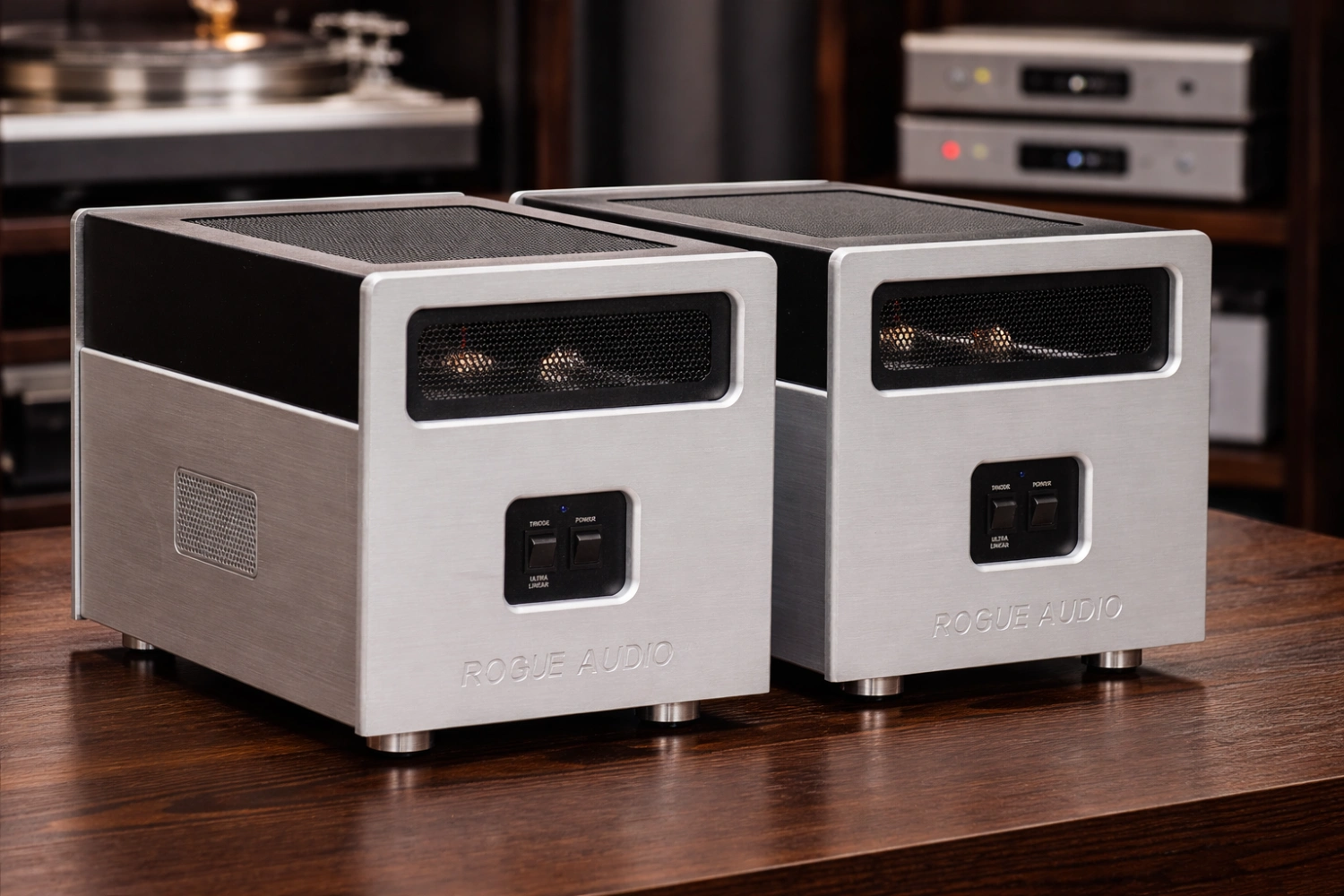
A Rogue Audio M250 Ultra tube monoblock with its exposed valves and built-in bias meter.
The Rogue Audio M250 Ultra is a mono tube power amplifier rated at 250 watts, making it fundamentally different from the integrated amplifiers above it.
Each chassis drives one channel, so stereo use requires two amplifiers as well as a separate preamplifier.
In return, it offers unusually high specified output for a pure tube design and a choice between triode and ultra-linear operating modes. Rogue Audio equips the amplifier with a built-in meter and individual bias switches to assist with tube adjustment. Massive linear power supplies and transformers underpin the design, while CNC-machined aluminum front and side panels define the enclosure. The manufacturer also claims wide bandwidth, flat frequency response, low distortion and substantial transient capability, but the supplied source does not include independent measurements to verify those statements.
Best for: High-power tube systems built around separate components
- 250-watt mono tube power-amplifier design
- Switchable triode and ultra-linear operating modes
- Built-in meter and individual bias controls
- Large linear power supply and substantial transformers
Verdict: The M250 Ultra is an ambitious high-output tube monoblock for enthusiasts prepared to accommodate two chassis, a separate preamplifier and ongoing tube setup.

7. Soulnote A-0 ver.2
The minimalist Soulnote A-0 ver.2 integrated amplifier, rated at 10 watts per channel.
The Soulnote A-0 ver.2 deliberately rejects the pursuit of large output figures.
This integrated amplifier is rated at only 10 watts per channel and is intended for realistic listening levels with suitably sensitive loudspeakers, including horn designs.
It would be an inappropriate match for many inefficient speakers or large rooms, but that limitation is central to its purpose rather than an omitted feature. Its fully discrete circuit operates without negative feedback, and the streamlined architecture routes input selection and volume control directly into the power-amplifier section. Soulnote says the minimal signal path is intended to prioritize timing, control and subtle detail. Those sonic aims are not substantiated by independent listening or measurements in the source, but the underlying design choices clearly differentiate the A-0 ver.2 from every high-power amplifier in the ranking.
Best for: Sensitive loudspeakers, horn systems and purist low-power setups
- Fully discrete amplifier circuitry
- No-negative-feedback architecture
- Minimal signal path between controls and power stage
- Compact 10-watt concept suited to efficient speakers
Verdict: The A-0 ver.2 is an unusually focused integrated amplifier whose 10-watt output demands careful speaker and room matching.

8. Cayin HA-300 MK3
The Cayin HA-300 MK3 headphone amplifier and its separate external power supply.
The Cayin HA-300 MK3 is a headphone amplifier rather than a loudspeaker amplifier, but it earns a place as the list’s dedicated personal-audio choice.
The third-generation flagship retains a single-ended Class A architecture and 300B output tubes while separating the amplifier and power supply into two enclosures.
Cayin has revised the circuit, connectivity and power-supply arrangements, with regulated low-noise voltage amplification and stepped independent power provision among the stated refinements. The manufacturer also reports higher output and optimization for a wider range of headphones, although the supplied excerpt does not give output figures or specific matching limits. Its ranking reflects this narrow application: it could be a centerpiece for an advanced headphone system, but it is not an alternative to the integrated speaker amplifiers ranked above.
Best for: Flagship tube-based headphone systems
- Single-ended Class A architecture using 300B output tubes
- Separate amplifier and external power-supply enclosures
- Revised third-generation circuit and connectivity
- Designed to accommodate a broader range of headphones
Verdict: The HA-300 MK3 is a highly specialized two-chassis 300B amplifier for personal audio rather than a general-purpose stereo-system solution.
9. Vincent SA-32 AE
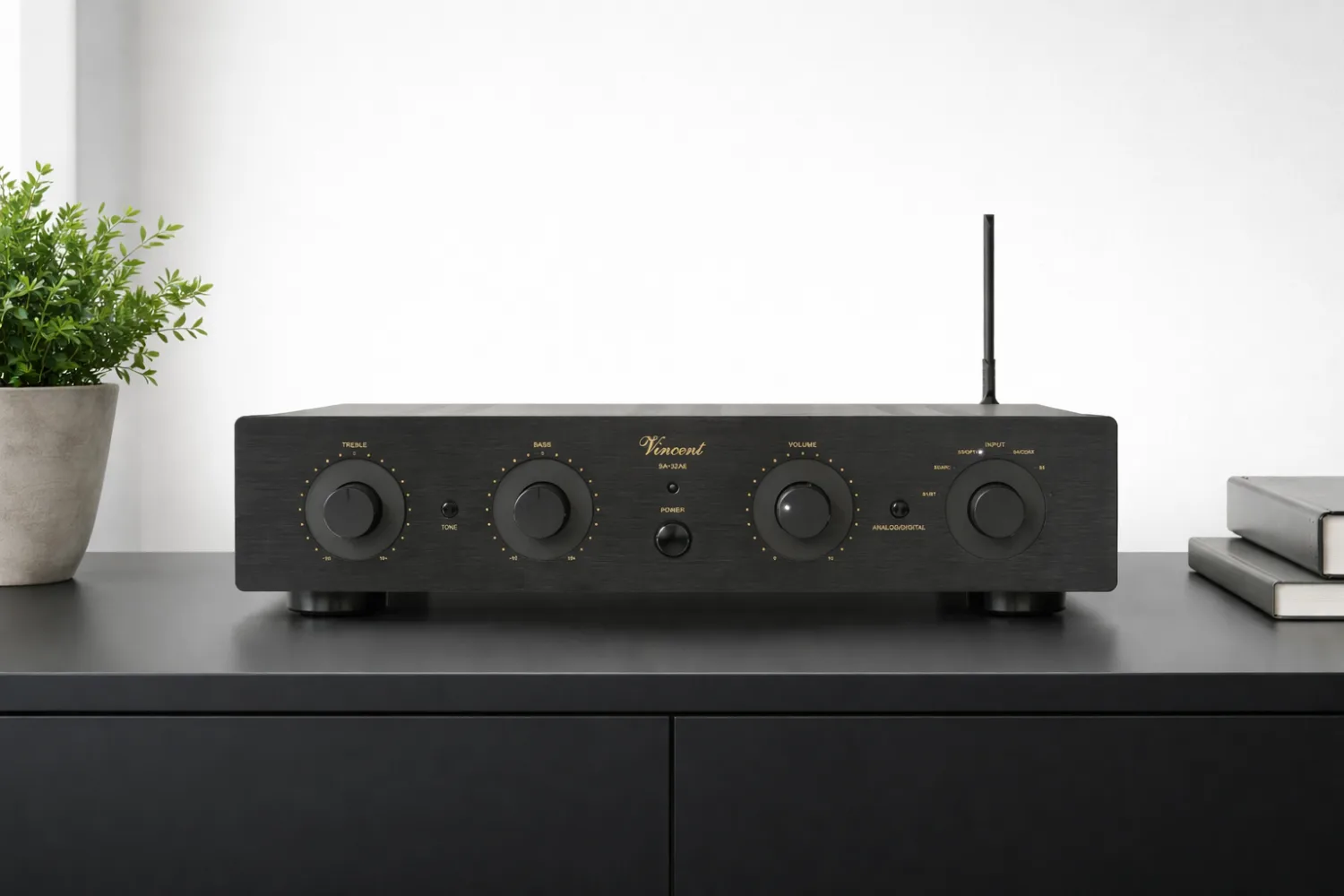
The limited-production Vincent SA-32 AE hybrid tube preamplifier.
The Vincent SA-32 AE is a hybrid stereo preamplifier, so it controls sources and signal level but still requires a separate power amplifier to drive loudspeakers.
This anniversary edition is limited to 200 units and expands the SA-32 concept with Bluetooth, coaxial and optical inputs plus HDMI ARC for straightforward television integration.
Vincent has also revised the tube complement. Two 12AU7 tubes sit near the beginning of the signal path, immediately after the inputs, while two ECC88 tubes operate as phase splitters in the tone-control stage. The larger chassis helps accommodate the expanded digital section. It is a distinctive control component for an owner building a separates system, but limited production and the need for additional amplification make it less universally useful than a complete integrated amplifier.
Best for: Hybrid separates systems needing television and digital inputs
- HDMI ARC for television audio
- Bluetooth, coaxial and optical input support
- Revised hybrid circuit using 12AU7 and ECC88 tubes
- Expanded connectivity housed in a larger chassis
Verdict: The SA-32 AE is a flexible limited-edition hybrid preamplifier, but it must be paired with a suitable power amplifier before it can drive a stereo system.

10. Dan D’Agostino Momentum C2Z
The Dan D’Agostino Momentum C2Z preamplifier, developed for use with Momentum Z monoblocks.
The Dan D’Agostino Momentum C2Z is the most system-specific product here.
It is a preamplifier developed as the intended partner for Momentum Z monoblock power amplifiers, not a self-contained amplifier for loudspeakers.
It also complements rather than replaces the existing Momentum C2. Its central change is a current-capable FET output stage designed to deliver more current into the revised, lower-impedance input topology used by the Momentum Z amplifiers. Dan D’Agostino says this closer electrical coupling is intended to improve stability, signal-path control and transient behavior, but the supplied source offers no independent measurements or comparative listening evidence. The C2Z may be highly relevant within its intended Momentum Z ecosystem, yet its narrow compatibility and requirement for costly separate amplification place it last in a general amplifier ranking.
Best for: Owners building a matched Momentum Z separates system
- Current-capable FET preamplifier output stage
- Purpose-designed electrical interface for Momentum Z monoblocks
- Offered as a complementary alternative to the existing Momentum C2
Verdict: The Momentum C2Z is a purpose-built partner for Momentum Z power amplifiers rather than a broadly applicable amplifier recommendation.

Sound Off
0Join the discussion if you have something to add.