

A serious home cinema is more than a screen and a set of speakers.
The processor or receiver at its center determines format support, channel routing, room correction, video switching, and, in many systems, the character of the whole installation.
This Stereoindex selection brings together the supplied Home Cinema coverage into a practical editorial guide. It spans custom-install immersive processors, full AV receivers, a stereo receiver with home-entertainment flexibility, and a market note on Blu-ray hardware. The emphasis is on supported distinctions: channel capability, calibration tools, connectivity, format handling, and suitability for different system ambitions. Some entries are clearly aimed at reference theaters and professional integration, while others are more accessible or specialized. The right choice depends less on prestige and more on system architecture: how many channels you need, whether you require immersive audio, how important video switching is, and whether room correction or physical media playback is part of the plan.

1. AudioControl raises the bar for custom home cinema with the new Hyperion APR-16
AudioControl Hyperion APR-16, a flagship immersive processor designed for custom-installed home cinemas.
AudioControl’s Hyperion APR-16 is presented as a flagship immersive sound processor for professional AV integrators and reference-grade theaters.
Its appeal lies in scale and calibration depth: the source highlights up to 16 channels of decoding and upmixing, compliance with the CEDIA/CTA-RP22 immersive audio design practice, HAA certification, and deep Dirac Live integration including Room Correction, Bass Control, and Active Room Treatment.
Best for: Custom reference theaters
- Up to 16 channels of decoding and upmixing
- Dirac Live Room Correction, Bass Control, and ART integration
- Designed for professional AV integrators
- CEDIA/CTA-RP22 and HAA credentials cited
Verdict: A highly specialized processor for ambitious immersive rooms where professional design and advanced correction are central to the brief.

2. Yamaha RX-V385: Fully equipped AV receiver
Yamaha RX-V385 with visible front-panel controls, USB, AUX, headphone output, and YPAO microphone input.
The Yamaha RX-V385 is described as a junior AV receiver in Yamaha’s RX-V line, with practical front-panel access and YPAO auto-calibration support.
The source focuses on usability and everyday connectivity, including a headphone output, microphone input for calibration, USB for audio files, and an analog AUX input for mobile devices.
Best for: Accessible AV receiver setups
- YPAO auto-calibration microphone input
- Front USB for audio files
- Front analog AUX input
- Headphone output
Verdict: A straightforward receiver option for users who want essential AV control and convenient front-panel connections without the complexity of higher-tier models.

3. Rotel RSP 1582: Carefully designed AV processor
Rotel RSP-1582 AV processor featuring a central 7-inch TFT display and front HDMI and USB access.
Rotel’s RSP-1582 is positioned as a carefully developed AV processor built around audio and video quality for home entertainment systems.
The source notes its 7-inch front TFT display for setup without an external screen, HDMI with 4K video pass-through, six Wolfson WM8740 DACs, a Texas Instruments signal processor, a 10-band parametric equalizer, and support for major surround formats including Dolby TrueHD and DTS-HD Master Audio.
Dolby Atmos and DTS:X are not supported at this stage in the supplied material.
Best for: Traditional high-quality surround systems
- 7-inch front TFT setup display
- Six Wolfson WM8740 DACs
- 10-band parametric equalizer
- 4K video pass-through noted
Verdict: A thoughtfully specified AV processor for systems prioritizing setup control and established surround formats over current object-audio support.

4. LG stops production of Blu-ray players
LG’s Blu-ray player exit affects buyers who still rely on UHD discs as a home-cinema source.
This entry is not a component recommendation but an important home-cinema market signal.
The source states that LG has halted development and manufacturing of Blu-ray players, including the UHD UBK80 and UBK90, while remaining inventory may still be available until supplies run out.
It also notes that Panasonic and Sony continue to offer UHD players, though neither is described as recently refreshed in the supplied material.
Best for: Physical-media planning
- Clarifies LG’s exit from Blu-ray player production
- Notes remaining UBK80 and UBK90 inventory may be available
- Identifies Panasonic and Sony as continuing UHD player sources
Verdict: For disc-based cinema systems, this is a reminder to consider player availability and long-term source strategy before finalizing a theater build.

5. Onkyo TX-8390: State-of-the-art Stereo receiver
Onkyo TX-8390 stereo receiver, combining two-channel amplification with calibration and network playback features.
The Onkyo TX-8390 is a two-channel receiver rather than a surround AV receiver, but the source gives it strong relevance for home-entertainment systems built around stereo.
It combines a substantial amplifier platform with 200 W per channel at 6 ohms, AccuEQ acoustic calibration adapted from Onkyo’s multichannel receivers, an AK4458 DAC, VLSC filtering, dual-band Wi-Fi, AirPlay, Bluetooth, and network playback support for high-resolution PCM and DSD in PCM conversion mode.
Best for: Stereo-first media rooms
- 200 W per channel at 6 ohms
- AccuEQ acoustic calibration for stereo
- AK4458 DAC with VLSC filtering
- Wi-Fi, AirPlay, Bluetooth, and network playback
Verdict: A feature-rich stereo receiver for listeners who value two-channel performance with modern streaming and calibration conveniences.

6. Anthem AVM 90: Powerful fifteen-channel AV processor
Anthem AVM 90, a flagship AV processor specified for up to 15.4-channel home theater systems.
Anthem’s AVM 90 is described as the company’s flagship fifteen-channel AV processor for home theater, built on newly developed electronics.
The supplied material highlights ARC Genesis room correction with an upgraded calibrated microphone, object-oriented audio codec support up to 15.4 channels, balanced XLR outputs, independent subwoofer outputs, HDMI connectivity, eARC, Bluetooth, Google Chromecast, AirPlay 2, remote configuration, and over-the-air updates.
Best for: Large immersive theaters
- Support for up to 15.4 channels
- ARC Genesis room correction with upgraded microphone
- Balanced XLR outputs
- Remote configuration and over-the-air updates
Verdict: A high-channel-count processor suited to substantial home cinemas where balanced outputs, room correction, and system management matter.

7. The Eight Best AV Receivers for Fall: Upgrading your home-cinema experience
AV receivers remain the control center for surround processing, amplification, and video switching in many home cinemas.
This article functions as a receiver-focused buying context rather than a single product profile.
The source frames the AV receiver as the control hub for amplification, surround sound, and video transmission, with attention to Dolby Atmos, 4K or 8K HDMI handling, and multichannel amplification.
The excerpt specifically mentions the Pioneer VSX-535 as an affordable basic option with five amplification channels, Dolby Atmos and Dolby Surround decoding, 8K/4K Ultra HD switching, Dolby Vision compatibility, Bluetooth, and MCACC calibration, while noting no DTS:X support.
Best for: AV receiver shortlisting
- Explains the AV receiver’s central system role
- Highlights spatial audio and HDMI video priorities
- Includes Pioneer VSX-535 as an affordable basic option
- Notes MCACC calibration and Bluetooth for the Pioneer example
Verdict: A useful starting point for buyers comparing receiver roles and features, especially if an affordable entry point such as the Pioneer VSX-535 is under consideration.

8. Denon AVC-A110: Special edition 13.2-channel AV receiver
Denon AVC-A110 special edition AV amplifier with 13.2-channel capability and broad surround-format support.
The Denon AVC-A110 is presented as a special edition 13.2-channel AV amplifier with broad surround-format support and advanced HDMI features.
The source lists Dolby Atmos, DTS:X, DTS:X Pro, IMAX Enhanced, Auro-3D, 8K/60Hz and 4K/120Hz video playback, HDR10, Dolby Vision, HLG, 8K upscaling, and gaming-related features including ALLM, VRR, and QFT.
It also states 210 watts per channel for its integrated power amplifier design.
Best for: Feature-dense premium receiver systems
- 13.2-channel AV amplifier design
- Supports Dolby Atmos, DTS:X Pro, IMAX Enhanced, and Auro-3D
- 8K/60Hz and 4K/120Hz video support
- ALLM, VRR, and QFT gaming features
Verdict: A heavily equipped AV amplifier for buyers who want extensive format support, built-in amplification, and modern video and gaming compatibility in one chassis.
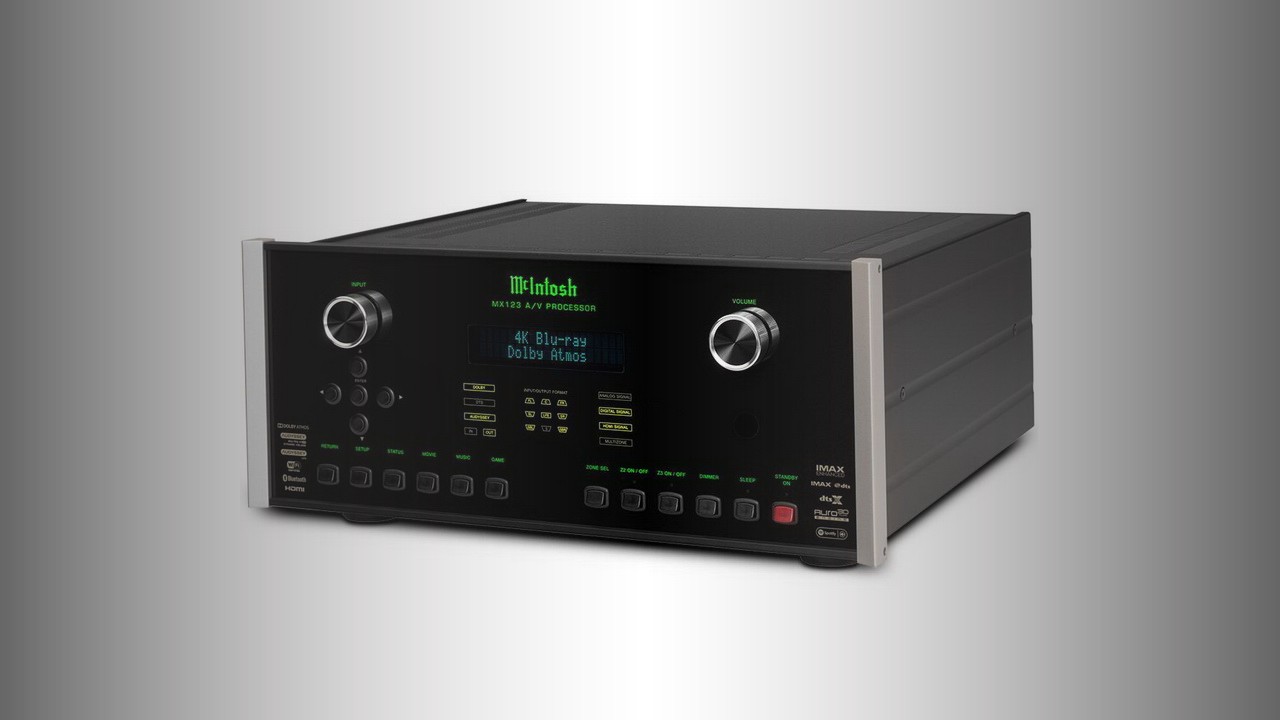
9. McIntosh MX123: AV processor perfect for home theater enthusiasts
McIntosh MX123 AV processor with 13.2-channel outputs and extensive HDMI connectivity for home theater systems.
The McIntosh MX123 combines a premium AV processor role with broad format and connection support.
The source specifies compatibility with Dolby Atmos, DTS:X, and Auro-3D, 13.2 discrete audio channels through balanced and unbalanced outputs, seven HDMI inputs, three HDMI outputs, HDCP 2.3, 18 Gbps HDMI bandwidth, Dolby Vision, HDR10, HLG, 4K Ultra HD at 50/60 Hz, 4:4:4 color spacing, 3D video, and eARC on one HDMI output.
Best for: Premium processor-based theaters
- 13.2 discrete audio channels
- Balanced and unbalanced outputs
- Dolby Atmos, DTS:X, and Auro-3D support
- Seven HDMI inputs and three HDMI outputs
Verdict: A well-connected AV processor for enthusiasts who want McIntosh styling and a 13.2-channel platform with broad surround and 4K video support.
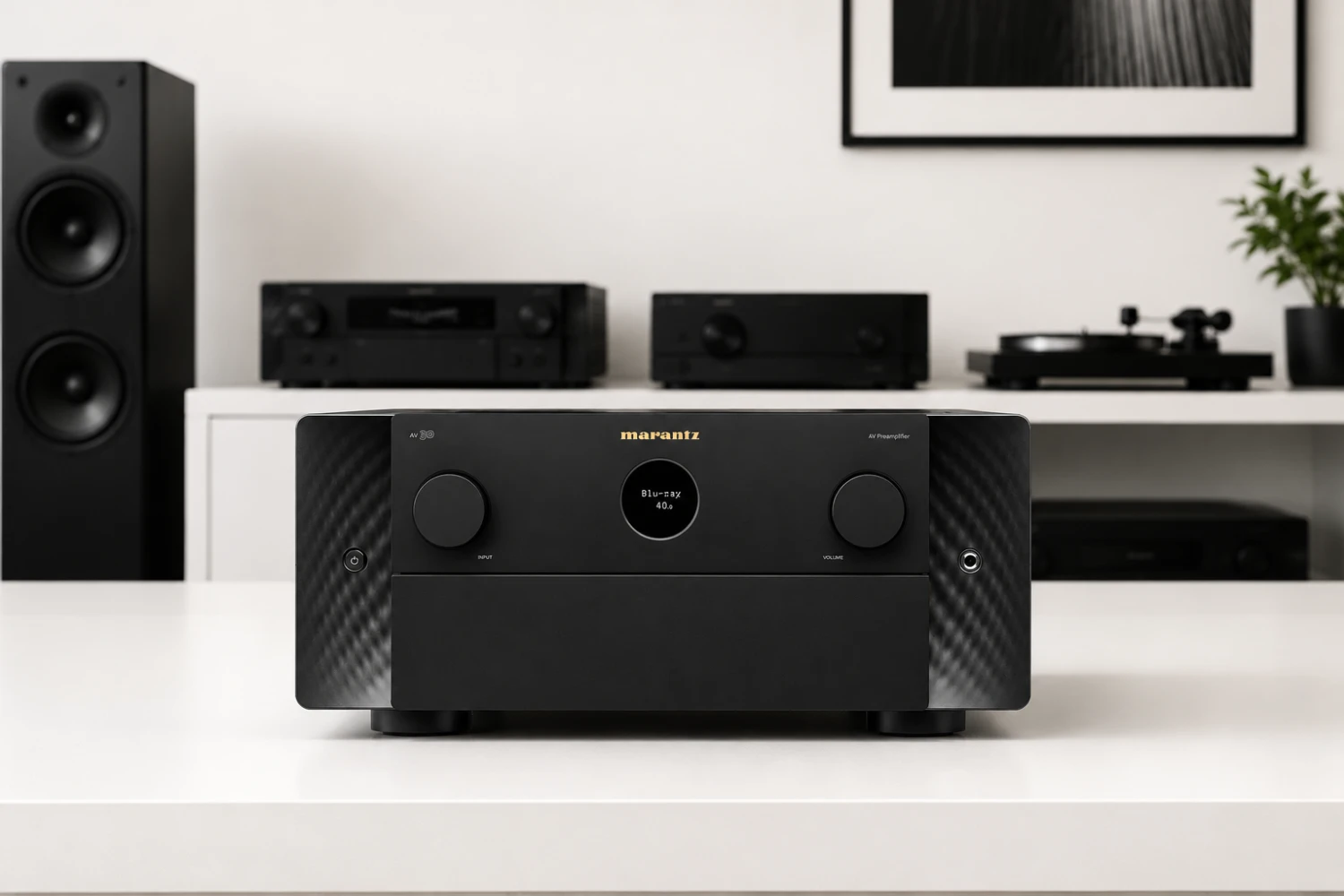
10. Marantz AV 30 Review: Premium Japanese Engineering for Ultimate Home Cinema
Marantz AV 30 surround preamplifier and processor with signature porthole display and concealed front controls.
The Marantz AV 30 is described as an 11.4-channel surround preamplifier and processor for serious home cinema systems, with a focus on refined sound as well as movie performance.
The source positions it for setups up to 7.4.4 and notes pairing with Marantz AMP 20 or AMP 30 power amplifiers.
It also highlights the solid aluminum chassis, Marantz porthole display, illuminated front panel, concealed secondary controls, and a clean minimalist design.
Best for: Refined separates-based cinemas
- 11.4-channel surround preamplifier and processor
- Suitable for setups up to 7.4.4
- Designed to pair with Marantz AMP 20 or AMP 30
- Solid aluminum chassis and concealed controls
Verdict: A premium surround processor for buyers building a separates system around Marantz design, 7.4.4 capability, and a more hi-fi-minded presentation.
Quick comparison
The products and articles differ most clearly by system architecture.
Some are processors that require external amplification, others are integrated receivers with onboard amplification, and one entry is a market update relevant to disc-based source planning.
| Product | Best for | Verdict |
|---|---|---|
| AudioControl Hyperion APR-16 Immersive Sound Processor | Custom reference theaters | Most clearly aimed at professional installations needing 16-channel immersive processing and advanced Dirac-based room optimization. |
| Yamaha RX-V385 | Accessible AV receiver setups | A practical entry-level receiver profile with YPAO calibration access and useful front-panel connectivity. |
| Rotel RSP-1582 | Traditional high-quality surround systems | A processor with strong setup ergonomics and established surround support, but no confirmed Atmos or DTS:X support in the source. |
| LG Blu-ray player production update | Physical-media planning | Not a component pick, but relevant for buyers assessing the future availability of LG UHD Blu-ray players. |
| Onkyo TX-8390 | Stereo-first media rooms | A two-channel receiver with calibration, streaming, network playback, and substantial stated power output. |
| Anthem AVM 90 | Large immersive theaters | A fifteen-channel processor platform with ARC Genesis correction, balanced outputs, and support for up to 15.4 channels. |
| The Eight Best AV Receivers for Fall: Upgrading your home-cinema experience | AV receiver shortlisting | A receiver-buying overview that frames key priorities and includes the Pioneer VSX-535 as an affordable basic example. |
| Denon AVC-A110 | Feature-dense premium receiver systems | A 13.2-channel AV amplifier with extensive surround-format, video, and gaming feature support. |
| McIntosh MX123 | Premium processor-based theaters | A 13.2-channel AV processor with balanced and unbalanced outputs, broad surround support, and comprehensive 4K HDMI handling. |
| Marantz AV 30 | Refined separates-based cinemas | An 11.4-channel preamplifier and processor for systems up to 7.4.4, especially when partnered with matching Marantz amplification. |
How to Choose the Right Home Cinema Component
Start with the system layout.
If you need a large immersive theater with many channels and external power amplifiers, processors such as the AudioControl Hyperion APR-16, Anthem AVM 90, McIntosh MX123, and Marantz AV 30 are the natural territory.
Within that group, the key differences are channel count, room-correction approach, output configuration, and video requirements. If you want one chassis with amplification included, look toward AV receivers and AV amplifiers. The Denon AVC-A110 is the most extensively specified integrated option in the supplied material, while the Yamaha RX-V385 represents a more accessible receiver approach. The receiver-buying overview is useful for clarifying why HDMI handling, room calibration, amplification channels, and spatial-audio support should be checked before purchase. For stereo-led rooms, the Onkyo TX-8390 sits apart. It is not a surround processor, but its two-channel amplification, AccuEQ calibration, DAC section, wireless support, and network playback make it relevant for media rooms where music and simpler screen-based entertainment share the same system. Finally, do not ignore sources. LG’s exit from Blu-ray player production does not end disc playback, but it does make hardware availability part of the planning conversation for anyone who values physical media. In a premium home cinema, the most durable choice is the one that matches the room, speaker layout, source habits, and calibration needs rather than the one with the longest feature list.

Join the discussion
Share your thoughts, listening impressions or product experience.