
Amplification takes several forms in this selection, from integrated and power amplifiers to preamplifiers, headphone models and a digitally managed Class D design.
Rather than treating them as interchangeable, this guide focuses on the system role, controls, connectivity and implementation that distinguish each product.
Value cannot be judged evenly because pricing is supplied for only two entries, while the source material does not include comparable listening tests or measurements. The practical approach is therefore to identify which products consolidate several functions, which prioritize specialized circuit design, and which provide useful setup tools. Two inclusions require particular context. The Focal Sub12 ST6 is a powered studio subwoofer rather than a conventional amplifier, while the PS Audio Aspen FR30 is a passive loudspeaker whose relevance lies in amplifier matching. They are retained here for completeness but should not be compared directly with the amplification components.

1. McIntosh C55: Solid state preamplifier for discerning audiophiles
McIntosh C55 solid-state preamplifier with extensive source selection and an eight-band analog equalizer.
The McIntosh C55 is a feature-rich solid-state control center for systems with numerous analog and digital sources.
Its 16 inputs comprise nine analog and seven digital connections, with support for turntables and digital playback at up to 24-bit/192 kHz.
An eight-band analog equalizer provides direct tonal adjustment, while three stereo pairs of variable balanced and unbalanced outputs accommodate more elaborate system layouts. The supplied price of $9,000 makes this a premium proposition whose value rests on connectivity, flexibility and system consolidation rather than low cost.
Best for: Premium systems with many sources
- Nine analog and seven digital inputs
- Eight-band analog equalizer
- Three pairs of variable outputs
- Automatic shutoff after 30 minutes of inactivity
Verdict: The C55 is a comprehensively equipped preamplifier for listeners who will make full use of its extensive input, output and tone-shaping facilities.

2. Pioneer A-70DA: A versatile and self-sufficient integrated amplifier
Pioneer A-70DA integrated amplifier featuring metal controls, a large volume dial and adjustable tone settings.
The Pioneer A-70DA stands out for physical construction and traditional hands-on operation.
Its case uses 1.8 mm aluminum side plates, a 3.5 mm milled aluminum front panel and solid-metal control knobs rather than plastic handles or trim.
Bass and treble controls can be bypassed, while tone compensation and an attenuator add practical adjustment options. The attenuator is especially useful when the available volume range needs to be limited. Because the supplied excerpt does not include output ratings or rear-panel details, its performance and wider connectivity cannot be assessed here.
Best for: Listeners who value tactile controls
- Milled aluminum front panel
- Solid-metal control knobs
- Defeatable bass and treble controls
- Volume-range attenuator
Verdict: The A-70DA is an appealing integrated amplifier for buyers who prefer substantial construction and direct control over tone and volume behavior.

3. Yamaha M-5000: High-End Fully Balanced Power Amplifier with MOSFET Design
Yamaha M-5000 power amplifier, engineered with isolated channels, symmetrical circuitry and mechanically grounded internal components.
The Yamaha M-5000 is a dedicated MOSFET power amplifier built around a fully symmetrical architecture.
Its left and right channels are physically isolated and assigned separate electrical circuits, while the component layout is intended to keep signal paths short and impedance low.
Yamaha also isolates the power-amplifier circuit from ground-related effects by connecting the positive and negative sides directly to the output stage. Mechanical grounding, a rigid structure and direct mounting of major components are used to address unwanted vibration. No output-power rating is provided in the source excerpt.
Best for: High-end systems built around separate components
- Fully symmetrical circuit architecture
- Physically isolated left and right channels
- MOSFET output design
- Rigid mechanically grounded construction
Verdict: The M-5000 is best suited to buyers prioritizing channel separation, structural rigidity and a carefully organized MOSFET power stage.

4. hARt Lab Tune Two: Versatile hybrid preamplifier unveiled
hARt Lab Tune Two hybrid preamplifier with integrated streaming, digital conversion, phono and headphone functions.
The hARt Lab Tune Two combines a network streamer, DAC, phono preamplifier and headphone amplifier in one preamplifier.
Its hybrid signal path uses a Class A vacuum-tube amplifier stage followed by a solid-state output stage, while the manufacturer attributes minimal signal distortion to its volume-control technology.
Usability extends beyond source integration: a remote control is included, and the front lighting offers 15 colors, three brightness levels or complete deactivation. Pricing and detailed input specifications are not included in the supplied material.
Best for: Systems needing a multifunction hybrid preamplifier
- Integrated streamer and DAC
- Built-in phono and headphone stages
- Class A tube stage with solid-state output
- Adjustable or switchable front lighting
Verdict: The Tune Two is a function-dense preamplifier for listeners seeking streaming, digital conversion, vinyl support and headphone operation in a single hybrid component.

5. Focal Sub12 ST6: Professional studio subwoofer
Focal Sub12 ST6 active studio subwoofer with a 13-inch woofer, BASH amplification and professional connections.
The Focal Sub12 ST6 is not a standalone amplifier but an active professional subwoofer with an integrated 1,000 W BASH amplifier.
It combines a 13-inch W woofer with a bass-reflex enclosure and front ventilation intended to reduce noise.
Its specified operating range is 30 Hz to 400 Hz, with a stated maximum sound-pressure level of 124 dB. Rear controls include frequency adjustment and variable phase, while XLR, TRS, LFE, bypass and focus connections support studio integration. The supplied price is $2,600, and its 58 kg weight demands careful placement.
Best for: Professional studio low-frequency monitoring
- Integrated 1,000 W BASH amplifier
- Variable phase and frequency controls
- Extensive XLR and TRS connectivity
- Automatic standby mode
Verdict: The Sub12 ST6 is a specialized powered studio subwoofer rather than a general amplifier, but its controls and connectivity make its intended role clear.

6. SMSL H300: Powerful balanced headphone amplifier
SMSL H300 balanced headphone amplifier with selectable gain and outputs for different headphone configurations.
The SMSL H300 concentrates on headphone drive, offering up to 10 W into 16 ohms and 5 W into 32 ohms.
Each channel uses 32 low-noise operational amplifiers in parallel for power amplification.
High, medium and low gain settings allow the output behavior to be adapted to headphones with different impedance and sensitivity, with the low-gain mode specifically optimized for in-ear headphones. Both balanced and single-ended interfaces are provided, making this one of the more adaptable dedicated headphone amplifiers in the selection on the supplied specifications.
Best for: Headphone collections with varied sensitivity
- Up to 10 W into 16 ohms
- Three selectable gain settings
- Low-gain mode for in-ear headphones
- Balanced and single-ended interfaces
Verdict: The H300 is a practical choice on paper for users who need substantial output, selectable gain and a choice of balanced or single-ended operation.

7. Dayton Audio APA1200DSP: Powerful and versatile Class D amplifier
Dayton Audio APA1200DSP Class D amplifier with integrated signal processing and browser-based system configuration.
The Dayton Audio APA1200DSP combines high-output Class D amplification with unusually extensive system adjustment.
It is rated to deliver two channels of 560 W or 1,150 W in bridged mode, and its DSP provides equalization, filtering, phase adjustment and delay control.
Settings can be managed from the front panel or through a web interface that works in a standard browser without a separate application. Profiles can be saved and transferred, and multiple amplifiers can share the same network. RCA, XLR and coaxial SPDIF inputs broaden its installation options.
Best for: Powerful systems requiring DSP and remote setup
- Two-channel or bridged operation
- Equalizer, filter, phase and delay controls
- Browser-based configuration
- RCA, XLR and coaxial SPDIF inputs
Verdict: The APA1200DSP is the most installation-oriented option here, pairing substantial stated output with browser-controlled processing and flexible connectivity.
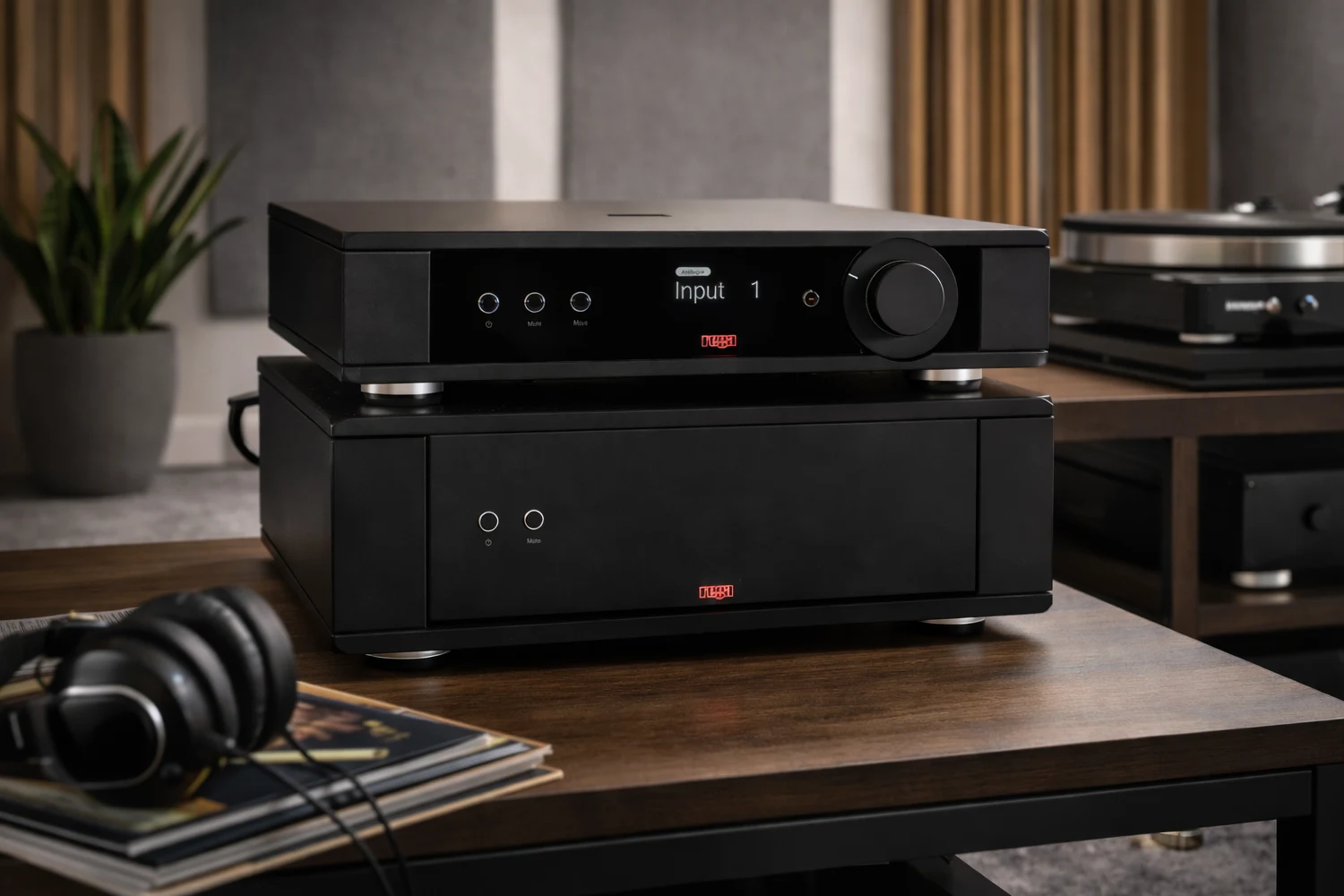
8. Rega Mercury & Solis: British-Built High-End Preamplifier and Power Amplifier
Rega Mercury preamplifier and Solis stereo power amplifier, designed as a matched high-end electronics pair.
Rega developed the Mercury preamplifier and Solis stereo power amplifier as a matched pair manufactured in England.
The supplied technical detail centers on the Solis, which uses fully symmetrical, fully discrete circuitry and is rated at 168 W per channel into 8 ohms and 305 W per channel into 4 ohms.
Sensitive low-voltage circuitry is physically separated from the high-current output section to reduce interference. Balanced and unbalanced inputs, a 12 V trigger and protection against short circuits, thermal overload and DC offset support integration and operational security. The excerpt does not provide equivalent detail for the Mercury's connections.
Best for: Buyers seeking a technically matched pre-power pair
- 168 W per channel into 8 ohms
- 305 W per channel into 4 ohms
- Discrete symmetrical Solis circuitry
- Short-circuit, thermal and DC protection
Verdict: Mercury and Solis form a compelling separates proposition on the available information, although the source explains the power amplifier more fully than the preamplifier.

9. PS Audio Aspen FR30: Reference floor speakers with eight woofers
PS Audio Aspen FR30 floorstanding loudspeaker with front-facing woofers, side-mounted passive radiators and planar drivers.
The PS Audio Aspen FR30 is a passive three-way floorstanding loudspeaker, not an amplifier.
Its relevance to this guide is system matching: the specified impedance is 4 ohms, and the source associates it with an amplifier rated at 100 W.
Each enclosure uses four 8-inch long-throw woofers, four 10-inch passive radiators, a 10-inch planar midrange driver and two 2.5-inch ribbon tweeters. At more than 100 kg per speaker and over 1.5 meters tall, it also presents substantial installation demands that extend beyond amplifier selection.
Best for: Readers matching amplification to large passive speakers
- Specified 4-ohm impedance
- Four long-throw woofers per speaker
- Planar midrange and ribbon tweeters
- Separate mid-high and bass housings
Verdict: The Aspen FR30 is useful here only as an amplifier-matching case, since it is a large passive loudspeaker rather than an amplification component.

10. Audio-GD Master-9P: Balanced headphone and combo amplifier
Audio-GD Master-9P fully balanced headphone and combination amplifier using Class A and ACSS circuitry.
The Audio-GD Master-9P is a fully balanced headphone and combination amplifier built around the company's ACSS current-amplification architecture.
Its amplification and preamplifier stages operate in Class A, and the ACSS stage is soldered directly to the main circuit board to shorten the signal path.
Four groups of Class A power supplies serve the ACSS section, while the output stages use a no-feedback Linear Fidelity design. The article also describes high output-current capability for demanding speaker systems, although it supplies no numerical power ratings in the excerpt.
Best for: Balanced headphone and combination-amplifier systems
- Fully balanced architecture
- Class A amplification and preamplifier stages
- ACSS current-amplification design
- High output-current capability
Verdict: The Master-9P is a technically distinctive option for buyers specifically interested in Class A operation, balanced circuitry and Audio-GD's ACSS architecture.


Sound Off
0Join the discussion if you have something to add.