
Choosing an amplifier starts with the system around it.
Speaker type, room size, source equipment and preferred listening formats matter more than the length of a feature list.
A compact integrated model can combine amplification, digital conversion and TV connectivity, while a dedicated power amplifier may offer greater output reserves but require a separate preamplifier. The products gathered here cover several distinct roles, including all-in-one stereo hubs, Class AB integrated amplifiers, dual-mono power amplification and desktop headphone systems. One entry, the Teac TN-5BB, is a turntable rather than an amplifier; it remains included in its supplied position but should be viewed as a source component that needs suitable phono amplification. Specifications should be interpreted in context. Power figures are only meaningful alongside speaker impedance and sensitivity, while input selection determines whether a television, turntable, computer or wireless source can connect without additional hardware. Use the distinctions below to identify the product type that fits your system before comparing output figures or design details.

1. SMSL AL400: Powerful All-in-One Amplifier with HDMI eARC, DAC & Phono
The compact SMSL AL400 combines stereo amplification with HDMI eARC, Bluetooth, digital inputs and an MM/MC phono stage.
The SMSL AL400 is designed to consolidate a varied music and television system into one compact chassis.
Its TPA3255-based stereo amplification is joined by a Cirrus Logic CS43131 DAC, an XMOS XU-316 USB interface, HDMI eARC, Bluetooth and a phono stage compatible with both MM and MC cartridges.
USB playback supports PCM up to 768 kHz and DSD256, while LDAC and aptX HD provide higher-quality Bluetooth options with compatible devices. This broad connectivity makes the AL400 particularly relevant to listeners moving between passive speakers, television sound, vinyl and computer audio.
Best for: Mixed TV, vinyl and digital systems
- HDMI eARC for television sound
- MM and MC phono support
- PCM up to 768 kHz and DSD256 via USB
- Bluetooth with LDAC and aptX HD
Verdict: A compact all-in-one choice for listeners who want amplification, digital conversion and phono connectivity in a single component.

2. New Limestone amplifiers are equipped with tubes from Ray Tubes
The Limestone PP1 is a 45-watt Class AB mono power amplifier supplied with Ray Tubes.
Limestone’s PP1 is a Croatian-made mono power amplifier operating in Class AB and rated at 45 watts.
The company now equips every amplifier it produces with Ray Tubes, positioning the collaboration around the warm character associated with vintage tube sound and the reliability expected from contemporary construction.
Because the PP1 is a monoblock rather than a stereo integrated amplifier, buyers should account for the wider system requirements, including separate amplification for each channel and appropriate source control.
Best for: Dedicated monoblock tube systems
- Class AB tube design
- 45-watt mono power amplifier
- Ray Tubes fitted as standard
Verdict: A specialist 45-watt monoblock for listeners deliberately building a system around tube amplification rather than seeking an all-in-one amplifier.

3. Teac TN-5BB: The new flagship turntable
The Teac TN-5BB turntable uses a layered hybrid frame and provides balanced outputs but no built-in phono preamplifier.
The Teac TN-5BB is not an amplifier, but it has direct implications for amplifier selection.
Unlike some turntables, it has no built-in phono preamplifier, so it must be paired with a suitable external phono stage or an amplifier offering a compatible phono input.
Its balanced outputs can be useful in an appropriately equipped system. The turntable uses a 36 mm hybrid frame combining artificial marble, MDF and Washi paper, while an optically monitored servo system controls its selectable 33, 45 and 78 rpm speeds.
Best for: Vinyl systems with separate phono amplification
- Balanced outputs
- Three selectable playback speeds
- Optically monitored speed control
- Hybrid vibration-damping frame
Verdict: A substantial three-speed turntable that belongs in this guide only as a source requiring carefully matched phono amplification.
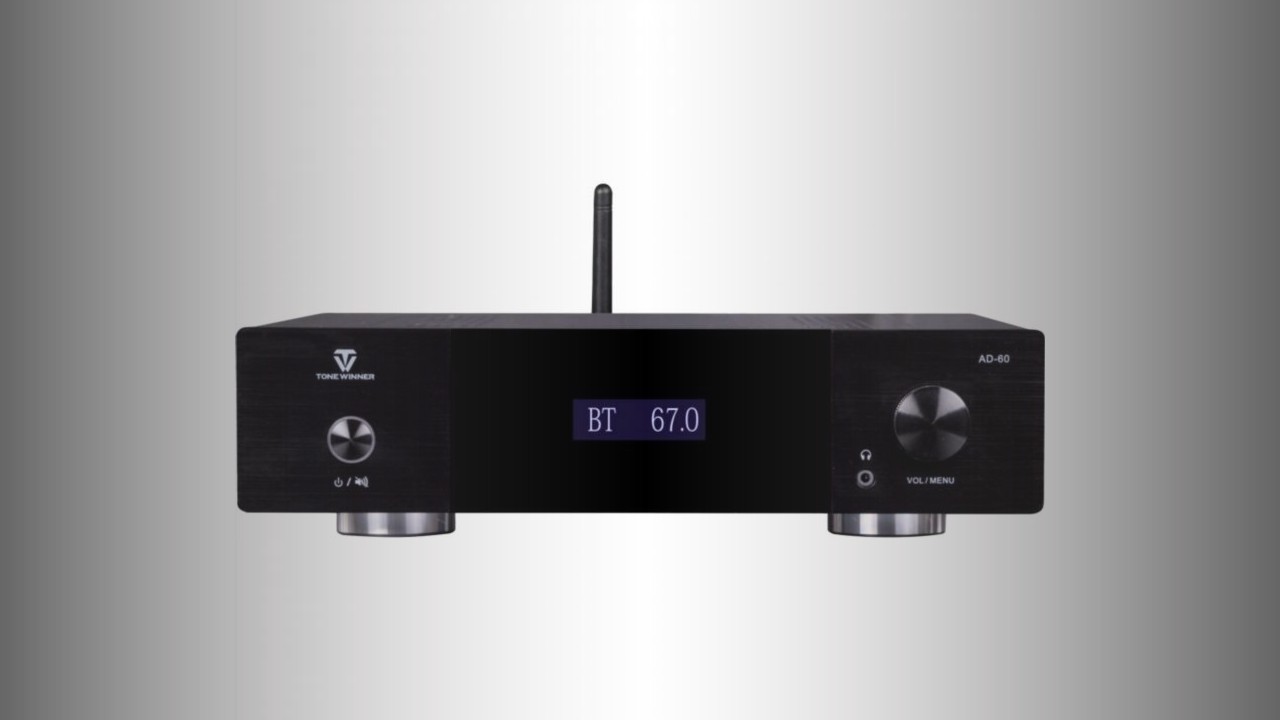
4. Tonewinner AD-60: Class AB integrated power amplifier
The Tonewinner AD-60 offers Class AB amplification, HDMI ARC and multiple digital connections in an integrated design.
The Tonewinner AD-60 combines Class AB stereo amplification with a particularly broad selection of digital and analog connections.
It is rated at 80 watts per channel into 4 ohms and 50 watts per channel into 8 ohms, with specified total harmonic distortion of no more than 0.025 percent at 1 kHz.
HDMI ARC, optical, coaxial, USB-A, USB-C, Bluetooth 5.0 and stereo RCA inputs support a range of sources, while headphone and subwoofer outputs expand its practical system options.
Best for: Connected stereo and TV systems
- 80 watts per channel into 4 ohms
- HDMI ARC and Bluetooth 5.0
- USB, optical, coaxial and RCA inputs
- Headphone and subwoofer outputs
Verdict: A versatile Class AB integrated amplifier for systems that need conventional stereo power alongside TV, computer and Bluetooth connectivity.

5. Audio-GD MASTER-2A: Power amplifier in dual mono form factor
The Audio-GD MASTER-2A separates its two channels into individual monoblocks with XLR and ACSS inputs.
The Audio-GD MASTER-2A is a dedicated dual-mono power amplifier supplied as two separate units.
Each monoblock is rated to deliver up to 300 watts into 4 ohms, supported by four transformers, including two R-core transformers with a stated combined capacity of 1,800 watts.
Connectivity is deliberately focused: the pair provides two XLR and two ACSS analog inputs, with rear-panel switching between the two connection types. This is a high-output power stage rather than a complete source-switching integrated amplifier, so a suitable preamplifier and source components are required.
Best for: High-output separates-based systems
- Up to 300 watts per monoblock into 4 ohms
- Separate dual-mono construction
- Balanced XLR and ACSS inputs
- Four-transformer power architecture
Verdict: A powerful two-chassis option for buyers who already have, or plan to add, the preamplification and source control required by a dedicated power amplifier.

6. Michi X5 Series 2: One of the best integrated amplifiers from Rotel
The Michi X5 Series 2 combines high-output amplification, dual toroidal transformers and extensive analog and digital source switching.
The Michi X5 Series 2 combines substantial amplification with the connectivity expected of a full-scale integrated amplifier.
It is rated at 350 watts into 8 ohms and 600 watts at the other stated load condition, while separate toroidal transformers supply different sections to help control unwanted noise and distortion.
Its ESS ES9028PRO DAC supports operation up to 32-bit/768 kHz. Thirteen source connections include RCA, balanced XLR, MM phono, optical, coaxial and PC-USB inputs, with aptX Bluetooth available for wireless playback.
Best for: Large, source-rich integrated systems
- 350 watts into 8 ohms
- Thirteen source connections
- MM phono and balanced XLR inputs
- ESS ES9028PRO DAC with PC-USB
Verdict: A high-output integrated amplifier for listeners who need extensive analog and digital switching without separating preamplifier and power-amplifier duties.

7. TANCHJIM VAST: Limited Edition amplifier with DAC on AK4497EQ
The TANCHJIM VAST pairs an AK4497EQ DAC with four headphone socket formats and line outputs for powered speakers.
The TANCHJIM VAST is primarily suited to a desktop headphone or active-speaker system rather than passive loudspeakers.
Its AK4497EQ-based DAC accepts USB, Bluetooth and coaxial sources, while headphone connections include 3.5 mm, balanced 4.4 mm, 6.3 mm and four-pin XLR formats.
RCA and balanced XLR line outputs allow connection to powered speakers. The aluminum enclosure is CNC-machined, and production is stated to be limited to 50 units, making availability an important practical consideration.
Best for: Headphones and powered desktop speakers
- Four headphone connection formats
- USB, Bluetooth and coaxial inputs
- RCA and balanced XLR outputs
- CNC-machined aluminum enclosure
Verdict: A highly limited desktop DAC and headphone amplifier with unusually broad headphone connectivity and outputs for active speakers.
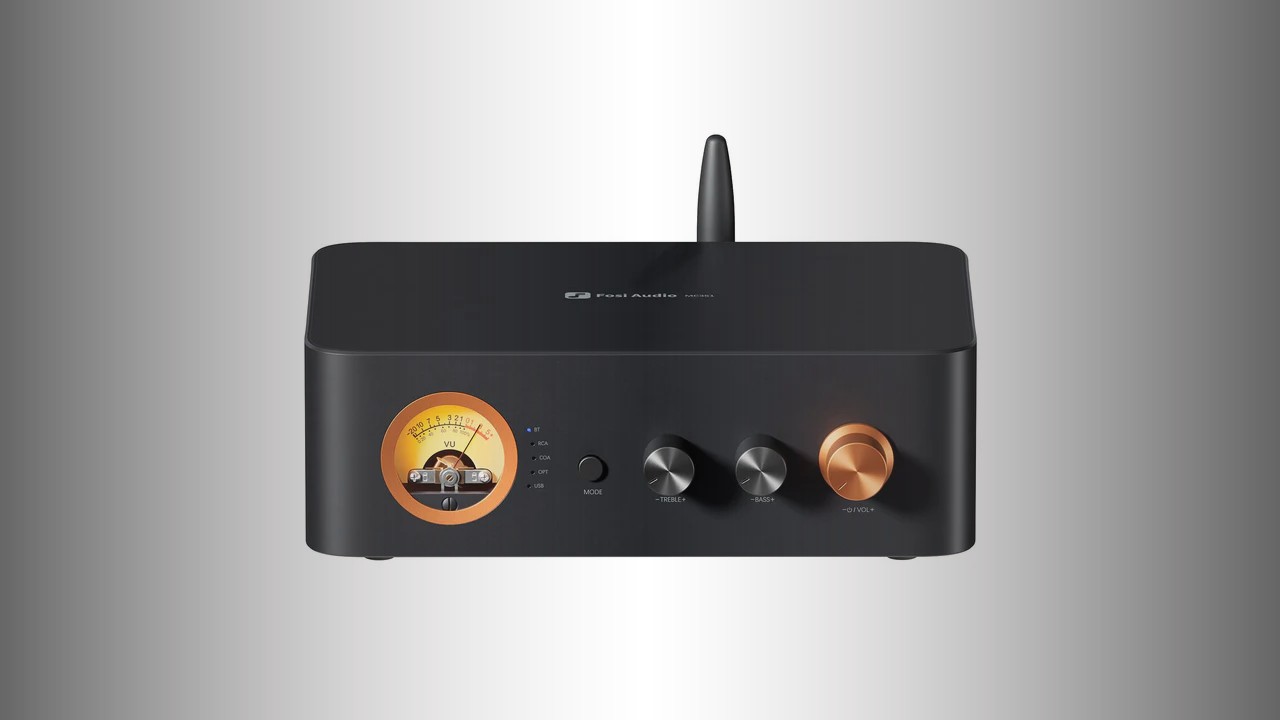
8. Fosi Audio MC351: A versatile integrated amplifier
The Fosi Audio MC351 combines a 2.1-channel Class D layout with digital inputs, tone controls and a miniature VU meter.
The Fosi Audio MC351 is built around a 2.1-channel layout, making it a practical fit for stereo speakers accompanied by a subwoofer.
Two Texas Instruments TPA3255 Class D chips provide stated output of up to 165 watts per stereo channel plus 350 watts for the subwoofer channel.
Bluetooth, USB, optical and coaxial inputs cover common digital sources, while bass and treble controls allow basic tonal adjustment. A miniature VU meter and aluminum-alloy body give the unit a more traditional visual identity than many compact Class D amplifiers.
Best for: Compact 2.1 speaker systems
- Dedicated 2.1-channel configuration
- Bluetooth, USB, optical and coaxial inputs
- Bass and treble controls
- Automatic standby after two minutes without a signal
Verdict: A feature-focused Class D amplifier for buyers who want stereo speakers, a powered bass channel and multiple digital sources in one compact system.

9. Technics SU-C700: Integrated amplifier with an unusual design
The Technics SU-C700 features illuminated VU meters, a compact aluminum enclosure and Load Adaptive Phase Calibration.
At 34 cm wide, the Technics SU-C700 occupies a middle ground between conventional full-width and half-width components.
Its Class D circuit is complemented by Load Adaptive Phase Calibration, which sends a test signal to the connected speakers and adjusts the amplifier’s output to their electrical characteristics.
A built-in DAC and multiple digital inputs support digital source systems, although analog connectivity is limited to one line-level input and one MM phono input. Illuminated VU meters and a rigid aluminum enclosure define its distinctive physical design.
Best for: Compact digital systems needing speaker calibration
- Load Adaptive Phase Calibration
- Built-in DAC with multiple digital inputs
- MM phono input
- Compact 34 cm-wide aluminum enclosure
Verdict: A distinctive compact integrated amplifier whose digital connectivity and speaker-adaptive calibration outweigh its limited selection of analog inputs for the right system.

10. McIntosh MA5300: Compact and powerful integrated amplifier
The McIntosh MA5300 places illuminated dual-stage wattmeters and a headphone output on its compact glass front panel.
The McIntosh MA5300 is the company’s most compact solid-state integrated amplifier by physical size and output within the described range.
It delivers 100 watts per channel into 8 ohms or 160 watts per channel into 4 ohms.
Dual-stage blue wattmeters display output for both loads, while the front panel also includes a 6.3 mm headphone connection, source selector, menu control and volume control. Its glass fascia, aluminum side pieces and illuminated meters preserve the established McIntosh visual language in a smaller enclosure.
Best for: Smaller rooms and compact premium systems
- 100 watts per channel into 8 ohms
- 160 watts per channel into 4 ohms
- Front-panel 6.3 mm headphone output
- Dual-stage output wattmeters
Verdict: A comparatively compact McIntosh integrated amplifier that retains substantial stereo output, headphone access and the brand’s characteristic metering.
Frequently asked questions
How much amplifier power do I need?
Start with the loudspeaker manufacturer’s impedance and sensitivity information, then consider room size and listening level.
Do not compare wattage figures without checking the stated load: an output specified into 4 ohms is not directly equivalent to one specified into 8 ohms.
Should I choose an integrated amplifier or a power amplifier?
An integrated amplifier combines volume control, source selection and power amplification, and may also include a DAC, phono stage or Bluetooth.
A dedicated power amplifier such as the Audio-GD MASTER-2A or Limestone PP1 needs separate source control and, in most systems, a preamplifier.
Do I need a phono input for a turntable?
You need a phono stage somewhere in the signal path unless the turntable has one built in.
The Teac TN-5BB has no internal phono preamplifier, whereas models such as the SMSL AL400, Michi X5 Series 2 and Technics SU-C700 provide phono connectivity; cartridge compatibility should still be checked.
Which connections matter for television and computer audio?
For a television, HDMI ARC or eARC can simplify control and cabling, as offered by the Tonewinner AD-60 and SMSL AL400 respectively.
For a computer, look for a compatible USB input; optical or coaxial connections may also work if the source provides them.
How to Match an Amplifier to Your System
Begin by deciding which product category you actually need.
An integrated amplifier is usually the simplest foundation for passive speakers because it combines source selection, volume control and speaker power.
A power amplifier or monoblock requires additional components, while a headphone amplifier with line outputs, such as the TANCHJIM VAST, is intended for headphones or powered speakers rather than conventional passive loudspeakers. Next, list every source you expect to connect. HDMI ARC or eARC is valuable when the amplifier will handle television audio. USB, optical and coaxial inputs support digital sources, while Bluetooth prioritizes convenience. Vinyl users must confirm both the presence and type of phono stage: MM support is common among the products described here, but the SMSL AL400 also supports MC cartridges. A turntable without a built-in phono stage, including the Teac TN-5BB, cannot be treated like a standard line-level source. Finally, match amplification to the speakers rather than choosing on wattage alone. Check power into the relevant impedance, verify that the speaker manufacturer’s requirements are met and leave room for normal listening peaks. Also consider practical details such as chassis size, ventilation, subwoofer outputs and headphone sockets. The strongest purchase is not necessarily the amplifier with the largest specification; it is the one whose role, connections and output align cleanly with the rest of the system.


Sound Off
0Join the discussion if you have something to add.