
Choosing speakers starts with the listening space and the role the system needs to perform.
A compact wireless model, a passive floorstander, an outdoor installation speaker and a subwoofer solve very different problems, even though they all sit within the broader speaker category.
Amplification, available space, source connections and placement flexibility should therefore come before appearance or headline specifications. This selection covers several distinct routes, from active bookshelf speakers and portable wireless audio to passive hi-fi designs, weather-resistant outdoor models and home-cinema expansion. It also includes a practical explanation of bass-reflex port placement, an issue that can influence how easily a speaker integrates with nearby walls. Not every entry is a direct alternative to the others. The aim is to clarify what each product or article contributes, where it fits and which limitations should be considered before choosing.
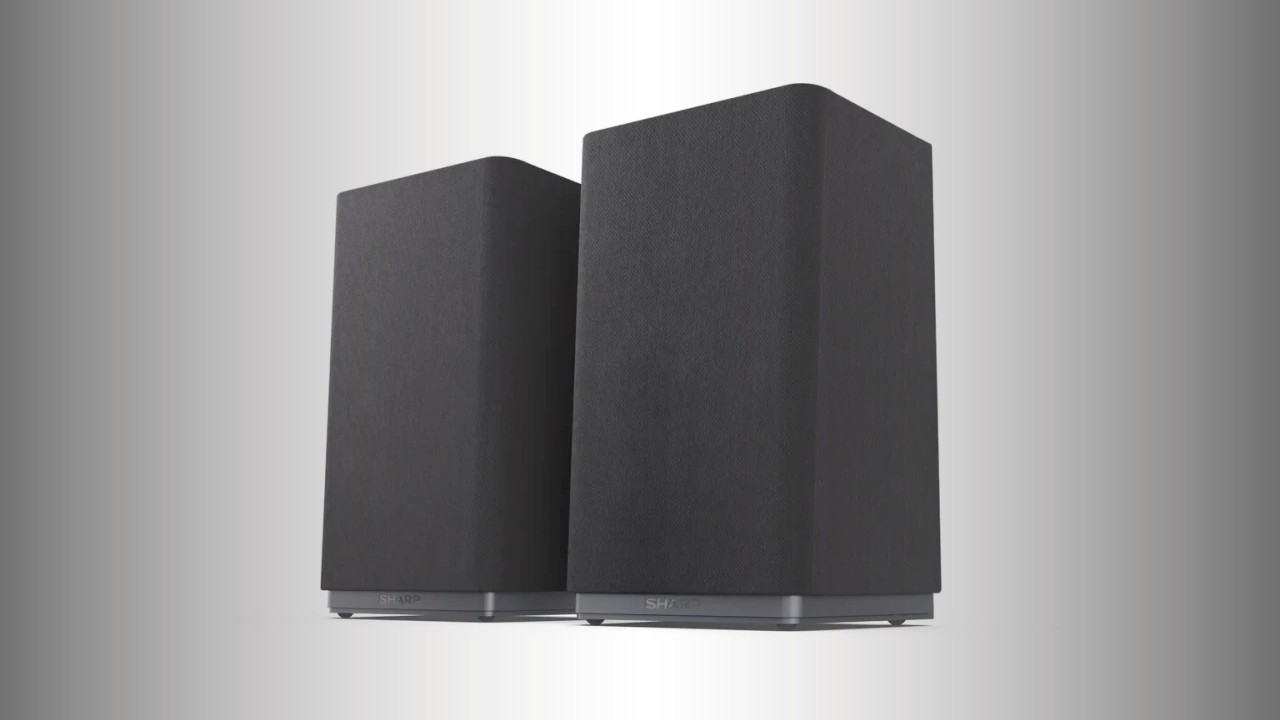
1. Sharp HT-SB700 and HT-AWS2001 surround speakers
The compact Sharp HT-SB700 soundbar shown with HT-AWS2001 wireless surround speakers.
Sharp’s HT-SB700 is a compact 52 cm-wide soundbar intended for small and medium-sized rooms.
Its 2.0.2 configuration supports Dolby Atmos and can be combined with other Sharp devices.
The accompanying HT-AWS2001 wireless speakers use AQUOS Wireless Surround to receive multichannel audio, including Dolby Atmos, from compatible Sharp televisions and expand a 2.0 arrangement to 4.0. Compatibility is central here: the wireless surround functionality is specifically tied to supported Sharp TVs rather than presented as a universal system.
Best for: Compact Sharp TV surround systems
- Compact 52 cm soundbar
- Dolby Atmos support
- Wireless expansion from 2.0 to 4.0
- Designed for compatible Sharp televisions
Verdict: A space-conscious route to wireless surround sound for owners of compatible Sharp televisions.

2. Klipsch RSM and PSM outdoor speakers
Klipsch RSM and PSM surface-mount speakers are designed for residential and professional outdoor audio.
Klipsch divides these passive outdoor speakers into residential and professional ranges, with four sizes offered in each.
RSM models use conventional 8-ohm connections for private installations, while PSM speakers have Phoenix connections for professional 70- or 100-volt systems such as those used in shops, churches and larger restaurants.
Every model combines a cone bass-midrange driver with a compression driver, while the five-fold horn-volume design is intended to strengthen bass performance within compact cabinets. An IPX6 rating provides resistance to pressurised water jets and light rain, making the ranges better suited to exposed locations than ordinary indoor speakers.
Best for: Residential or commercial outdoor installations
- Residential and professional ranges
- Four sizes in each series
- IPX6 water-resistance rating
- Two-way driver configuration
Verdict: A clearly segmented outdoor range with connection options for both conventional home systems and distributed professional installations.

3. DALI SUB C-8 D
The DALI SUB C-8 D combines an 8-inch driver, internal Class D amplifier and rear-panel setup controls.
The DALI SUB C-8 D is a compact powered subwoofer intended to handle low-frequency effects from films as well as bass in music.
Its 8-inch driver is partnered with an internal Class D amplifier rated at up to 170 W operating power and 220 W peak.
Rear-panel controls cover gain, crossover frequency, phase and automatic standby, while an LFE mono input serves home-cinema systems and stereo RCA connections provide a low-pass-filtered option. The MDF enclosure is available in Black Ash or White, which should simplify visual matching with a range of speakers and rooms.
Best for: Adding adjustable bass to music or cinema systems
- Adjustable gain, crossover and phase
- LFE and stereo RCA inputs
- Built-in Class D amplification
- Black Ash or White finishes
Verdict: A compact, configurable subwoofer for buyers who need both home-cinema and stereo connection options.

4. Acoustic Energy AE 120²
The Acoustic Energy AE 120² is a slim three-way floorstander with twin bass drivers and a dedicated midrange unit.
The AE 120² is the flagship three-way floorstander in Acoustic Energy’s AE 100² series, developed to produce a large-scale presentation from a relatively narrow cabinet.
It uses two 130 mm bass drivers and a separate 130 mm midrange unit housed in an isolated chamber.
A 25 mm fabric-dome tweeter sits in the company’s Wide Dispersion Technology waveguide. The cabinet is built from 15 mm HDF panels with internal bracing, while the stated 90 dB sensitivity and 6-ohm impedance provide useful starting points when assessing amplifier compatibility. Satin Black and Walnut vinyl veneer are the available finishes.
Best for: Full-range passive sound from a narrow floorstander
- Dedicated three-way configuration
- Twin 130 mm bass drivers
- Internally braced HDF cabinet
- 90 dB stated sensitivity
Verdict: A substantial three-way design for listeners who want floorstanding scale without an especially wide enclosure.
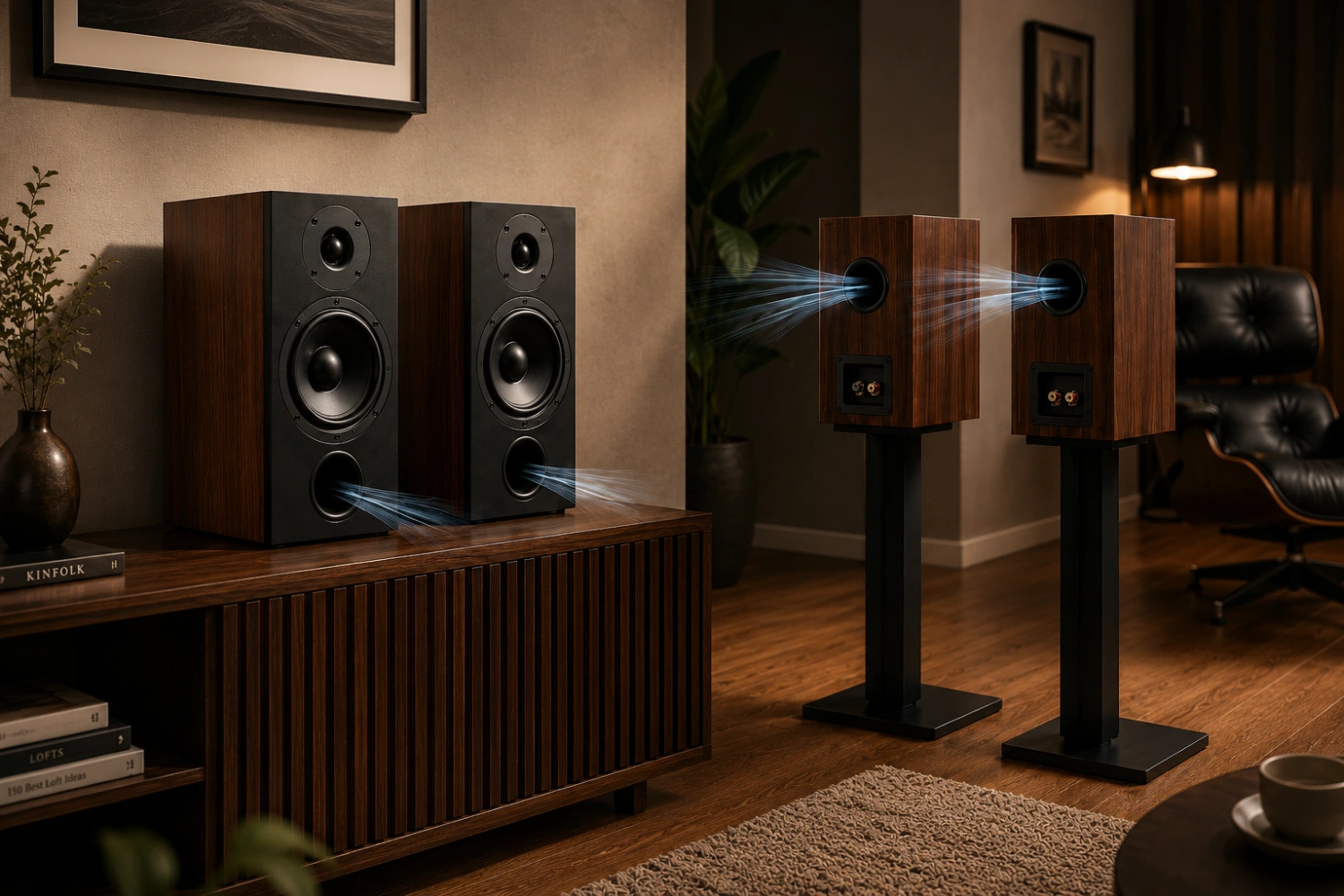
5. Front vs Rear Bass Reflex Ports: What’s the Difference?
Front- and rear-facing bass-reflex ports require consideration of cabinet tuning, walls and room acoustics.
This placement guide explains why port direction should not be treated as a simple indicator of whether a speaker can sit near a wall.
A bass-reflex enclosure uses a tuned cabinet opening and internal duct to increase output around the low-frequency tuning point.
Front-facing ports may alter practical placement and the audibility of turbulence, but they do not automatically make wall-adjacent positioning safe. Equally, a rear port does not always demand a large gap behind the cabinet. Room acoustics, speaker tuning and distance from nearby boundaries generally matter more than port direction alone, so final placement should be judged in the intended room.
Best for: Planning speaker placement before buying
- Clarifies how bass-reflex ports work
- Challenges common placement assumptions
- Considers room and boundary interaction
- Applies to front- and rear-ported designs
Verdict: A useful corrective to the assumption that port direction alone determines where a speaker can be placed.
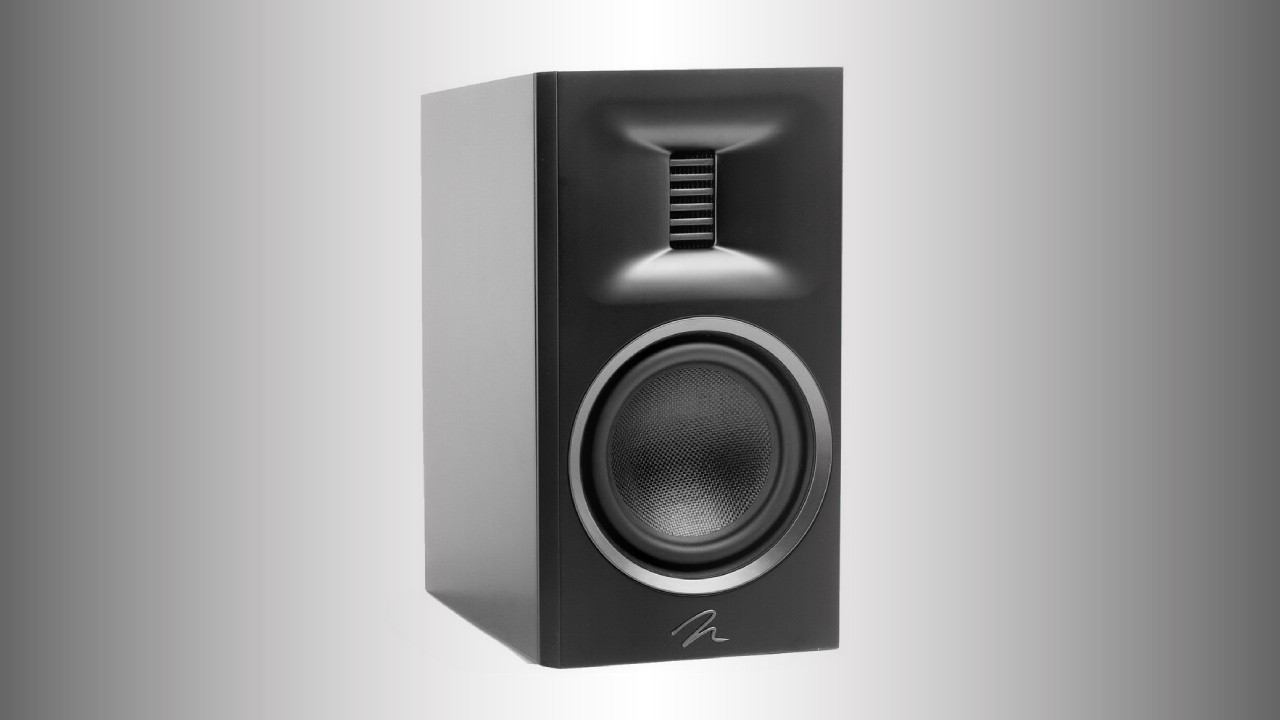
6. Martin Logan Motion XT B100
The Martin Logan Motion XT B100 is a standmount speaker with a folded-motion tweeter and reinforced woofer.
The Motion XT B100 is a passive bookshelf speaker positioned as a high-performance alternative to moving up to a floorstanding model.
It combines a Gen2 Folded Motion XT tweeter with a Nomex Kevlar-reinforced woofer and can be used in either a two-channel or home-theatre system.
Threaded mounting points allow secure attachment to the matching STAND25 stand, which is sold separately. Walnut, Satin White and Gloss Black finishes offer three distinct approaches to room integration.
Best for: Performance-focused standmount systems
- Gen2 Folded Motion XT tweeter
- Reinforced woofer construction
- Suitable for stereo or home theatre
- Threaded attachment for the matching stand
Verdict: A flexible passive bookshelf design for listeners building a serious stereo or home-theatre setup without choosing floorstanders.

7. Triangle Borea BR02 BT
Triangle Borea BR02 BT active speakers are offered in several light and dark finish combinations.
The Triangle Borea BR02 BT is an active bookshelf system with amplification rated at 50 W per channel, reducing the need for a separate amplifier.
Its input selection includes a turntable connection alongside line-level and digital inputs, while Bluetooth accommodates wireless playback from mobile devices.
A subwoofer output provides an upgrade path for listeners who want greater bass extension. The expanded finish selection includes Cream, Light Oak, Light Oak Blue and Oak Green, with coordinating grille treatments for different interiors.
Best for: Compact systems with multiple source types
- Built-in 50 W-per-channel amplification
- Turntable, line and digital inputs
- Bluetooth connectivity
- Subwoofer connection
Verdict: A versatile active bookshelf option for buyers who want wired sources, Bluetooth and turntable support in one system.
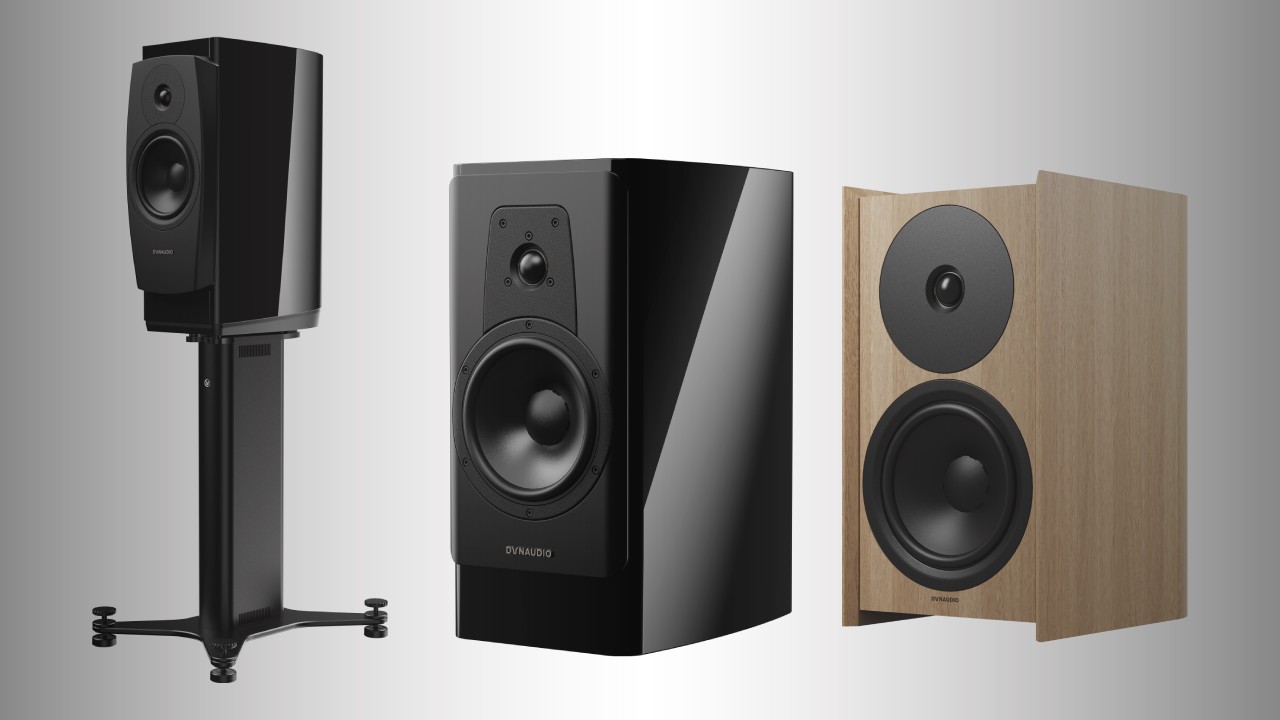
8. Dynaudio set to unveil four new products at High-end Munich
Dynaudio’s Contour Legacy is a hand-built two-way floorstander finished in matched American Walnut veneer.
Dynaudio’s preview spans several parts of its range rather than presenting one directly comparable speaker.
The most fully described model is the Contour Legacy, a two-way floorstander inspired by earlier Contour designs and equipped with a 28 mm Esotar 3 soft-dome tweeter, two 18 cm woofers derived from the Evidence series and a crossover made with high-grade components.
It is hand-built in Denmark, finished in matched American Walnut veneer and limited to 1,000 numbered pairs. The announcement also identifies the Confidence 20A as an active version of the Confidence 20, alongside another Contour model and a product from Dynaudio’s Japandi collaboration, although the supplied material does not provide equivalent detail for those products.
Best for: Followers of limited-production Dynaudio designs
- Esotar 3 soft-dome tweeter in Contour Legacy
- Twin 18 cm woofers in Contour Legacy
- Hand-built construction
- Matched American Walnut veneer
Verdict: An informative preview led by the carefully specified Contour Legacy, though details of the other announced products remain limited.

9. Wiibo Vintage 6
The Wiibo Vintage 6 pairs a three-way passive design with a walnut-finished retro cabinet.
The Wiibo Vintage 6 is a passive three-way speaker with a distinctly retro visual direction and a stated power figure of 100 W.
Each cabinet measures 57 by 35 by 42 cm, making it relatively compact for this style of speaker, although buyers still need to account for suitable positioning and amplification.
Black and brown versions both use a walnut-effect finish. These are not self-powered speakers, so a compatible hi-fi amplifier or receiver is an essential part of the system rather than an optional upgrade.
Best for: Passive systems with a vintage visual theme
- Three-way speaker design
- Relatively compact cabinet
- Black or brown finish options
- Retro-inspired appearance
Verdict: A compact three-way choice for buyers who favour retro styling and already have, or plan to add, suitable amplification.

10. Sonos Roam SL
The microphone-free Sonos Roam SL is a portable IP67-rated speaker with Wi-Fi, Bluetooth and AirPlay 2 support.
The Sonos Roam SL retains the portable format and core connectivity of the Roam while removing its microphone.
It carries an IP67 rating, supports Apple AirPlay 2 and offers up to 10 hours of continuous playback, with charging available through compatible Qi wireless chargers.
The absence of a microphone means there is no Amazon Alexa or Google Assistant access, and the SL also omits automatic Trueplay adjustment and Sound Swap. It can form a stereo pair with another Roam SL or the original Roam over Wi-Fi, but the Roam range does not support stereo pairing over Bluetooth.
Best for: Portable Sonos use without microphones
- IP67 protection rating
- Apple AirPlay 2 support
- Up to 10 hours of playback
- Qi wireless charging compatibility
Verdict: A practical portable option for Sonos users who do not need voice assistants, automatic Trueplay or Sound Swap.
Frequently asked questions
Should I choose active or passive speakers?
Active speakers such as the Triangle Borea BR02 BT include amplification and can simplify a compact system.
Passive models require a suitable amplifier or receiver but allow the amplification and speakers to be selected separately.
Check connections, available space and upgrade plans before deciding.
Can rear-ported speakers be placed close to a wall?
Possibly, but port direction alone does not determine the correct distance.
Cabinet tuning, room acoustics and nearby boundaries all affect bass response.
Follow the manufacturer’s placement guidance, leave room for adjustment and test the speakers in the intended position where possible.
Do outdoor speakers need a weather-resistance rating?
Speakers installed in exposed locations should have protection appropriate to the environment.
The Klipsch RSM and PSM models carry an IPX6 rating for resistance to pressurised water jets and light rain, but installation requirements and connection type must also suit the site.
When should I add a subwoofer?
A subwoofer can extend low-frequency output for music and film systems, particularly when the main speakers are compact.
Look for compatible inputs and useful setup controls: the DALI SUB C-8 D, for example, provides LFE and stereo RCA connections plus gain, crossover and phase adjustment.
How to narrow down the right speaker choice
Begin by defining the system rather than choosing by cabinet style.
A television-based surround setup has different compatibility requirements from a passive stereo pair, while outdoor installations may need weather protection and specialised connections.
Portable speakers place greater emphasis on battery life, network support and durability, and active bookshelf models can reduce the number of separate components required. Room size and placement deserve equal attention. Floorstanders such as the Acoustic Energy AE 120² require appropriate floor space, while bookshelf speakers still need stable furniture or stands and should not automatically be assumed to work in every tight position. Bass-reflex port direction can influence installation, but distance from walls, room behaviour and the speaker’s specific tuning are more meaningful than whether the opening faces forward or backward. Finally, check the complete signal path. Passive speakers need compatible amplification, active models must provide the inputs required by your sources, and wireless surround products may depend on a particular television or ecosystem. If deeper bass is a priority, confirm that the system can accommodate a subwoofer and offers enough adjustment to blend it with the main speakers. The strongest choice is the one that fits the room, connections and intended use without relying on features that cannot be used in the finished system.



Sound Off
0Join the discussion if you have something to add.