
A DAC is not bought in isolation.
The right choice depends on what happens after the digital signal arrives: headphones, active speakers, a separate amplifier, a streaming platform, or a full hi-fi system with balanced connections.
Some of the strongest options here are compact USB-C desktop units, while others are dedicated R2R converters, streaming DACs, or headphone amplifier combinations with broader control features.

1. iFi Zen Dac 3: DA converter and headphone amplifier
iFi Zen Dac 3 desktop DAC and headphone amplifier with front balanced headphone output and rear connections for hi-fi equipment.
The iFi Zen Dac 3 is a compact desktop DAC and headphone amplifier built around USB-C input, balanced and unbalanced analogue outputs, and high-resolution digital support.
Its appeal is the combination of headphone use and system integration: the front 4.4 millimeter balanced output serves headphones, while the rear balanced 4.4 millimeter connection and stereo cinch output allow connection to other hi-fi equipment, active speakers, or a preamplifier.
It also carries familiar iFi features such as XBass+ and PowerMatch, giving users some analogue adjustment without turning the unit into a complicated component.
Best for: Desktop users who want one DAC for headphones and speakers
- USB-C digital input
- Balanced headphone and rear hi-fi outputs
- PCM up to 32-bit/768 kHz and DSD up to DSD512
- XBass+ and PowerMatch listening adjustments
Verdict: The Zen Dac 3 is a practical desktop hub for listeners who need USB-C input, headphone drive, and simple analogue outputs in one compact unit.
2. Five DACs Compared: Which Desktop Converter Fits Your System?
A desktop DAC comparison focused on matching conversion type, outputs, and system role rather than judging by specifications alone.
This Stereoindex comparison is useful because it does not treat every DAC as the same kind of product.
It separates a converter chip intended for manufacturers from complete desktop units, dedicated balanced R2R conversion, and DAC/headphone amplifier combinations.
The guide identifies the Topping DX9 Discrete as the most complete product in the group, while also pointing readers toward the Shanling EH2 for R2R functionality, the SMSL D100 for a compact desktop setup, and the Denafrips Ares 12TH-1 for use with a separate amplifier.
Best for: Readers choosing between different desktop DAC formats
- Clearly separates DAC chips, dedicated DACs, and DAC/amp units
- Highlights compact, R2R, and dedicated-DAC choices
- Considers power, connectivity, and control features
- Useful for matching a DAC to the rest of a system
Verdict: This comparison is the most helpful starting point here for anyone still deciding whether they need a compact DAC, a balanced headphone unit, or a dedicated converter.

3. Shanling H0: Compact DAC and headphone amplifier with high-quality sound
Shanling H0 compact DAC and headphone amplifier with standard and balanced headphone connectivity.
The Shanling H0 is a small DAC and headphone amplifier aimed at users who need broad digital compatibility in a compact form.
It uses a 16-core XMOS XU316 chip for digital processing and a Cirrus Logic CS43198 DAC chip, with support for PCM up to 32-bit/768 kHz, DSD256, and MQA.
Its headphone section includes standard 3.5 millimeter and balanced 4.4 millimeter outputs, plus three gain levels for adapting output to different headphones. The source also notes compatibility with USB transmission of optical and coaxial signals, extending its use with PCs and game consoles such as PlayStation 5 and Nintendo Switch.
Best for: Compact headphone setups with varied digital sources
- Compact DAC and headphone amplifier design
- 3.5 millimeter and balanced 4.4 millimeter headphone outputs
- Three adjustable gain levels
- PCM up to 32-bit/768 kHz, DSD256, and MQA support
Verdict: The Shanling H0 is a straightforward portable-style DAC/amp for users who want balanced headphone output and high-resolution USB support without a large chassis.

4. HeartField R1: Portable headphone amplifier with an R2R DAC
HeartField R1 portable headphone amplifier using a discrete R2R DAC architecture in a lightweight body.
The HeartField R1 stands out in this list as a very light portable headphone amplifier built around a discrete R2R DAC.
The design uses 32 resistors per channel, 64 in total, with a stated tolerance of 0.1 percent.
The source positions the R2R architecture as an alternative to delta-sigma and 1-bit conversion, with an emphasis on direct analogue signal conversion through a resistor network. Its stated applications are broad, covering Android devices, iPhone and iPad, Mac and Windows computers, and portable players with USB audio output.
Best for: Listeners who want a lightweight portable R2R DAC/amp
- Portable R2R DAC and headphone amplifier
- Discrete resistor network with 32 resistors per channel
- Works with phones, tablets, computers, and USB audio players
- Very light 19.8 gram design
Verdict: The HeartField R1 is the portable choice here for users specifically interested in an R2R approach and broad USB device compatibility.
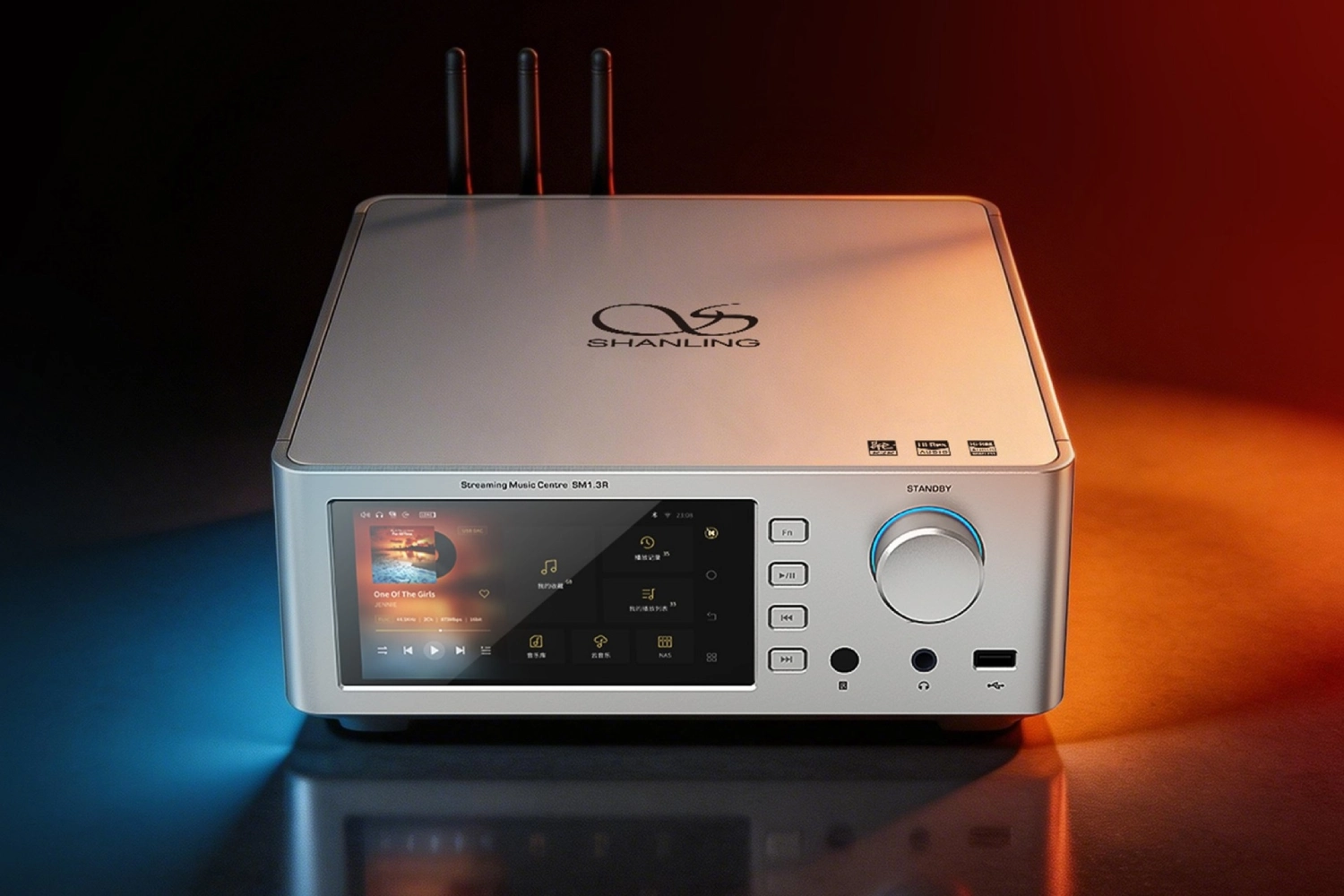
5. Shanling SM1.3R R2R DAC: A More Analog Take on Streaming with Roon, Tidal & Qobuz
Shanling SM1.3R streaming DAC with touchscreen interface, R2R conversion, and built-in streaming services.
The Shanling SM1.3R is a streaming DAC that keeps the housing, 5.8-inch touchscreen, Android-based platform, and connectivity approach of the SM1.3 while changing the core conversion architecture to a proprietary 24-bit R2R module.
Shanling describes this R2R version as offering a more analog representation than the earlier delta-sigma design.
Its streaming feature set is extensive within the supplied source: it is Roon Ready, includes Tidal Connect, Qobuz Connect, and Spotify Connect, and also supports separate apps for services including Apple Music, Apple Classic, and Amazon Music. The closed Android build is worth noting because it does not allow sideloading or Google Play Store installation.
Best for: Streaming-focused systems that need an integrated R2R DAC
- Proprietary 24-bit R2R DAC module
- 5.8-inch touchscreen
- Roon Ready with Tidal Connect, Qobuz Connect, and Spotify Connect
- Internal SSD slot for local playback
Verdict: The Shanling SM1.3R is for listeners who want a streaming DAC built around R2R conversion rather than a separate streamer and converter.

6. QUESTYLE CMA Eighteen Master: Flagship DAC and headphone amplifier
QUESTYLE CMA Eighteen Master flagship DAC and headphone amplifier with USB and Bluetooth connectivity.
The QUESTYLE CMA Eighteen Master is presented as a flagship DAC and headphone amplifier built around Questyle’s current-mode amplification approach.
Its digital section uses an upgraded XMOS XU316 USB platform and supports conversion up to PCM768 at 32-bit and DSD512.
Connectivity includes both USB-B and USB-C interfaces, while Bluetooth has been updated with aptX-HD and LDAC support. For buyers considering a serious desktop DAC/headphone amplifier, the important distinction is that this is not only a converter; it is part of Questyle’s current-mode DAC and amplification ecosystem.
Best for: High-end desktop headphone systems with wired and wireless sources
- Current-mode amplification technology
- XMOS XU316 USB platform
- PCM768 at 32-bit and DSD512 support
- USB-B, USB-C, aptX-HD, and LDAC
Verdict: The CMA Eighteen Master is the Questyle option for users who want a flagship DAC/headphone amplifier with current-mode amplification and broad modern input support.

7. SMSL RAW Pro-DAC1: Tailored for audiophiles
SMSL RAW Pro-DAC1 standalone DAC with multiple digital inputs and balanced XLR output connectivity.
The SMSL RAW Pro-DAC1 is a feature-rich standalone DAC based on the ESS ES9039MSPRO chip.
It supports MQA and MQA-CD playback through USB, optical, and coaxial inputs, and its XMOS XU-316 USB solution handles 32-bit audio, DoP, and native DSD formats, with PCM up to 768 kHz and DSD up to DSD512.
The connectivity list is unusually broad in the supplied material: USB, optical, coaxial, Bluetooth, and AES/EBU inputs, with balanced XLR and unbalanced RCA outputs. The source also notes low-noise crystal oscillators, an enhanced clock circuit, and a specialized low-noise source for the analogue circuitry.
Best for: Systems that need a flexible standalone DAC with balanced outputs
- ESS ES9039MSPRO DAC chip
- USB, optical, coaxial, Bluetooth, and AES/EBU inputs
- Balanced XLR and unbalanced RCA outputs
- PCM up to 768 kHz and DSD up to DSD512
Verdict: The SMSL RAW Pro-DAC1 is a strong fit for listeners who want broad digital input support, XLR and RCA outputs, and high-resolution format handling in one DAC.
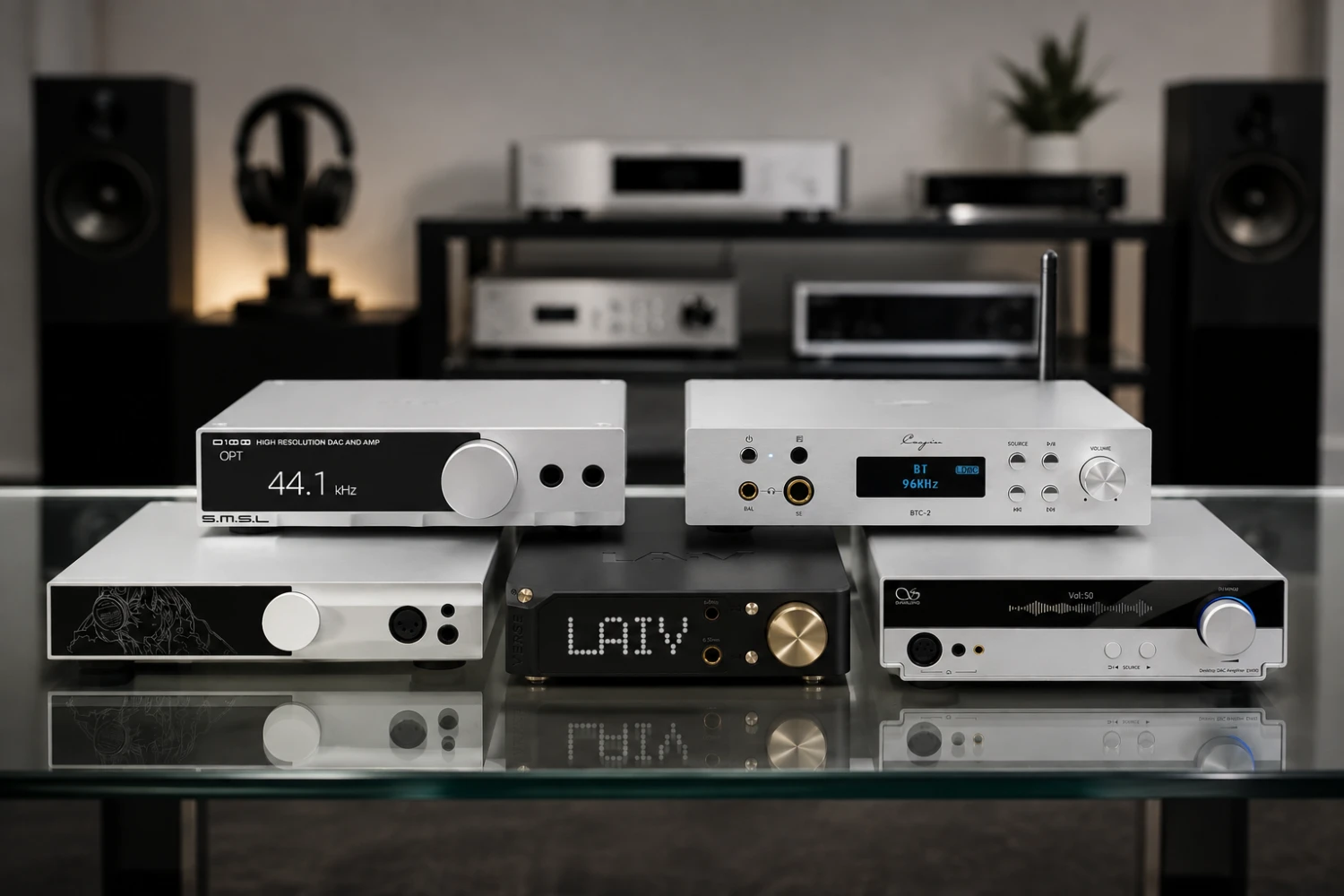
8. Best Headphone DAC/Amps in: 7 Desktop Models Worth Considering
A desktop headphone DAC/amp guide covering compact units, balanced headphone outputs, and modern digital input options.
This headphone DAC/amp guide is valuable for DAC buyers because it focuses on the modern desktop all-in-one category, where USB audio, balanced headphone outputs, Bluetooth, preamp functions, and digital processing can sit in one chassis.
The source describes a market that includes both conventional delta-sigma DACs and increasingly common R2R ladder converters, along with units powerful enough for demanding headphones.
One concrete example in the excerpt is the SMSL D100, a compact model with USB-C, optical and coaxial inputs, 6.35 millimeter and balanced 4.4 millimeter headphone outputs, and an ESS ES9081 DAC.
Best for: Desktop headphone listeners comparing all-in-one DAC/amp units
- Covers seven desktop DAC/headphone amplifier models
- Addresses USB audio, balanced outputs, Bluetooth, and preamp functions
- Includes both delta-sigma and R2R approaches
- Useful for headphone-first desktop systems
Verdict: This guide is most useful for readers whose DAC purchase is tied directly to headphone amplification and desktop space requirements.

9. HiFi Rose RD160: High-end streaming DAC priced at $5,295 launched
HiFi Rose RD160 external DAC with fully balanced dual-mono architecture and separated power-supply design.
The HiFi Rose RD160 is a high-end external DAC built around a fully balanced architecture and dual-mono principles.
The source describes separate power supplies for different areas of the component, including three linear power supplies for the digital section and the left and right analogue amplification channels.
HiFi Rose also highlights proprietary technologies: ROSE DPC synchronizes the digital stream at the DAC input using a high-precision OCXO clock generator, ROSE CIM isolates digital and analogue paths using separate DAC chips for each channel, and ROSE NRA is an analogue noise-reduction filter designed to maintain a flat frequency response even at low frequencies.
Best for: High-end systems needing a dedicated balanced DAC
- Fully balanced dual-mono architecture
- Three linear power supplies for separate sections
- OCXO-based ROSE DPC digital processing
- Isolated digital and analogue paths through ROSE CIM
Verdict: The HiFi Rose RD160 is the specialist high-end entry here, aimed at systems where power-supply separation, balanced architecture, and isolation are central priorities.

10. FiiO Warmer R2R: The Tube DAC That Blends Retro Warmth with Modern Precision
FiiO Warmer R2R tube DAC with analogue VU meters, R2R conversion, and RCA and XLR outputs.
The FiiO Warmer R2R combines tube output character, R2R conversion, and a retro visual presentation.
It uses four JJ Electronic E88CC tubes, a patented R2R architecture, and a toroidal transformer-based power supply.
Via USB, it supports PCM signals up to 32-bit/384 kHz, while RCA and XLR outputs broaden its use from desktop systems to more traditional hi-fi setups. The large analogue VU meters are not only decorative in the source description; they are presented as visual feedback elements, and the perforated rear cover is intended to aid heat dissipation around the tubes and power supply.
Best for: Listeners who want an R2R DAC with tube character and analogue styling
- R2R DAC architecture with four JJ Electronic E88CC tubes
- Toroidal transformer-based power supply
- USB PCM support up to 32-bit/384 kHz
- RCA and XLR outputs
Verdict: The FiiO Warmer R2R is the most characterful option in this selection, pairing R2R conversion with tubes, VU meters, and both RCA and XLR outputs.
How to choose the right DAC from this shortlist
Start by deciding what the DAC must physically connect to.
If the main source is a desktop computer and the same box must drive headphones and active speakers, a USB-C DAC/headphone amplifier such as the iFi Zen Dac 3 or Shanling H0 is easier to justify than a dedicated DAC with no headphone stage.
If headphones are the priority and the system may expand later, the Questyle CMA Eighteen Master and the headphone DAC/amp comparison article point toward fuller desktop solutions with more emphasis on amplification, balanced outputs, and control features. For a conventional hi-fi system, output type matters as much as digital format support. The SMSL RAW Pro-DAC1 offers balanced XLR and unbalanced RCA outputs with a wide input set, while the HiFi Rose RD160 takes a more elaborate high-end route with dual-mono architecture, isolated paths, and separated linear power supplies. If the goal is to feed an existing amplifier rather than power headphones, these dedicated DAC approaches deserve closer attention than portable DAC/amps. Listeners specifically interested in R2R conversion have several distinct routes. The HeartField R1 is the lightweight portable R2R option, the Shanling SM1.3R adds R2R conversion to a streaming DAC platform, and the FiiO Warmer R2R combines R2R architecture with tubes, VU meters, RCA, and XLR outputs. These are not interchangeable products, even though they share the R2R label. One is for mobile USB use, one is for streaming-centered systems, and one is for listeners who want a tube-equipped DAC in a desktop or hi-fi context. Avoid choosing by the largest format number alone. High PCM and DSD support can be useful, but the practical decision is usually simpler: USB-C or USB-B, balanced or RCA output, headphone amplifier or pure DAC, streaming platform or external source, compact body or full-size component. Matching those basics to the system will do more to prevent a poor purchase than chasing the most impressive specification on the page.


Sound Off
0Join the discussion if you have something to add.