Luxman MQ-300 Product Spotlight: A Focused 300B Amplifier with Classic Intent
The Luxman MQ-300 is a carefully focused stereo 300B tube power amplifier that combines heritage-inspired industrial design with modern parts choices, including Takatsuki TA-300B output tubes and a zero-feedback single-ended circuit.
The Luxman MQ-300 is not trying to be an all-purpose power amplifier. Its appeal lies in how deliberately it narrows the brief: a stereo single-ended 300B design, built around a classic tube architecture, presented in a chassis that openly acknowledges Luxman’s own amplifier history. For prospective owners, that focus is part of the attraction. This is an amplifier for systems where loudspeaker sensitivity, room size, listening priorities, and visual presence are considered together. Its 8-watt-per-channel output will not suit every loudspeaker, but the MQ-300’s documented design choices make clear what Luxman is aiming for: a carefully executed, heritage-aware tube amplifier for listeners who value simplicity of circuit concept, premium valve selection, and a tactile connection to traditional high-end audio.
A design language rooted in Luxman history
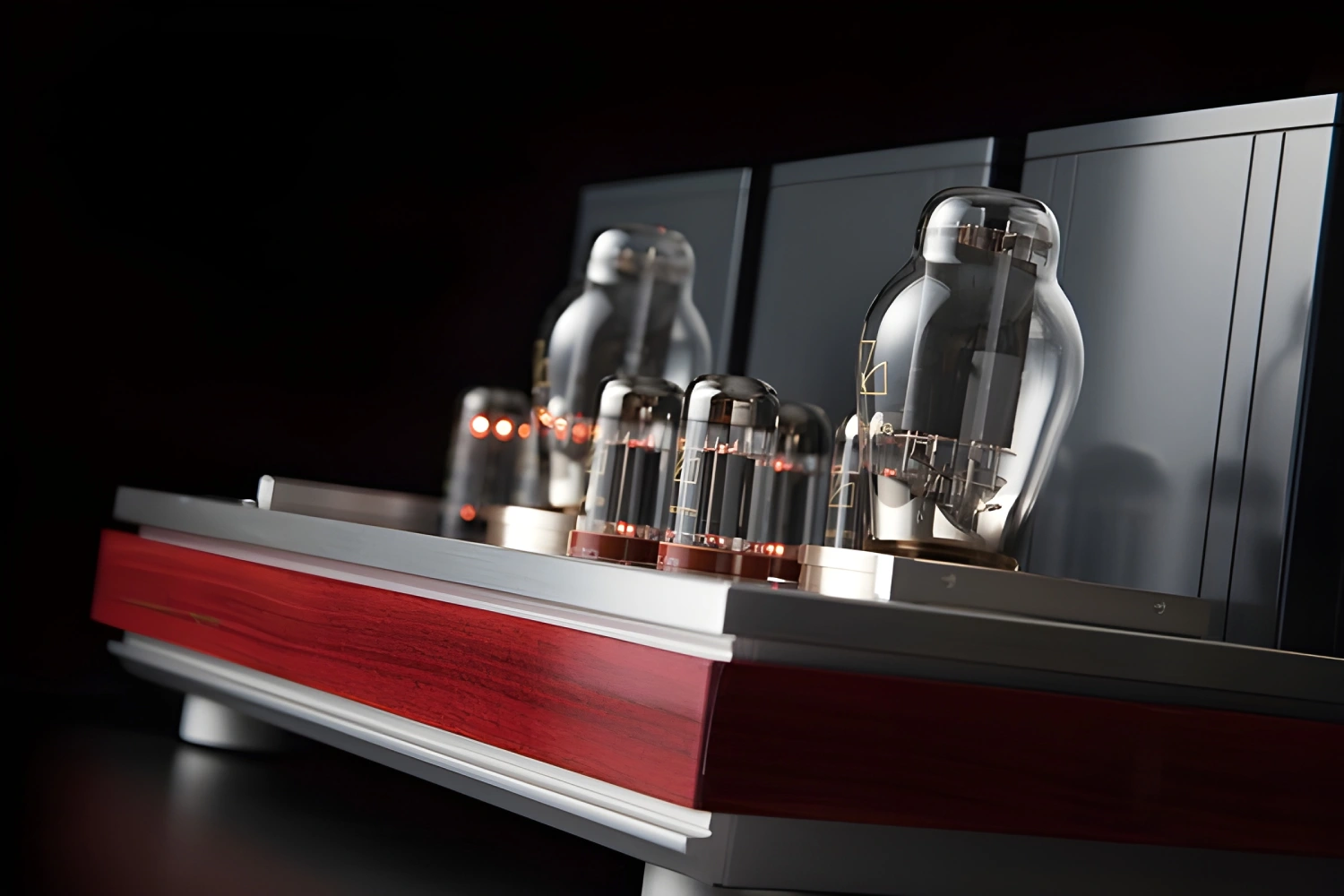
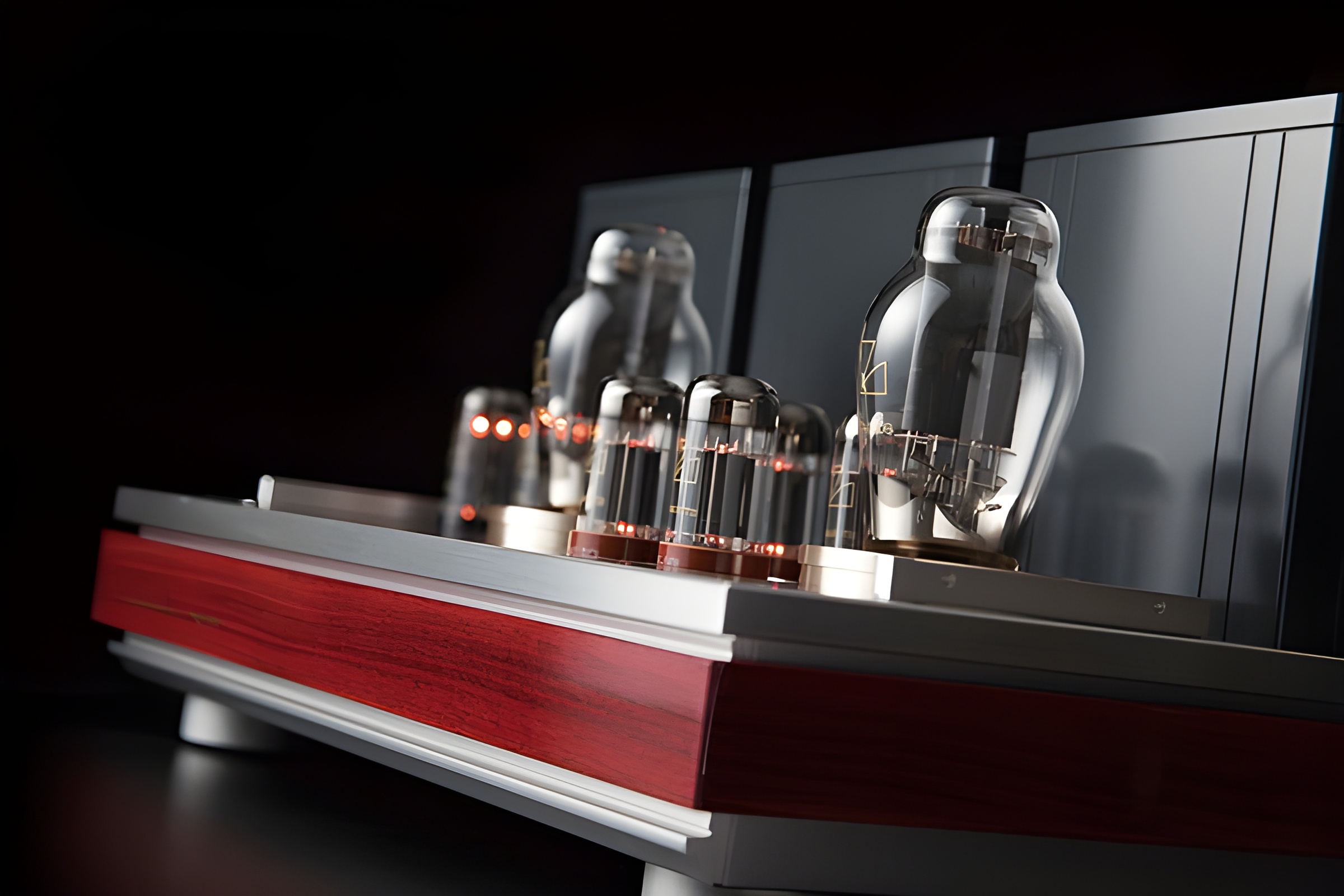
The MQ-300’s exterior is one of its most immediately distinctive qualities. Luxman has drawn on the visual character of its late-1970s and 1980s tube amplifiers, particularly the MB-300 monoblocks, without disguising the MQ-300 as an untouched vintage product. The natural walnut frame, exposed transformer layout, proportions, and transformer-plate detailing all contribute to an amplifier that looks intentionally mechanical and architectural rather than anonymous.
That matters because tube amplifiers are often objects owners live with visibly, not components hidden away in a rack. The exposed valves and transformers are part of the ownership experience, and the walnut surround softens the technical appearance without making the unit look ornamental. At 46 cm wide, 23.7 cm high, 34 cm deep, and 29 kg, the MQ-300 also has the physical seriousness expected of a transformer-coupled tube power amplifier. It is compact enough to be a single stereo chassis, yet substantial enough to signal that its output transformers and power supply are central to the design.

A modern 300B implementation
The defining device in the MQ-300 is the 300B output tube. Luxman specifies a pair of Takatsuki Electric TA-300B valves, one of the most notable current-production 300B types. This is an important choice because it avoids reliance on scarce vintage valves while giving the amplifier a premium contemporary tube foundation. For an owner, that makes the MQ-300 feel less like a nostalgic exercise and more like a current product built around a still-relevant valve technology.
The rest of the tube complement is also clearly documented: four Tung-Sol 6SN7GTB tubes serve in the driver stage, while two Sovtek 5AR4 rectifier tubes are used in the power supply. This tube lineup gives the MQ-300 a traditional all-valve signal and rectification architecture, which will appeal to buyers who want the amplifier’s behavior to be shaped by valves throughout key parts of the circuit rather than by a hybridized approach.

Single-ended, zero-feedback simplicity
Luxman’s circuit choices show that the MQ-300 is aimed at a specific kind of high-end system. It is a stereo single-ended amplifier using a zero-feedback circuit. In practical terms, that points to a design philosophy that values circuit directness and the intrinsic behavior of the 300B tube rather than using negative feedback as a central corrective tool. This does not make the amplifier universally better or automatically compatible with every loudspeaker, but it does define its character as a focused triode amplifier.
The amplifier also uses cathode biasing and a DC heater ignition system. In a directly heated triode amplifier, the heater supply is not a trivial detail; it is part of the engineering challenge. Luxman’s use of DC heater ignition reflects attention to the operating conditions around the 300B valves. The published signal-to-noise ratio of 105 dB and total harmonic distortion figure of 1% provide additional context for the design, though they should be understood alongside the amplifier’s intended use rather than as isolated claims of superiority.

Eight watts that require thoughtful system matching
The MQ-300 is rated at 8 watts per channel in stereo operation. That number is central to understanding the product. It is not built for difficult, low-sensitivity loudspeakers or for listeners who expect high output levels in large spaces. Instead, it is intended for carefully matched systems, typically involving higher-sensitivity speakers and owners who understand the trade-offs of low-power single-ended amplification.
Luxman provides output impedance taps for 4, 8, and 16 ohms, which gives the amplifier useful flexibility with different loudspeaker nominal impedances. This is especially relevant in the world of high-sensitivity speakers, where designs can vary widely, including conventional dynamic models and more specialized horn-loaded systems. The 240 kΩ input impedance and 490 mV input sensitivity suggest that the MQ-300 should be approachable for a range of preamplifiers, though, as with any power amplifier, final system compatibility depends on the full chain.

Why the stereo chassis matters
Historically, many serious 300B amplifiers have been configured as monoblocks, but the MQ-300 is a stereo power amplifier. That choice has several practical attractions. It reduces the number of chassis, power cords, and support surfaces required, and it gives the owner a more consolidated installation without abandoning the classic exposed-tube layout. For those building a refined but not sprawling system, that matters.
A stereo 300B amplifier also makes the MQ-300 easier to integrate visually. Rather than placing two separate amplifiers beside or behind loudspeakers, the owner can position one substantial component on an equipment rack or dedicated platform. Because the amplifier weighs 29 kg, furniture and ventilation still need proper attention. The exposed valves also mean clearance and airflow are not optional details. But as a single-chassis solution, the MQ-300 offers a more streamlined route into Luxman’s 300B concept.
A product for a particular listener
The MQ-300 will make the most sense for listeners who already know why they want a 300B amplifier, or who are building a system around the strengths and limitations of low-power tube amplification. It is especially relevant for owners of suitable high-sensitivity loudspeakers, listeners who prioritize small-ensemble music, vocals, acoustic recordings, or moderate listening levels, and those who value an amplifier as both an engineering object and a visible part of the room.
It is less suitable for users who need large power reserves, drive very inefficient speakers, expect one amplifier to work in any system, or want extensive modern connectivity features built into the power amp itself. The MQ-300 is not a networked component, an integrated amplifier, or a feature-heavy hub. Its proposition is more traditional and more specialized: accept the requirements of a single-ended 300B design, and in return gain a product built with a clear, coherent purpose.
Market position and lasting appeal
Luxman’s broader identity gives the MQ-300 additional context. The company was founded in 1925, and the MQ-300 reflects a brand comfortable drawing from its own archive rather than chasing every contemporary format trend. The amplifier’s appeal is not based on novelty alone. It is based on continuity: classic visual cues, a tube type with deep high-end audio associations, and a modern execution using current-production Takatsuki output valves.
That combination may be particularly attractive to buyers who want a new amplifier with the atmosphere of a historic design, but not the maintenance uncertainty of a vintage unit. The MQ-300’s documented specifications, tube complement, output taps, and physical construction all support the impression of a product designed for long-term system building rather than casual experimentation.
Conclusion
The Luxman MQ-300 stands out because it is so clearly defined. Its strongest documented qualities are its heritage-informed walnut-and-transformer design, its use of Takatsuki TA-300B output tubes, its zero-feedback single-ended circuit, and its practical 4-, 8-, and 16-ohm speaker taps. With 8 watts per channel, it is not a universal amplifier, and it asks for thoughtful loudspeaker matching. For the right owner, however, that focus is exactly the point: the MQ-300 is best suited to listeners building a deliberate high-sensitivity system around the enduring appeal of a carefully executed 300B tube amplifier.