HiFiMuse B5: A Compact Desktop Amplifier Built for Modern Sources
The HiFiMuse B5 is a small integrated amplifier for desktop audio systems, combining a DAC, Bluetooth 5.0, USB storage playback, tone controls, remote volume adjustment, and multiple wired inputs in a compact black chassis.

The HiFiMuse B5 is aimed at one of the most practical corners of hi-fi: the compact desktop system. Rather than treating a computer desk, office shelf, or small home setup as an afterthought, it brings together several functions that are often split across separate boxes. It is an amplifier for passive speakers, a digital-to-analog converter for optical and coaxial sources, a Bluetooth receiver, and a USB audio file player, all in a chassis measuring 110 x 135 x 30 mm. That combination makes the B5 interesting not because it chases complexity, but because it addresses the everyday problem of connecting many sources to a pair of speakers without filling the desk with hardware.
A compact amplifier designed around desktop systems
The defining feature of the HiFiMuse B5 is its format. At 110 mm wide, 135 mm deep, and 30 mm tall, it is built for spaces where full-size hi-fi components would be impractical. A desktop audio system often has to share room with a monitor, keyboard, laptop stand, documents, or office accessories. In that environment, a small amplifier can be more useful than a conventional integrated amp, provided it still offers enough connectivity and control.
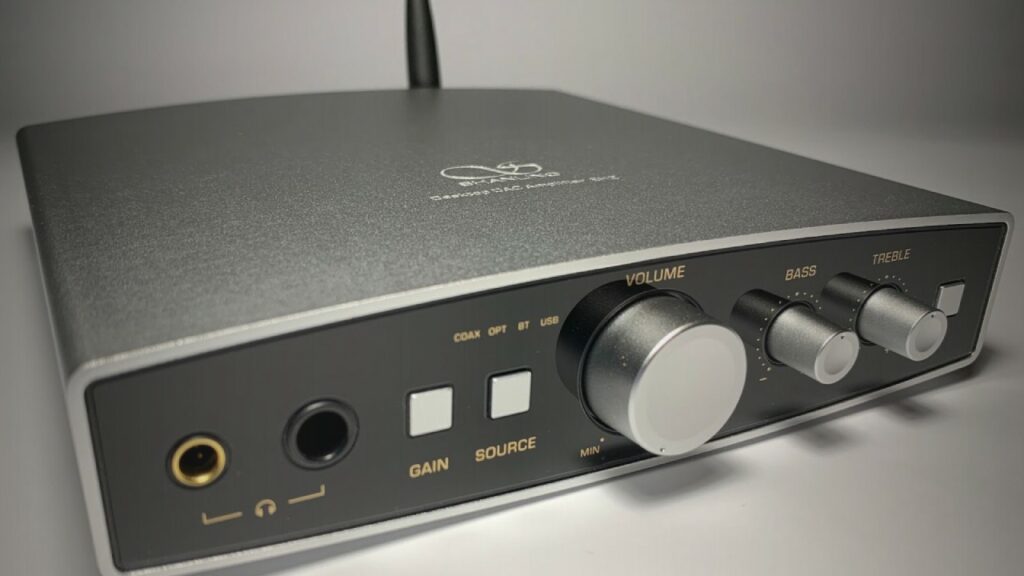
The B5’s black finish and restrained front-panel layout support that role. The design is described as strict and compact, with a clear display on the front showing the current operating mode. That matters in daily use because a multi-input amplifier can quickly become frustrating if the user has to guess which source is active. A simple display gives the unit a more appliance-like quality: switch from Bluetooth to optical, USB, coaxial, RCA, or computer decoding, and the selected mode is visible rather than hidden.
The main rotary control also reflects this compact approach. It handles volume adjustment through a potentiometer and doubles as an operating-mode switch when pressed. The B5 also supports volume control via remote control, along with standby mode. For a desktop amplifier, this mix of direct physical control and remote convenience is sensible. The knob gives immediate access when the unit is within arm’s reach, while remote operation helps when the amplifier is used on a shelf, with a TV, or in a small room rather than directly beside a keyboard.
Built-in DAC for optical, coaxial, and computer sources
A central part of the B5’s appeal is that it includes digital conversion rather than relying only on analog inputs. Its optical and coaxial decoding are handled by an ESS9018K2M DAC, with support for digital signals up to 32-bit/192 kHz through those inputs. That makes the amplifier suitable for common digital source components such as TVs, CD players with digital outputs, computers, and other devices that can provide optical or coaxial audio.
The benefit of having optical and coaxial inputs in a compact amplifier is flexibility. A television can be connected digitally without using its headphone output. A CD player can be used as a transport if it has a digital output. A computer-based setup can also be simplified, depending on the connection path chosen. In each case, the B5 becomes the point where digital sources are converted and amplified for passive speakers.
The source information also lists computer decoding among the B5’s functions, alongside USB, optical, coaxial, RCA, and AUX 3.5 mm connectivity. This positions the amplifier as a hub for mixed digital and analog systems. For users who move between work audio, streaming from a computer, physical media, and occasional TV sound, the DAC section is not merely an add-on; it is what allows the B5 to reduce the number of separate devices needed on the desk.
Bluetooth 5.0 and USB playback add source flexibility
The B5 includes Bluetooth 5.0 with an ATS2825 decoding chip. The supplied specification describes this chip as supporting noise and echo suppression, with stable signal transmission and minimal loss of quality. Bluetooth is especially useful in a desktop or office system because it allows quick playback from a smartphone, tablet, or laptop without requiring a cable change. It also makes the amplifier accessible to guests or shared users who may not want to reconfigure a wired source.
The ATS2825 chip is also listed for USB decoding, and the B5 can play audio files directly from USB storage. Supported USB file formats include WAV, APE, FLAC, and MP3. This is a practical feature for listeners who keep a curated folder of music files on a USB drive and want playback without turning on a computer or connecting a separate streamer. It is not a substitute for every modern network-audio feature, and no network streaming platform support is specified, but direct USB playback gives the amplifier another independent source option.
The sampling rate specification is different depending on the input. Optical and coaxial inputs are listed up to 32-bit/192 kHz, while USB and Bluetooth are listed at 16-bit/48 kHz. That distinction is important for system planning. A user who specifically wants to feed higher-resolution digital signals should look to the optical or coaxial inputs, while USB storage and Bluetooth serve more as convenience-oriented playback paths. The advantage is not that every input does the same job, but that each one gives the B5 a different way to fit into a real-world system.

Amplifier architecture and speaker matching
The power amplifier stage is built around two TPA3116 chips, one for each channel. The headline output is specified as up to 150 W per channel, and the source material indicates that the amplifier is intended to drive even larger bookshelf speaker systems with 6- to 8-inch drivers. For a compact chassis, that emphasis on passive speaker drive is central to the B5’s identity: it is not just a DAC or Bluetooth receiver, but a complete compact amplifier for speaker-based listening.
The detailed power information also shows that output depends on voltage and load. With a 19 V supply, output is listed at 32 W into 8 ohms and more than 45 + 45 W into 4 ohms. With a 24 V supply, the figures are 38 W into 8 ohms and more than 55 + 55 W into 4 ohms. The listed power adapter is 24 V/3 A, and the power supply range is 12–24 V. These details are useful because they show the B5’s performance is linked to its operating voltage and speaker impedance, as is common with compact Class D amplifier designs.
Other listed specifications include total harmonic distortion of 0.001%, a signal-to-noise ratio of 92 dB, a frequency range of 15 Hz to 25 kHz, and input sensitivity of 500 mV. These figures give prospective owners a clearer view of the amplifier’s intended technical envelope, though they should not be treated as a substitute for system matching. As with any compact amplifier, speaker sensitivity, room size, listening distance, and desired playback level will all influence whether it is the right fit.
Controls that suit everyday listening
The B5 includes features that are easy to overlook but important in daily operation. Bass and treble adjustment are listed, giving users a degree of tonal control at the amplifier itself. In a desktop environment, speakers are often placed close to walls, on shelves, or at non-ideal angles. Basic tone controls can help adapt the sound balance to placement and preference without requiring software EQ on every source device.
The presence of USB source selection, standby mode, front-panel display feedback, a physical volume knob, and remote volume adjustment suggests an amplifier designed for routine switching rather than a single fixed connection. Many compact systems now serve several roles: computer audio during the day, Bluetooth music in the evening, TV sound in a small room, or USB playback when the main computer is off. The B5’s control scheme appears built around that multi-role use case.
Analog input support also broadens the range of sources. RCA and AUX 3.5 mm inputs allow older devices, portable players, DACs, or analog outputs from computers and televisions to be connected. While the digital inputs are a major part of the design, these analog connections prevent the B5 from being locked into only modern digital equipment. That is valuable for anyone building a compact system from a mix of existing components.

Who the HiFiMuse B5 is best suited for
The HiFiMuse B5 is most suitable for listeners who want a small, practical amplifier to sit at the center of a desktop or compact home audio setup. It makes the most sense for users with passive bookshelf speakers who need multiple input options in one box: Bluetooth for phones and tablets, optical or coaxial for digital sources, RCA or AUX for analog components, and USB storage playback for direct file listening.
It also suits people who want a cleaner desk or simpler office system. Instead of using a separate DAC, Bluetooth receiver, USB player, and amplifier, the B5 gathers those functions into one compact unit. The front display, remote volume adjustment, tone controls, and standby mode are all useful for a system that may be used throughout the day by different sources.
It may be less suitable for buyers who need network streaming, app-based multiroom audio, built-in phono input, headphone amplification, or extensive home-theater integration, because those features are not specified. It is also not aimed at users who require a full-size amplifier with numerous line-level inputs or balanced connections. Its strengths are compactness, broad everyday connectivity, and passive speaker drive in a small desktop-friendly package.
Conclusion
The HiFiMuse B5 stands out as a compact integrated amplifier that combines several useful functions for modern small-space audio: ESS9018K2M-based optical and coaxial digital conversion up to 32-bit/192 kHz, Bluetooth 5.0, USB storage playback, RCA and AUX inputs, tone adjustment, remote volume control, and a dual-TPA3116 amplifier stage for passive speakers. Its strongest documented qualities are not extravagance or complexity, but convenience, input flexibility, and a form factor suited to desks, offices, and compact home systems. For listeners who want to connect computers, TVs, mobile devices, CD players, USB drives, and analog sources to a pair of bookshelf speakers without assembling multiple separate components, the B5 offers a focused and space-conscious solution.