

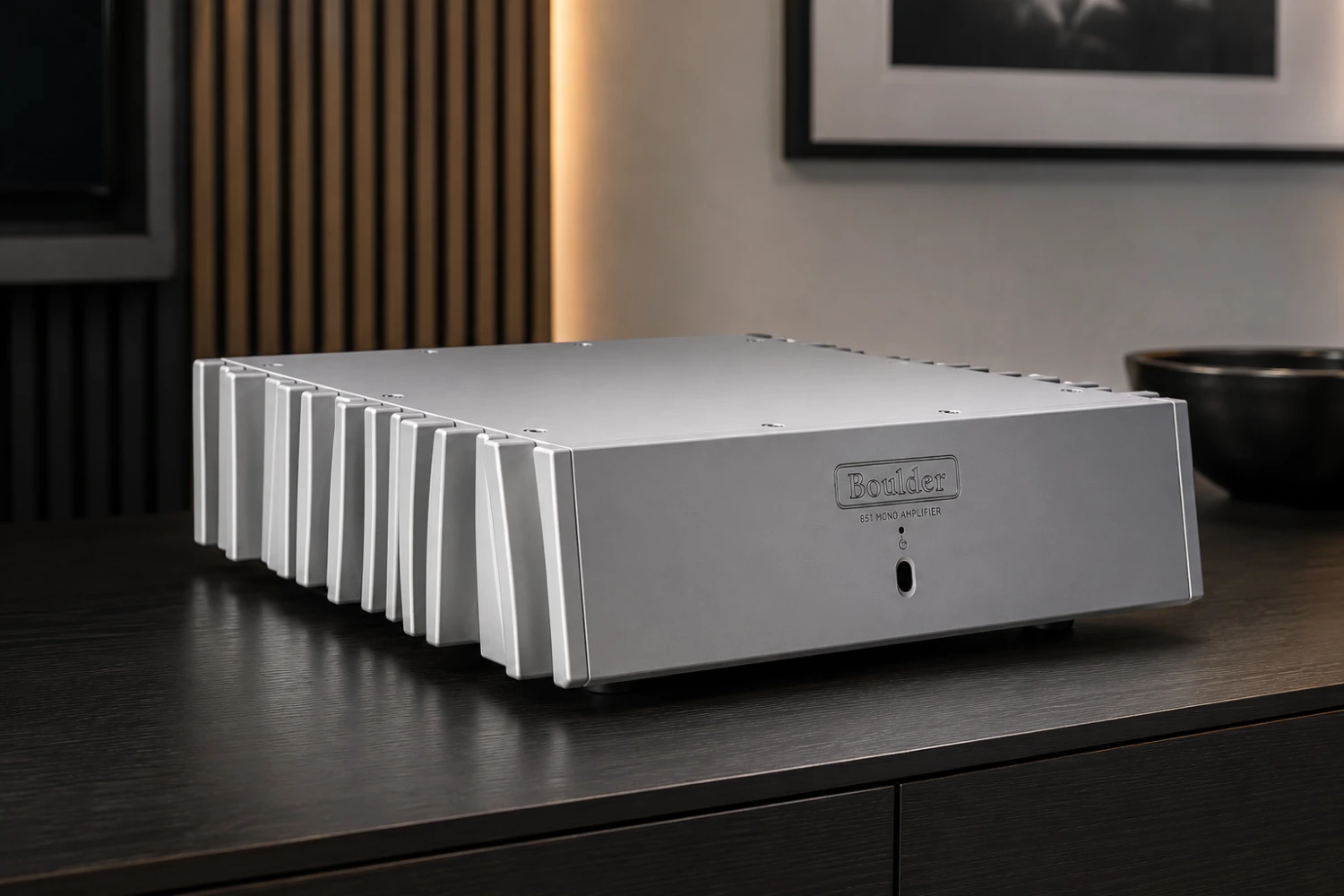
Boulder’s 800 Series has become the company’s more compact route into its high-end electronics, and the 851 monoblock power amplifier and 808 MM/MC phono preamplifier broaden that idea in two important directions. One addresses loudspeaker drive through a single-channel power amplifier derived from the engineering of the 861 stereo amplifier. The other serves vinyl playback with a balanced phono stage designed to sit between Boulder’s 508 and 1108 models. Together, they show how the 800 Series is being developed as a full system platform rather than a single-component range. The attraction is not simply that the products are smaller than Boulder’s upper-tier electronics. It is that they preserve key design priorities—balanced signal handling, rigid machined chassis construction, careful noise control, and system-level consistency—in dimensions that are easier to accommodate in modern listening rooms.
A compact 800 Series system approach
The 851 and 808 are designed to match the dimensions and visual language of existing 800 Series components, including the 812 DAC Preamplifier. That matters for owners building a system one piece at a time. Matching chassis proportions and styling reduce the practical friction of adding components: equipment racks can be planned more predictably, cable routing becomes more orderly, and the system has a cohesive appearance rather than looking like a collection of unrelated boxes.
This compactness is not presented as a lifestyle compromise. The 851 measures 30.5 × 30.5 × 8.9 cm and weighs about 10 kg, which is modest by high-end power-amplifier standards, especially for a monoblock. The 808 follows the same 800 Series chassis philosophy, using machined aluminum construction and attention to mechanical rigidity. For prospective owners, this combination of serious engineering and smaller physical footprint may be especially relevant where rack depth, ventilation space, or room aesthetics are real constraints.
Boulder 851: a single-channel amplifier with useful headroom
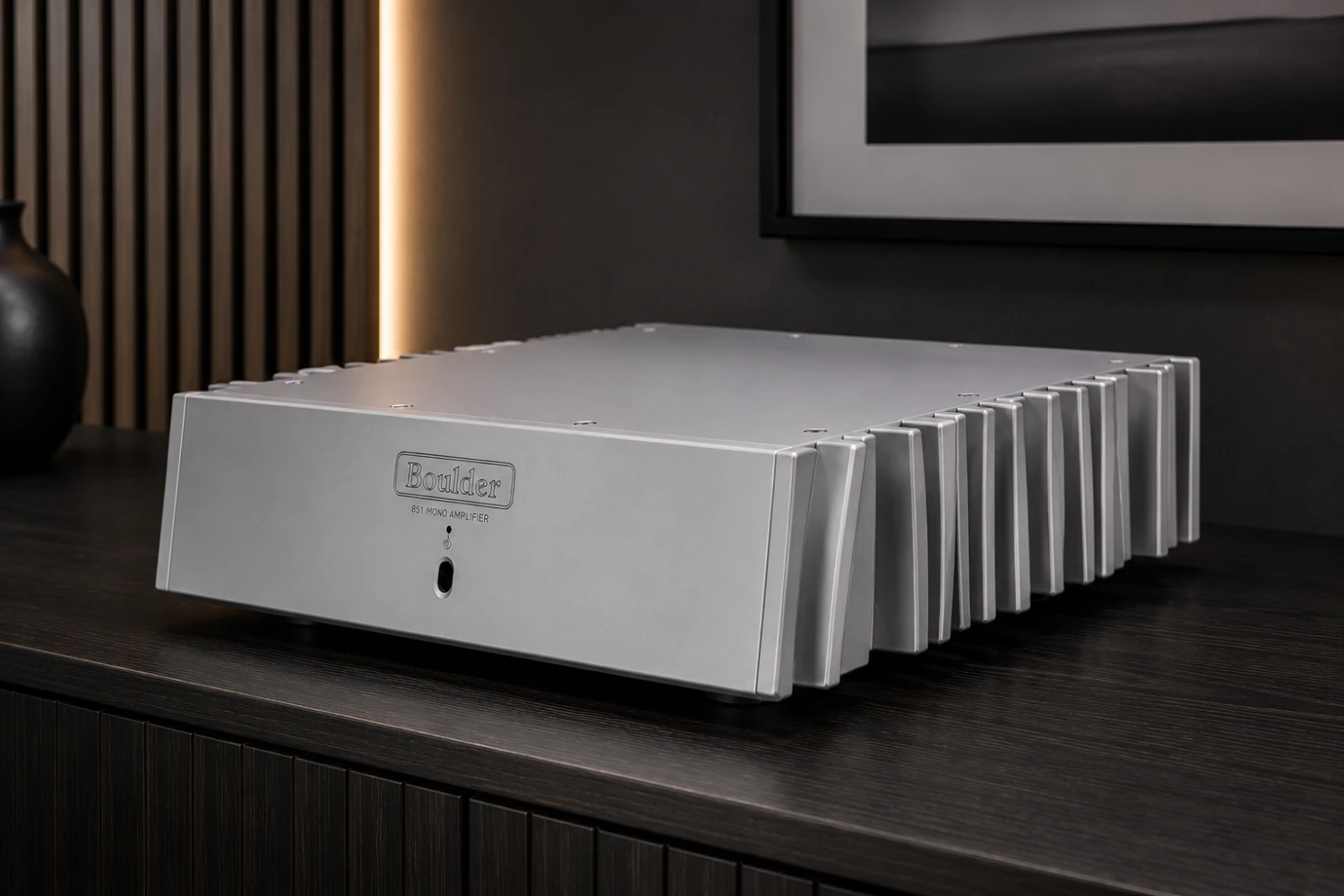
The Boulder 851 is a monoblock amplifier, meaning each unit powers one channel. This configuration has several practical attractions in a high-end system. Separating the left and right channels into individual chassis can simplify speaker-side placement, shorten speaker cable runs in some rooms, and give each channel its own dedicated amplifier structure. Boulder’s decision to bring this format to the 800 Series gives system builders an alternative to a stereo amplifier while retaining the compact 800 Series footprint.
The documented output figures are central to the 851’s appeal. Each amplifier is rated at 100 watts into 8 ohms and 200 watts into 4 ohms, with peak output of up to 350 watts into demanding 2-ohm speaker loads. The doubling from 8 to 4 ohms is the kind of specification prospective owners often look for when considering amplifiers for speakers whose impedance varies across the frequency range. It does not by itself describe sound quality, but it does indicate that the amplifier is designed with meaningful current delivery and load tolerance in mind. For loudspeakers that need control as impedance drops, that electrical behavior can be an important matching consideration.
Smart Current output stage and wide-bandwidth engineering
A notable technical development is the inclusion of Boulder’s Smart Current output stage, making the 851 the first amplifier in the 800 Series to use this architecture. The design is described as supporting wider bandwidth, lower distortion, and greater efficiency. These are not merely specification-sheet talking points. In an amplifier, output-stage behavior affects how the component manages signal demands, heat, and loudspeaker interaction. A more efficient and carefully controlled output architecture can be valuable when a manufacturer is trying to combine compact dimensions with demanding performance targets.
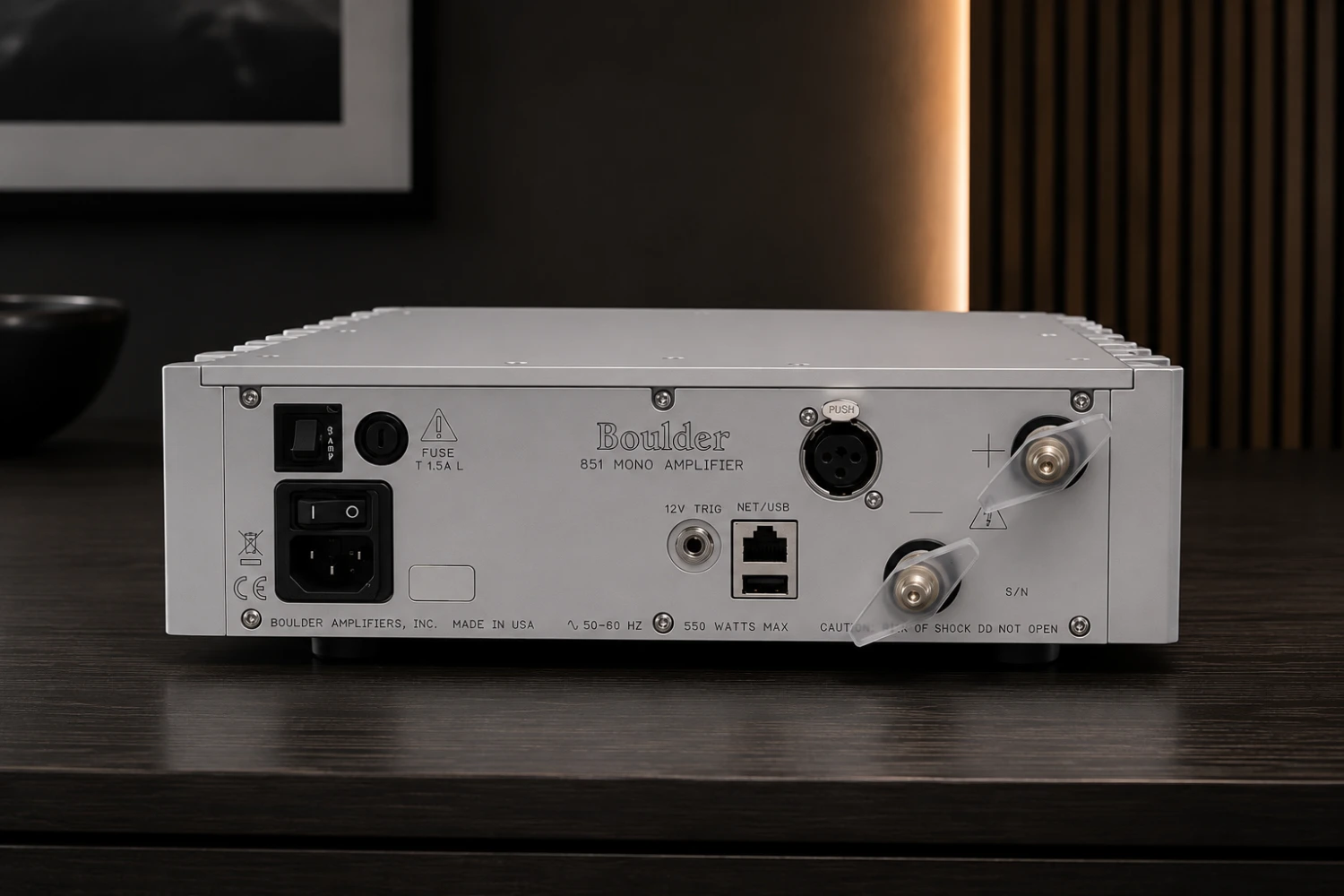
The 851’s published figures reinforce the wide-bandwidth emphasis. Total harmonic distortion is specified at 0.002%, and frequency response is listed from 0.015 Hz to 150 kHz at -3 dB. Prospective owners should not interpret bandwidth beyond the audible range as a direct promise of audible extension. Its relevance is more about engineering margin: a circuit designed to operate linearly across a very broad range may have less need to work near its limits within the audio band. The amplifier also includes fully balanced XLR connectivity, heavy-duty 6 mm speaker terminals, and an extensive protection system intended to safeguard both the amplifier and connected loudspeakers. Those details point to a component built for serious system integration rather than casual plug-and-play use.
Boulder 808: a phono stage for both MM and MC cartridges
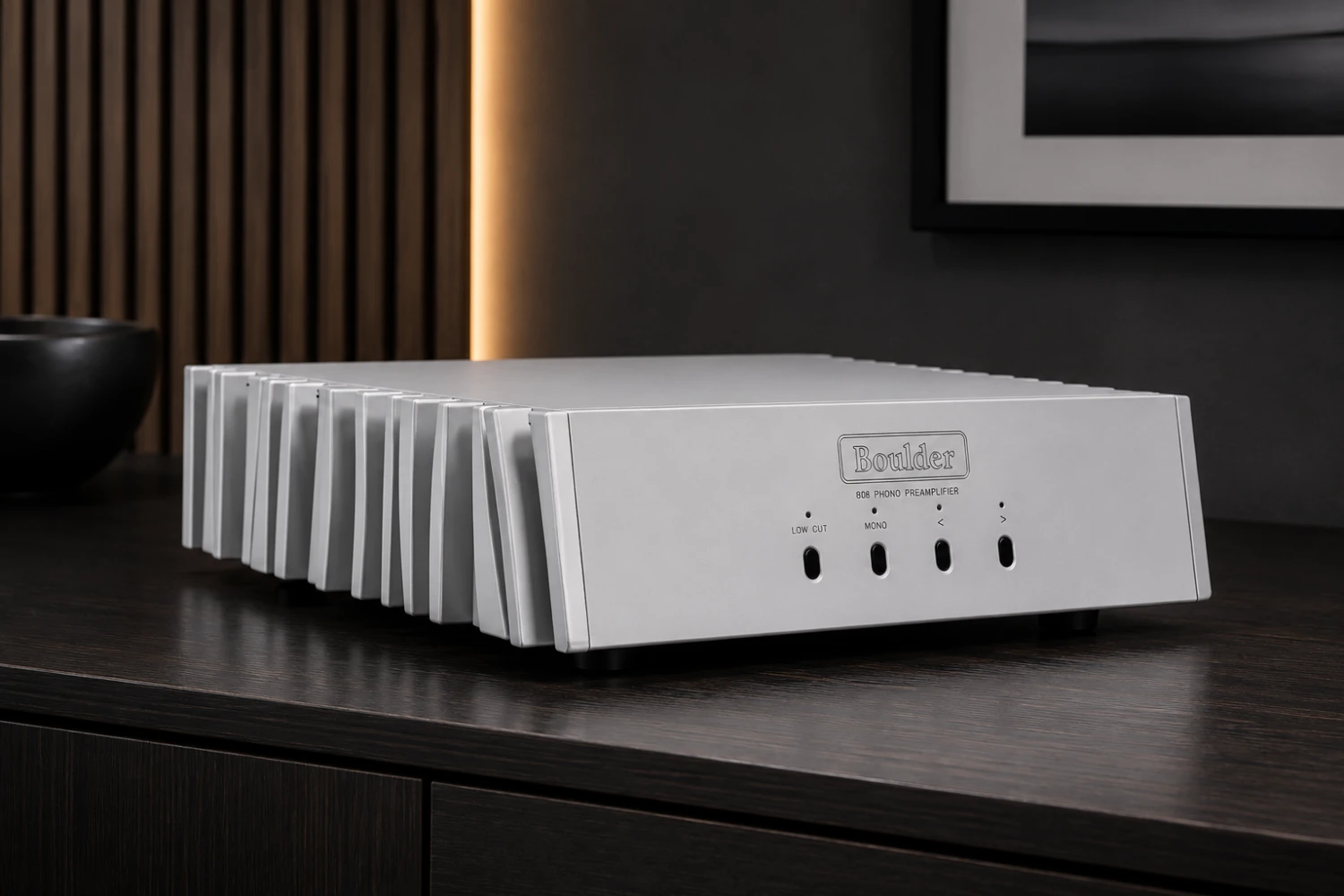
The 808 MM/MC phono preamplifier brings vinyl playback into the same compact 800 Series environment. Positioned between Boulder’s 508 and 1108 phono stages, it is aimed at listeners who want a more ambitious analog front end without moving into the company’s largest phono products. The design supports both moving magnet and moving coil cartridges, which immediately broadens its usefulness. A vinyl owner can use a conventional MM cartridge, a low-output MC cartridge, or potentially change cartridge types later without replacing the phono stage.
Gain is specified at 70 dB for moving coil cartridges and 44 dB for moving magnet cartridges. Those values indicate that the 808 is intended to support the very different output levels associated with the two cartridge families. Its frequency response is rated at 20 Hz to 20 kHz within ±0.25 dB, and total harmonic distortion is specified at 0.01%. In a phono preamplifier, low-level signal handling is especially critical because the cartridge output is tiny compared with line-level sources. Boulder’s stated attention to internal shielding, circuit layout, mechanical rigidity, and noise suppression is therefore directly relevant to the product’s purpose.
Balanced connectivity and cartridge loading flexibility
The 808 uses balanced XLR inputs and outputs throughout the signal path. Balanced connectivity can be particularly valuable in high-end systems where long cable runs, multiple components, or electrically noisy environments are involved. The benefit is not universal in every room or system, but for owners already using balanced preamplifiers or integrated system architectures, the 808’s connectivity helps keep the analog chain consistent.
One of the more distinctive features is Boulder’s Personality Card system for moving coil cartridge loading. Rather than relying only on front-panel switches or fixed internal settings, MC loading is configured using replaceable cards mounted on the rear panel. Loading values can be adjusted up to 1,000 ohms, while MM cartridges use the standard fixed 47 kOhm input impedance. This approach will likely appeal to vinyl users who care about cartridge matching and are comfortable treating loading as part of system setup. The inclusion of mono playback and a selectable low-pass filter adds further practical flexibility, especially for record collections that include mono pressings or discs where ultrasonic or high-frequency noise management may be useful.
Who the 851 and 808 are most suitable for
The 851 is best suited to systems where the owner wants the separation and channel-specific architecture of monoblock amplification but does not want very large amplifier chassis. It should be of particular interest to listeners already building around the Boulder 800 Series, or to those using loudspeakers that may benefit from an amplifier specified to double output into 4 ohms and remain stable into demanding 2-ohm loads. Its fully balanced input also makes most sense in systems where the upstream preamplifier can provide balanced output.
The 808 is most suitable for vinyl-focused systems that require support for both MM and MC cartridges and where cartridge matching is treated as an important part of setup. Its Personality Card loading system is more specialized than a basic phono input, so it will appeal most to owners who either already understand cartridge loading or are working with a dealer or installer who can optimize it. Conversely, listeners with very simple turntable needs, only one fixed MM cartridge, or no interest in balanced analog connectivity may not need the 808’s full feature set. Both products appear aimed at committed high-end users who want compact Boulder electronics without abandoning system-building flexibility.
Market position within the 800 Series
The 851 and 808 strengthen the 800 Series by filling important functional roles around the existing digital and preamplifier components. The 851 adds a dedicated monoblock option alongside the 861 stereo amplifier, while the 808 gives analog listeners a phono stage that sits above the 508 and below the 1108. This positioning is useful because high-end buyers often prefer to assemble systems within a coherent design family, especially when chassis size, balanced connectivity, and styling are consistent.
No USD price has been announced for either model, so their final value proposition will depend on pricing, dealer support, and how each product fits within an owner’s wider system plans. Even without that information, the documented design choices make their roles clear: the 851 is a compact, balanced, wide-bandwidth monoblock with serious load capability, while the 808 is a flexible, balanced phono preamplifier intended for both MM and MC cartridge users.
Conclusion
The Boulder 851 and 808 expand the 800 Series in ways that are practical as well as technical. The 851 brings monoblock amplification, Smart Current output-stage technology, balanced XLR input, substantial load tolerance, and a compact machined chassis to systems that need serious speaker drive without oversized hardware. The 808 complements it with balanced phono architecture, MM and MC support, configurable MC loading through Personality Cards, mono playback, and a selectable low-pass filter. Their strongest documented qualities are compact integration, balanced system design, flexible matching, and engineering continuity with Boulder’s larger products. They are best suited to committed high-end listeners building a space-conscious but ambitious system around the 800 Series, especially those who value careful loudspeaker matching, vinyl setup flexibility, and consistent component design.


Join the discussion
Share your thoughts, listening impressions or product experience.