Arcam AVR10: A Flexible AV Receiver Built Around Processing, Calibration, and System Growth
The Arcam AVR10 is positioned as a serious home-theater receiver for listeners who want modern surround processing, built-in amplification, room calibration, and room to expand into a larger immersive system.

The Arcam AVR10 is not simply an AV receiver with a long list of inputs. Its appeal lies in how it combines conventional receiver convenience with more ambitious surround processing and calibration features. With seven channels of built-in Class AB amplification, 12.1-channel processing, Dirac Live room correction, HDMI 2.0a connectivity, network playback, AirPlay 2, Chromecast, Bluetooth, and extensive preamp outputs, it is designed for a home cinema system that may begin as a powered receiver installation but later grow into something more elaborate. That flexibility is the most important part of the AVR10’s identity: it can serve as the central control point for speakers, video sources, streaming, radio, external amplifiers, and room tuning without forcing the owner into a single fixed configuration.
A receiver with processor-level ambitions
The headline distinction of the Arcam AVR10 is the difference between its amplification count and its processing capability. It includes seven channels of onboard amplification, rated at 60 W per channel into 8 ohms with all channels operating, and 85 W per channel into 4 ohms under the same stated distortion condition. At the same time, its processor section supports 12.1 channels, and the unit provides a 12-channel processor pre-output for use with external amplification.
This matters because immersive home theater systems often evolve. A user may begin with a 5.1.2 Dolby Atmos layout driven directly by the receiver’s internal amplifiers. That configuration can deliver front left and right, center, surrounds, subwoofer, and two height channels without adding separate power amplifiers. For a larger 7.1.4 arrangement, the AVR10’s processing can be used with additional amplification. In other words, the receiver is not limited by its seven speaker terminals in the same way a simpler seven-channel receiver might be.
That architecture gives the AVR10 a useful middle ground in system planning. It can behave like a conventional integrated AV receiver when simplicity is preferred, while also offering the preamp connectivity needed by owners who want to build a more complex multi-amplifier theater over time.
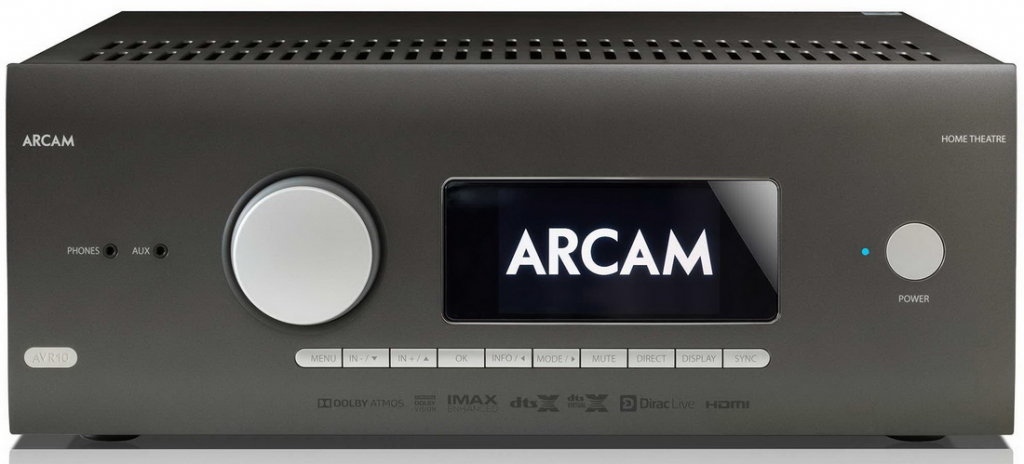
Immersive format support for modern cinema systems
The AVR10 is documented with support for Dolby Atmos and a broad selection of surround formats including Dolby Digital Plus, Dolby TrueHD, DTS-HD High Resolution Audio, DTS-HD Master Audio, DTS Neural:X, Auro-3D, and DTS:X. The source information notes that DTS:X access is enabled after a software update, which is worth keeping in mind for setup planning and firmware maintenance.
For prospective owners, the value is not just the presence of familiar codec names. Modern movie soundtracks can use object-based and height-channel formats to create a more enveloping presentation when the speaker layout supports it. The AVR10’s ability to process beyond seven channels is therefore significant. It gives the receiver relevance in installations that use ceiling, height, or elevation speakers, rather than restricting the system to a traditional horizontal surround layout.
The inclusion of IMAX Enhanced support also places the AVR10 within the ecosystem of receivers designed to handle current premium home-theater formats. As always, the practical benefit depends on source material, speaker layout, and configuration, but the receiver’s format support gives it the decoding foundation expected of a serious contemporary AV hub.
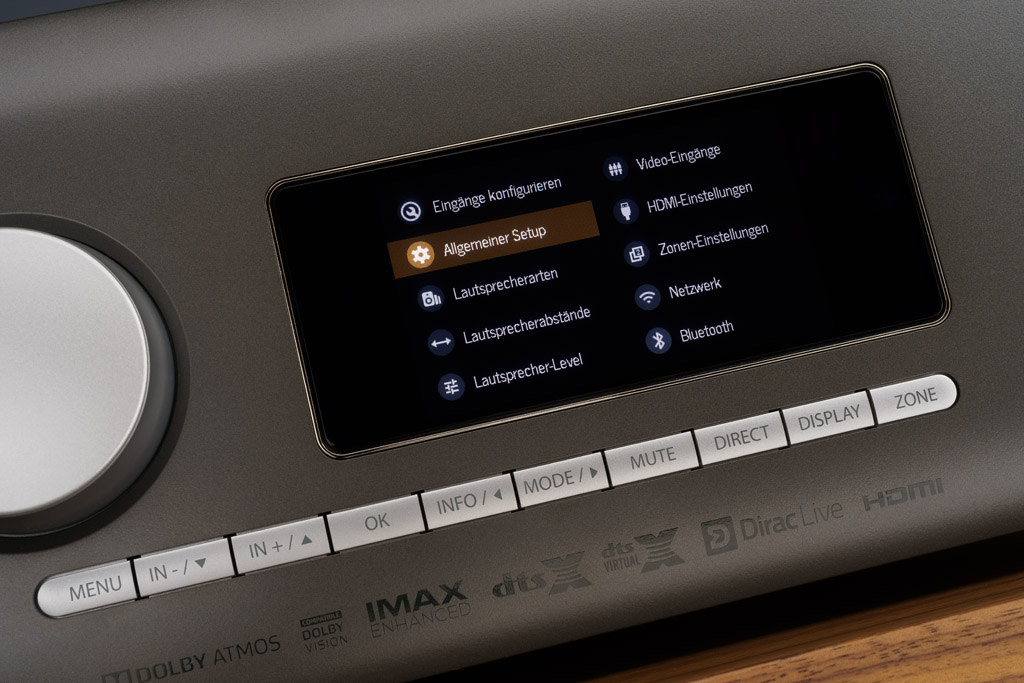
Dirac Live as a central design feature
Room correction is one of the AVR10’s most important documented capabilities. The receiver includes full 12-channel Dirac Live calibration, using measurements taken with a microphone at nine positions. Those measurements are processed on a computer and then loaded into the AV receiver.
This workflow is more involved than a basic one-button calibration routine, but that is also part of its attraction for the intended user. Dirac Live is included here as a system-tuning tool for aligning the receiver, speakers, and room as a complete acoustic environment. In real installations, speaker placement, room boundaries, seating positions, and subwoofer location all affect performance. A calibration system that works across the full processed channel count gives owners more control when assembling a multi-channel system.
The AVR10 also includes crossover frequency adjustment and a Direct mode. These features serve different priorities: calibration and crossover settings help integrate speakers and subwoofers in a theater system, while Direct mode is intended for a purer stereo signal path when that is desired. The combination reflects the receiver’s dual role as both cinema controller and music-capable audio component.
Class AB amplification and practical speaker connectivity
Arcam specifies the AVR10 with Class AB amplification rather than a compact switching-amplifier design. The supplied specifications list seven amplification channels, with seven pairs of screw terminals for speaker connection. This is a conventional but still important design choice for an AV receiver aimed at users who care about the audio side of home cinema as much as the video switching.
The power ratings are presented with all channels operating, which is useful context for system matching. The AVR10 is not described as a receiver intended to power every possible immersive channel internally; instead, it offers seven powered channels and the option to use external amplification for expanded layouts. Owners with demanding speakers, larger rooms, or full 7.1.4 ambitions can use the preamp outputs as part of a staged upgrade path.
For users who want a clean one-box installation, the seven onboard amplifier channels are enough for a 5.1.2 Atmos configuration. For users who already own power amplifiers, or who plan to add them later, the AVR10 can remain the processor and control center rather than being replaced.
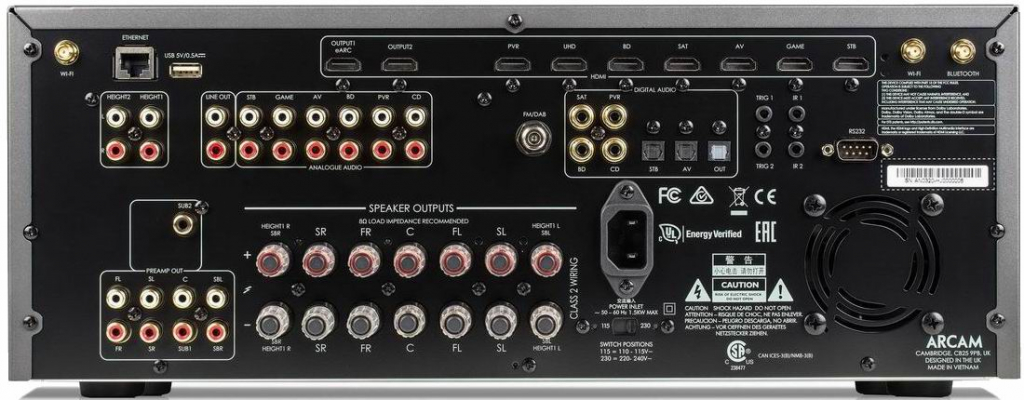
Connectivity for video sources, audio components, and custom integration
The AVR10’s rear-panel connectivity is extensive. It includes seven HDMI inputs and two HDMI outputs using HDMI 2.0a, with support for 4K Ultra HD at 60 Hz, 3D video, HDCP 2.2, HDR10+, HLG, Dolby Vision, and Dynamic HDR as listed in the supplied specifications. One HDMI output includes return channel support, while another can be used for an additional zone. MHL support is also documented for HD video from compatible mobile devices.
On the audio side, the receiver includes two optical digital inputs, four coaxial digital inputs, seven line-level analog inputs including one on the front panel, optical output, subwoofer output, headphone output, second-zone output, and processor pre-outs. A USB connection is provided for external drives according to the source material, while the specifications also identify USB for software updates. Ethernet is included for network functions.
The AVR10 is also equipped for more advanced installations. RS-232, trigger outputs, and IR sensor inputs are useful in custom-control environments, equipment racks, or systems where the receiver must integrate with automation hardware. These are not flashy features, but they can be highly practical for a neatly installed theater where components are hidden or centrally controlled.
Streaming, radio, and everyday control options
The AVR10 is not limited to disc players and HDMI sources. It supports native mobile streaming through Apple AirPlay 2 and Google Chromecast, and Bluetooth is also included. Spotify Connect and vTuner support are documented, along with playback of audio files from computers and servers over a local network through Ethernet. The source material specifically notes playback of both compressed and lossless content over the network.
Radio listeners are also covered, with both an FM tuner and DAB/DAB+ digital radio tuner. That gives the receiver a more traditional everyday-audio role, particularly in systems where the AV receiver is also the main music hub for the room.
Control options include the supplied universal remote control, the MusicLife application on iOS devices, and network control using an IP address. The front panel is designed for direct access as well, with a large volume knob, display, source and menu buttons, Direct mode access, headphone socket, 3.5 mm auxiliary input, standby control, and status indicator. These physical controls matter because an AV receiver should remain usable even when a phone app is not immediately available.
Who the Arcam AVR10 is most suitable for
The AVR10 is best suited to home-theater owners who want a serious central component and are prepared to spend time on configuration. Its strengths are most relevant in systems that use immersive audio formats, multiple HDMI sources, room calibration, and possibly external amplification. Someone planning a 5.1.2 system today but considering 7.1.4 later is a natural match for the receiver’s seven-channel amplification and 12.1-channel processing structure.
It is also a good conceptual fit for listeners who want their AV receiver to handle music sources as well as movie playback. AirPlay 2, Chromecast, Spotify Connect, Bluetooth, network audio, FM, and DAB/DAB+ give the AVR10 several ways to serve daily listening without requiring a separate streamer for every use case.
It may be less suitable for someone who wants the simplest possible plug-and-play receiver, or for an installation that will never use room correction, preamp outputs, network features, or immersive speaker layouts. The AVR10’s value is tied to its flexibility. Owners who only need basic HDMI switching and a compact surround setup may not use much of what makes this model distinctive.
Conclusion
The Arcam AVR10 stands out as a home-theater receiver built around flexibility rather than mere channel counting. Its documented strengths include seven channels of Class AB amplification, 12.1-channel processing, Dirac Live calibration across the full channel platform, broad surround-format support, generous HDMI and audio connectivity, network playback, mobile streaming, radio tuners, and integration-friendly control options. It is most compelling for users building a serious surround or immersive cinema system who want a receiver that can operate as a complete powered hub today while leaving room for external amplifiers and expanded speaker layouts later.