Acoustic Energy AE300: Compact Speakers With Serious Driver Thinking
The Acoustic Energy AE300 is a compact two-way bookshelf speaker built around upgraded ceramic-aluminum driver technology, a newly developed aluminum dome tweeter, and a carefully braced MDF cabinet. Its appeal lies in bringing elements of Acoustic Energy’s more ambitious engineering into a manageable standmount format.

The Acoustic Energy AE300 sits in an interesting place within the company’s loudspeaker thinking. It is still a compact bookshelf model, with dimensions that make it realistic for smaller rooms, stands, shelves, and living-room systems. Yet its design priorities are clearly more ambitious than those of a simple entry-level speaker. The AE300 focuses on driver construction, cabinet control, dispersion, and finish quality rather than relying only on size or visual presence. For prospective owners, that makes it a product worth understanding not as a generic standmount, but as a carefully developed two-way speaker with several technical choices intended to improve rigidity, integration, and usability.
A standmount speaker built around upgraded driver technology
The central story of the Acoustic Energy AE300 is its mid/bass driver. Rather than using the paper-cone approach associated with more affordable models such as the AE100, the AE300 uses a 130 mm aluminum-ceramic cone. This compressed sandwich-style construction is important because it reflects a move toward greater stiffness and control in the diaphragm itself. In loudspeaker design, the cone must behave predictably while being asked to start, stop, and reproduce a broad portion of the musical range. A more rigid cone structure is intended to help the driver maintain its shape under movement, which can support cleaner articulation and a more composed presentation within the speaker’s operating limits.
paragraphs.ERROR? wait duplicate key issue
Reference-derived ideas in a more accessible format
The AE300’s driver thinking is linked to Acoustic Energy’s proprietary design work and is described as a refined version of technology previously used in the AE1 Active, a model associated with the brand’s Reference line. That connection matters because it suggests the AE300 was not treated as a purely cost-driven bookshelf speaker. Instead, it draws on a driver concept developed for a more ambitious platform and adapts it to a passive standmount design.
For an owner building a system around compact speakers, this kind of trickle-down engineering can be attractive. It does not change the AE300’s basic role as a two-way bookshelf speaker, but it helps explain why Acoustic Energy has placed so much emphasis on the mid/bass unit. In a speaker of this size, the main driver has to carry much of the workload: bass, lower midrange, and a substantial part of the vocal and instrumental range. Improving that driver is therefore not a minor detail; it is fundamental to the speaker’s character and capability.
Foam suspension and a larger 130 mm driver
Another notable distinction is the move to a 130 mm mid/bass driver, larger than the 100 mm unit referenced in the AE100 series context. A larger driver can be useful in a compact speaker because it gives the system more radiating area to work with. Acoustic Energy positions this as part of the AE300’s ability to create a broader soundstage and greater scale than a smaller driver arrangement might allow, while still remaining within a bookshelf-sized enclosure.
The AE300 also uses foam suspension rather than the rubber suspension noted in the 100 series. The source information presents this as a design choice intended to allow more detail and nuance. From a user perspective, the significance is that Acoustic Energy has not only changed the cone material, but also the way the moving assembly is supported. Cone, suspension, and magnetic system all interact; refining one element without considering the others would limit the benefit. The AE300’s driver package is therefore best understood as a coordinated upgrade rather than a single-material substitution.
A new aluminum tweeter with wide-dispersion thinking
High frequencies are handled by a 28 mm aluminum dome tweeter developed specifically for the 300 series. This is a meaningful change from the fabric dome tweeter used in the AE100. By using aluminum in the tweeter and an aluminum-ceramic construction in the mid/bass driver, Acoustic Energy aims for consistency in the behavior of the drive units across the frequency range. The goal is not simply to add a brighter-looking component, but to create a more unified two-way system.
The tweeter is mounted within Acoustic Energy’s WDT, or Wide Dispersion Technology, waveguide. A waveguide can be an important part of a tweeter implementation because it influences how high frequencies spread into the room. Even dispersion is valuable for real-world listening, where users may not always sit in a fixed central position and where room reflections contribute to perceived balance. The AE300’s waveguide is intended to help distribute treble energy more evenly and support a spacious stereo image without requiring the speaker to be unusually large.
Cabinet construction designed to control resonance
The AE300’s cabinet work is another reason it stands apart from a basic compact speaker. The enclosure is made from MDF with 18 mm wall thickness, and Acoustic Energy uses internal spacers and partitions to reduce unwanted overtones. This is a practical concern: a loudspeaker cabinet should ideally support the drivers without adding its own audible signature. If the enclosure stores and releases energy, the result can be a box-like coloration that distracts from the drivers’ output.
The design of the AE300 enclosure is described as closely related to the Reference series approach, with the aim of minimizing resonances. The pair weighs 13 kg, or 6.5 kg per speaker, which is substantial for a model measuring 300 x 175 x 260 mm. Weight alone does not guarantee performance, but in this context it reflects the use of a more solid cabinet structure. For owners, this can also influence practical setup: stable stands or secure furniture placement will be important to let the speaker sit firmly and safely.
A compact two-way specification with useful system clues
The AE300 is a two-way bass-reflex bookshelf speaker with a stated frequency range of 45 Hz to 30,000 Hz. Its nominal impedance is 6 ohms, sensitivity is listed at 86 dB, and power handling is specified at 125 W. These figures outline the type of system matching a prospective owner should consider. The 86 dB sensitivity suggests that amplifier quality and control will matter, especially in larger rooms or for listeners who prefer higher playback levels. The 6 ohm impedance is common enough for many modern amplifiers, but it still points toward using an amplifier comfortable with real loudspeaker loads rather than treating the AE300 as an afterthought.
The bass-reflex design is also relevant for placement. A compact speaker with a reflex alignment can offer useful low-frequency extension for its size, but room positioning remains important. Owners should expect to experiment with distance from walls and stand height to get the best integration in their own space. The AE300’s size makes it flexible, but it is still a serious loudspeaker rather than a casual desktop accessory.

Finish options and domestic integration
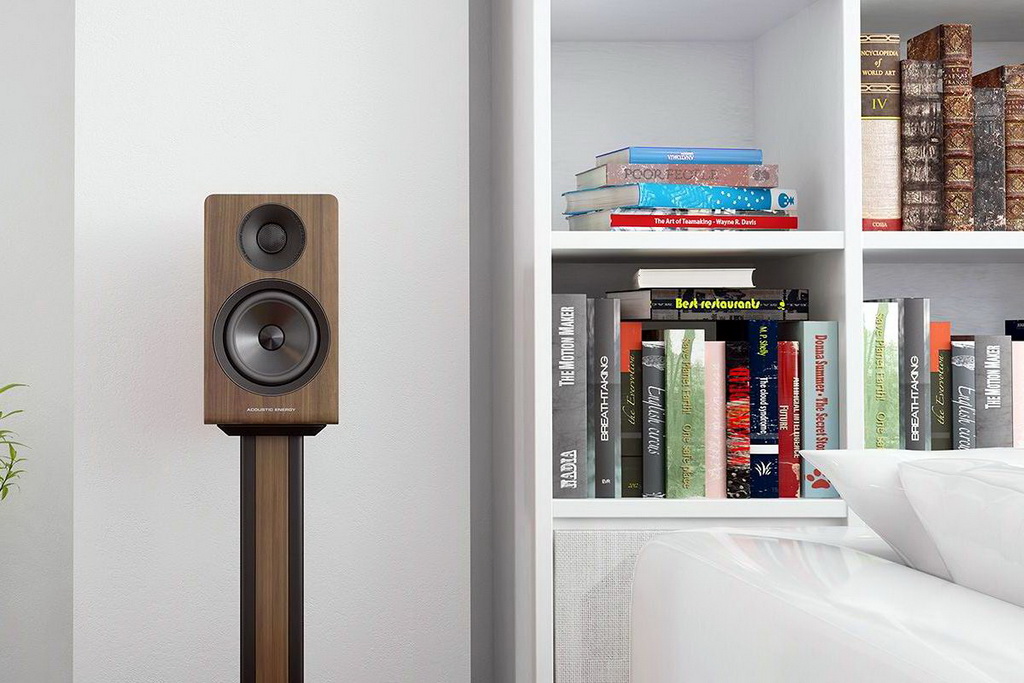
Acoustic Energy offers the AE300 in gloss white, gloss black, and walnut wood veneer. That range of finishes gives the speaker a practical advantage in domestic systems, where appearance can be almost as important as dimensions. Gloss black may suit more traditional hi-fi racks and media furniture; gloss white can work in brighter modern rooms; walnut veneer offers a warmer furniture-like option.
The cabinet’s compact proportions also help. At 300 mm high, 175 mm wide, and 260 mm deep, the AE300 is not visually imposing, but it is not a lightweight lifestyle cube either. It occupies the middle ground many listeners need: small enough to integrate into a room, but engineered as a genuine hi-fi component. The design appears aimed at listeners who want technical seriousness without moving to floorstanding speakers.
Conclusion
The Acoustic Energy AE300 is best suited to listeners who want a compact passive bookshelf speaker with more engineering depth than an entry-level model, but who still need manageable dimensions and living-room-friendly finishes. Its strongest documented qualities are its 130 mm aluminum-ceramic mid/bass driver, dedicated aluminum dome tweeter, WDT waveguide, resonance-conscious MDF cabinet, and thoughtful finish options. It will make the most sense for owners prepared to pair it with a capable amplifier and give attention to placement, especially those seeking a standmount speaker that combines compact form with driver and cabinet ideas drawn from Acoustic Energy’s more ambitious designs.