
Choosing a vinyl front end involves more than comparing turntables alone.
Plinth construction, drive method, speed support, tonearm adjustment and phono-stage requirements all influence how readily a product will fit into an existing system.
Cartridges and setup tools can be just as important when refining a deck you already own. This selection spans complete record players, a cartridge-alignment tool and several specialist pickups. The turntables range from straightforward analog designs to wireless models and elaborate high-end constructions, while the cartridges address moving-coil and dedicated monophonic playback. Because the source material does not include comparative listening tests or consistent pricing, the recommendations focus on documented design choices, connectivity and setup considerations. The right option depends on whether you need a complete deck, a convenient route into wireless playback or a carefully matched upgrade for an established analog system.
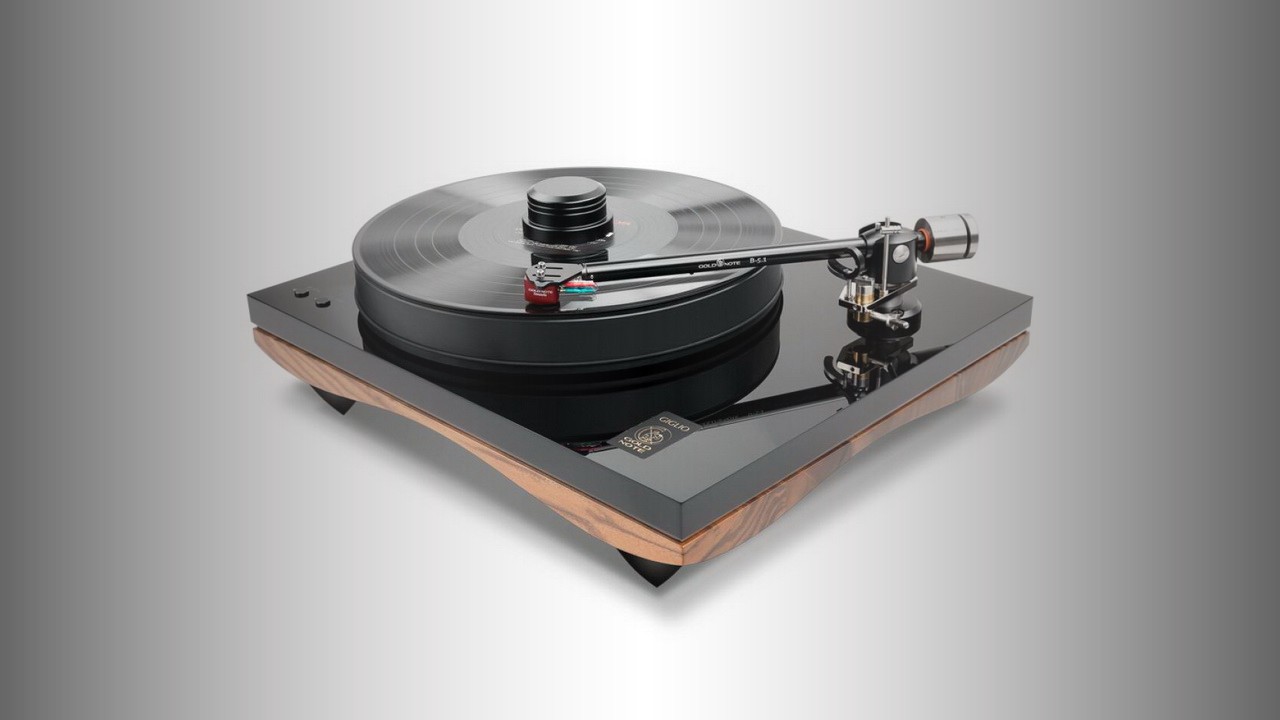
1. Gold Note Giglio
The Gold Note Giglio combines a sculpted wooden base with steel and polished acrylic plinth layers.
The Gold Note Giglio approaches vibration control through a three-part plinth.
Its hand-carved wooden lower section is joined to a 3 mm steel sheet at 16 points, creating internal tension intended to increase rigidity and suppress vibration.
A 20 mm layer of polished black acrylic completes the structure. Its 12-volt synchronous motor uses pulse-width modulation to convert the incoming power before recreating the alternating current used to drive the motor. Fine speed adjustments are available and remain stored after the turntable is disconnected from power. A carbon-steel spindle and hardened-steel-and-bronze bearing system reinforce the emphasis on precision engineering.
Best for: Listeners prioritizing substantial construction and precise speed adjustment
- Three-layer wood, steel and acrylic plinth
- Fine speed adjustment with memory
- Carbon-steel spindle and bronze bearing
- Motor system designed to minimize vibration
Verdict: The Giglio is a meticulously constructed Italian turntable built around plinth rigidity, vibration management and fine motor control.
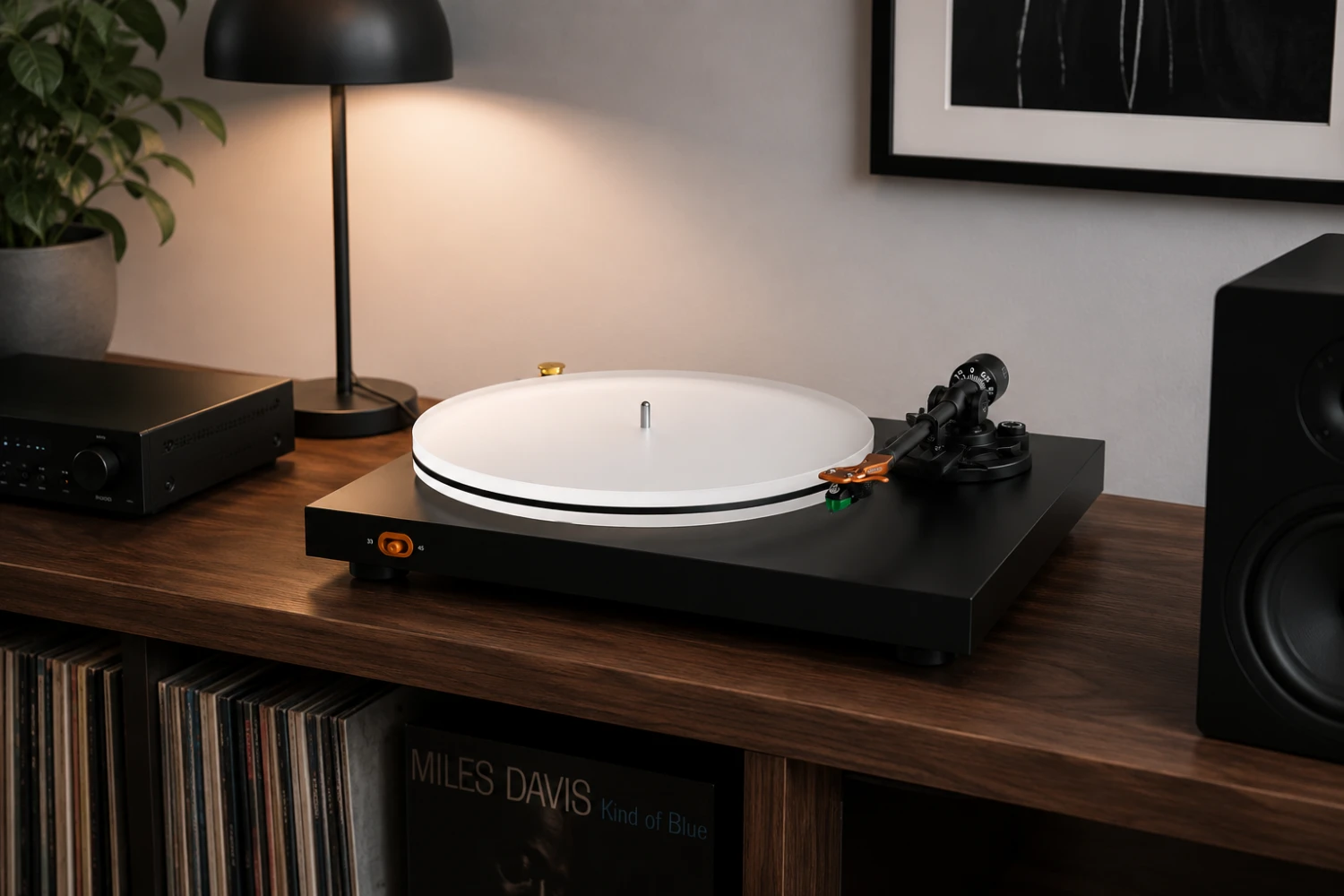
2. Fosi Audio LUNA 3
The Fosi Audio LUNA 3 is a belt-drive deck with an acrylic platter and factory-fitted Audio-Technica VM95E cartridge.
The Fosi Audio LUNA 3 is a belt-driven turntable for listeners who want to choose their own phono electronics.
It omits an internal phono stage, so it must be connected to an external phono preamplifier or an amplifier with a suitable phono input.
That separation also leaves owners free to change the phono stage independently of the deck. A 300 mm acrylic platter provides the record-supporting surface, while selectable 33⅓ and 45 RPM speeds cover conventional LPs and singles. Fosi Audio supplies the turntable with an Audio-Technica VM95E moving-magnet cartridge, a model with a replaceable stylus and an established upgrade path within the VM95 family.
Best for: Vinyl listeners building a system around a separate phono stage
- Pure analog signal path without an internal phono stage
- 300 mm acrylic platter
- Audio-Technica VM95E cartridge included
- Supports 33⅓ and 45 RPM playback
Verdict: The LUNA 3 offers a focused analog starting point with a supplied VM95E cartridge and freedom to select external phono electronics.

3. TEAC TN-400BT X/TB
TEAC gives the limited-edition TN-400BT X/TB a turquoise high-gloss MDF cabinet and an S-shaped tonearm.
The limited-edition TEAC TN-400BT X/TB pairs a glossy turquoise finish with unusually broad speed and connection options.
Its belt-driven platter can run at 33⅓, 45 or 78 RPM, while a low-friction spindle with brass bearings supports stable rotation.
The MDF chassis, decoupled feet and high-gloss cabinet address both rigidity and external vibration. An S-shaped, statically balanced tonearm provides adjustable counterweight and anti-skating controls. TEAC fits an Audio-Technica AT95E moving-magnet cartridge at the factory. Bluetooth 5.2 and an internal phono amplifier add flexibility for systems where wireless output or a separate phono stage would otherwise be required.
Best for: Listeners wanting wireless convenience, three speeds and a distinctive finish
- Playback at 33⅓, 45 and 78 RPM
- Bluetooth 5.2 and built-in phono amplification
- Factory-installed Audio-Technica AT95E cartridge
- Adjustable counterweight and anti-skating
Verdict: The TN-400BT X/TB combines traditional tonearm adjustment with Bluetooth, an internal phono stage and support for three record speeds.

4. McIntosh MT10
The McIntosh MT10 features an illuminated acrylic platter, glass front panel and centrally mounted speed indicator.
McIntosh’s MT10 is a belt-driven turntable with its principal tracking-force, anti-skating and cartridge adjustments completed at the factory.
Its damped chassis uses a layered construction comprising polished stainless steel, aluminum and acrylic, with the differing materials intended to control resonance and vibration.
The acrylic platter weighs more than 5 kg and runs on a ceramic bearing with magnetic suspension. An electronic servo system monitors 33⅓, 45 and 78 RPM operation through an optical sensor reading stroboscopic markings. The illuminated platter, glass front panel and central speed display also give the MT10 the visual presentation associated with McIntosh components.
Best for: McIntosh systems and listeners seeking a factory-adjusted high-end deck
- Factory-set tracking force, anti-skating and cartridge adjustment
- Layered stainless-steel, aluminum and acrylic chassis
- Electronic speed monitoring for three speeds
- Heavy acrylic platter with magnetic suspension
Verdict: The MT10 combines substantial mechanical construction, monitored three-speed operation and factory-completed setup in a characteristically illuminated design.
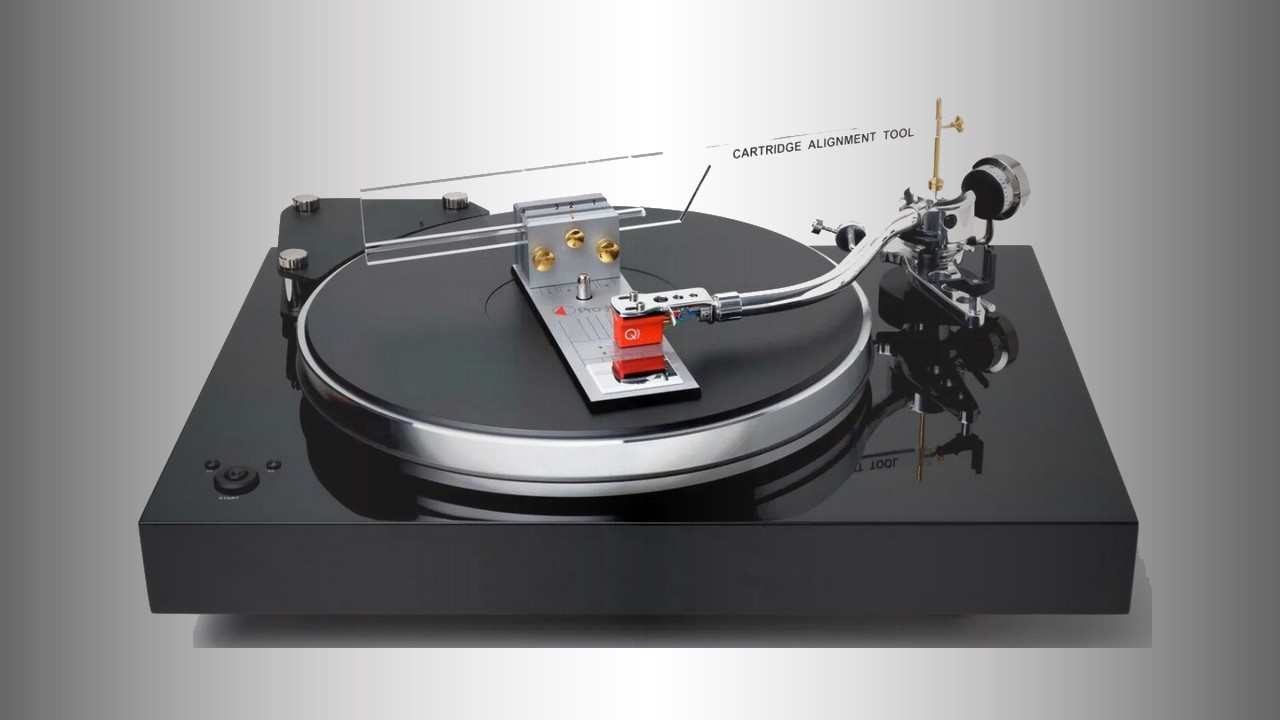
5. Pro-Ject Align it Pro
The Pro-Ject Align it Pro provides tonearm-length markings and a reversible locating screw for cartridge setup.
The Pro-Ject Align it Pro is not a turntable but a setup tool for establishing cartridge overhang.
Its markings accommodate 8-, 9-, 10- and 12-inch tonearm lengths, allowing the user to tailor alignment to the arm rather than rely on a single fixed template.
Pro-Ject bases the tool on Baerwald geometry. A reversible machine screw has a pointed end for broad tonearm or bearing compatibility and a flat end shaped for the center screw used on selected Pro-Ject products. Named compatible models include the X1, X2 and several 9cc, 10cc and 12cc tonearms. Its method is designed to establish the required overhang without repeatedly moving between inner and outer null points.
Best for: Owners installing or realigning a cartridge
- Markings for four common tonearm lengths
- Dual-ended machine screw
- Broad compatibility with special provision for Pro-Ject models
- Designed to set overhang without alternating between two null points
Verdict: Align it Pro is a practical Baerwald-geometry tool for users who need repeatable overhang adjustment across different tonearm lengths.

6. Yamaha TT-N503 MusicCast VINYL 500
The Yamaha TT-N503 MusicCast VINYL 500 places wireless MusicCast functions inside a traditional gloss-black turntable design.
The Yamaha TT-N503, also presented as the MusicCast VINYL 500, combines a conventional belt-drive layout with network and wireless features.
It plays records at 33⅓ and 45 RPM using an aluminum platter, a 9-inch straight tonearm and a moving-magnet cartridge.
Four anti-vibration feet support the gloss-black plinth. For a wired system, Yamaha provides RCA outputs and a switchable internal phono stage. Wi-Fi and the MusicCast platform extend playback to compatible headphones, speakers and receivers, while Yamaha’s app manages network-related settings and features. Access to supported streaming services means the unit can also act as a source for digital music within a MusicCast installation.
Best for: MusicCast users who want vinyl and network playback in one system
- Wi-Fi and MusicCast integration
- Switchable built-in phono stage
- RCA outputs for wired systems
- Belt drive with 33⅓ and 45 RPM playback
Verdict: The TT-N503 is a flexible choice for listeners who value multiroom connectivity but still want conventional RCA output and a switchable phono stage.

7. Yukiseimitsu Empathy AP-01 EM
The Yukiseimitsu Empathy AP-01 EM uses two custom-machined tonearm bases on a vibration-isolating floating chassis.
The Yukiseimitsu Empathy AP-01 EM is designed around two tonearm bases.
Owners can install different arm and cartridge combinations, making it possible to maintain separate setups for particular record types or alignment preferences without continually replacing a single cartridge.
Yukiseimitsu offers customized machining of the bases to suit the tonearms selected when the turntable is ordered. A floating-chassis design isolates the platter from external vibration, complementing the emphasis on precise installation. This is consequently a specialized proposition for experienced vinyl users who already understand which tonearms and cartridges they intend to use.
Best for: Experienced collectors maintaining multiple tonearm and cartridge setups
- Two tonearm bases
- Bases machined for the owner’s chosen tonearms
- Floating chassis for vibration isolation
- Supports separate arm and cartridge configurations
Verdict: The Empathy AP-01 EM stands out for its dual-arm flexibility and made-to-order tonearm-base machining.

8. EBI Audio Khumar
The EBI Audio Khumar moving-coil cartridge uses an ebony body, Shibata III stylus and boron cantilever.
EBI Audio’s Khumar is a moving-coil cartridge made in Uttar Pradesh, India.
Its construction combines a handcrafted ebony body with a nude Shibata III stylus, a 0.28 mm boron cantilever, a soft-iron magnetic core and neodymium magnets.
The cartridge produces an output of 0.3 mV and has a 2-ohm DC resistance, with a specified load resistance of at least 20 ohms. Recommended tracking force is 1.9 g, within a stated adjustment range of 1.7 to 2.3 g. Its 8.8 g weight and 17.8 mm height are important figures to check against a prospective tonearm and headshell before installation.
Best for: MC users whose tonearm and phono stage match its mechanical and electrical requirements
- Handcrafted ebony body
- Nude Shibata III stylus
- Boron cantilever
- Specified channel separation above 32 dB
Verdict: The Khumar combines an ebony body and advanced stylus assembly with clearly stated loading and setup requirements for careful system matching.
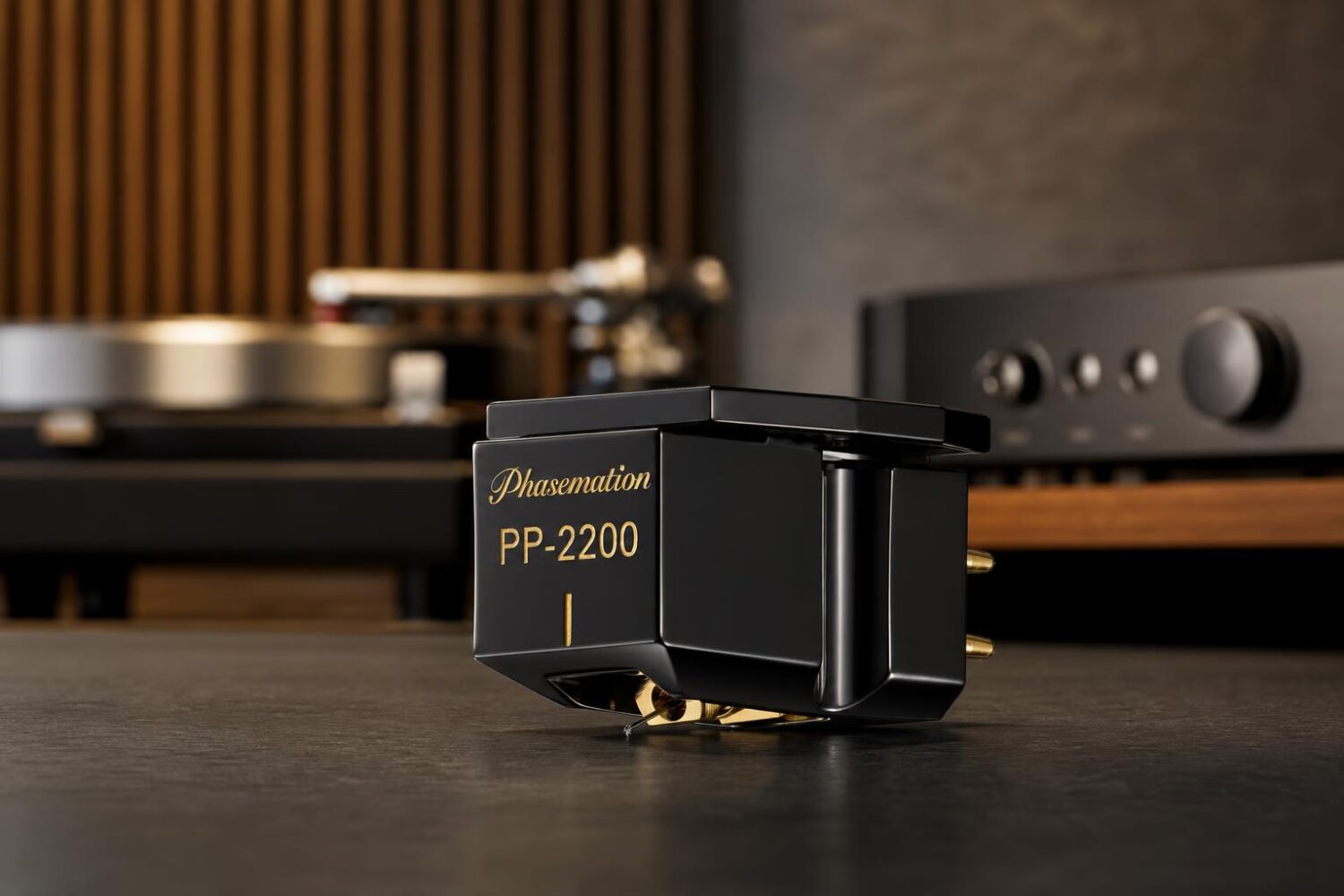
9. Phasemation PP-2200
Phasemation’s PP-2200 moving-coil cartridge introduces a redesigned magnetic circuit in place of the earlier PP- architecture.
The Phasemation PP-2200 is a moving-coil cartridge developed to succeed the PP-.
Rather than continuing the earlier model unchanged, Phasemation revised the design in response to component-processing and supply difficulties that had complicated ongoing production.
Its principal technical change is a reworked magnetic circuit intended to improve generation efficiency at the point where stylus movement becomes an electrical signal. Phasemation says this arrangement is designed to reduce audible distortion and retain finer musical information. The available source does not provide the loading, output, tracking-force or dimensional figures needed for a complete compatibility assessment, so those details should be confirmed before purchase.
Best for: Experienced MC-cartridge users considering Phasemation’s redesigned reference-line successor
- Substantially revised magnetic circuit
- Moving-coil design
- Developed as a comprehensive successor to the PP-
Verdict: The PP-2200 is a significant redesign centered on magnetic-circuit efficiency, though full system matching requires additional specification checks.

10. DS Audio Mono Series
A DS Audio Mono Series optical cartridge uses a brass base and a suspension tailored to lateral mono-groove movement.
The DS Audio Mono Series consists of optical cartridges developed specifically for monophonic records.
Their suspension responds only to horizontal stylus movement, matching the lateral modulation used to encode a mono groove rather than reacting to both horizontal and vertical movement as a stereo pickup does.
DS Audio mounts the cartridge structure on a brass base selected for its combination of stiffness and internal damping. Mono versions are offered across the company’s cartridge models and are priced at the same level as their corresponding versions. Their specialized operating principle makes them relevant to collectors building a dedicated playback path for monophonic pressings rather than seeking one conventional cartridge for every record.
Best for: Collectors establishing a dedicated optical-cartridge setup for mono records
- Suspension responds only to horizontal stylus movement
- Designed specifically for monophonic records
- Stiff, internally damped brass base
- Mono versions offered across the DS Audio cartridge range
Verdict: The DS Audio Mono Series applies a lateral-only suspension to optical cartridges intended expressly for serious monophonic playback.
Frequently asked questions
Which products in this selection are complete turntables?
The Gold Note Giglio, Fosi Audio LUNA 3, TEAC TN-400BT X/TB, McIntosh MT10, Yamaha TT-N503 and Yukiseimitsu Empathy AP-01 EM are turntables.
The Pro-Ject Align it Pro is an alignment tool, while the EBI Audio Khumar, Phasemation PP-2200 and DS Audio Mono Series are cartridges.
When is a built-in phono stage useful?
A built-in phono stage lets a turntable connect to a conventional line-level input without a separate preamplifier.
The TEAC includes phono amplification, while Yamaha provides a switchable stage.
The Fosi Audio LUNA 3 deliberately omits one and therefore requires an external phono preamplifier or an amplifier with a suitable phono input.
Do I need a turntable that plays 78 RPM records?
Only if 78 RPM discs are part of your collection.
The TEAC TN-400BT X/TB and McIntosh MT10 support 78 RPM, while the Fosi Audio LUNA 3 and Yamaha TT-N503 cover 33⅓ and 45 RPM.
Before playing older 78s, also verify that the fitted cartridge and stylus are appropriate for the record.
What should I check before changing a cartridge?
Confirm tonearm and headshell compatibility, cartridge weight and height, tracking-force range, alignment geometry and the electrical requirements of the phono stage.
Low-output moving-coil models such as the EBI Audio Khumar need appropriately matched amplification, while a tool such as the Pro-Ject Align it Pro can help establish overhang for supported tonearm lengths.
How to choose the right vinyl upgrade
Begin by deciding whether you need a complete turntable or want to improve an existing one.
A new deck should match the rest of the system at the connection level: models with built-in phono amplification can feed a standard line input, whereas a pure analog design such as the Fosi Audio LUNA 3 needs a separate phono stage or a suitable phono-equipped amplifier.
Wireless features on the TEAC and Yamaha broaden placement and system options, but they should be chosen because they solve a genuine connection need. Record format matters as well. Most collections require only 33⅓ and 45 RPM, while 78 RPM support is useful for specialist libraries. Dedicated mono cartridges such as the DS Audio Mono Series go further by optimizing the pickup mechanism for laterally modulated monophonic grooves. A dual-tonearm deck such as the Yukiseimitsu provides a practical way to keep specialist and general-purpose configurations available at the same time. For cartridge upgrades, compatibility should take priority over materials or technical novelty. Check output level, loading, tracking force, weight, height and alignment requirements against the tonearm and phono stage. Precise installation is essential, and an alignment tool must use geometry and dimensions appropriate to the arm. Where the supplied source does not provide all of these figures, obtain the missing information before committing to a cartridge or turntable.



Sound Off
0Join the discussion if you have something to add.