
A rewarding home cinema can take several forms.
One room may call for a bright 4K projector and a full multichannel speaker layout, while another is better served by a compact 5.1 package, an HDMI-equipped stereo receiver or a straightforward soundbar system.
The right choice depends on the room, the sources being connected and how much installation complexity you are prepared to accept. This selection covers products and guidance addressing those different priorities. It includes complete systems, receivers, speakers, a projector, a media player and an advanced surround processor, alongside a practical explanation of channel counts. Specifications and feature sets should always be considered in the context of the wider system: speakers may require amplification, processors need suitable supporting equipment, and the latest video formats are useful only when the source and display support them too. Rather than treating every entry as interchangeable, focus on the problem each one solves. Some simplify the move beyond television speakers, some combine music and video connectivity, and others provide the foundation for an ambitious dedicated cinema room.

1. Viewsonic unveils V57-4K Laser Home Cinema Projector
The Viewsonic V57-4K laser projector, featuring 4K UHD support, 1.6x optical zoom and vertical lens shift.
The Viewsonic V57-4K is a laser projector built around 4K UHD support, RGB laser technology and full BT. color-gamut coverage.
Its specified brightness of 5,200 lumens, support for HDR and HLG, and 0.65-inch Texas Instruments DMD chip make it a feature-rich display option for home entertainment.
Installation aids include 1.6x optical zoom, vertical lens shift, horizontal and vertical keystone correction, side projection and four-corner adjustment. Gaming support extends to 1440p at 120 Hz, accompanied by a Created for Xbox designation. The mercury-free, lamp-free light source has a stated lifespan of 30,000 hours.
Best for: Bright, flexible projection and high-frame-rate gaming
- 4K UHD with HDR and HLG support
- Specified 5,200-lumen brightness
- Flexible optical and geometric adjustment
- Supports 1440p gaming at 120 Hz
Verdict: A strongly specified RGB laser projector that combines broad installation controls with modern video and gaming support.

2. Zidoo UHD8000: New player with 8K picture, Amlogic S928X-K processor and two disk slots
The symmetrical Zidoo UHD8000 media player places two hard-drive slots on either side of its central display and controls.
Zidoo’s UHD8000 is designed for substantial locally stored media libraries as well as networked playback.
Its two hard-drive slots support up to 32 TB in total, while Wi-Fi 6, Bluetooth 5.2 and DLNA broaden connection options.
The player is based on an Amlogic S928X-K processor with 8 GB of DDR4 RAM and 64 GB of eMMC memory. HDMI 2.1 video support reaches 8K at 60 frames per second, and separate HDMI audio and video paths allow 4K pictures and HD audio to be handled independently. RCA and balanced XLR analogue outputs are also provided, while the USB DAC input enables use as a digital-to-analogue converter.
Best for: Large local movie and music libraries
- Two drive bays with up to 32 TB total capacity
- Separate HDMI audio and video paths
- Wi-Fi 6, Bluetooth 5.2 and DLNA
- RCA and balanced XLR analogue outputs
Verdict: An extensively connected media player for users who value internal storage, high-resolution playback and separate audio-video routing.
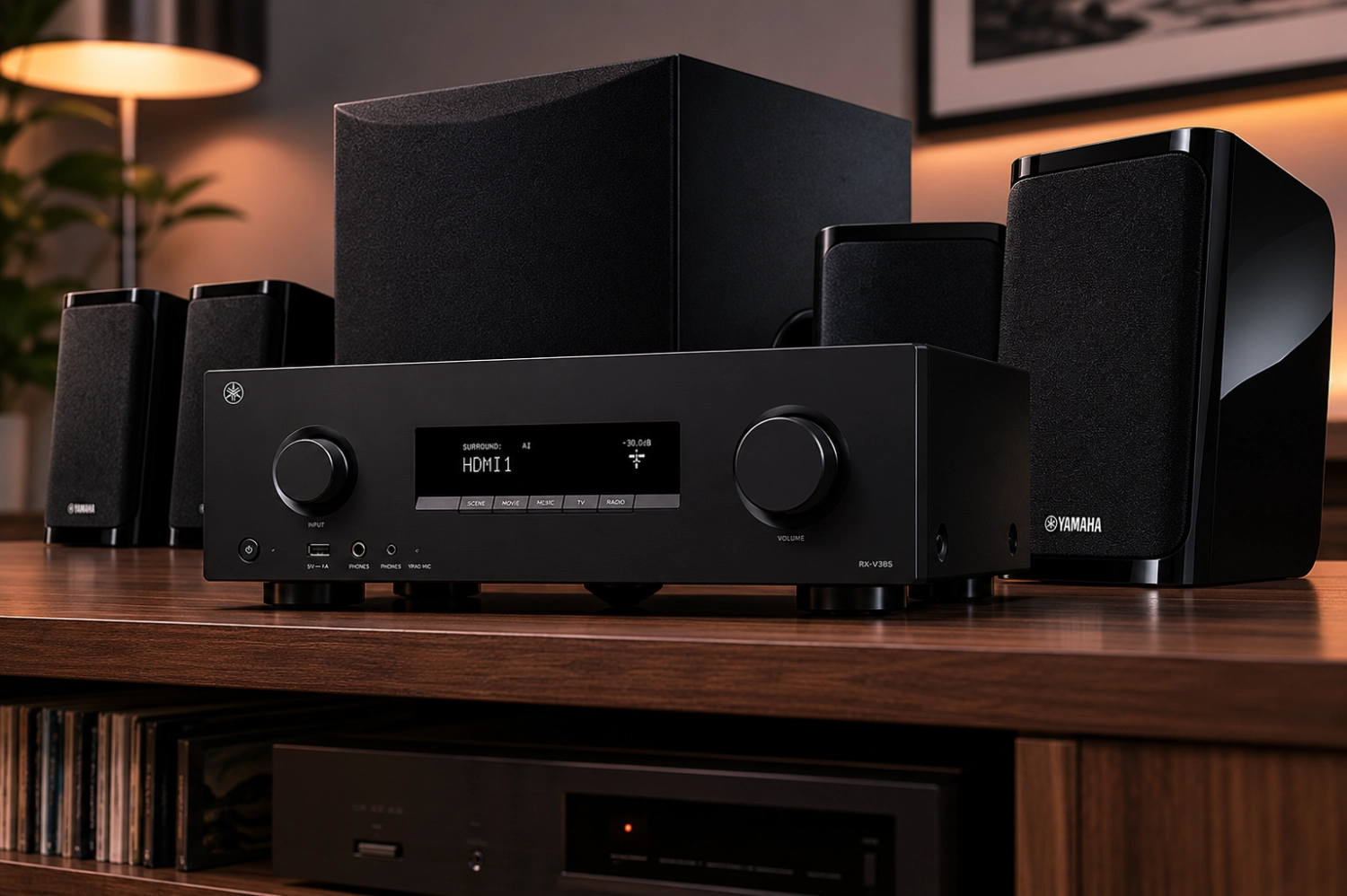
3. Yamaha YHT-4970U: Affordable 5.1 Home Theater System With 8K HDMI
The Yamaha YHT-4970U combines an RX300A receiver, five compact speakers and an active 8-inch subwoofer.
The Yamaha YHT-4970U packages the main components required for a conventional 5.1-channel system: an RX300A AV receiver, five compact satellite speakers, an active subwoofer with an 8-inch driver, speaker cable and setup accessories.
The receiver provides a 5.2-channel configuration and is rated at 70 watts per channel into 8 ohms under the stated conditions.
Its HDMI 2.1 connectivity supports 8K at 60 Hz and 4K at 120 Hz, along with HDR10+, Dolby Vision, VRR and ALLM. Dolby Atmos decoding and Bluetooth 5.3 Multipoint are also included. Its clearest advantage is convenience for buyers who would rather not assemble an entry-level separates system component by component.
Best for: A first component-based 5.1 system
- Complete 5.1 speaker and receiver package
- 8K/60 Hz and 4K/120 Hz video support
- HDR10+, Dolby Vision, VRR and ALLM
- Speaker cable and setup accessories included
Verdict: A practical all-in-one route into separate-speaker home cinema with current HDMI and gaming features.

4. Denon AVR-X2800H: Advanced and versatile 7.1-channel receiver
The black Denon AVR-X2800H receiver provides six HDMI inputs, two HDMI outputs and integrated HEOS streaming.
The Denon AVR-X2800H is a 7.1-channel surround receiver rated at 95 watts under the cited hi-fi measurement conditions.
It supports Dolby Atmos and DTS:X, while Atmos Height Virtualization and DTS Virtual:X can create a sense of height without ceiling speakers.
Six HDMI inputs and two outputs provide support for 8K video, and the two outputs can accommodate installations using both a television and projector. Gaming provisions include 4K at 120 Hz, ALLM, QFT and VRR. HEOS multiroom, AirPlay 2, Spotify Connect, internet radio and two-way Bluetooth expand its usefulness beyond film soundtracks.
Best for: Versatile surround systems with multiple displays or sources
- Dolby Atmos and DTS:X support
- Six HDMI inputs and two outputs
- 4K/120 Hz, VRR, ALLM and QFT for gaming
- HEOS, AirPlay 2 and two-way Bluetooth
Verdict: A well-connected surround receiver that balances immersive formats, gaming features and networked music playback.

5. Onkyo TX-8470: Two-channel receiver with an abundance of functions
The Onkyo TX-8470 combines two-channel Class G amplification with HDMI, phono, digital and network inputs.
The Onkyo TX-8470 is aimed at listeners who want stereo reproduction without giving up television-friendly connectivity.
Its Class G amplification is specified at 110 watts per channel into 8 ohms, while four HDMI connections support ARC and video bandwidth up to 40 Gbps, including 8K signals.
The receiver also provides two pairs of speaker connections, analogue inputs, two optical inputs, one coaxial digital input and a turntable input. Network access is available through Ethernet or Wi-Fi, complemented by Bluetooth, Chromecast and AirPlay. An AKM DAC handles digital music signals at resolutions up to 32-bit/768 kHz.
Best for: Stereo listeners who also use a television
- Four HDMI connections with ARC
- Turntable and multiple digital inputs
- Ethernet, Wi-Fi, Bluetooth, Chromecast and AirPlay
- Two pairs of speaker connections
Verdict: A versatile two-channel receiver for buyers who prioritize music but still need extensive HDMI and network connectivity.

6. How many speakers should a home theater system have?
A home cinema speaker layout illustrating how full-range, subwoofer and height channels contribute to the system count.
This guide explains the channel notation used to describe home cinema speaker systems.
In a designation such as 5.1, the first number refers to the full-range channels and the second to the subwoofer channel.
A third number, as found in configurations such as 7.1.4, represents height channels. Understanding that structure makes it easier to compare a basic surround system with layouts that add rear, subwoofer or overhead speakers. The article is particularly useful before buying hardware because the desired speaker layout determines how many channels of amplification and processing the system will need.
Best for: Planning speaker numbers and channel layouts
- Explains common channel-number notation
- Distinguishes full-range, subwoofer and height channels
- Helps define a system before equipment is selected
Verdict: A useful starting point for understanding how conventional and immersive home cinema configurations are described.

7. MiniDSP Tide16 Unveiled: 16-Channel Dolby Atmos Processor with Full Dirac Suite for $3,500
The rack-mountable MiniDSP Tide16 uses a color OLED display and provides 16 balanced XLR outputs for multichannel installations.
The MiniDSP Tide16 is a rack-mountable AV DSP processor capable of decoding up to 16 channels, depending on the chosen layout and source material.
Format support includes Dolby Atmos, Dolby TrueHD, DTS-HD Master Audio, DTS:X and their associated virtualization and upmixing options.
Three HDMI inputs are joined by eARC for sources routed through a compatible television, while 16 balanced XLR outputs serve the wider audio system. Dirac Live Room Correction, Bass Control and Active Room Treatment licenses are included, alongside advanced bass management, a flexible matrix mixer and processing across all outputs. A 1.8 GHz quad-core processor handles digital audio processing up to 32-bit/48 kHz.
Best for: Advanced multichannel rooms with extensive room correction
- Decodes configurations of up to 16 channels
- Sixteen balanced XLR outputs
- Full stated suite of Dirac room technologies included
- Advanced bass management and matrix mixing
Verdict: A specialized processor for complex Atmos and DTS:X installations requiring balanced outputs and comprehensive Dirac processing.

8. Harman/Kardon Radiance 2400: Perfect combination of minimalist design and premium materials
The Harman Kardon Radiance 2400 pairs two 1.8-metre ultra-thin speaker towers with an active subwoofer and digital hub.
The Harman Kardon Radiance 2400 takes a visually discreet approach to room-filling audio.
Its two floor-standing speakers are only 5 cm wide and 6 cm deep, despite standing 1.8 metres tall, and each contains an array of calibrated 1.25-inch full-range drivers.
Harman’s Constant Beamwidth technology is designed to provide more consistent coverage for listeners across the room rather than concentrating sound in a narrow sweet spot. The package also includes an active 200-watt subwoofer with a 10-inch driver and a compact digital hub for connecting a television and other AV devices. Wi-Fi provides access to compatible music-streaming services.
Best for: Minimalist living rooms where design and broad coverage matter
- Ultra-thin floor-standing speaker design
- Constant Beamwidth coverage technology
- Active 200-watt, 10-inch subwoofer
- Digital hub for TV and AV connections
Verdict: A distinctive slim-speaker system that combines a compact visual footprint with a dedicated subwoofer and digital control hub.

9. Yamaha NS-P41 5.1: Home Theater Sound with Advanced YST II Subwoofer
The glossy black Yamaha NS-P41 package includes compact surround speakers, a center channel and an Advanced YST II subwoofer.
The Yamaha NS-P41 is a traditional 5.1-channel speaker package intended for movies and music.
Compact satellite and center speakers are accompanied by a subwoofer using Yamaha’s Advanced YST II technology, which applies negative-impedance and constant-current principles to control the driver.
Its Linear Port bass-reflex design is intended to reduce unwanted port noise and maintain a smooth low-frequency response. Rear mounting holes allow the compact speakers to be installed on a wall, while the glossy black finish is designed to complement modern televisions. As a speaker package rather than a complete electronics system, it should be matched with an appropriate multichannel receiver.
Best for: Compact 5.1 systems built around an AV receiver
- Complete 5.1 speaker configuration
- Advanced YST II subwoofer technology
- Linear Port design intended to reduce noise
- Rear holes for wall mounting
Verdict: A conventional and space-conscious surround speaker package with dedicated Yamaha subwoofer technology.

10. Sony HT-S20R: 5.1 soundbar at a competitive price
The Sony HT-S20R uses a three-channel soundbar with separate surround speakers and a dedicated subwoofer.
The Sony HT-S20R provides a 5.1-channel alternative to a basic stereo soundbar.
Its main bar contains the front left, center and right channels, while separate surround speakers and a subwoofer complete the system.
Total output is specified at 400 watts. A metal mesh grille protects the front drivers, rubber feet stabilize the bar on furniture, and wall mounting is supported. This configuration is intended to improve on the limited bass and spatial presentation of built-in television speakers without requiring a fully component-based home cinema installation.
Best for: An accessible upgrade from television speakers
- Physical 5.1-channel speaker arrangement
- Separate subwoofer and surround speakers
- Specified 400-watt total output
- Tabletop or wall-mounted soundbar placement
Verdict: A straightforward 5.1 soundbar package for buyers who want separate surround channels without assembling a full separates system.
Frequently asked questions
How many speakers do I need for home cinema?
A 5.1 system is a common starting point, using five full-range channels and one subwoofer channel.
Layouts such as 7.1 add more surround channels, while a third figure, as in 7.1.4, identifies height channels.
Choose the layout before buying a receiver or processor so that it provides enough amplification and decoding capacity.
Should I choose a soundbar package or separate speakers?
A soundbar package such as the Sony HT-S20R reduces equipment and setup complexity while still providing physical surround channels.
Separate speakers and an AV receiver offer greater freedom to choose components and layouts, but require more space, cabling and system matching.
Do I need 8K HDMI support in a home cinema system?
It is most relevant when connecting compatible displays, game consoles or other high-bandwidth video sources.
Features such as 4K at 120 Hz, VRR and ALLM may be more immediately useful for gaming.
Confirm that the source, receiver or processor, cables and display all support the required format.
What is the difference between an AV receiver and an AV processor?
An AV receiver combines surround processing, source switching and power amplification in one unit.
A processor such as the MiniDSP Tide16 concentrates on decoding, routing and room processing through line-level outputs, so the wider installation must provide suitable amplification and speakers.
How to Choose the Right Home Cinema Foundation
Begin with the room and the speaker layout rather than the longest feature list.
A living room that must remain uncluttered may suit the Sony HT-S20R, Harman Kardon Radiance 2400 or a compact Yamaha speaker package.
Buyers seeking a conventional separates system can consider the complete Yamaha YHT-4970U or build around a receiver such as the Denon AVR-X2800H. If surround sound is unnecessary, the Onkyo TX-8470 offers a more music-focused stereo route while retaining HDMI connectivity. Match the electronics to both the current speakers and any realistic expansion plans. Count the required ear-level, subwoofer and height channels, then check that the receiver or processor can decode and route them. For complex installations, balanced outputs, bass management and room-correction tools may justify a specialist processor such as the MiniDSP Tide16. Simpler rooms may benefit more from careful speaker placement and a manageable 5.1 configuration than from adding channels without adequate space. Video compatibility also needs to be checked from end to end. High-bandwidth formats such as 8K/60 Hz or 4K/120 Hz require compatible sources, switching equipment, cables and displays. Projector buyers should additionally consider placement, zoom, lens shift and geometric adjustment; the Viewsonic V57-4K provides several such controls. For stored media, capacity and audio-video routing make the Zidoo UHD8000 a different proposition from a streaming source. Finally, account for everything needed to complete the system. A speaker package may still require an AV receiver, while a dedicated processor must be integrated with suitable amplification. Establishing those requirements before purchase helps avoid paying for unused capabilities or discovering that an essential connection, channel or supporting component is missing.



Sound Off
0Join the discussion if you have something to add.