Home Cinema Components Worth Hearing
A focused guide to home cinema components, covering AV receivers, AV processors and a universal disc player with clear advice on system matching, room correction, video support and speaker layouts.

A capable home cinema system is built from more than screen size.
The receiver, processor, or source component determines how surround formats are decoded, how speakers are driven or integrated, and how video signals move through the system without becoming a bottleneck.

1. Onkyo TX-NR696: AV receiver with plenty of bass
The Onkyo TX-NR696 combines a traditional AV receiver layout with seven-channel amplification and immersive surround processing.
The Onkyo TX-NR696 is a seven-channel AV receiver from the brand’s popular 600 series, presented in the source as a strong quality-to-price proposition.
Its appeal is the combination of high-current amplifier design, Dolby Atmos and DTS:X support, virtual height processing for systems without height speakers, and THX Select certification.
The source also highlights its ability to send stereo sound to a second room, making it more flexible than a purely single-room cinema amplifier.
Best for: A value-focused surround receiver with strong bass emphasis
- Seven-channel AV receiver
- Dolby Atmos and DTS:X support
- Virtual height processing without height speakers
- THX Select certified
Verdict: A practical AV receiver for users who want immersive-format support, solid dynamics, and useful multiroom flexibility without moving into processor-and-power-amp territory.

2. Mcintosh MVP901: Blu-ray player that provides the highest quality pictures
The McIntosh MVP901 is built as a universal disc and digital media player for high-end home cinema sources.
The McIntosh MVP901 is a universal audio and video player aimed at systems that still value disc playback.
It handles a wide range of optical media including Blu-ray, DVD, CD and SACD, and supports many file formats from MP3 and AAC through FLAC, ALAC, AIFF, LPCM and DSD.
The source is clear that it does not read 4K UHD Blu-ray discs, but it can upscale compatible video formats, while multichannel audio output requires connection to an AV processor through optical, coaxial or HDMI outputs.
Best for: Disc-based systems needing a premium universal source
- Plays Blu-ray, DVD, CD and SACD
- Supports Hi-Res audio file playback
- Balanced XLR and RCA stereo outputs
- Can upscale compatible video formats
Verdict: A serious source component for owners with large optical-disc and file libraries, provided they do not require native 4K UHD Blu-ray playback.

3. Denon AVC-S660H: AV Receiver boasting superior surround sound and gaming experiences
The Denon AVC-S660H is an entry-level S series AV amplifier with five channels, network playback and modern video handling.
The Denon AVC-S660H is positioned as an entry-level model in Denon’s S series and differs from the AVR-S660H by omitting the FM tuner.
It supports 8K at 60 Hz video, uses five high-current discrete amplifiers, and is specified in the source at up to 135 watts per channel into 6 ohms.
Surround support includes Dolby TrueHD and DTS-HD Master Audio, while Audyssey MultEQ, Dynamic EQ and Dynamic Volume help adapt the system to the room and listening level. Network and USB playback are also covered, with support for high-resolution WAV, ALAC and FLAC files up to 24-bit/192 kHz and DSD up to 5.6 MHz, plus services such as Tidal, TuneIn, Deezer and Spotify Connect.
Best for: Entry-level AV receiver buyers who want modern video and streaming features
- 8K at 60 Hz video support
- Five high-current discrete amplifiers
- Audyssey MultEQ calibration
- Bluetooth, dual-band Wi-Fi and AirPlay 2
Verdict: A compact starting point for home cinema that balances current video support, room calibration, network audio and straightforward five-channel amplification.
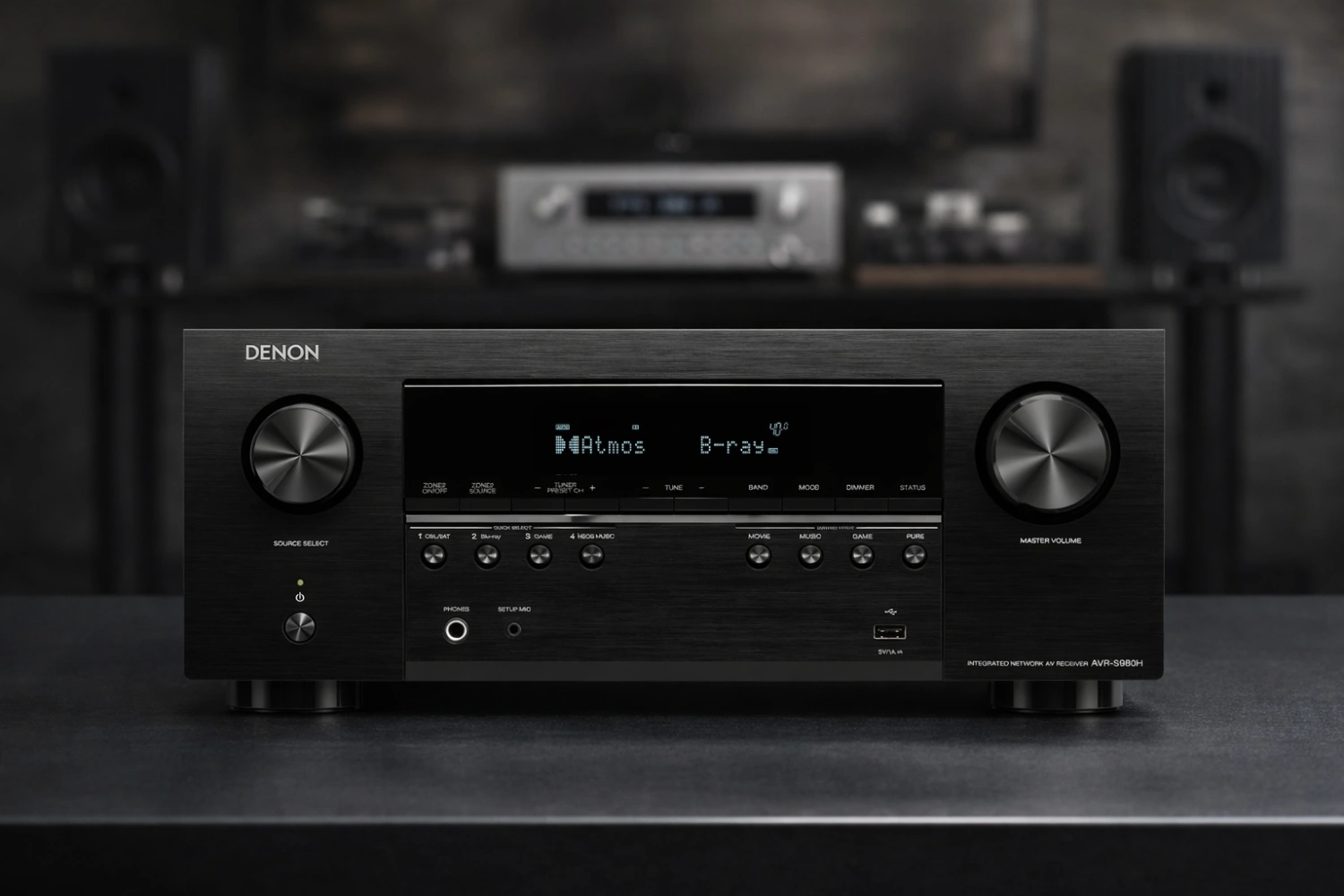
4. Denon AVR-S980H: Powerful 7.2 AV Receiver with HEOS Multiroom & Wireless Surround Upgrade
The Denon AVR-S980H is a 7.2-channel receiver aimed at accessible home cinema with multiroom flexibility.
The Denon AVR-S980H is described as a 7.2-channel AV receiver for listeners moving beyond a soundbar or basic setup while still wanting an accessible system.
The source presents it as flexible for both two-channel and multichannel use, with 90 watts per channel and a design intended to keep full-featured AV receiver ownership approachable.
Its title also points to HEOS multiroom and wireless surround upgrade capability, placing it firmly in the connected home entertainment category rather than only traditional wired cinema.
Best for: Households wanting a user-friendly step into full AV receiver sound
- 7.2-channel AV receiver
- Designed as a step up from a soundbar
- Flexible for stereo and multichannel sound
- HEOS multiroom capability
Verdict: A sensible upgrade path for listeners who want fuller home cinema than a soundbar while keeping setup and daily use approachable.
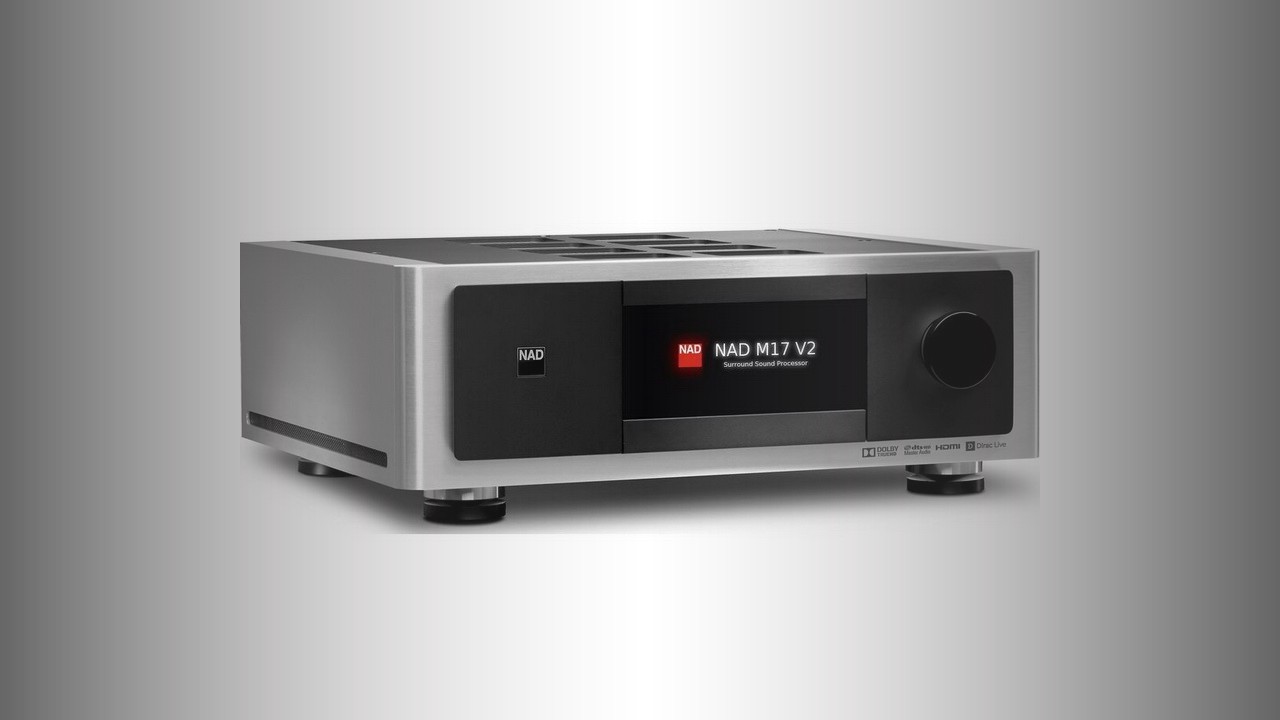
5. NAD M17 v2: Next-generation AV processor
The NAD M17 v2 is an AV processor-preamplifier with modular construction, Dirac Live and extensive rear-panel connectivity.
The NAD M17 v2 is a processor-preamplifier rather than an all-in-one receiver, so it is intended to be paired with external amplification.
The source highlights Dolby Atmos, Dolby TrueHD and DTS-HD Master Audio compatibility, Dirac Live automatic room correction, and NAD’s modular MDC concept for replacing internal modules.
It also supports 4K, HDR and 4:4:4 content, provides extensive connectivity including HDMI, balanced XLR pre-outs, RCA outputs and automation ports, and can operate within a BluOS music system with access to services such as Tidal, Deezer and Spotify.
Best for: Custom home theaters needing a processor with room correction and modular design
- Dolby Atmos support
- Dirac Live room correction
- Modular MDC architecture
- BluOS streaming platform
Verdict: A serious AV processor for systems built around separate amplification, especially where Dirac Live, BluOS and broad system integration matter.

6. Marantz NR1711: AV receiver equipped with advanced sound optimization
The Marantz NR1711 packages seven-channel AV receiver functionality into the brand’s slim NR-format chassis.
The Marantz NR1711 stands out because it brings AV receiver functionality into a low-profile chassis roughly half the height of conventional full-size units in the NR line.
It supports 8K at 60 Hz video, 4K at 120 Hz, and 3D audio formats including DTS:X and Dolby Atmos in a 5.1.2-channel configuration.
For systems without height speakers, DTS Virtual:X and Dolby Atmos Height Virtualization are included, while Audyssey MultEQ, Dynamic Volume and Dynamic EQ provide speaker calibration and listening-level optimization. The source also notes voice-assistant compatibility with Google Assistant, Apple Siri and Amazon Alexa, plus control through a proprietary app or remote.
Best for: Rooms where full AV receiver features must fit a slimmer cabinet
- Low-profile chassis
- Dolby Atmos and DTS:X in 5.1.2
- 8K at 60 Hz and 4K at 120 Hz support
- Audyssey room calibration
Verdict: A strong choice for space-conscious home cinema systems that still need modern video support, immersive audio and automated room setup.

7. Marantz AV7705: AV processor equipped with the latest AV technologies
The Marantz AV7705 provides 11.2-channel processing with balanced outputs for systems built around separate power amplification.
The Marantz AV7705 is an 11.2-channel AV processor designed for high-end home theater systems using external power amplification or active speakers.
Its strength is flexibility: it offers balanced and unbalanced 11.2-channel outputs, eight HDMI inputs including one on the front panel, and three HDMI outputs.
Video support includes 4K, HDR, BT. and Dolby Vision, with conversion of signals from other inputs to HD or 4K for HDMI output. On the audio side, the source lists Dolby Atmos, DTS:X and Auro-3D, while Audyssey MultEQ XT32 handles multichannel calibration.
Best for: High-end separates-based theaters needing broad output flexibility
- 11.2-channel processing
- Balanced and unbalanced outputs
- Dolby Atmos, DTS:X and Auro-3D
- Audyssey MultEQ XT32 calibration
Verdict: A versatile AV processor for ambitious multichannel systems where external amplification, immersive formats and detailed calibration are priorities.

8. NAD T758 V3i: AV Receiver worthy of consideration
The NAD T758 V3i combines AV receiver functionality with modular construction, AirPlay 2 and Dirac Live correction.
The NAD T758 V3i is presented as an AV receiver that follows the company’s simpler-is-better approach while addressing both home theater and audiophile expectations.
It adds AirPlay 2 and Siri support compared with its predecessor and uses separate digital audio and video modules that can be replaced with newer options.
The AM230 audio module supports Dolby Atmos and DTS-HD Master Audio processing and can handle MQA, while amplification is handled by NAD’s PowerDrive circuit. Speaker iQ auto-calibration with an included microphone and Dirac Live room correction are both cited as tools for adapting the receiver to a specific room.
Best for: Listeners wanting an AV receiver with audiophile-leaning design and room correction
- AirPlay 2 support
- Dolby Atmos and DTS-HD Master Audio processing
- Dirac Live room correction
- Replaceable audio and video modules
Verdict: A distinctive receiver for buyers who prefer NAD’s restrained feature philosophy, modular thinking and serious acoustic correction over long feature lists.
9. Onkyo PR-RZ5100: AV Reciever with flagship level quality
The Onkyo PR-RZ5100 is an 11.2-channel AV processor designed for full-scale immersive surround layouts.
The Onkyo PR-RZ5100 is a THX Ultra2 Plus certified 11.2-channel AV processor from the RZ series.
It supports a full 7.2.4-channel home theater configuration using Dolby Atmos and DTS:X, along with 4K video at 60 Hz.
The source emphasizes its separated digital and analog circuits, dual 32-bit Analog Devices SHARC DSPs and multiple DAC chips, positioning it as a processor for large, immersive systems rather than a simple receiver replacement. As with any processor, it is intended to be partnered with external amplification.
Best for: Large immersive theaters needing 11.2-channel processing
- 11.2-channel processing
- 7.2.4 Dolby Atmos and DTS:X support
- THX Ultra2 Plus certified
- Separated digital and analog circuits
Verdict: A flagship-style Onkyo processor for users building a full 7.2.4 Atmos or DTS:X system with separate power amplification.

10. McIntosh MX170: Reference AV Processor built for uncompromising audiophile home theater performance
The McIntosh MX170 is a reference AV processor with extensive HDMI routing, immersive surround support and RoomPerfect correction.
The McIntosh MX170 is a reference AV processor for high-end home cinema systems built around separate amplification.
Its HDMI section includes eight inputs and four outputs, with 4K Ultra HD support, HDCP 2.2, 18 Gbps bandwidth and 4:4:4 color depth.
The source also lists HDR, HDR10, Dolby Vision and HLG, plus three ARC-capable outputs and one eARC-capable output. For audio, it supports Dolby Atmos, DTS:X and Auro-3D, and includes RoomPerfect room correction to measure and compensate for the acoustic properties of the room. A dedicated HDBaseT output is provided for installations where the processor is located far from the display.
Best for: Reference-level separated theaters with advanced video routing needs
- Eight HDMI inputs and four outputs
- HDR10, Dolby Vision and HLG support
- Dolby Atmos, DTS:X and Auro-3D
- RoomPerfect room correction
Verdict: A highly specified AV processor for demanding installations that require extensive HDMI connectivity, immersive audio and room correction rather than built-in amplification.
Quick comparison
The products here split into three practical groups: AV receivers with built-in amplification, AV processors for systems with separate power amps, and source components for disc and file playback.
Choosing between them depends less on prestige and more on system architecture, speaker count, room correction needs and the video formats your display chain must support.
| Product | Best for | Verdict |
|---|---|---|
| Onkyo TX-NR696 | Value-focused receiver buyers wanting Dolby Atmos and DTS:X | A seven-channel receiver with virtual height options, second-room stereo output and THX Select certification. |
| McIntosh MVP901 | Disc collectors and high-end source systems | A universal player for Blu-ray, DVD, CD, SACD and Hi-Res files, but not native 4K UHD Blu-ray discs. |
| Denon AVC-S660H | Entry-level modern AV setups | A five-channel Denon with 8K at 60 Hz support, Audyssey calibration, network playback and wireless connectivity. |
| Denon AVR-S980H | Soundbar upgraders wanting a fuller receiver-based system | A 7.2-channel receiver focused on approachable use, stereo and multichannel flexibility, and HEOS multiroom capability. |
| NAD M17 v2 | Separate-amplifier systems needing Dirac Live and BluOS | A processor-preamplifier with modular MDC design, immersive audio support and wide integration options. |
| Marantz NR1711 | Slim-cabinet installations | A low-profile Marantz receiver with 5.1.2 Atmos and DTS:X, 8K at 60 Hz, 4K at 120 Hz and Audyssey optimization. |
| Marantz AV7705 | Flexible 11.2-channel separates systems | An AV processor with balanced and unbalanced outputs, immersive formats, 4K HDR video handling and Audyssey MultEQ XT32. |
| NAD T758 V3i | Receiver buyers prioritizing correction and modularity | A NAD receiver with AirPlay 2, Dirac Live, Speaker iQ and replaceable audio and video modules. |
| Onkyo PR-RZ5100 | Full 7.2.4 immersive theaters | An 11.2-channel THX Ultra2 Plus processor designed for Dolby Atmos and DTS:X systems using external amplification. |
| McIntosh MX170 | Reference processor installations with extensive HDMI needs | A McIntosh processor with eight HDMI inputs, four outputs, HDR format support, eARC and RoomPerfect correction. |
Frequently asked questions
Should I choose an AV receiver or an AV processor?
Choose an AV receiver if you want decoding, switching and amplification in one box, as with the Onkyo TX-NR696, Denon AVC-S660H, Denon AVR-S980H, Marantz NR1711 and NAD T758 V3i.
Choose an AV processor such as the NAD M17 v2, Marantz AV7705, Onkyo PR-RZ5100 or McIntosh MX170 when you plan to use separate power amplifiers or active speakers and need more system-design flexibility.
Do I need height speakers for Dolby Atmos or DTS:X?
Height speakers are the more complete route for object-based layouts, but several receivers in the source offer virtualization for systems without them.
The Onkyo TX-NR696 includes Dolby Atmos Height Virtualizer and DTS Virtual:X, while the Marantz NR1711 includes DTS Virtual:X and Dolby Atmos Height Virtualization.
How important is room correction in a home cinema system?
Room correction can be very useful because speaker placement and room acoustics strongly affect surround balance.
The supplied products include several approaches, such as Audyssey on the Denon and Marantz models, Dirac Live on NAD models, Speaker iQ on the NAD T758 V3i, and RoomPerfect on the McIntosh MX170.
What should I check before buying a home cinema component for video use?
Match the component to your display and sources.
Some models in the source support 8K at 60 Hz or 4K at 120 Hz, others focus on 4K HDR video, and the McIntosh MVP901 can upscale compatible formats but does not read native 4K UHD Blu-ray discs.
HDMI inputs, outputs, ARC or eARC support, HDR format support and installation distance all matter.
How to choose the right home cinema component
Start with the system shape.
If you want a clean, cost-conscious installation with one main electronics box, an AV receiver is the logical route.
The Onkyo TX-NR696 suits buyers who want seven channels, immersive-format support and THX Select certification. The Denon AVC-S660H is the simpler entry point with five-channel amplification, network playback and modern video support. The Denon AVR-S980H is aimed at households stepping beyond a soundbar into a 7.2-channel system, while the Marantz NR1711 is the more cabinet-friendly slim option. The NAD T758 V3i is the receiver to consider when modular construction and Dirac Live correction are central to the plan. Move to an AV processor when amplification is already handled separately or when the theater is large enough to justify separates. The Marantz AV7705 and Onkyo PR-RZ5100 both suit 11.2-channel ambitions, with the Onkyo specifically highlighted for 7.2.4 Dolby Atmos and DTS:X layouts. The NAD M17 v2 adds the appeal of Dirac Live, BluOS and modular MDC construction. The McIntosh MX170 is the most installation-oriented processor in this group, with extensive HDMI routing, HDR support, eARC, HDBaseT and RoomPerfect correction. Do not overlook the source. The McIntosh MVP901 makes sense where disc and file playback remain important, especially for Blu-ray, DVD, CD, SACD and Hi-Res audio libraries. Its limitation is just as important as its strengths: it does not read 4K UHD Blu-ray discs, so buyers should match it carefully to their media collection. Across the whole category, the most reliable buying decision comes from matching channel count, room correction, HDMI requirements, speaker layout and source formats before choosing on brand or appearance.