AV Receivers and System Hubs That Bring Music to Life
A carefully differentiated guide to AV receivers and related system hubs, from compact surround models to advanced Denon and Marantz platforms, stereo-first Yamaha and Naim options, and Teufel receiver alternatives.

A great AV receiver is more than a switching box.
In a modern system, it has to handle film soundtracks, music sources, television audio, gaming signals, room setup and speaker management without pushing the equipment rack into needless complexity.

1. Naim NAC 282
Naim NAC 282 preamplifier, a stereo control component with a unity-gain input for integration with AV receivers.
The Naim NAC 282 is not an AV receiver, but it earns its place here as a serious stereo preamplifier for systems that also need to coexist with home-cinema electronics.
Its dedicated configurable unity-gain input is specifically intended for use with AV receivers and similar components, allowing a two-channel Naim system to be integrated into a wider setup.
The source material also highlights Naim’s attention to circuit development, microprocessor control, optical protection monitoring, anti-resonance construction and precision rotary potentiometers, all aimed at preserving musical integrity and long-term stability. With six inputs, separate listening and recording functions, and DIN or RCA flexibility on two inputs, the NAC 282 is best understood as an audiophile control centre rather than a surround hub.
Best for: Stereo-first systems that need AV integration
- Configurable unity-gain input for AV receiver integration
- Anti-resonance design to reduce vibration effects
- DIN or RCA flexibility on two inputs
- Customizable remote control
Verdict: Choose the Naim NAC 282 when two-channel musical performance is the priority and the AV receiver needs to fit around a dedicated preamplifier.

2. Yamaha R-N1000A
Yamaha R-N1000A network stereo receiver, combining amplification, streaming, radio and HDMI ARC in a two-channel system hub.
The Yamaha R-N1000A is a network stereo receiver rather than a multichannel AV receiver, but it is highly relevant for listeners who want a music-centred system with modern TV connectivity.
It combines a discrete integrated amplifier, FM tuner and network player in one chassis, with MusicCast support for Yamaha multi-room use.
Its HDMI input with ARC support allows a TV connection for improved reproduction of film and television soundtracks, while digital and optical inputs broaden source compatibility. Yamaha’s True Sound concept, metal case, double chassis, ToP-ART amplifier construction, symmetrical boards, custom transformer and selected filter capacitors all point to a receiver designed around precise stereo reproduction rather than surround decoding.
Best for: Music-first living rooms with TV audio needs
- HDMI ARC for TV audio
- Built-in network player and FM tuner
- MusicCast multi-room support
- Double chassis for vibration and interference control
Verdict: The Yamaha R-N1000A is a strong alternative to an AV receiver when stereo music, streaming and TV sound matter more than surround speaker layouts.

3. Yamaha RX-V6A
Yamaha RX-V6A AV receiver, equipped for 7.2-channel home theater with HDMI switching and YPAO calibration.
The Yamaha RX-V6A is the first fully fledged AV receiver in this selection and is positioned in the source as a quality-and-price choice for a modern home theater.
Its 7.2 configuration and support for Dolby Atmos and DTS:X allow a surround system with sound from around the listener and, with suitable layouts, from above.
Seven HDMI inputs and one output support 4K Ultra HD with Dolby Vision and HLG, while three inputs are described as supporting 8K. Yamaha also includes analog and digital inputs, discrete-element amplifiers, high-quality DACs and YPAO auto-calibration to help adapt multichannel sound to the listening room and speakers.
Best for: Balanced home theater builds with broad source support
- 7.2-channel AV receiver configuration
- Dolby Atmos and DTS:X support
- Seven HDMI inputs
- YPAO room calibration
Verdict: The Yamaha RX-V6A is the most straightforward choice here for buyers who want a versatile AV receiver foundation without stepping into the larger high-end models.
4. Marantz Model 40n
Marantz Model 40n integrated amplifier, built as a stereo streaming amplifier with analog amplifier architecture.
The Marantz Model 40n is an integrated analog amplifier with built-in digital streaming, not an AV receiver.
Its relevance lies in systems where stereo sound quality is the goal but television audio also needs a serious amplifier path.
The source describes current-feedback circuitry, third-generation HDAM SA3 discrete amplifier modules, a carefully designed high-current power supply, a shielded toroidal transformer and high-capacity capacitors. Marantz also emphasizes separate internal treatment of preamp and output-stage functions. With its streaming capability and analog amplifier architecture, the Model 40n is a refined two-channel solution rather than a surround processor.
Best for: Refined stereo systems with digital streaming
- Built-in digital audio streaming
- Current-feedback circuit topology
- HDAM SA3 discrete amplifier modules
- High-current power supply with shielded toroidal transformer
Verdict: The Marantz Model 40n suits listeners who want streaming and serious two-channel amplification instead of multichannel AV receiver features.

5. Onkyo TX-SR393
Onkyo TX-SR393 AV receiver, designed for accessible small-room home theater with virtual surround technologies.
The Onkyo TX-SR393 is presented as an affordable AV receiver suited to a small room or an average city apartment.
Its most important features are Dolby Atmos Height Virtualizer and DTS Virtual:X, which are designed to create a three-dimensional sound field without requiring physical height speakers.
That makes it practical where ceiling installation or extra speaker wiring is not desirable. The receiver is also described as easy to set up and use, with a rear USB port, four HDMI inputs, and added pre-out outputs for a second sound zone. For games, movies and music in a compact home theater, it is one of the more approachable AV receiver options in the supplied material.
Best for: Small-room home theater on a simpler setup
- Dolby Atmos Height Virtualizer
- DTS Virtual:X
- Four HDMI inputs
- Second-zone pre-out outputs
Verdict: The Onkyo TX-SR393 is a practical entry point for compact surround systems that need virtual height effects without extra height speakers.
6. Denon AVR-X2900H DAB
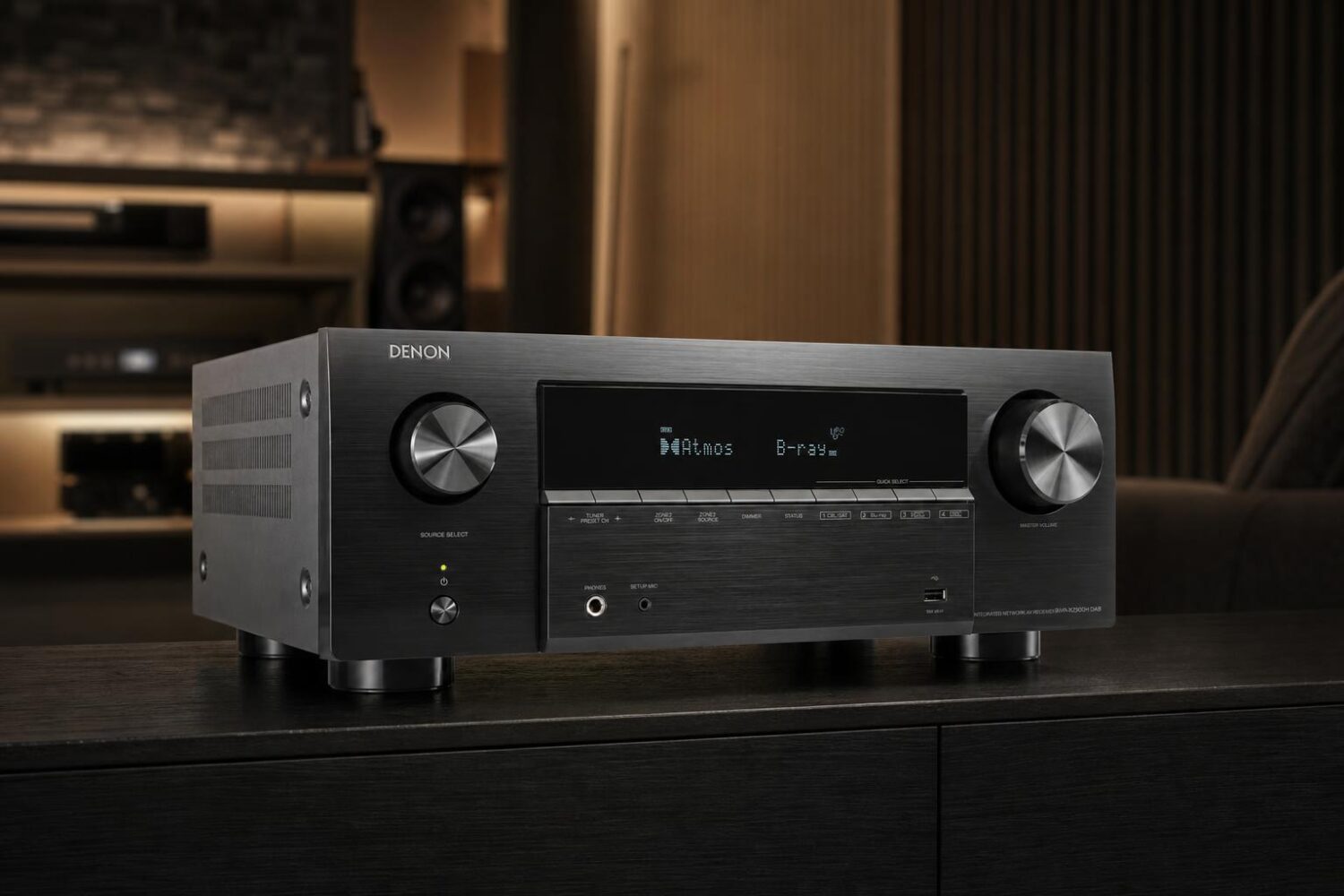
Denon AVR-X2900H DAB AV receiver, combining 7.1-channel amplification, HDMI 2.1 features, HEOS and DAB+/FM radio.
The Denon AVR-X2900H DAB is a 7.1-channel AV receiver intended as the central control point for a compact but capable film and music system.
It provides seven amplifier channels, support for a 7.1 speaker layout, and connections for two subwoofers.
Surround support includes Dolby Atmos and DTS:X, while Dolby Atmos Height Virtualization and DTS Virtual:X help create a perceived height effect when ceiling or height speakers are impractical. Video connectivity is a major distinction: the receiver includes HDMI 2.1 handling with six HDMI inputs, one HDMI output and support for 8K video features as described in the source. HEOS wireless music features and built-in DAB+/FM radio broaden its role beyond movie playback.
Best for: Compact home cinema with radio, streaming and modern HDMI needs
- 7.1-channel amplification
- Dolby Atmos and DTS:X support
- Dolby Atmos Height Virtualization and DTS Virtual:X
- HEOS plus DAB+/FM radio
Verdict: The Denon AVR-X2900H DAB is a well-rounded AV receiver for users who want surround processing, current HDMI handling, wireless music features and built-in radio in one unit.

7. Denon AVC-X4700H
Denon AVC-X4700H AV amplifier, a 9-channel platform with expanded processing and object-based surround support.
The Denon AVC-X4700H is a higher-specification AV amplifier with a 9-channel configuration and 11.2-channel linear outputs for expanded system layouts.
The source highlights support for Dolby Atmos, DTS:X, IMAX Enhanced and Auro 3D, plus configuration options such as 7.2.2 or 5.2.4 for object-based soundtracks.
Its construction is described as more substantial than the younger model referenced in the source, with improved anti-vibration characteristics and a front-panel hinged lid. Internally, it uses Denon’s 32-bit DDSC HD Digital technology, a power supply with a strong current reserve, SHARC-based DSP processing, proprietary AL32 processing and 32-bit AKM DAC chips across all channels. This is the more ambitious Denon choice for larger or more complex surround rooms in the supplied group.
Best for: Expanded object-based surround systems
- 9-channel AV amplifier configuration
- 11.2-channel linear outputs
- Dolby Atmos, DTS:X, IMAX Enhanced and Auro 3D support
- Audibly relevant anti-vibration construction is emphasized in the source
Verdict: The Denon AVC-X4700H is the Denon option to consider when the system needs more channels, broader surround-format support and expansion beyond a basic 7-channel layout.

8. Teufel Concept 8 and Concept 12
Teufel Concept 8 and Concept 12 active subwoofers, designed with integrated 5.1 amplifier technology for receiver-free surround setups.
The Teufel Concept 8 and Concept 12 are active subwoofers with integrated 5.1 amplifier technology, so they take a different route from buying a separate AV receiver.
Their built-in amplifier stages can power the subwoofer and distribute power to satellite speakers through speaker connections.
The source notes compatibility with Teufel passive speaker packages and speakers from other brands via standard terminals. For a 5.1 setup, HDMI is described as the preferred connection, with optical, USB digital, stereo RCA and Bluetooth also available. The Concept 8 uses an 8-inch downfire driver with 120 watts of power, while the Concept 12 uses a 12-inch frontfire driver with 150 watts. A 25-meter roll of speaker cable and a remote control are included to simplify setup.
Best for: Simplified 5.1 systems without a separate receiver
- Integrated 5.1 amplifier technology
- Can reduce the need for a separate AV receiver
- HDMI, optical, USB digital, stereo RCA and Bluetooth inputs
- Speaker cable and remote control included
Verdict: The Teufel Concept 8 and Concept 12 are alternatives to a conventional AV receiver for users who want a subwoofer-led 5.1 setup with built-in amplification.

9. 5 useful tips for choosing your first turntable
A first-turntable buying guide focused on operation style, construction and sound-quality considerations.
This is not an AV receiver product article, but it is useful for anyone building a receiver-based system that includes vinyl.
The source focuses on practical first-turntable decisions, beginning with whether to choose a fully automatic model or a more tactile manual hi-fi design.
It also stresses that sound quality is influenced by construction materials, so the turntable should not be treated as a purely decorative source. In an AV receiver context, the key editorial takeaway is simple: decide how involved you want to be with record playback, then choose a turntable whose build and operation suit the system you are actually assembling.
Best for: First vinyl source planning
- Explains manual versus fully automatic operation
- Connects construction materials with sound quality
- Useful for adding vinyl to a receiver-based system
Verdict: This guide helps receiver buyers think clearly about turntable usability and build before adding records to a broader music or home-theater system.

10. Marantz Cinema 50
Marantz Cinema 50 AV receiver, built for expanded home cinema with 9-channel amplification and 11.4-channel processing.
The Marantz Cinema 50 is a high-end AV receiver with 9 channels of amplification and an 11.4-channel processor for system expansion.
Its discrete-component amplifiers are described as providing significant output current, while the anti-resonance chassis is intended to protect the circuits from vibration.
HDMI switching is a major strength in the source material, with six HDMI inputs and three outputs supporting 8K at 60 Hz and 4K at 120 Hz, plus HDR10, HDR10+, HLG, Dolby Vision and Dynamic HDR. The main HDMI output supports eARC, and the processor decodes Dolby Atmos and DTS:X HD Master 3D formats while also generating virtual height channels for standard soundtracks. Audyssey MultEQ XT32 is included for system tuning, making this the Marantz choice for a more advanced surround installation.
Best for: Advanced home cinema with expansion plans
- 9 channels of amplification
- 11.4-channel processing for expansion
- Six HDMI inputs and three outputs
- Audyssey MultEQ XT32 tuning
Verdict: The Marantz Cinema 50 is the most ambitious Marantz AV receiver in this group, suited to systems that need premium HDMI handling, room correction and room to grow.
Quick comparison
The supplied material covers true AV receivers alongside stereo amplifiers, preamplifiers and receiver alternatives.
The clearest choice depends on whether the system is meant to prioritize surround cinema, stereo music, TV sound, simplified 5.1 installation or vinyl-source planning.
| Product | Best for | Verdict |
|---|---|---|
| Naim NAC 282 | Stereo-first systems that need AV receiver integration | A dedicated preamplifier with unity gain for AV integration, not a surround receiver. |
| Yamaha R-N1000A | Music-first living rooms with TV audio needs | A network stereo receiver with HDMI ARC, MusicCast and FM radio rather than multichannel decoding. |
| Yamaha RX-V6A | Balanced home theater builds with broad source support | A 7.2-channel AV receiver with Dolby Atmos, DTS:X, YPAO and extensive HDMI input provision. |
| Marantz Model 40n | Refined stereo systems with digital streaming | An integrated streaming amplifier for two-channel systems, not a home-theater receiver. |
| Onkyo TX-SR393 | Small-room home theater on a simpler setup | An affordable, compact AV receiver option with virtual height and surround processing. |
| Denon AVR-X2900H DAB | Compact home cinema with radio, streaming and modern HDMI needs | A 7.1-channel AV receiver combining surround formats, HDMI 2.1 features, HEOS and DAB+/FM radio. |
| Denon AVC-X4700H | Expanded object-based surround systems | A 9-channel AV amplifier with broader format support and 11.2-channel output expansion. |
| Teufel Concept 8 and Concept 12 | Simplified 5.1 systems without a separate receiver | Active subwoofer-based 5.1 amplifier systems that can replace a separate AV receiver in some setups. |
| 5 useful tips for choosing your first turntable | First vinyl source planning | A practical source-selection guide for anyone adding records to a receiver-based system. |
| Marantz Cinema 50 | Advanced home cinema with expansion plans | A 9-channel AV receiver with 11.4-channel processing, advanced HDMI switching and Audyssey MultEQ XT32. |
Frequently asked questions
Do I need a true AV receiver, or will a stereo receiver be enough?
Choose a true AV receiver if you want surround speakers, Dolby Atmos or DTS:X processing, HDMI switching for several video sources and room calibration.
A stereo receiver such as the Yamaha R-N1000A is better suited to music-first systems that only need two-channel playback and TV audio through HDMI ARC.
What matters most when choosing between 7-channel and 9-channel AV receivers?
Speaker layout is the key difference.
Models such as the Yamaha RX-V6A and Denon AVR-X2900H DAB suit more compact 7-channel systems, while the Denon AVC-X4700H and Marantz Cinema 50 provide 9 channels of amplification and more expansion potential for object-based surround layouts.
Can virtual height processing replace ceiling speakers?
Virtual height modes such as Dolby Atmos Height Virtualization, Dolby Atmos Height Virtualizer and DTS Virtual:X are useful when real height speakers are impractical.
They are designed to create a perceived height effect from more conventional layouts, but they should be treated as a practical compromise rather than the same installation approach as physical height channels.
How should music playback influence an AV receiver decision?
If music is central, look beyond surround format lists and consider the amplifier approach, streaming options and how the component fits the rest of the system.
The supplied material points to different paths: an AV receiver with HEOS or MusicCast features, a stereo receiver with HDMI ARC, or a dedicated stereo preamplifier such as the Naim NAC 282 integrated with an AV receiver through unity gain.
How to Choose the Right AV Receiver or System Hub
Start by deciding what the system must do every day.
For a living-room cinema with several video sources, a true AV receiver such as the Yamaha RX-V6A, Denon AVR-X2900H DAB, Denon AVC-X4700H or Marantz Cinema 50 is the most complete route because it combines HDMI switching, surround decoding, speaker management and room setup in one chassis.
If the room is small or speaker placement is limited, models with virtual height processing make sense because they are designed to create a more enveloping field without physical height speakers. Channel count should follow the intended speaker layout, not the other way around. A 7.1 or 7.2 receiver is appropriate for a compact surround installation, while 9-channel models and processors with expanded outputs are better aligned with larger object-based systems or future growth. HDMI capability is also important if the receiver will sit between modern sources and a TV; the supplied Denon and Marantz AV receivers place particular emphasis on current HDMI handling, while the Yamaha RX-V6A offers multiple HDMI inputs and support for advanced video formats described in the source. If music is the priority, do not assume that a multichannel AV receiver is automatically the right answer. The Yamaha R-N1000A, Marantz Model 40n and Naim NAC 282 show three different music-led approaches: a network stereo receiver with HDMI ARC, an integrated streaming amplifier, and a dedicated preamplifier that can integrate with AV electronics. These are better considered when stereo quality and source control matter more than surround-channel count. Finally, consider whether you need a receiver at all. The Teufel Concept 8 and Concept 12 offer a subwoofer-led 5.1 path with integrated amplification, while the turntable guide reminds buyers to think carefully about source quality and day-to-day usability. The best choice is the component that matches the room, the speakers, the sources and the way the system will actually be used.