
Speakers built for a dedicated listening room, a production desk and a television solve very different problems.
This selection therefore spans passive stereo speakers, active monitors, soundbars and complete surround packages rather than treating them as interchangeable products.
The conventional models range from the compact DALI Opticon 1 Mk2 to imposing floorstanders from Backes & Müller and Wilson Audio. Focal provides a coordinated family for stereo or home cinema, while the Kali Audio IN-5 addresses near-field monitoring. A separate vintage-inspired roundup offers further options for listeners drawn to traditional cabinet design. For television sound, the Sony and Samsung systems take three distinct approaches: a compact Dolby Atmos soundbar, a packaged 5.1 system and a soundbar with a wireless subwoofer. The right choice begins with the intended use, available space and required connections—not simply the largest cabinet or longest feature list.

1. Focal Omada
The Focal Omada family combines high-gloss black cabinets, curved front baffles and distinctive Slatefiber cones.
Focal’s Omada range sits between the company’s Theva and Vestia lines.
It comprises the compact two-way Omada No.
1 monitor, Omada No. 3 and No. 4 floorstanders, and a matching Omada Center for home cinema. All four models use Focal’s Slatefiber driver technology and share a high-gloss black cabinet, gently curved front baffle and leather-effect front panel, making this the most system-oriented option in the selection.
Best for: Building a coordinated stereo or home-cinema system
- Four coordinated speaker models
- Matching center speaker for home cinema
- Focal Slatefiber driver technology
- Consistent high-gloss black design
Verdict: A cohesive Focal range with monitor, floorstanding and center-channel choices for buyers who want a visually matched system.
2. Backes & Müller BM Line 35
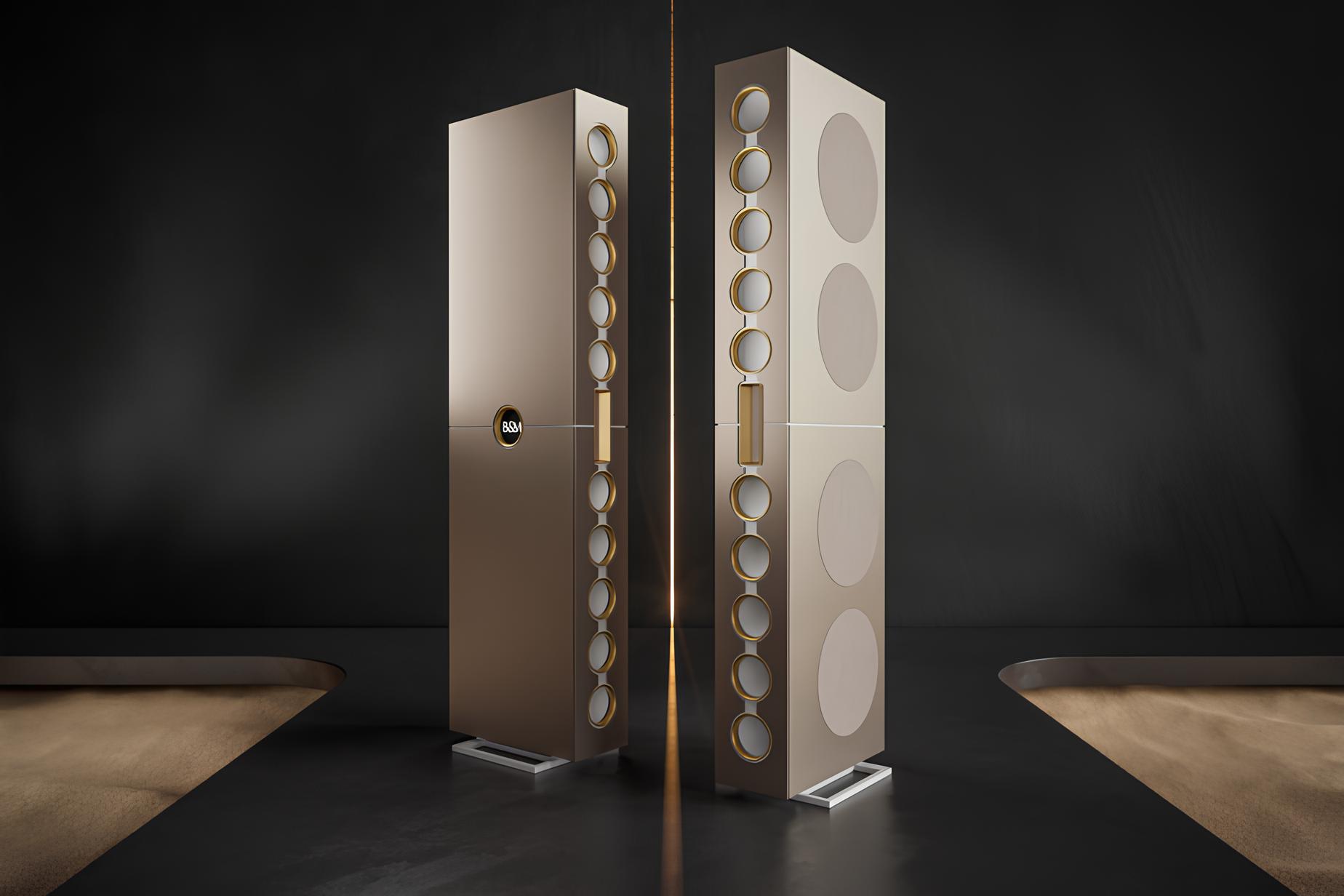
The 170-centimeter-tall Backes & Müller BM Line 35 places its cylindrical wave radiator at the center of a narrow front panel.
The BM Line 35 is an active high-end floorstander designed around an unusually tall, narrow enclosure measuring 170 centimeters high and 20 centimeters across the front.
Its central cylindrical wave radiator is combined with a midrange linear beam.
Backes & Müller says this vertically focused arrangement reduces floor and ceiling reflections while supporting a wide listening area, making the design particularly relevant to large contemporary rooms where cabinet width is a concern.
Best for: Large rooms requiring a narrow active floorstander
- Active floorstanding design
- Slim 20-centimeter front panel
- Patented cylindrical wave radiator
- Designed for large living rooms
Verdict: A specialized active design that combines substantial height with a slim footprint and controlled vertical dispersion.

3. 10 modern speakers with vintage design and sound
The featured vintage-inspired speakers revive the large cabinets, paper drivers and prominent horn elements associated with earlier hi-fi designs.
This broader source article gathers ten speakers inspired by classic designs from the 1970s and 1980s, covering multiple price levels.
Its focus is on traditional styling and an engaging musical presentation rather than appearance alone.
One highlighted model, the Magnat Transpuls 1000, is a three-way design with a 10-inch paper woofer, a 13.5-centimeter paper-cone midrange driver and a horn-loaded one-inch dome tweeter; the source praises its dynamics while noting limited sophistication.
Best for: Exploring modern speakers with vintage character
- Ten models across different price levels
- Traditional cabinet and driver concepts
- Magnat Transpuls 1000 offers a three-way design
- Strong dynamics attributed to the Magnat
Verdict: A useful starting point for listeners who prefer classic proportions and presentation but still want a range of modern choices.
4. Magnat Signature 507
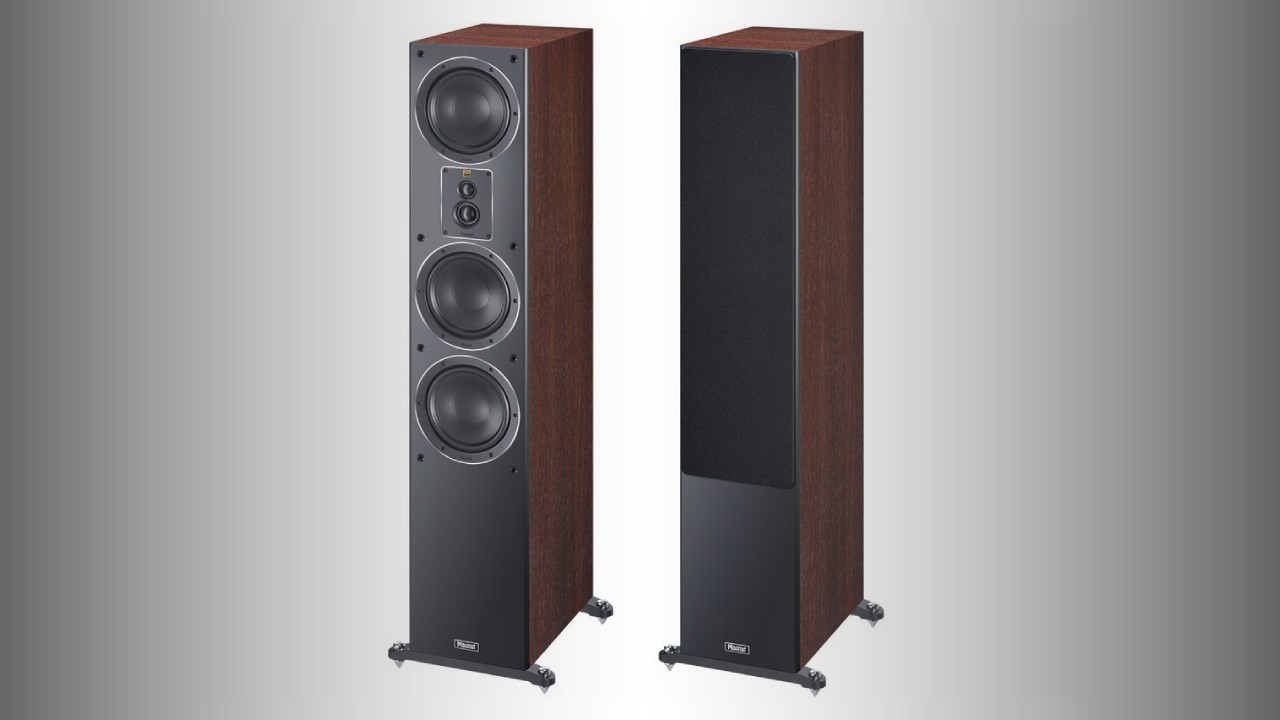
The Magnat Signature 507 is available with contrasting cabinet and front-panel finishes and features the range’s dual-tweeter module.
The Signature 507 is a floorstanding member of a wider Magnat range that also includes bookshelf, center-channel and subwoofer options.
Signature models use a two-tweeter assembly: a 1.2-inch dome hands over at the top of its range to a 20-millimeter super tweeter specified to operate up to 53 kHz.
The MDF cabinet is offered in black oak with a high-gloss black front or mocha with a matte front, while the rear terminals support bi-wiring and bi-amping.
Best for: Floorstanding stereo systems with flexible cabling options
- Dual-tweeter assembly
- MDF cabinet construction
- Bi-wiring and bi-amping terminals
- Two documented finish combinations
Verdict: A traditionally configured floorstander distinguished by its dual-tweeter arrangement, finish choices and split-terminal connectivity.

5. Kali Audio IN-5
The Kali Audio IN-5 pairs a five-inch woofer with a coaxial midrange and tweeter in a compact front-ported cabinet.
Kali Audio’s IN-5 is a compact three-way active monitor intended for mixing, production and control-room use.
A five-inch woofer is joined by a coaxial assembly containing a four-inch midrange driver and one-inch tweeter.
Separate Class D amplification supplies 80 watts to the woofer and 40 watts each to the midrange and tweeter, while balanced XLR and TRS inputs sit alongside RCA. Placement-oriented EQ settings, mounting options and a front-facing port strengthen its suitability for small studios and near-field setups.
Best for: Compact near-field mixing and production setups
- Three-way active architecture
- Coaxial midrange and tweeter
- Balanced XLR and TRS plus RCA inputs
- Placement and room EQ settings
Verdict: A well-equipped active monitor for users who need three-way construction, practical input options and placement adjustment in limited space.
6. DALI Opticon 1 Mk2
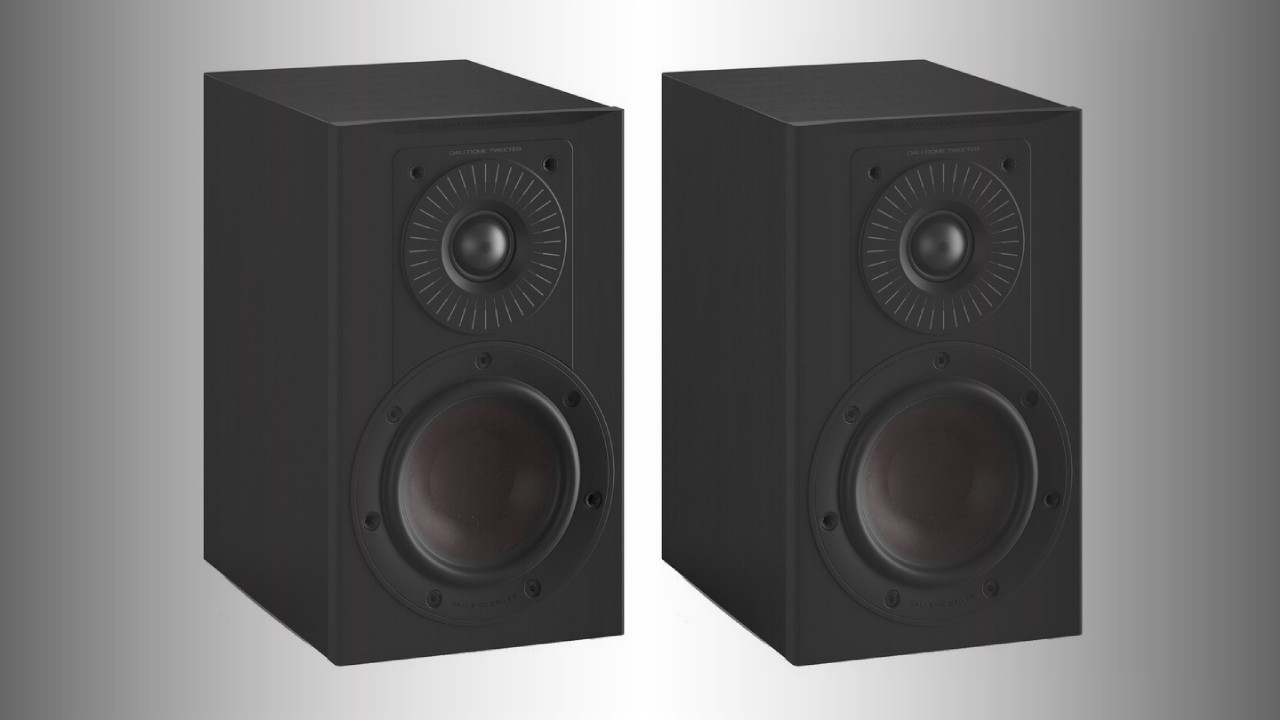
The compact DALI Opticon 1 Mk2 uses a 4.75-inch bass driver and a rear reflex port that influences room placement.
The Opticon 1 Mk2 is the smallest speaker in DALI’s series and is intended for compact stereo systems or rear-channel duties.
Its two-way design uses a 4.75-inch wood-pulp-and-paper bass driver with DALI’s SMC magnetic system.
The rear-firing reflex port makes clearance from the wall an important placement consideration. DALI also presents the speaker as capable of serving larger rooms when supported by a subwoofer.
Best for: Small stereo systems and surround rear channels
- Compact two-way cabinet
- Wood-pulp-and-paper bass driver
- SMC magnetic system
- Suitable for stereo or rear-channel use
Verdict: A compact passive speaker with flexible stereo and home-cinema roles, provided its rear port is given suitable wall clearance.

7. Sony HT-S2000
The Sony HT-S2000 fits five drivers into an 80-centimeter-wide 3.1-channel soundbar that can anchor an expandable system.
The HT-S2000 is an 80-centimeter-wide 3.1-channel soundbar with three full-range drivers and two X-Balanced woofers.
It supports Dolby Atmos and DTS:X, with Sony’s processing used to create virtual surround and height effects from the front of the room.
HDMI eARC and optical digital inputs handle wired sources, while Bluetooth and Wi-Fi provide wireless options. The system can be expanded with compatible Sony wireless rear speakers and either of two specified subwoofers.
Best for: A compact TV system with an expansion path
- Dolby Atmos and DTS:X decoding
- HDMI eARC and optical inputs
- Expandable with compatible Sony speakers and subwoofers
- Compact 3.1-channel format
Verdict: A space-conscious soundbar for buyers who want current surround-format support and the option to add compatible Sony components later.
8. Wilson Audio Autobiography
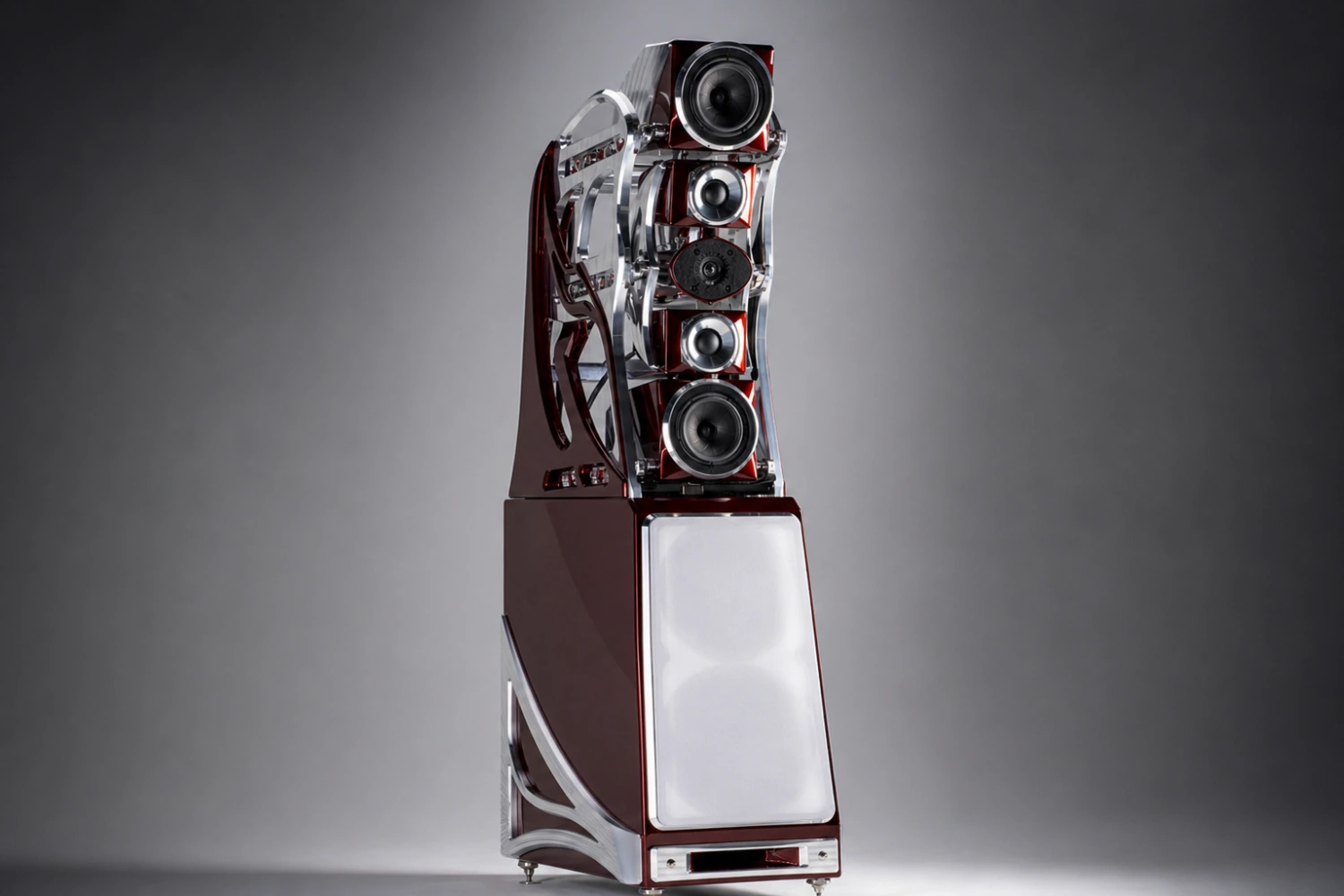
The approximately 212-centimeter Wilson Audio Autobiography uses eight drivers in a five-way floorstanding configuration.
Wilson Audio’s Autobiography is a five-way flagship floorstander standing approximately 212 centimeters tall.
Its eight-driver M(MTM)M configuration includes two seven-inch PentaMag midrange drivers, two two-inch midrange units flanking a forward-facing CSLS tweeter, separate 12-inch and 15-inch woofers, and a rear-facing ambient tweeter.
Every driver is described as new for this system. The scale and complexity make it a highly specialized proposition rather than a conventional living-room speaker.
Best for: Large-scale ultra-high-end installations
- Five-way, eight-driver configuration
- Separate 12-inch and 15-inch woofers
- New CSLS front tweeter
- Rear-facing ambient tweeter
Verdict: An exceptionally large and elaborate flagship whose physical demands and specialized architecture require careful system and room planning.

9. Sony HT-S40R
The Sony HT-S40R combines a front soundbar with a subwoofer, two rear speakers and a separate compact amplifier.
The HT-S40R packages a soundbar, subwoofer, two rear speakers and a compact rear-speaker amplifier into a 5.1-channel system rated at 600 watts.
HDMI ARC, optical digital and analog inputs are provided, along with Bluetooth streaming and USB playback.
Dolby Digital is supported, but object-based formats are not declared in the source. Although the system reduces the need to run a signal cable from the front to the back of the room, the rear speakers still connect by wire to their compact amplifier.
Best for: Straightforward 5.1 surround from a packaged system
- Packaged 5.1-channel system
- Dedicated rear speakers and subwoofer
- HDMI ARC, optical and analog inputs
- Bluetooth and USB music playback
Verdict: A practical route to physical rear-channel sound, as long as buyers account for the local wiring between the rear speakers and their amplifier.

10. Samsung HW-B650
The Samsung HW-B650 uses a 1,031-millimeter-wide, low-profile soundbar with a separate wirelessly connected subwoofer.
The Samsung HW-B650 combines a wide, low-profile soundbar with a wirelessly connected subwoofer.
The bar measures 1,031 millimeters across but only 57 millimeters high, so buyers should check that it fits between a television’s feet even though it is unlikely to obstruct the screen vertically.
Wall-mounting holes and a mounting kit provide an alternative installation method. The subwoofer measures 184 by 342 by 297 millimeters and only requires a power connection in addition to its wireless link with the bar.
Best for: TV installations needing a low-profile bar and separate subwoofer
- Low 57-millimeter bar height
- Wireless subwoofer connection
- Wall-mounting kit included
- Protective metal speaker grilles
Verdict: A simple bar-and-subwoofer arrangement whose main purchasing consideration is accommodating the soundbar’s substantial width.
Frequently asked questions
Should I choose passive speakers, active monitors or a soundbar?
Choose passive speakers when building a conventional hi-fi system around a separate amplifier.
Active monitors such as the Kali Audio IN-5 suit near-field desks and production spaces because amplification is built in.
A soundbar is generally the simpler option for television use, while a packaged 5.1 system adds physical rear channels.
How much does room size affect the choice?
Room size and listening distance should guide both cabinet type and placement.
Compact speakers such as the DALI Opticon 1 Mk2 suit smaller systems, while tall floorstanders need more physical and acoustic space.
A subwoofer can extend a compact speaker system, but it does not remove the need for careful positioning.
What should I check before placing speakers near a wall?
Check the port location and the manufacturer’s recommended clearance.
The DALI Opticon 1 Mk2 has a rear reflex port, so it needs appropriate space behind it.
Front-ported designs such as the Kali Audio IN-5 can be easier to accommodate, although room boundaries still affect bass response.
Does wireless surround mean there are no cables?
Not necessarily.
Wireless components still require power, and some systems retain local speaker wiring.
With the Sony HT-S40R, for example, the rear speakers connect by cable to a compact amplifier even though the arrangement reduces the need for a signal cable running from the front of the room.
How to narrow the choice
Begin by deciding what the system must do.
For focused music listening, choose between passive speakers that require external amplification and active designs with amplification already integrated.
Studio users should prioritize suitable inputs, near-field behavior and placement controls; the Kali Audio IN-5 addresses those needs more directly than the domestic floorstanders in this selection. Room planning comes next. Measure the available width, height and listening distance, then account for stands, wall clearance and cable routes. The DALI’s rear port deserves breathing space, the Samsung soundbar may be too wide to sit between some television feet, and the Backes & Müller and Wilson Audio models demand substantial vertical room. Large speakers should never be chosen on cabinet scale alone. For home cinema, decide whether virtual surround from a single bar is sufficient or whether physical rear speakers are essential. The Sony HT-S2000 offers format support and a modular expansion path, whereas the HT-S40R supplies rear channels as part of the package but still requires wiring around its rear amplifier. Also confirm HDMI compatibility, source inputs and support for the audio formats you actually use. Finally, treat design, finish and system matching as practical considerations rather than afterthoughts. Coordinated ranges such as Focal Omada make multichannel matching easier, while vintage-inspired speakers bring different proportions and styling demands. Once the format, room fit and connectivity are settled, auditioning with familiar material remains the most reliable way to decide whether a speaker’s presentation suits your priorities.


Sound Off
0Join the discussion if you have something to add.