
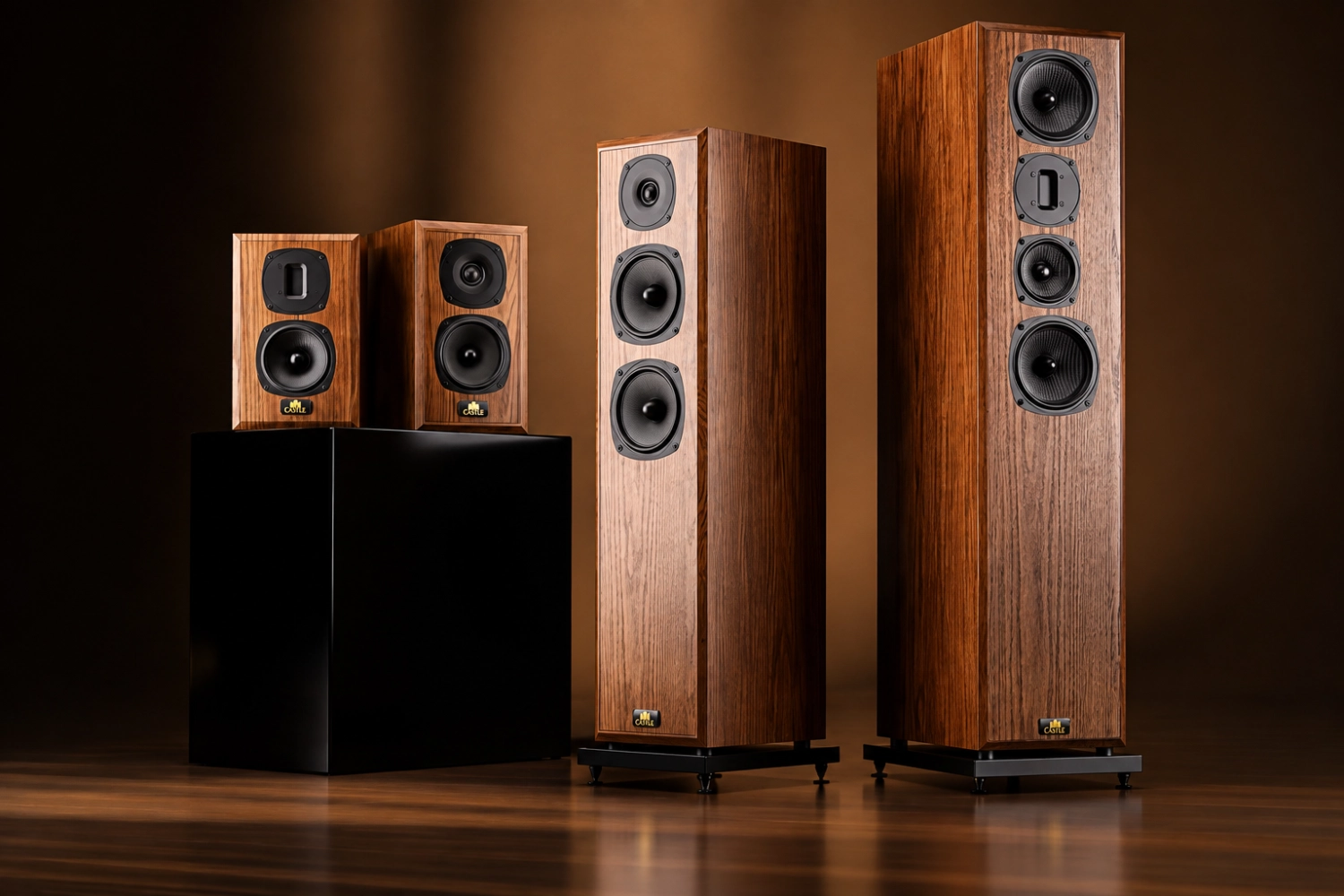
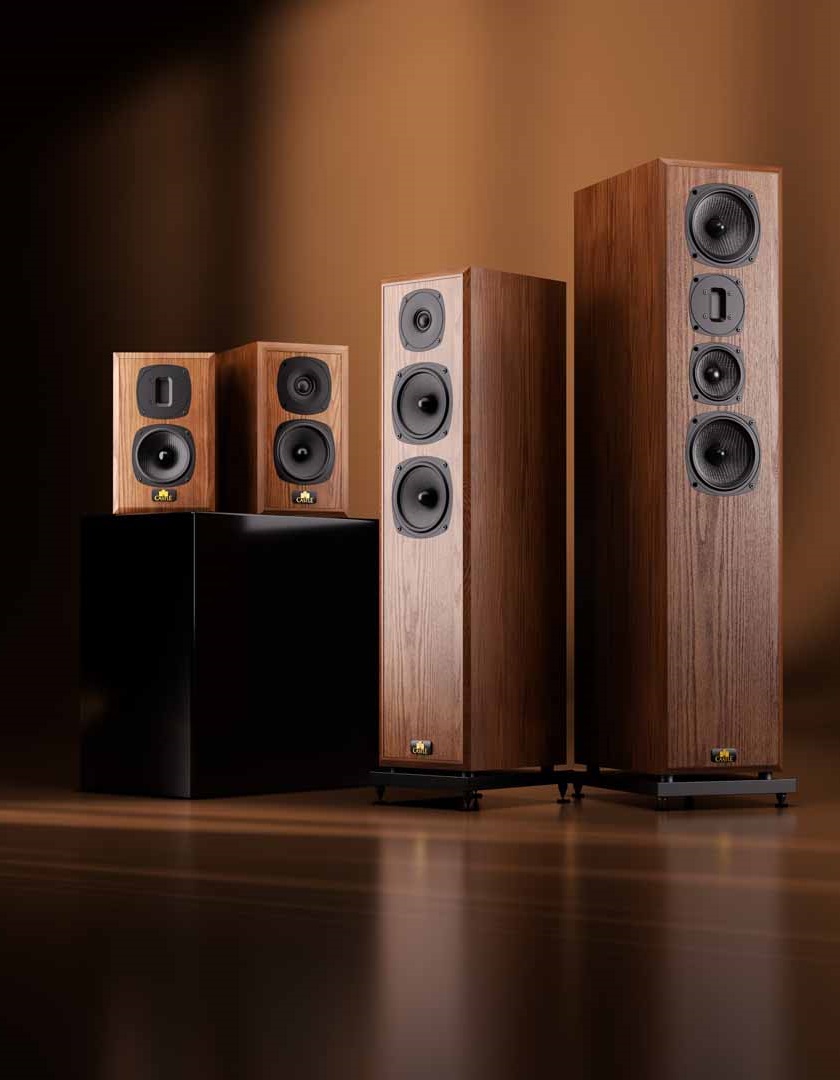
Castle Acoustics has unveiled the Tintagel and Walmer loudspeaker families, each comprising a compact monitor and a floorstanding model. All four speakers are designed, manufactured and finished in Huntingdon, Cambridgeshire, extending the British production program that began with the Windsor series.
Two ranges complete Castle’s British-made lineup
Tintagel serves as the more accessible entry point to Castle’s new British-made range, while Walmer occupies a higher position with more advanced driver materials and acoustic technologies. Together with the existing Windsor series, the launch creates a three-tier family of UK-produced Castle speakers, with two cabinet formats offered at each level.
The four new models are the first Castle introductions since the Windsor Earl and Windsor Duke arrived in 2023. Castle’s older Avon, Knight and Richmond lines remain part of the wider portfolio, although they are not manufactured entirely in the UK.
Castle was founded in Skipton, North Yorkshire, in 1973 by figures with experience at Wharfedale and Quad. International Audio Group acquired the brand and its associated manufacturing processes in 2007. Its current return to British production is being directed by Castle’s management and engineering team, including acoustic design director Peter Comeau.
Tintagel combines fiber drivers with silk-dome treble
The Tintagel 1 is a two-way monitor using a 130mm advanced-fiber mid-bass driver and a purpose-developed 28mm silk-dome tweeter. A shallow waveguide around the tweeter controls high-frequency dispersion, with the design intended to maintain a consistent tonal balance both on and away from the central listening axis.
Its larger sibling, the Tintagel 2, translates the same approach into a 2.5-way floorstanding enclosure. It employs two 150mm advanced-fiber drivers alongside the same 28mm silk-dome tweeter. A downward-firing bass port vents into a calculated air volume formed by the plinth, an arrangement designed to support controlled low-frequency extension and make positioning more manageable in typical rooms.
The compact Tintagel 1 instead uses a large flared rear port. Both models have a nominal impedance of 8 ohms and medium-to-high sensitivity, making them suitable for use with a broad selection of amplifiers.
Beyond their drivers, the Tintagel speakers incorporate cast-aluminum chassis, internal bracing, bitumen damping panels and long-fiber wool absorption. Their crossovers were developed to integrate the drive units as a complete acoustic system rather than simply divide the frequency range.
Walmer introduces carbon-fiber cones and ribbon tweeters
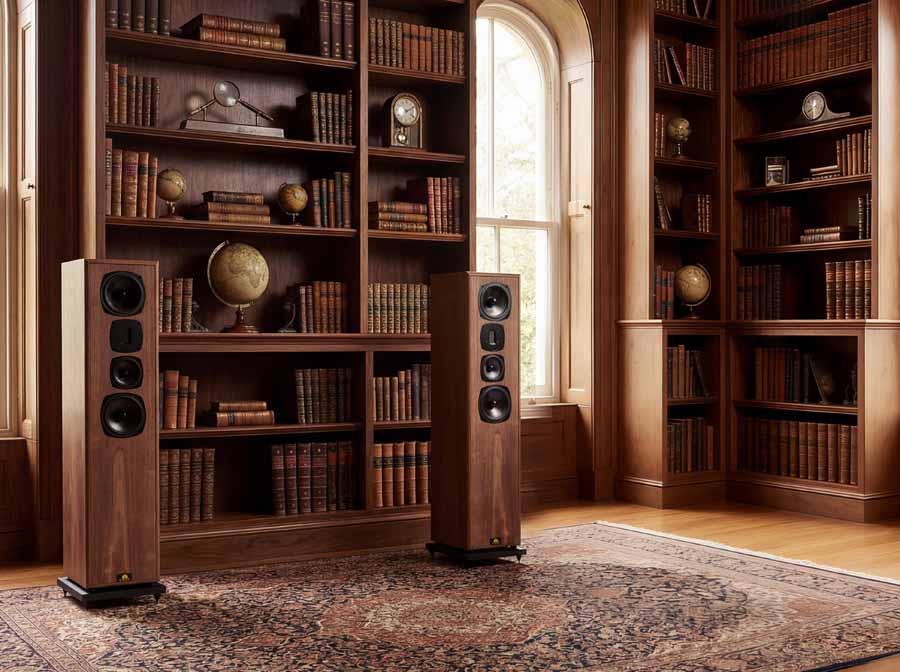
Walmer raises the technical specification with woven carbon-fiber diaphragms and a 12 x 45mm ribbon tweeter. The two-way Walmer 1 monitor pairs the ribbon unit with a 130mm woven carbon-fiber mid-bass driver.
The Walmer 2 is a three-way floorstander featuring two 150mm woven carbon-fiber bass drivers and a dedicated 115mm woven carbon-fiber midrange unit. That midrange driver operates in its own chamber, isolating it from pressure generated by the bass section of the cabinet.
Castle selected woven carbon fiber for its stiffness-to-weight ratio and resistance to unwanted cone flexing. The ribbon tweeter has very low moving mass and broad horizontal dispersion, while the crossover networks are configured to keep each driver within its intended operating range.
Walmer’s crossover components include polypropylene capacitors in the signal path and air-core inductors in the high- and mid-frequency filters. The Walmer 2 also uses a Mass Loaded Transmission Line system, developed from Castle’s quarter-wave loading principles. It terminates through a calculated air volume in the plinth and is specified to extend bass response down to 32Hz.
Cabinet production remains central to Castle’s identity
Every Tintagel and Walmer model is produced from concept through final finishing in Huntingdon. Castle designs the drivers and crossovers for their specific enclosures, maintaining control over the relationship between the drive units, filter networks and cabinet volumes.
Real-wood veneers are selected by hand, while cabinet panels are bonded under high pressure and left to dry naturally for 48 hours. The enclosures are then sanded and finished by hand, with quality checks conducted throughout production.
This integrated approach reflects Castle’s longstanding emphasis on treating the loudspeaker as a complete instrument. The company’s modern engineering is therefore paired with furniture-grade exterior finishing rather than separating acoustic development from cabinet manufacture.
With Tintagel covering the approachable end of the collection and Walmer adding carbon-fiber drivers, ribbon tweeters and more elaborate bass loading, Castle now offers a broader selection of British-made monitors and floorstanders. The launch also reinforces the brand’s focus on in-house engineering, real-wood veneer craftsmanship and complete production under one roof.


Sound Off
0Join the discussion if you have something to add.