

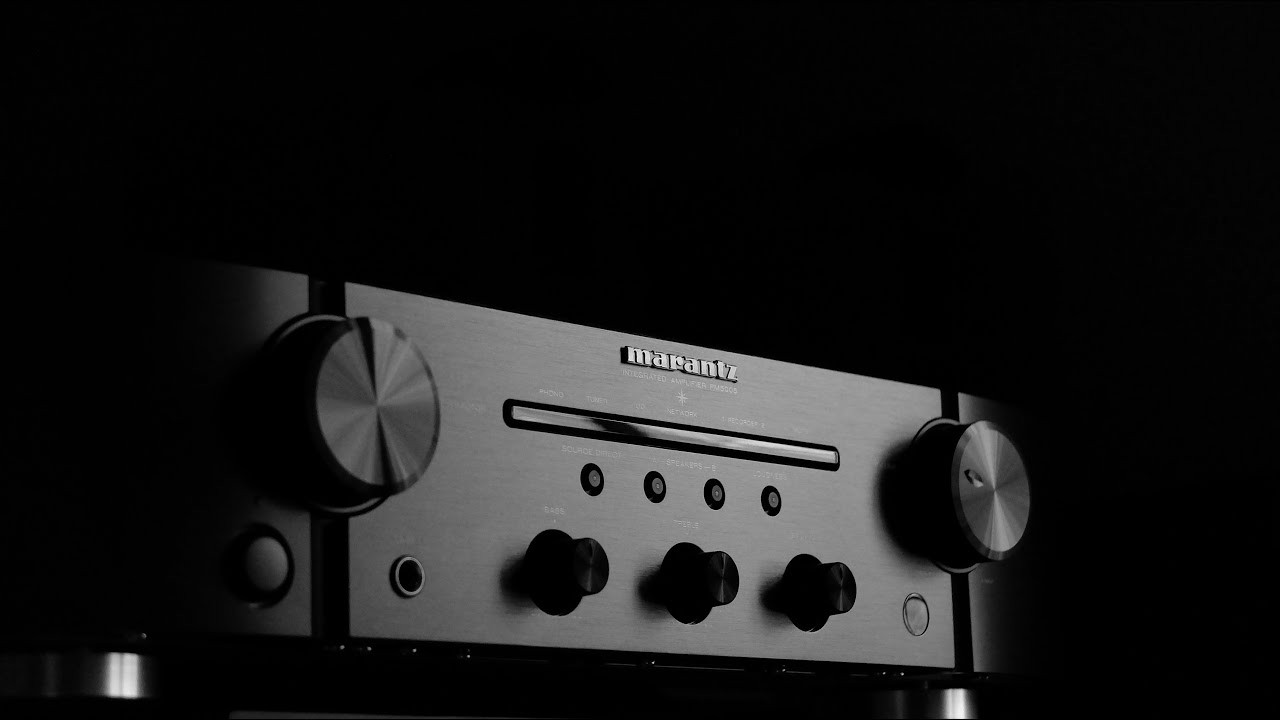
At a listed price of $350, the Marantz PM5005 is positioned as an accessible route into component-based stereo. Its appeal lies less in novelty than in the way it brings together the functions required by many conventional hi-fi systems: analog source switching, amplification, record-player support, headphone listening, tone adjustment, and connections for two pairs of speakers. Marantz also equips it with technologies associated with the company’s more ambitious designs, including current-feedback circuitry and proprietary HDAM-SA3 modules. The result is a focused integrated amplifier for listeners who want to build a stereo system around physical sources and separate components without paying for functions they may not use.
Current-feedback amplification at entry level
The PM5005 is a two-channel integrated amplifier rated at 40 watts per channel into 8 ohms and 55 watts per channel into 4 ohms. Those figures make it a sensible candidate for bookshelf speakers and compact floor-standing designs, particularly in small to medium-sized rooms. As with any amplifier, the impedance and sensitivity of the intended speakers should still be considered rather than relying on wattage alone.
A notable element of the design is its current-feedback circuit. Marantz specifies this topology as a means of working with a range of speaker loads while maintaining a consistent frequency response. Current feedback is also intended to process rapidly changing audio signals with speed and precision. Its inclusion is significant because the technology had previously been associated with models positioned higher in the company’s range.
The amplifier’s documented frequency response extends from 10 Hz to 50 kHz at +0/-1 dB. Marantz also specifies harmonic distortion of 0.01 percent and a damping factor of 100. These figures help describe the engineering objectives behind the PM5005, although they should not be treated as a substitute for matching the amplifier carefully to the rest of a system.
HDAM-SA3 modules and selected components
Marantz supplements the current-feedback circuit with its proprietary HDAM-SA3 modules. These modules are used in important parts of the signal path, while other sound-critical areas employ selected audiophile-grade components. For a prospective owner, the relevance is that the PM5005 is not simply a basic collection of generic amplifier functions. It incorporates circuit choices that reflect Marantz’s established approach to analog amplification.
The design remains appropriately straightforward for its market position. There is no documented digital-to-analog converter, USB connection, wireless receiver, or integrated streaming platform. Instead, the engineering and feature budget is concentrated on analog source handling and stereo amplification. That can be an advantage for someone who already owns a separate network player, CD player, or DAC and does not want those components duplicated inside the amplifier.

Five line inputs for a component-based system
The PM5005 provides five line-level inputs, designated for CD, tuner, network player, and two recorders. These labels make the intended system layout easy to understand, but the connections are conventional analog RCA inputs. The network input therefore does not add streaming by itself; it is a line-level connection for an external network player or another compatible analog source.
Five inputs provide enough room for a varied stereo system without requiring frequent cable changes. A user could connect a CD player, tuner, streamer, and two additional analog components simultaneously. All RCA connectors have gold-plated contacts, a durable and corrosion-resistant detail that is particularly welcome on a product intended to serve as the central connection point for several sources.
Two recorder outputs are also provided. These support traditional recording equipment or other applications that require a fixed-level analog feed. Although recording loops are less common in newer minimalist amplifiers, they remain useful for owners of cassette decks, CD recorders, and similar legacy hardware.

A built-in phono stage for vinyl playback
A dedicated phono input is one of the PM5005’s most practical features. It allows a compatible turntable to be connected without adding an external phono preamplifier, reducing both cost and system complexity. The phono input is specified at 2.2 mV sensitivity with an impedance of 47 kilohms, while the line inputs are rated at 200 mV and 20 kilohms.
Including phono support gives the amplifier a broader role than a simple line-level hub. It can anchor a system that combines vinyl with CD playback, radio, streaming through a separate network player, and recording equipment. This flexibility is especially relevant for listeners whose music collections span several generations of formats.

Two speaker pairs and room-to-room flexibility
Four pairs of speaker terminals are fitted, providing connections for two stereo pairs. This arrangement can accommodate two sets of speakers, including installations in separate rooms. It can also be useful when a listener wants access to different speakers without physically moving cables between terminals.
The feature expands the PM5005’s usefulness beyond a single, permanently configured listening position. However, owners should still pay attention to the electrical demands created by the speakers, especially if both pairs are used. Speaker impedance, cable routing, room size, and desired playback level all influence whether a particular arrangement is appropriate.
The stated output of 55 watts per channel into 4 ohms gives the amplifier greater rated power into the lower impedance than its 40-watt figure into 8 ohms. Within the intended medium-room context, that specification supports matching with a range of conventional bookshelf and compact floor-standing speakers rather than suggesting a role in unusually large or demanding installations.
Everyday control without unnecessary complexity
The front-panel feature set includes bass and treble controls, each offering an adjustment range of plus or minus 10 dB. Tone controls can be useful when dealing with difficult room acoustics, older recordings, or speakers whose balance benefits from modest correction. Their presence gives the owner more flexibility than an amplifier built around volume and source selection alone.
A headphone output supports private listening without requiring a separate headphone amplifier for basic use. The supplied RC002PMCD remote extends control beyond the PM5005 itself: it can also operate a Marantz CD player and network player. For a system assembled from compatible Marantz components, this reduces remote-control clutter and creates a more unified operating experience.
Control-system inputs and outputs are also included. Together with the multi-product remote, these connections reinforce the PM5005’s intended role as the center of a coordinated Marantz system rather than an isolated amplifier.
Practical size and power consumption
The PM5005 measures 440 mm wide, 105 mm high, and 370 mm deep, with a weight of 6.7 kg. Its full-width format suits a conventional component rack, but the 370 mm depth should be considered when choosing furniture. Additional clearance for connectors, speaker cables, and ventilation will also be necessary in a real installation.
Power consumption is specified at 110 watts, while standby consumption is rated at 0.3 watt. The low standby figure is a useful everyday detail for an amplifier likely to remain connected to mains power and operated by remote control.
Conclusion
The Marantz PM5005 is most suitable for listeners building an affordable, analog-centered stereo system around separate source components. Its strongest documented qualities are the current-feedback amplifier circuit, HDAM-SA3 modules, built-in phono stage, five line inputs, recorder connectivity, headphone output, and support for two speaker pairs. The coordinated remote control is particularly useful for owners of compatible Marantz CD and network players. Conversely, anyone seeking built-in streaming, wireless playback, digital inputs, or unusually high output power will need additional components or a different type of amplifier. For vinyl, CD, tuner, and externally streamed sources in a small or medium-sized room, the PM5005 offers a clear and flexible system foundation without loading the design with undocumented extras.


Sound Off
0Join the discussion if you have something to add.