
Amplifier matching begins with the job the component must perform.
An integrated amplifier can anchor a straightforward stereo system, while a power amplifier requires a separate preamplifier or processor.
A preamplifier such as the McIntosh C2700 handles source selection and volume but still needs downstream amplification, whereas Meridian’s active DSP speakers incorporate their own amplifiers. Channel count, speaker demands and connections matter as much as headline power. A five-channel model is a natural partner for home theater, a pair of monoblocks suits a dedicated stereo separates system, and a miniature Bluetooth amplifier can work where space is limited. Inputs and speaker terminals also need to match the rest of the system: the products here range from RCA and conventional speaker terminals to balanced XLR and SpeakON connections. The following selections are organized by practical system fit rather than by a single ranking criterion. Each has a distinct role, from driving five passive speakers in a large room to simplifying a digital system with fully active loudspeakers.
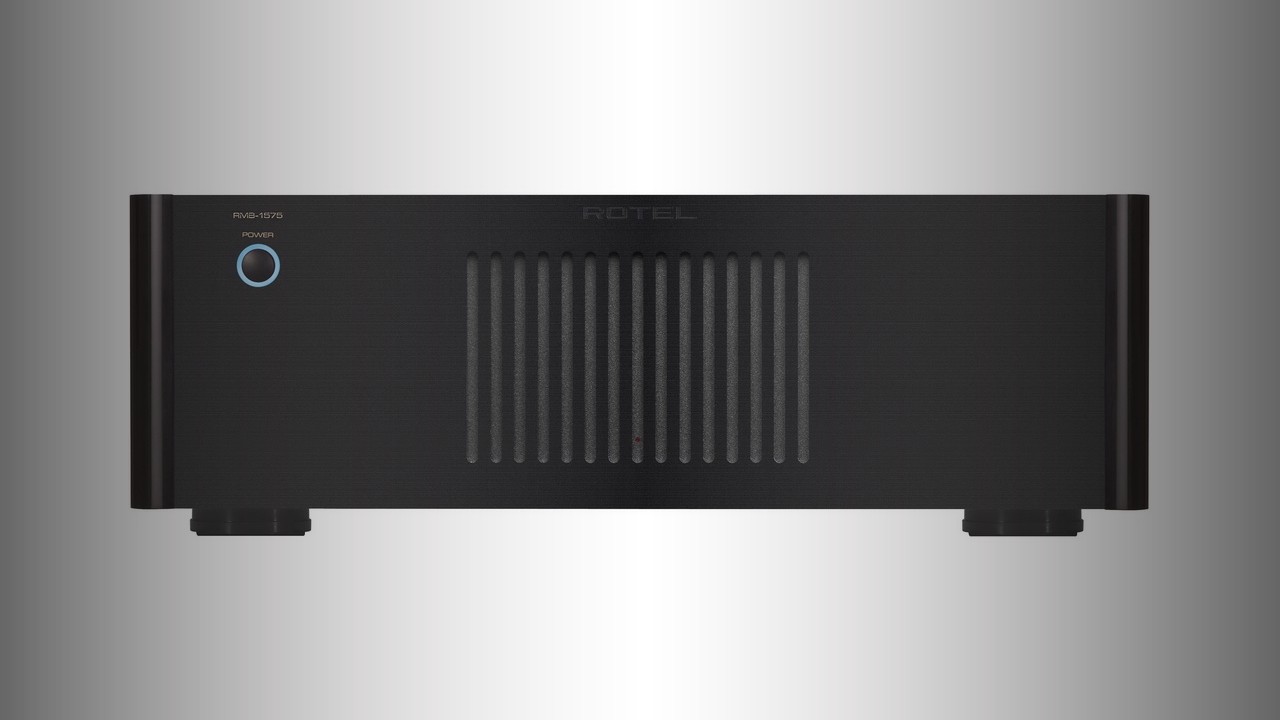
1. Rotel RMB-1575
Rotel RMB-1575 five-channel Class D power amplifier with RCA inputs, WBT speaker terminals and remote triggering.
The Rotel RMB-1575 is designed for systems that need five substantial amplification channels in one chassis.
It is rated at 5 x 250 watts with every channel operating into 8 ohms, while the supplied source states that output doubles with 4-ohm speakers.
Its Class D design draws 600 watts from the mains, produces relatively little heat and does not use noisy cooling fans. Five RCA inputs, five pairs of WBT speaker terminals and a trigger connection make it a logical match for a surround processor in a large-room home-theater installation.
Best for: Large-room five-channel home theater
- Five channels rated at 250 watts each into 8 ohms
- Designed to accommodate demanding 4-ohm speakers
- Low-heat, fanless Class D operation
- Trigger input for system integration
Verdict: A focused choice for an RCA-connected surround system requiring five powerful channels without fan noise or excessive heat.

2. Nobsound NS-10G PRO
Nobsound NS-10G PRO, a miniature two-channel Bluetooth amplifier rated at 50 watts per channel.
The Nobsound NS-10G PRO addresses a very different system brief: powering bookshelf speakers from an amplifier small enough to hold in one hand.
Its updated TPA3116-based design is rated at 50 watts per channel and includes Bluetooth 5.0+EDR, with the source claiming a wireless range of up to 15 metres.
Nobsound removed the volume control to simplify the circuit and shorten the signal path, so level adjustment must come from the connected source or another upstream component. Gold-plated copper connectors are included for improved corrosion resistance.
Best for: Compact wireless systems with bookshelf speakers
- Compact one-hand-sized enclosure
- Bluetooth 5.0+EDR connectivity
- Rated at 50 watts per channel
- Gold-plated copper connectors
Verdict: A space-saving Bluetooth amplifier for a simple stereo setup, provided volume can be controlled elsewhere in the signal chain.

3. McIntosh C2700
McIntosh C2700 tube preamplifier with an upgradeable DA2 digital module, HDMI ARC and dedicated MM and MC inputs.
The McIntosh C2700 is a tube preamplifier rather than a complete amplifier, making it suitable for a separates system with an external power amplifier.
Its DA2 digital module adds two coaxial, two optical, USB, MCT and HDMI ARC connections; Dolby and DTS multichannel signals can be converted to stereo.
USB support extends to DSD512 and DXD at up to 384 kHz. Analog provision is equally broad, with balanced and unbalanced line inputs plus separate MM and MC phono inputs. McIntosh separates the analog and digital input circuits, and the extensive balanced and unbalanced outputs offer flexibility when integrating power amplifiers.
Best for: Mixed digital, vinyl and television-based separates systems
- HDMI ARC and extensive digital connectivity
- Separate MM and MC phono inputs
- USB support for DSD512 and DXD up to 384 kHz
- Balanced and unbalanced adjustable outputs
Verdict: A highly connected tube preamplifier for systems that need modern digital access and serious analog flexibility in the same control component.
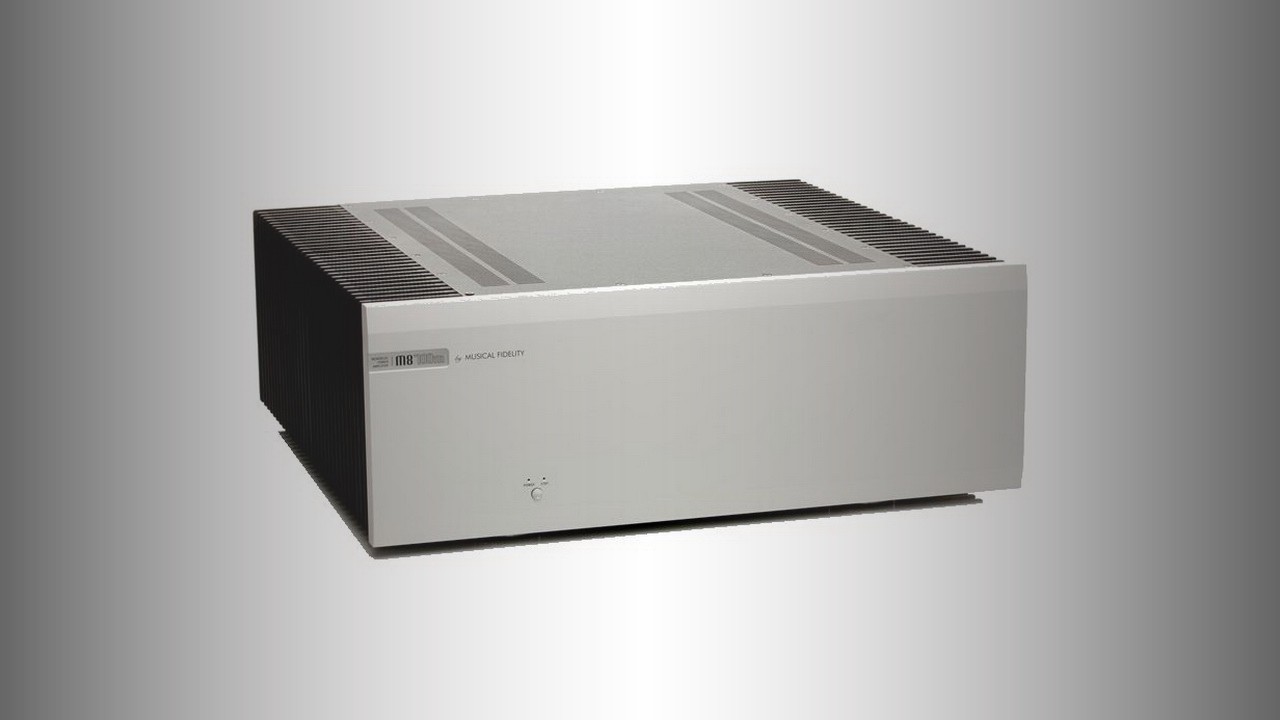
4. Musical Fidelity M8 700m
Musical Fidelity M8 700m mono power amplifier, built around bridged amplification sections and independent power supplies.
The Musical Fidelity M8 700m is a mono power amplifier, so a conventional stereo installation requires one unit for each channel as well as a separate preamplifier.
Inside each chassis are two amplification sections in a bridged configuration, two independent power supplies and a balanced converter responsible for phase matching.
Two pairs of speaker connectors support dual-cable connection, and the design also permits bi-amplifier configurations. The construction prioritizes electronic components, circuit boards and power transformers over decorative metalwork, using a welded steel chassis, substantial heat sinks and a thick, restrained front panel.
Best for: High-end stereo separates built around monoblock power
- Bridged internal amplification sections
- Two independent power supplies per monoblock
- Dual-cable speaker connection
- Supports bi-amplifier configurations
Verdict: A purpose-led monoblock for systems that prioritize substantial internal engineering, flexible speaker wiring and separate amplification for each channel.

5. Luxman L-507uX Mark II
Luxman L-507uX Mark II integrated amplifier with illuminated output meters, analog controls and MM and MC phono inputs.
The Luxman L-507uX Mark II is the most self-contained option here for a traditional analog stereo system.
This integrated amplifier combines system control and speaker amplification while providing four pairs of analog-device inputs, two pairs of connections for recording equipment and phono inputs for both MM and MC cartridges.
Its electronically operated LECUA1000 volume control offers 88 steps, while front-panel balance and tone controls provide adjustments that many minimalist amplifiers omit. A remote control and illuminated output meters complete a feature set suited to listeners with several analog sources.
Best for: Analog-focused stereo and vinyl systems
- Integrated design for a simpler stereo system
- Dedicated MM and MC phono connectivity
- 88-step electronic volume control
- Balance, tone and remote controls
Verdict: A versatile integrated amplifier for listeners who want vinyl support, recording connections and comprehensive front-panel control without assembling separate preamp and power stages.
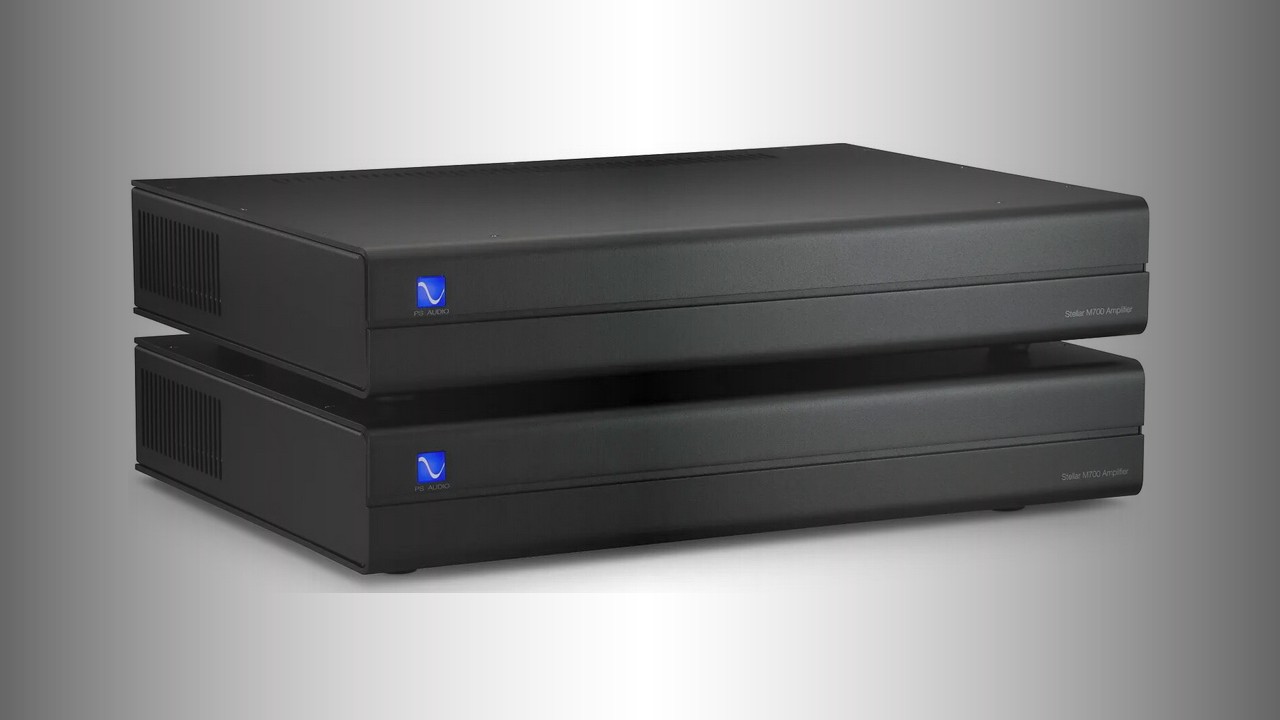
6. PS Audio Stellar M700
PS Audio Stellar M700 power amplifier, combining a discrete Class A Analog Cell input with an ICEpower Class D output stage.
The PS Audio Stellar M700 combines two amplification approaches within a power-amplifier design.
Its input section is PS Audio’s Analog Cell, a balanced, discrete Class A differential circuit using MOSFETs and no feedback.
The output stage is based on an ICEpower 700ASC Class D module, selected for efficiency, current delivery, linearity and low distortion. The resulting architecture is intended to retain the open and detailed character associated in the source with Class A while gaining the efficiency and damping characteristics of Class D. It belongs in a separates system with a suitable preamplifier or DAC capable of volume control.
Best for: Stereo separates combining Class A input design with Class D power
- Discrete balanced Class A input stage
- Zero-feedback Analog Cell circuit
- Efficient ICEpower Class D output stage
- High damping coefficient
Verdict: An appealing hybrid-topology power amplifier for systems seeking an analog-focused input stage alongside efficient Class D output engineering.

7. Ultrafide Audio SP500
Ultrafide Audio SP500 compact stereo power amplifier with RCA, XLR, XLR loop-through and SpeakON connectivity.
The Ultrafide Audio SP500 is presented as a compact 500-watt stereo power amplifier for installations where space and visual simplicity matter.
Its electronics are closely related to those of the larger U500DC, including Ultrafide’s Ultra Sigma output topology, but the enclosure and input-output arrangement are simplified.
Both RCA and balanced XLR inputs are provided, along with XLR loop connections. Loudspeakers connect through SpeakON terminals, an important consideration when planning cables for a domestic system. Its professional-audio background and compact enclosure distinguish it from more conventionally styled home amplifiers.
Best for: Space-conscious systems using professional-style connections
- Compact, minimalist stereo chassis
- RCA and balanced XLR inputs
- XLR loop-through connections
- Ultra Sigma output topology
Verdict: A compact high-output stereo power amplifier that makes particular sense when XLR, loop-through and SpeakON connectivity fit the installation.

8. Meridian DSP8000 XE
Meridian DSP8000 XE active loudspeaker system with dedicated Class AB and bridged Class D amplification for its driver sections.
The Meridian DSP8000 XE is not a conventional standalone amplifier but a fully active DSP loudspeaker system, making it relevant as an alternative to choosing separate speakers and power amplification.
Each midrange driver and beryllium-dome tweeter is powered by 150-watt Class AB amplification, while bridged Class D amplifier pairs deliver 240 watts to each of the three woofers.
Signal options include USB, Bluetooth through a Meridian B-Link and connection through a Meridian controller. Analog input requires the optional IA21 module. This approach shifts system matching away from amplifier and speaker compatibility toward source, controller and input selection.
Best for: High-end active digital systems without separate power amplifiers
- Amplification matched internally to each driver section
- Class AB amplification for midrange and treble
- Bridged Class D amplification for three woofers
- USB and Meridian system connectivity
Verdict: A comprehensive active-speaker route for listeners who prefer internally matched amplification and DSP over assembling passive speakers and external power amps.
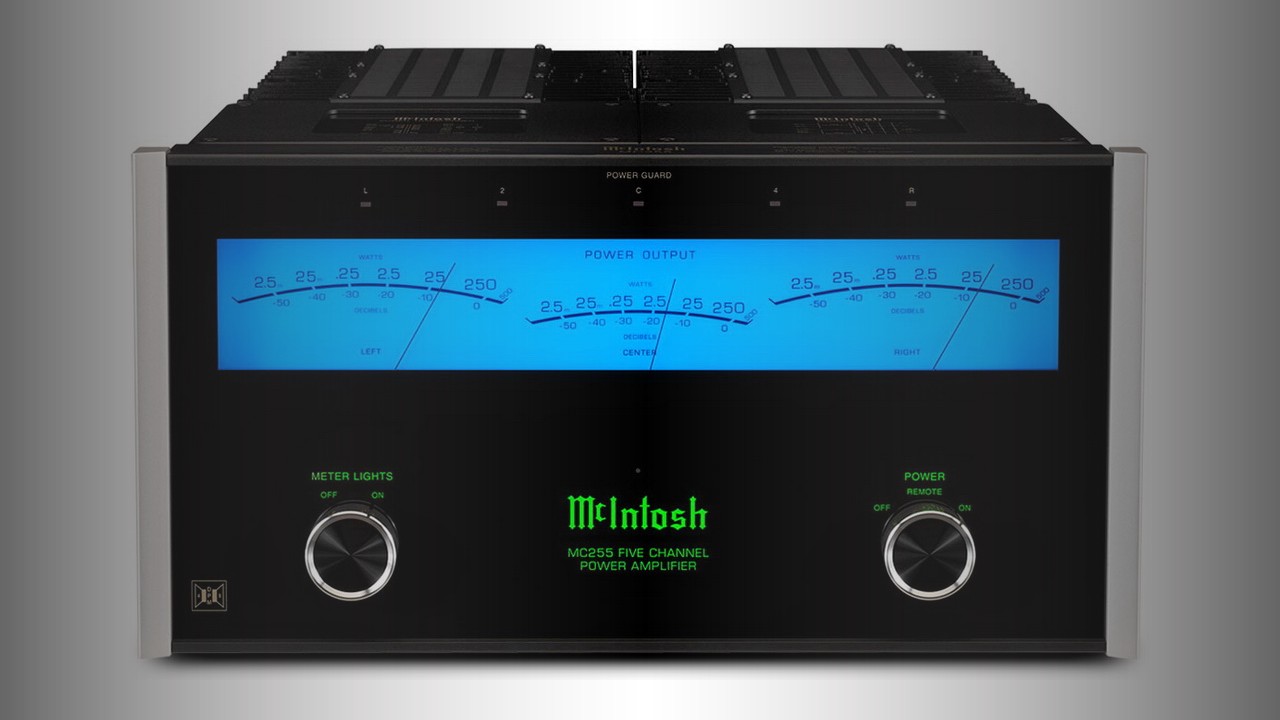
9. McIntosh MC255
McIntosh MC255 five-channel home-theater amplifier with a wide TripleView display for the three front channels.
The McIntosh MC255 is a five-channel power amplifier aimed squarely at home-theater systems.
With all five channels operating, it supplies 200 watts per channel; when only the front left, center and right channels are used, output rises to 250 watts per channel.
McIntosh’s Dynamic Power Manager maintains those ratings with either 4-ohm or 8-ohm speakers. The wide TripleView meter displays real-time output for the three front channels, while four heat sinks and a specially wound toroidal isolation transformer are intended to keep operation quiet. It can therefore support either a complete five-channel speaker array or a front-three-channel installation.
Best for: Five-channel theaters or dedicated front-stage amplification
- Five channels at 200 watts each
- Front three channels deliver 250 watts each when used alone
- Consistent ratings into 4- and 8-ohm speakers
- TripleView meter monitors the front channels
Verdict: A flexible theater power amplifier that can drive all five main channels or concentrate its output on the front left, center and right speakers.

10. Audio Note Oto SE 35
Audio Note Oto SE 35, a substantially revised single-ended pentode tube amplifier developed and manufactured in-house.
The Audio Note Oto SE 35 is described as the most substantial revision of the company’s long-running Oto tube amplifier in decades.
Its underlying concept remains a single-ended pentode design developed and manufactured in-house, reflecting Audio Note’s emphasis on durable, serviceable products and musical experience.
The supplied source does not state output power, input provision or supported speaker loads, so it cannot support a responsible recommendation for a particular room size or speaker sensitivity. A precise system match therefore depends on technical details beyond those included in the article excerpt.
Best for: Tube systems centered on single-ended pentode amplification
- Single-ended pentode tube design
- Major revision of the established Oto platform
- Developed and manufactured in-house
- Manufacturer emphasizes long-term servicing and repair
Verdict: A distinctive tube-amplifier proposition with a strong design philosophy, although the supplied information is too limited for precise speaker matching.


Sound Off
0Join the discussion if you have something to add.