

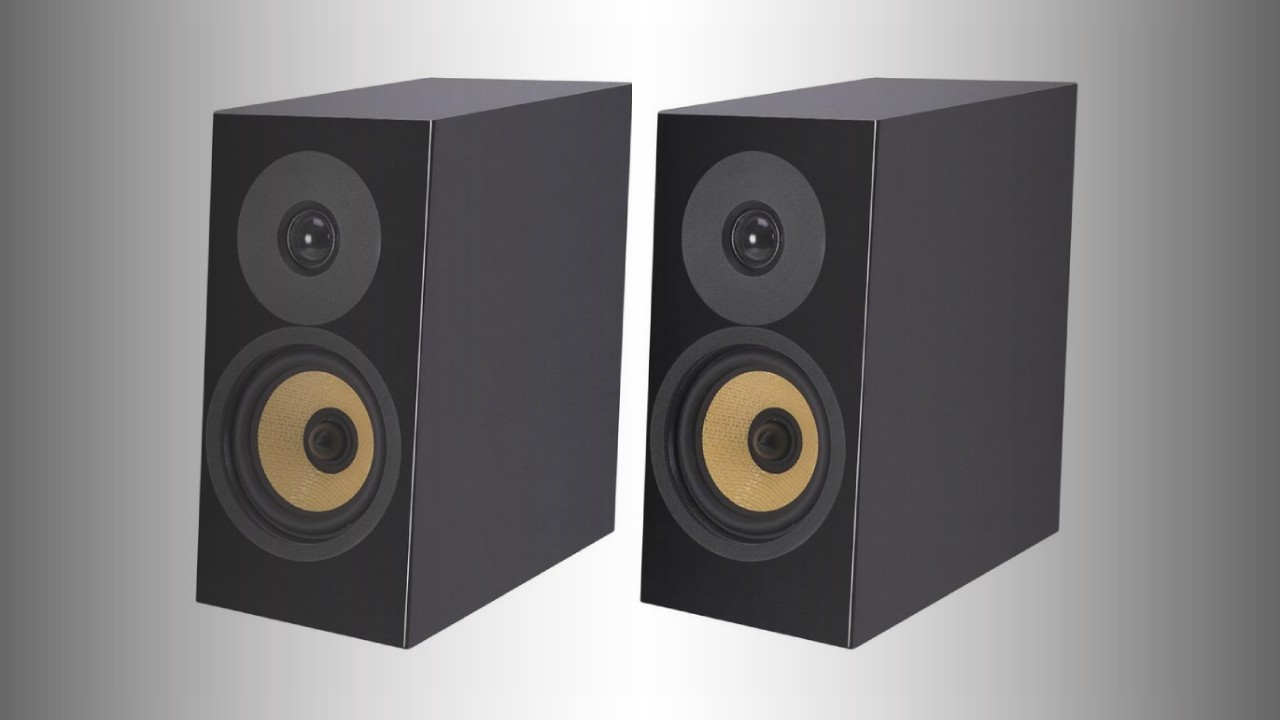
The Davis Acoustics Courbet No. 3 is a compact two-way bookshelf speaker with a particularly clear identity: it is the standmount member of the Courbet series, built in France by a manufacturer that develops and produces its own drive units for specific loudspeaker projects. That approach matters because it gives the speaker more than a generic parts-bin character. The tweeter was created for the Courbet line, the 13 cm Kevlar mid/bass driver fits the narrow cabinet concept, and the enclosure geometry is shaped around both sound radiation and room-friendly proportions. For prospective owners, the appeal is not only that the Courbet No. 3 is small enough for many living spaces, but that its compactness appears to be part of the engineering brief rather than an afterthought.
A compact speaker with a complete in-house philosophy
One of the most distinctive aspects of the Courbet No. 3 is Davis Acoustics’ production model. The company develops and manufactures dynamic drivers for particular applications rather than selecting only from externally available units. In practical terms, this allows the driver, cabinet and intended acoustic behavior to be considered together from the beginning of the design process. For a speaker such as the Courbet No. 3, where cabinet width, driver size and crossover integration all affect the final result, that level of control is a meaningful part of the product’s appeal.
The Courbet No. 3 is also made at Davis Acoustics’ own factory in France. This is not just a matter of national branding. A full production cycle gives the manufacturer control over driver creation, assembly and final build processes. For the prospective owner, this suggests a speaker whose main elements are conceived as a system rather than as a collection of purchased components. It also helps explain why the Courbet No. 3 has a specific technical character within the company’s range instead of feeling like a scaled-down version of a floorstanding design.
As the only bookshelf loudspeaker in the Courbet family, the No. 3 occupies a useful position. It offers the series’ design language and bespoke-driver approach in a format that can suit smaller rooms, apartment systems, secondary listening spaces or listeners who prefer standmount speakers paired with carefully chosen electronics.
Purpose-built drivers for a focused two-way layout
The Courbet No. 3 uses a two-driver, two-way configuration in a bass-reflex enclosure. Its high-frequency unit is the TW28LD, a 28 mm fabric-dome tweeter developed specifically for the Courbet series. The dome is impregnated with a damping compound, while the reinforced magnetic system includes air channels intended to cool the voice coil. The rear radiation from the dome is directed into a narrowing waveguide, a design choice aimed at reducing resonant peaks. According to the published specifications, the tweeter covers 4 kHz to 25 kHz with minimal nonlinearity.
The mid/bass driver is a 13 cm Kevlar unit, consistent with Davis Acoustics’ long association with that material. Kevlar is notable for combining low weight with high strength, and in a loudspeaker cone those qualities can support responsiveness while helping the diaphragm maintain its form under motion. The relatively small diameter also allows the front baffle to remain narrow, which is central to the Courbet No. 3’s visual and acoustic design.
A two-way bookshelf loudspeaker depends heavily on how successfully its two drivers share the musical spectrum. Davis Acoustics does not specify the crossover type or order here, so it would be unwise to draw conclusions about its topology. What is documented is the split between a dedicated tweeter and a long-stroke midrange/bass driver in a compact cabinet. The speaker’s stated frequency range of 55 Hz to 25 kHz gives it useful standalone bandwidth for a small stereo system, while its bass-reflex loading helps extend low-frequency output within the limits of a standmount enclosure.
Narrow cabinet, tilted front panel and domestic ease
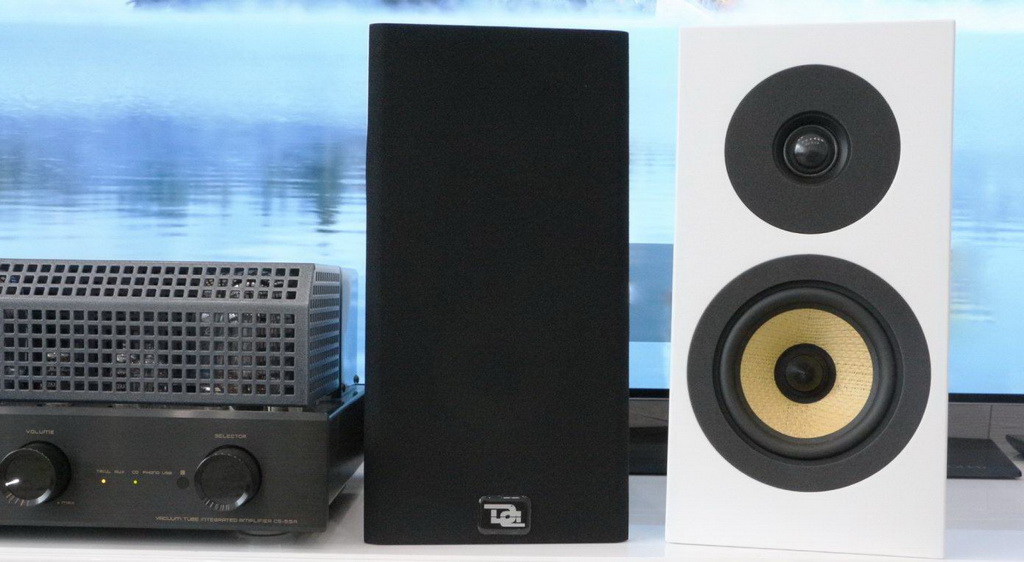
The physical design of the Courbet No. 3 is one of its strongest practical attractions. The speaker measures 340 x 175 x 250 mm and weighs 6.5 kg per unit, making it compact enough for many rooms without appearing visually intrusive. The 17.5 cm-wide front panel is particularly important: a narrow baffle can help reduce early reflections from the cabinet edges, supporting more precise imaging and a cleaner radiation pattern. It also gives the speaker a slim, understated look that is easier to integrate into living spaces than broader bookshelf designs.
The cabinets are made from thick MDF and include internal spacers. That construction is intended to provide the necessary rigidity for a compact enclosure handling both midrange and bass duties. The front panel is slightly tilted so that high and low frequencies reach the listener at the same time, a design feature associated with improved driver timing at the listening position. This is a subtle but worthwhile detail, because standmount loudspeakers often rely on careful physical geometry to support coherent presentation.
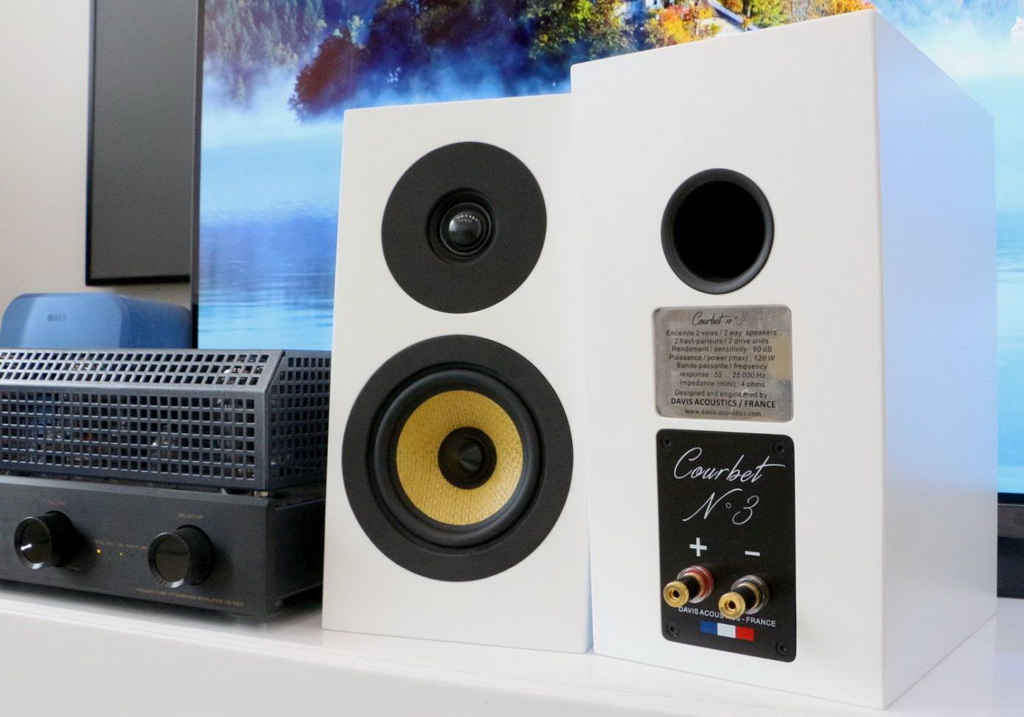
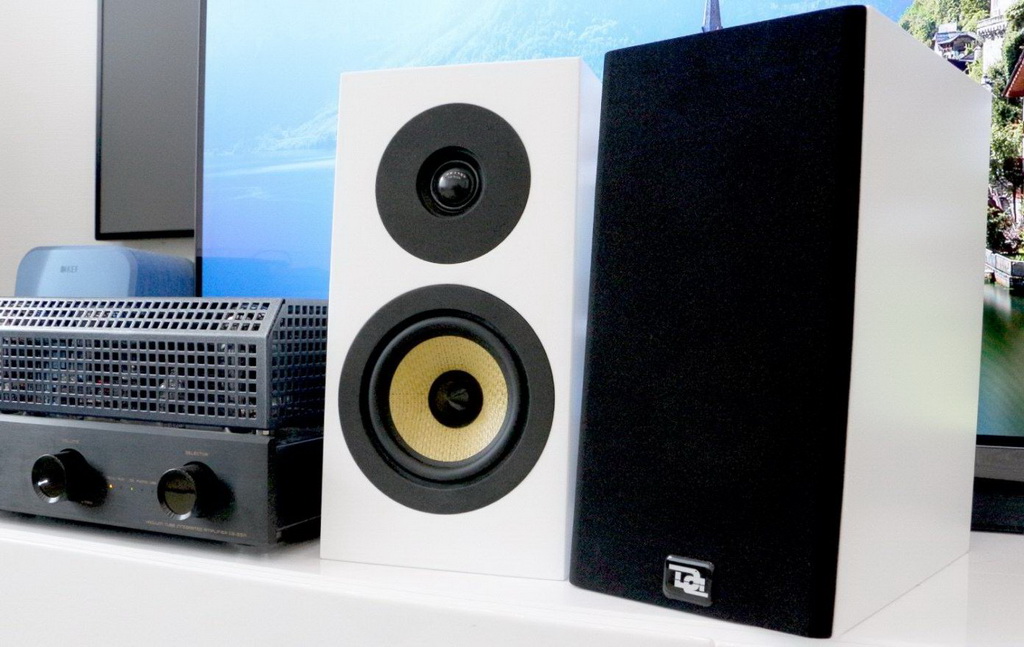
Davis Acoustics also addresses everyday appearance and usability. Fabric grilles cover the full front panel and attach magnetically, avoiding visible grille sockets and allowing the speaker to be used cleanly with or without grilles. The documented finishes are black lacquer and matte white, with mahogany and dark walnut veneer planned. That range gives the Courbet No. 3 two immediate visual personalities: a gloss-black finish for a more formal hi-fi look, and matte white for rooms where the speaker needs to recede visually.
Connectivity and system matching considerations
The Courbet No. 3 provides bi-wiring terminals, with paired solid terminals connected by jumpers in the standard configuration. This gives owners flexibility. Most users can run a conventional single speaker cable connection using the supplied jumpers, while those who prefer to separate high- and low-frequency wiring have that option available. The presence of bi-wiring does not require a more complex setup, but it does leave room for system experimentation.
The specifications also make the Courbet No. 3 relatively straightforward to consider in system planning. Sensitivity is stated at 90 dB for 2.83 V at 1 m, nominal impedance is 8 ohms, and minimum impedance is 4 ohms. Nominal and maximum input power are listed at 80 W and 120 W respectively. These figures suggest a speaker intended for normal integrated-amplifier use rather than requiring unusually specialized amplification. As always, amplifier quality, room size and listening levels will matter, but the documented numbers give the Courbet No. 3 a practical electrical profile for many stereo systems.
Because the low-frequency extension is specified at 55 Hz, placement and room interaction will be important. On proper stands, with some attention to distance from rear and side walls, the speaker’s bass-reflex design should be allowed to operate as intended. In larger rooms or for listeners who prioritize deep bass, a subwoofer could be considered, but the Courbet No. 3’s stated bandwidth is sufficient for many music-focused compact systems without making a subwoofer mandatory.
Why the design choices matter in use
Several of the Courbet No. 3’s features are valuable because they serve more than one purpose. The small 13 cm driver supports a narrow baffle, and that narrow baffle contributes both to acoustic behavior and visual elegance. The magnetic grilles preserve the clean front-panel design while giving owners a choice between a more technical exposed-driver appearance and a softer, furniture-friendly presentation. The tilted front panel is also not merely stylistic; it is intended to help align the arrival of different frequency ranges at the listener.
The documented sonic character emphasizes fast bass, detail, natural timbres, a spacious stage and clearly localized elements within a three-dimensional picture. Without presenting those descriptions as listening test results, it is reasonable to connect them to the design priorities: controlled tweeter behavior, a narrow front baffle, a rigid braced cabinet and a lightweight Kevlar mid/bass driver. For buyers who value stereo imaging and rhythmic clarity in a compact loudspeaker, the Courbet No. 3’s engineering choices are aligned with those goals.
Its format is also useful for people who want a high-quality stereo system that does not dominate a room. A speaker of this size can be placed on dedicated stands, used in a refined office system or integrated into a living room where large floorstanding speakers would be impractical. The Courbet No. 3 is therefore not simply a smaller alternative; it is a speaker designed around the advantages of a compact enclosure.
Who the Courbet No. 3 is most suitable for
The Courbet No. 3 is likely to appeal most to listeners who want a serious bookshelf loudspeaker with a strong engineering backstory, compact dimensions and flexible placement potential. It is especially relevant for stereo systems in small to medium rooms, for owners who appreciate French manufacturing, and for those who value purpose-designed drivers rather than a speaker assembled from standard off-the-shelf units.
It also suits buyers who care about visual integration. The narrow cabinet, full-height magnetic grille and choice of black lacquer or matte white finishes make it easier to place in contemporary interiors. The forthcoming wood veneer options may broaden its appeal for more traditional rooms, but even in its documented finishes the design is relatively discreet.
It may be less suitable for listeners who need very deep bass from the main speakers alone, who are filling a large space at high levels, or who prefer the physical scale of floorstanding speakers. Its strengths are more clearly aligned with compact high-fidelity systems where imaging, construction quality, driver integration and room compatibility are priorities.
Conclusion
The Davis Acoustics Courbet No. 3 is attractive because its compact bookshelf format is supported by a coherent set of documented design decisions: French in-house manufacture, a Courbet-specific 28 mm fabric-dome tweeter, a 13 cm Kevlar mid/bass driver, a narrow braced MDF cabinet, magnetic grilles, bi-wiring terminals and a slightly tilted front baffle for improved arrival alignment. Its strongest qualities are its integration of bespoke drivers with practical proportions and its ability to bring the Courbet series concept into smaller, more flexible stereo systems. It is best suited to listeners who want a refined standmount speaker for a music-focused room where careful engineering, compact size and clean visual design all matter.



Join the discussion
Share your thoughts, listening impressions or product experience.