FiiO LF-RB: A More Flexible Cable for MMCX In-Ear Systems
The FiiO LF-RB is designed for listeners who move between multiple portable sources and do not want a separate cable for every headphone output. Its magnetic interchangeable plug system covers 2.5 mm, 3.5 mm and 4.4 mm connections, while the cable itself uses silver-coated copper conductors, shielding, a TPU jacket and MMCX earphone connectors.

The FiiO LF-RB addresses a very specific but increasingly common problem in portable hi-fi: one pair of in-ear headphones may need to work with several different headphone outputs. A smartphone adapter, a portable DAC, a digital audio player and a compact amplifier can all use different connection standards. Some provide a conventional 3.5 mm output, while others offer balanced outputs on 2.5 mm or 4.4 mm sockets. Instead of forcing the owner to choose one termination at the time of purchase, the LF-RB is built around a set of replaceable magnetic plugs that let the same cable adapt to all three formats.
A cable built around changing sources
The central idea of the FiiO LF-RB is simple: keep the cable, change the plug. At the source end, the cable can be fitted with a 2.5 mm balanced plug, a 4.4 mm PENTACONN-style balanced plug, or the widely used 3.5 mm single-ended mini-jack. That combination is useful because portable audio has not settled on one universal connector. Many older and compact balanced devices use 2.5 mm, a growing number of modern players and amplifiers use 4.4 mm, and the 3.5 mm jack remains the most familiar connection on a wide range of equipment.
For a listener who owns more than one source device, this kind of flexibility can reduce the need to buy duplicate cables for the same pair of in-ear headphones. It also makes the cable easier to carry with a portable system: the owner can pack the cable and the relevant plug rather than keep multiple complete cables organized. The point is not that every listener needs every output, but that the LF-RB is designed for systems where the source component may change more often than the earphones do.
Magnetic plug attachment instead of a screw system
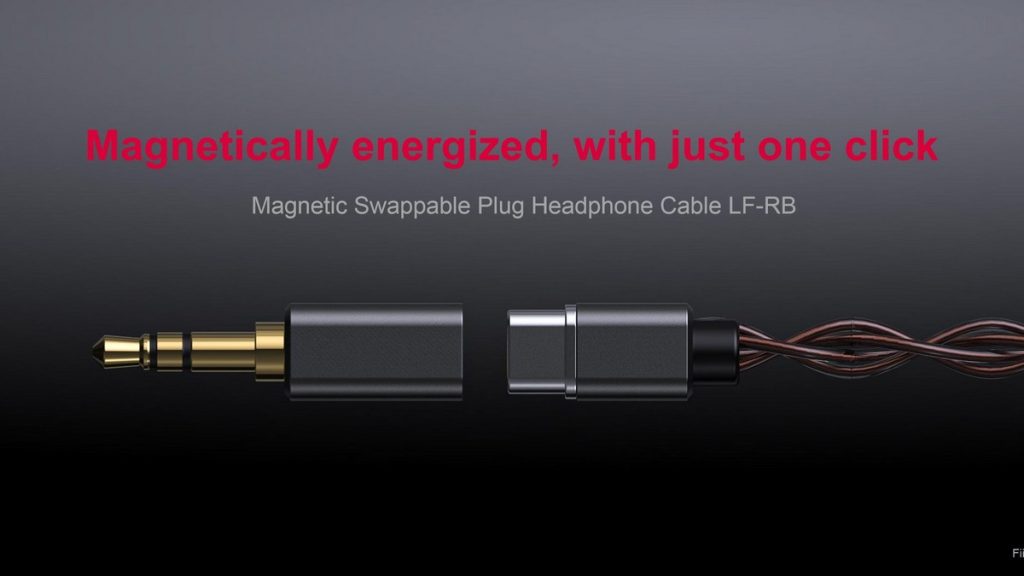
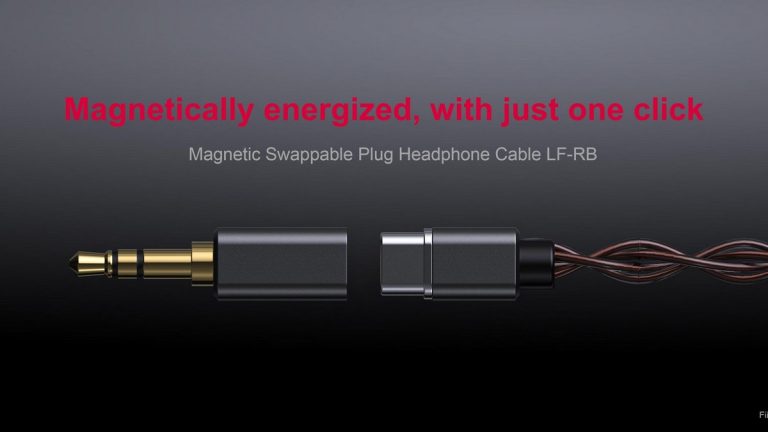
FiiO has previously used interchangeable plug approaches involving twist-lock hardware. The LF-RB takes a different route with a proprietary magnetic fixation design. The replaceable plug is attached magnetically rather than by the kind of screw mechanism often associated with modular cable systems. FiiO has applied for a patent for this design, underlining that the plug interface is a key part of the product rather than an accessory detail.
The practical appeal is ease of use. A modular cable only makes sense if changing the connector is quick enough to become part of normal day-to-day use. A magnetic attachment system is intended to make the changeover more direct, with less handling than a threaded connector. For portable listeners, that can matter. Swapping from a balanced output on a music player to a 3.5 mm output on another device should not feel like a workshop task; it should be a simple setup change.
Reliability is also an important design consideration. Any interchangeable connector adds an extra interface in the signal path, so the mechanism has to hold securely and maintain proper contact. The LF-RB’s magnetic arrangement is presented as a way to make the connection not only easier to engage, but also robust in regular use. That is especially relevant for an in-ear cable, which may be coiled, packed, unplugged and reconnected frequently.

Why three plug types matter
The inclusion of 2.5 mm, 3.5 mm and 4.4 mm plugs gives the LF-RB a useful spread across current portable audio hardware. The 3.5 mm mini-jack remains the default for many single-ended headphone outputs. It is the practical option when balanced drive is not available or not required, and it preserves compatibility with a broad range of sources.
The 2.5 mm plug serves users whose balanced-output devices follow the older compact portable standard. It remains present on many digital audio players and headphone amplifiers, particularly models designed around small chassis dimensions. The 4.4 mm plug, often referred to in connection with PENTACONN, serves the newer and physically larger balanced standard found on many modern portable and desktop-adjacent devices.
The value here is not merely the number of plugs. It is that the LF-RB covers the three cases a portable audio user is most likely to encounter. Someone who owns a 4.4 mm player today, a 3.5 mm dongle tomorrow, and an older 2.5 mm balanced amplifier as part of a second system can keep the same earphone cable in use across all of them, provided the earphones themselves match the cable’s MMCX side.
MMCX connectors for compatible in-ear headphones
At the earphone end, the FiiO LF-RB uses MMCX connectors. MMCX has become a familiar connection type for many detachable-cable in-ear monitors, making it a practical choice for a cable aimed at portable hi-fi users. The LF-RB is therefore intended for in-ear headphones that accept MMCX rather than two-pin or fixed-cable designs.
The MMCX connectors are gold plated and described as being built for long-term heavy use. That matters because the earphone connector is another high-touch part of any detachable cable. Owners may disconnect cables for storage, replace worn parts, or swap between different cable types. A connector that is designed for repeated use is important for preserving the convenience that detachable IEM systems are meant to provide.
FiiO also includes red and blue channel markings to distinguish right and left. It is a small detail, but a useful one. In-ear systems are often handled in low light, on a desk crowded with small accessories, or while traveling. Clear channel identification helps reduce mistakes and makes the cable easier to use without checking documentation.
Conductor construction and cable geometry
Beyond the interchangeable plug system, the LF-RB has a notably detailed cable construction. FiiO describes the conductors as high-purity monocrystalline silver-coated copper wire. In practical product terms, this places the cable in the category of purpose-built hi-fi accessories rather than a basic replacement lead. The use of copper with a silver coating is a common audiophile cable approach, though the specific audible outcome will depend on the complete earphone and source system and should not be assumed from materials alone.
The LF-RB uses a four-core geometry. Each core is specified with 120 signal cores and 100 cores in the insulation layer. The cable also includes an additional shield and a TPU jacket. These details matter because a headphone cable is not only an electrical connection; it is a product that must survive movement, bending and regular handling while remaining comfortable enough for portable use.
The four cores are loosely intertwined. That geometry is described as contributing to protection against external influences while also supporting flexibility. For in-ear headphones, flexibility is not a secondary issue. A stiff cable can make earphones less pleasant to wear, can pull on the shells, and can be harder to route around clothing or into a carrying case. A flexible jacket and an intertwined structure help address the physical realities of daily portable listening.
A practical accessory for multi-device portable audio
The LF-RB occupies an interesting place in a hi-fi system. It is not a source, amplifier or earphone, but it can make the relationship between those components more convenient. Its value is most obvious in setups built around detachable MMCX in-ear headphones and more than one playback device. If a listener regularly moves between a compact DAC, a balanced digital audio player and another device with a standard 3.5 mm output, a modular cable can simplify the kit.
It may also be useful for owners who are planning future upgrades. A listener using a 3.5 mm source today may later add a device with 4.4 mm balanced output. With a fixed-termination cable, that change can trigger another cable purchase. With the LF-RB, the source-side connector can be changed while the main cable remains the same. That can make the accessory feel less tied to a single device generation.
The design also has benefits for organization. Portable audio enthusiasts often accumulate small adapters, spare cables and short interconnects. A cable with its own interchangeable plug set can reduce clutter, especially if the user’s earphones stay consistent across different source devices. It is a tidy solution to a connector landscape that remains fragmented.
Who the FiiO LF-RB is most suitable for
The FiiO LF-RB is best suited to owners of MMCX-equipped in-ear headphones who use, or expect to use, multiple headphone outputs. It makes particular sense for listeners who have both balanced and single-ended devices, or who move between 2.5 mm and 4.4 mm balanced equipment. It is also a logical match for portable users who care about keeping their accessory setup compact and adaptable.
It is less relevant for someone who uses only one source with one output type. If a listener has a single 3.5 mm device and no interest in balanced outputs or modular connections, the LF-RB’s main advantage may go unused. It is also not intended for earphones with other connector standards, such as two-pin designs, unless an owner has a separate solution outside the cable’s stated configuration.
For the right user, however, the attraction is clear. The LF-RB is not trying to be a universal cable for every earphone; it is a focused accessory for a common portable hi-fi scenario: one MMCX in-ear headphone, several possible source connections, and a preference for changing the plug rather than changing the whole cable.
Conclusion
The FiiO LF-RB stands out for combining a modular source-end connection with a considered in-ear cable build. Its magnetic interchangeable plug system covers 2.5 mm balanced, 4.4 mm balanced and 3.5 mm single-ended outputs, while its MMCX earphone connectors, gold plating, channel markings, shielded four-core construction and TPU jacket support practical everyday use. Its strongest appeal is not novelty for its own sake, but flexibility: it is made for listeners who want one cable to serve multiple portable audio devices without giving up a purpose-built hi-fi construction. For owners of MMCX in-ear headphones who regularly move between different sources, the LF-RB is a well-targeted and genuinely useful accessory.