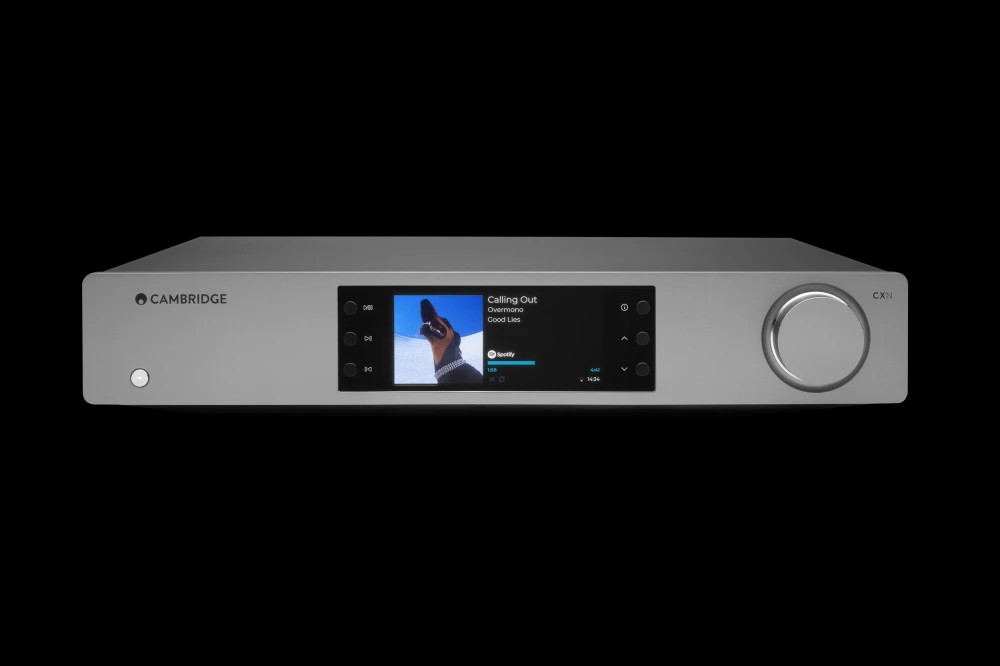
Cambridge Audio CXN100: A Network Streamer Built Around a New Digital Core
The Cambridge Audio CXN100 updates the company’s long-running network streamer formula with a new ESS SABRE32 DAC, fourth-generation StreamMagic module, broad streaming support, and flexible digital and analog connectivity.

The Cambridge Audio CXN100 is positioned as the successor to the CXN V2, a model that had become familiar in many digital hi-fi systems before leaving the range. Rather than simply continuing the same platform, Cambridge Audio has given the CXN100 a revised internal digital architecture, a newer streaming module, and a broad set of input and output options intended to make it useful in both modern app-based systems and more traditional separates-based hi-fi setups. Its appeal lies less in any single headline feature than in the way it brings together network streaming, high-resolution digital input capability, and both single-ended and balanced analog outputs in one component.
A new DAC stage at the heart of the player
One of the most significant documented changes in the CXN100 is the move to an ESS ES9028Q2M SABRE32 DAC chip. This replaces the Wolfson WM8740 DAC used in the previous CXN V2. For a network streamer, the DAC is central because it determines how incoming digital audio data is converted into an analog signal for an amplifier, integrated amplifier, or active speaker system.
The ESS ES9028Q2M is specified here as part of a wider redesign rather than as an isolated part swap. Cambridge Audio has also upgraded supporting system components, including capacitors and operational amplifiers. Those changes are described as reducing distortion and improving signal-to-noise ratio. For a prospective owner, this matters because a streamer is often expected to serve as a long-term digital hub, and the quality of the analog output stage can be as important as the supported streaming services.
The importance of this change is also practical. Many listeners choosing a dedicated network streamer want to avoid relying solely on the DAC built into a computer, television, or general-purpose device. By including a revised DAC stage and upgraded related components, the CXN100 is designed to act as a complete source component rather than merely a digital transport.
Fourth-generation StreamMagic for modern streaming use
The CXN100 uses Cambridge Audio’s fourth-generation StreamMagic module. This same platform is noted as appearing in the MXN10 budget player and the Evo 75 and Evo 150 streaming amplifiers, which indicates that Cambridge Audio is using a common streaming foundation across several product types. For users, that can be attractive because the network platform is not an afterthought added to a conventional DAC; it is a core part of the product’s design.
The supported streaming and playback options cover many of the ways people now access music. The CXN100 supports Chromecast, AirPlay 2, Bluetooth, UPnP, Spotify Connect, Tidal Connect, Qobuz, and Deezer. That breadth gives owners several routes into the same hi-fi system. Someone who mainly uses Spotify can use Spotify Connect, while another listener in the same household may prefer AirPlay 2 or Chromecast. A user with a local music library can turn to UPnP, which is supported up to 32 bit/768 kHz.
This flexibility is important because streaming habits are rarely static. Services change, households use mixed devices, and some owners combine subscription streaming with locally stored files. A product with multiple access methods can remain useful even if the owner’s preferred app or device changes over time.
High-resolution digital inputs for more than network audio
Although the CXN100 is described as a streamer, its input options make it more than a network-only source. It includes USB and USB Type B inputs supporting up to 32 bit/768 kHz and DSD512. Those specifications are relevant for users who keep high-resolution PCM or DSD files on a computer or another compatible digital source and want the CXN100 to handle conversion rather than using a separate DAC.
The inclusion of coaxial and optical digital inputs adds further system flexibility. The coaxial input supports up to 24 bit/192 kHz, while the optical input supports up to 24 bit/96 kHz. These inputs can be useful for connecting digital sources such as disc transports, televisions, or other components with S/PDIF outputs, depending on the wider system. The CXN100 can therefore serve as a digital hub, accepting signals from network services, USB sources, and conventional digital outputs.
For many hi-fi systems, reducing component sprawl is a practical advantage. A streamer that can also accept external digital sources may reduce the need for a separate standalone DAC. That does not make it the right answer for every system, but it gives owners more ways to integrate digital audio without rebuilding the entire setup.

Analog outputs for different amplifier configurations
On the output side, the CXN100 provides both RCA and balanced XLR analog connections. RCA outputs remain the standard connection for many integrated amplifiers, preamplifiers, and powered speakers. Their inclusion makes the CXN100 straightforward to place into a wide range of conventional stereo systems.
Balanced XLR outputs expand the unit’s compatibility with amplifiers and preamplifiers that provide balanced inputs. In systems where XLR connectivity is preferred or already used, this can make cabling cleaner and allow the streamer to match the rest of the electronics more naturally. The presence of both output types is a useful design choice because it allows the CXN100 to fit into different system levels and layouts without forcing the owner into one connection standard.
This is especially relevant for users who may upgrade other parts of their system later. A streamer with both RCA and XLR outputs can remain compatible if the owner moves from an entry-level integrated amplifier to electronics with balanced inputs. That kind of flexibility can be a reason to choose a more fully equipped source component.
Wireless convenience without ignoring hi-fi systems
Bluetooth support is included, with SBC and AAC codec compatibility. Bluetooth is not the only wireless option here, and it is not presented as the highest-resolution path in the specification list, but it remains useful for quick, casual playback from phones, tablets, or visiting devices. In everyday use, convenience features can matter as much as headline file support.
The more system-oriented wireless and network options are Chromecast, AirPlay 2, Spotify Connect, Tidal Connect, Qobuz, Deezer, and UPnP. This range allows the CXN100 to work with both casual streaming behavior and more deliberate hi-fi listening habits. A user can cast music from a phone, hand off playback through a service-specific Connect function, or access a network library, depending on the situation.
This combination reflects a modern source component’s dual role. It must be easy enough for routine daily listening, yet capable enough to justify its place in a dedicated stereo system. The CXN100’s documented feature set is designed around that balance.
Who the Cambridge Audio CXN100 is most suitable for
The CXN100 is likely to appeal most to listeners who want a dedicated network streamer with a built-in DAC and broad service support, rather than a minimal transport that requires an external DAC. It is also a sensible candidate for systems built around integrated amplifiers or preamplifiers that accept analog line-level inputs, including setups where balanced XLR connections are desirable.
It may be particularly attractive to owners of mixed digital libraries. Someone who uses subscription services, local UPnP playback, USB audio, and occasional Bluetooth playback can consolidate those sources through one component. The high-resolution USB capability and support for DSD512 also make it relevant for users with stored high-resolution files, provided the rest of their playback chain and software are compatible.
It is less clearly aimed at users who only need a simple Bluetooth receiver, or those who already own a preferred standalone DAC and want a streamer with no analog output stage. Likewise, anyone whose system depends on a very specific app ecosystem or connection type should confirm compatibility before purchase. The CXN100’s strength is breadth and integration, not a stripped-down single-purpose approach.
A successor with meaningful internal changes
As the replacement for the CXN V2, the CXN100 is notable because it updates several core areas: the DAC chip, supporting analog and digital components, and the streaming platform. Those are not cosmetic changes. In a product category where longevity depends heavily on connectivity, file support, and platform stability, the fourth-generation StreamMagic module and expanded high-resolution input support are central to the product’s identity.
The CXN100 also reflects a pragmatic approach to hi-fi source design. It does not rely on network streaming alone, nor does it limit itself to basic analog outputs. Instead, it combines app-friendly playback, local network compatibility, USB input capability, S/PDIF inputs, RCA outputs, and balanced XLR outputs. That makes it adaptable across different rooms, systems, and user habits.
Conclusion
The Cambridge Audio CXN100 stands out for its documented combination of a new ESS ES9028Q2M SABRE32 DAC, upgraded supporting components, fourth-generation StreamMagic streaming platform, extensive service support, high-resolution USB capability, and both RCA and balanced XLR outputs. Its strongest qualities are flexibility and integration: it is designed to function as a complete digital source for listeners who want streaming convenience, local file support, and useful system connectivity in a single hi-fi component. It is best suited to owners building or updating a dedicated stereo system around a capable network streamer with its own DAC stage, rather than those looking for a very basic wireless adapter or a transport-only device.