Rega AOS MC: A Focused Phono Stage for Moving-Coil Systems
The Rega AOS MC is a purpose-built moving-coil phono stage with adjustable loading, Aura-derived analogue circuitry, Class A gain stages and a compact half-width aluminium enclosure.

The Rega AOS MC is aimed at one of the more demanding parts of analogue replay: extracting a clean, properly matched signal from a moving-coil cartridge. Rather than positioning it as a universal phono box for every cartridge type, Rega has built the AOS MC specifically around MC operation, with gain, loading and circuit choices intended to suit low-output cartridges and more carefully configured vinyl systems. Its appeal lies in that focus. It is a fully analogue, two-stage phono amplifier whose design is heavily based on Rega’s Aura, the company’s reference MC phono amplifier, but presented in a compact half-width chassis with practical adjustability for a broad range of moving-coil cartridges.
A dedicated approach to moving-coil cartridges
Moving-coil cartridges can be exceptionally revealing, but they also place particular demands on the phono stage. Their low output requires quiet, carefully implemented gain, while their electrical loading can influence how they integrate with the rest of the analogue front end. The AOS MC addresses this by concentrating entirely on MC use rather than splitting its design brief between moving-magnet and moving-coil requirements.
Rega describes the AOS MC as a no-compromise, fully adjustable phono amplifier for MC cartridges. The key point for prospective owners is that the product is not merely offering an MC input as an add-on feature. Its gain structure, input loading options and circuit topology are all documented around the needs of MC cartridges, including low-output designs that need sufficient gain before the signal reaches a line-level preamplifier or integrated amplifier.
That specialization can be attractive for listeners who have already committed to an MC cartridge, or who are building a turntable system around one. In such systems, the phono stage is not a background accessory; it is an essential gain and equalization component that must preserve a very small signal while applying RIAA correction accurately. The AOS MC’s design choices are intended to support that role directly.
Aura-derived circuitry in a more compact form
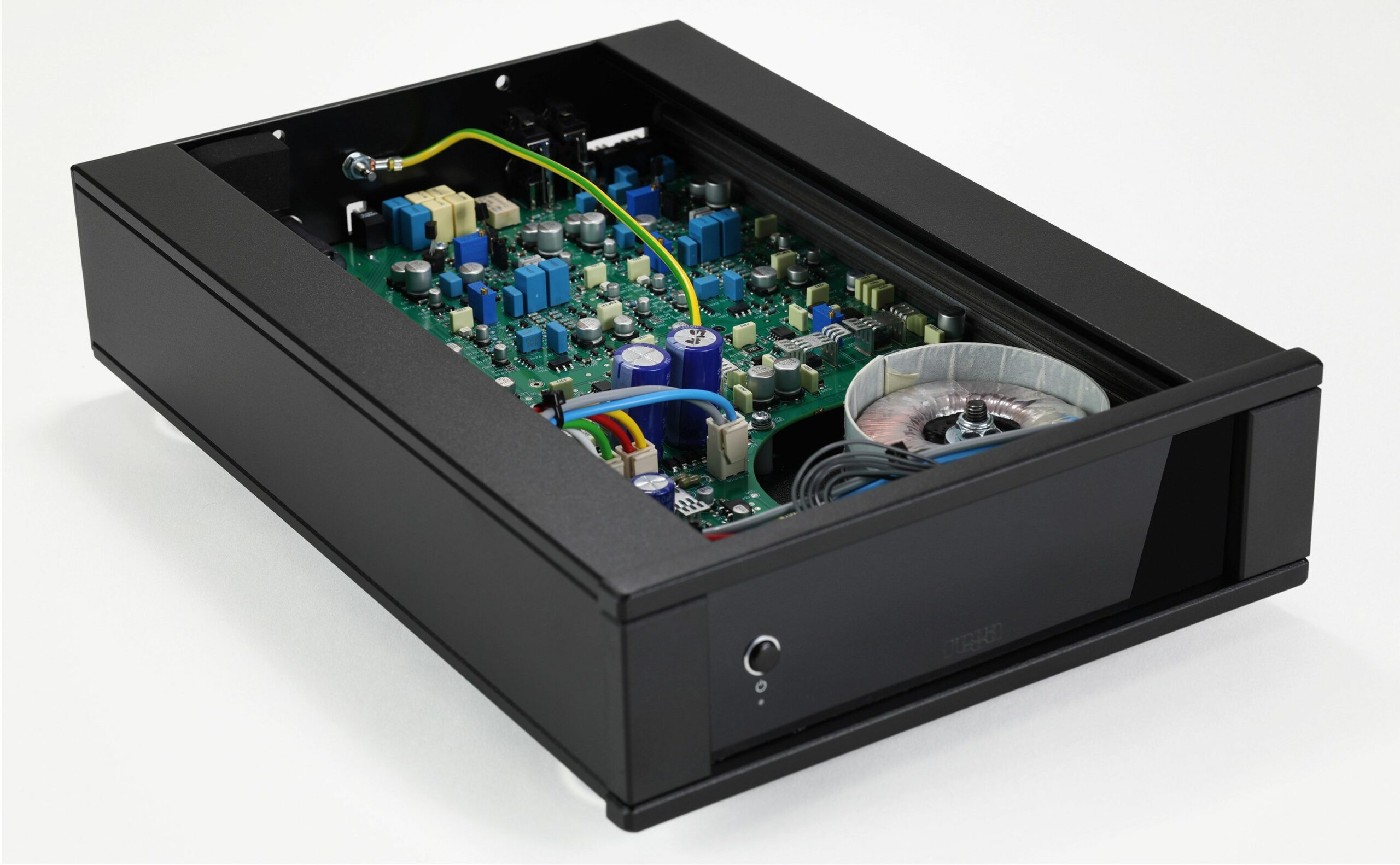
One of the AOS MC’s most notable design credentials is its relationship to the Rega Aura. The new phono stage uses circuit design heavily based on Rega’s flagship MC phono amplifier, which gives the AOS MC a clear place in the company’s analogue hierarchy. It is not presented as a general lifestyle component, but as a serious phono amplifier informed by Rega’s higher-end MC work.
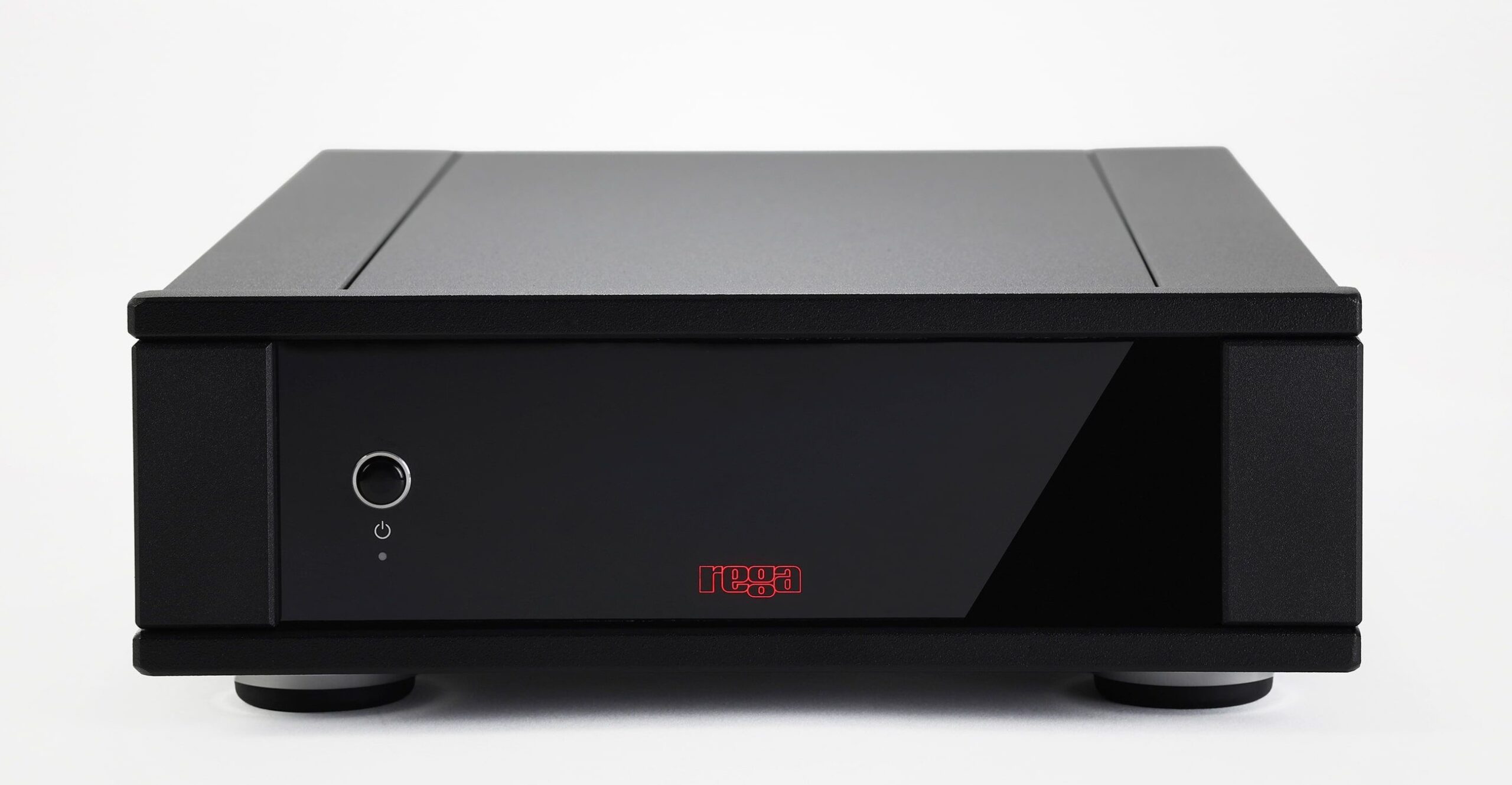
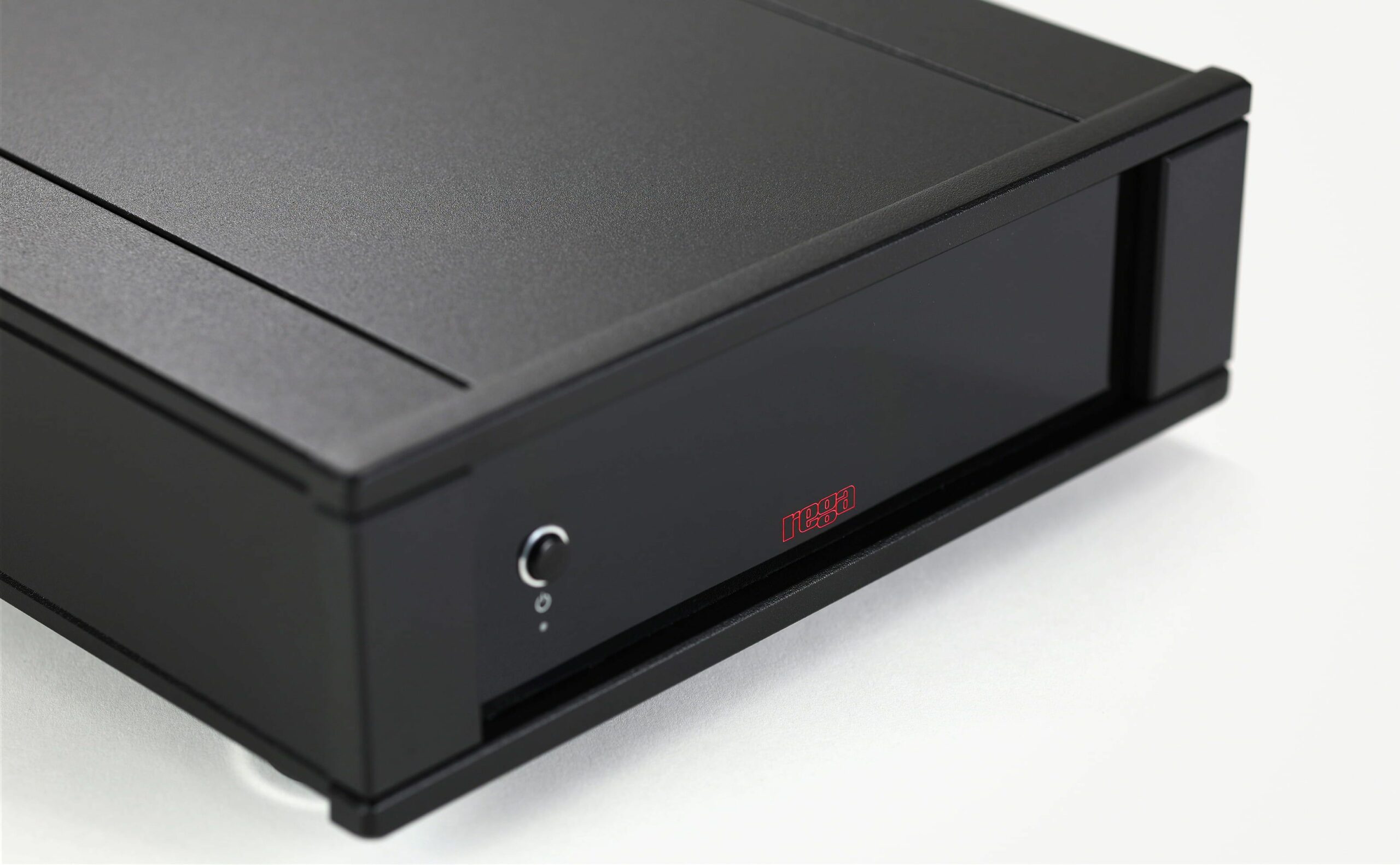
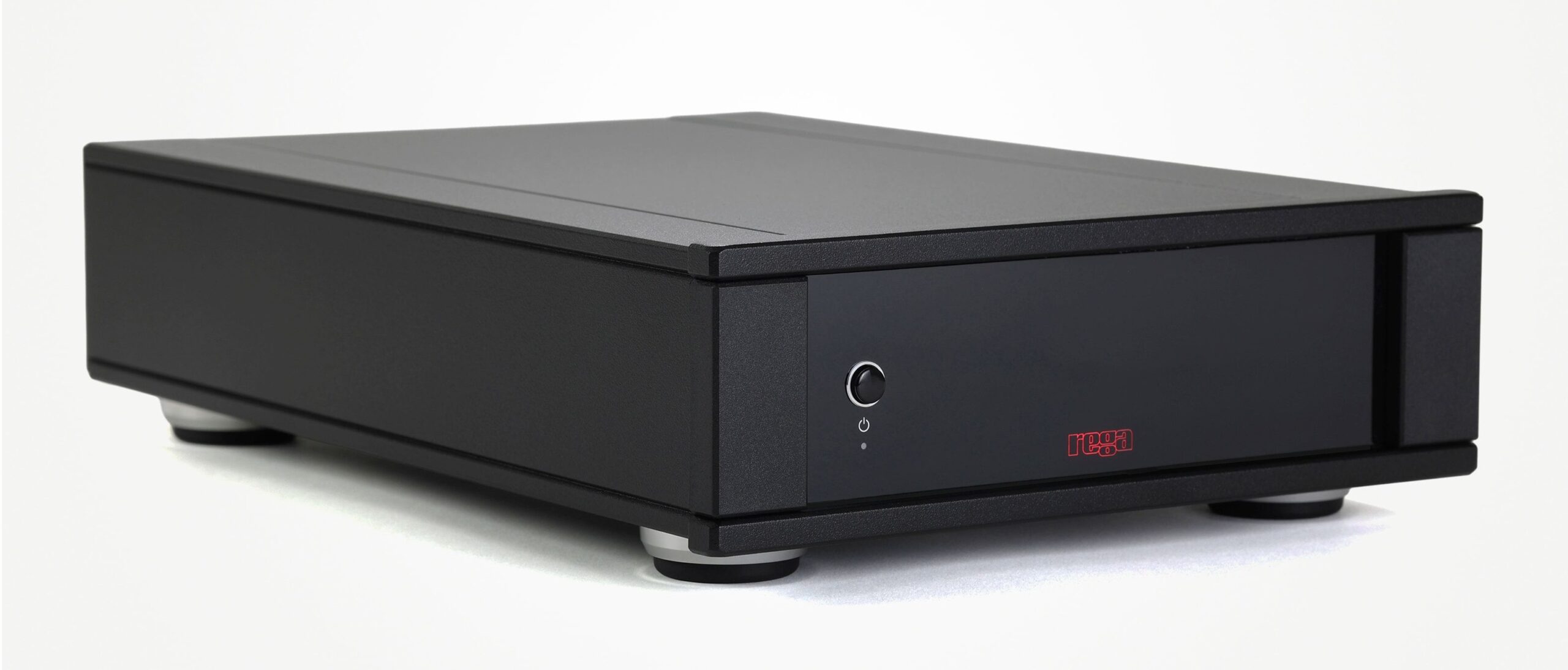
The unit is housed in a custom-designed half-width cabinet. This format may be useful in systems where full-width component space is limited, or where the phono stage is positioned close to a turntable and associated cabling. Rega’s consistent black cabinet finish gives it the understated visual identity associated with the brand, while the all-aluminium enclosure serves a functional purpose as well as an aesthetic one.
That aluminium casework is specified to shield the internal circuitry from disruptive radio-frequency interference. This matters because a phono stage has to amplify an extremely low-level cartridge signal, making it more vulnerable to noise and interference than many line-level components. While system layout, grounding and cabling will always remain important in vinyl replay, a shielded enclosure is a sensible design measure for a product operating in this part of the signal chain.
Fully analogue signal handling without digital control circuits
The AOS MC is described as a fully analogue two-stage amplifier without digital control circuits. For owners who prefer a simple analogue signal path in a vinyl system, this is a meaningful design statement. Rega also says unnecessary components or circuits that could degrade the signal path have been avoided, which aligns with the company’s broader emphasis on direct, purpose-led engineering.
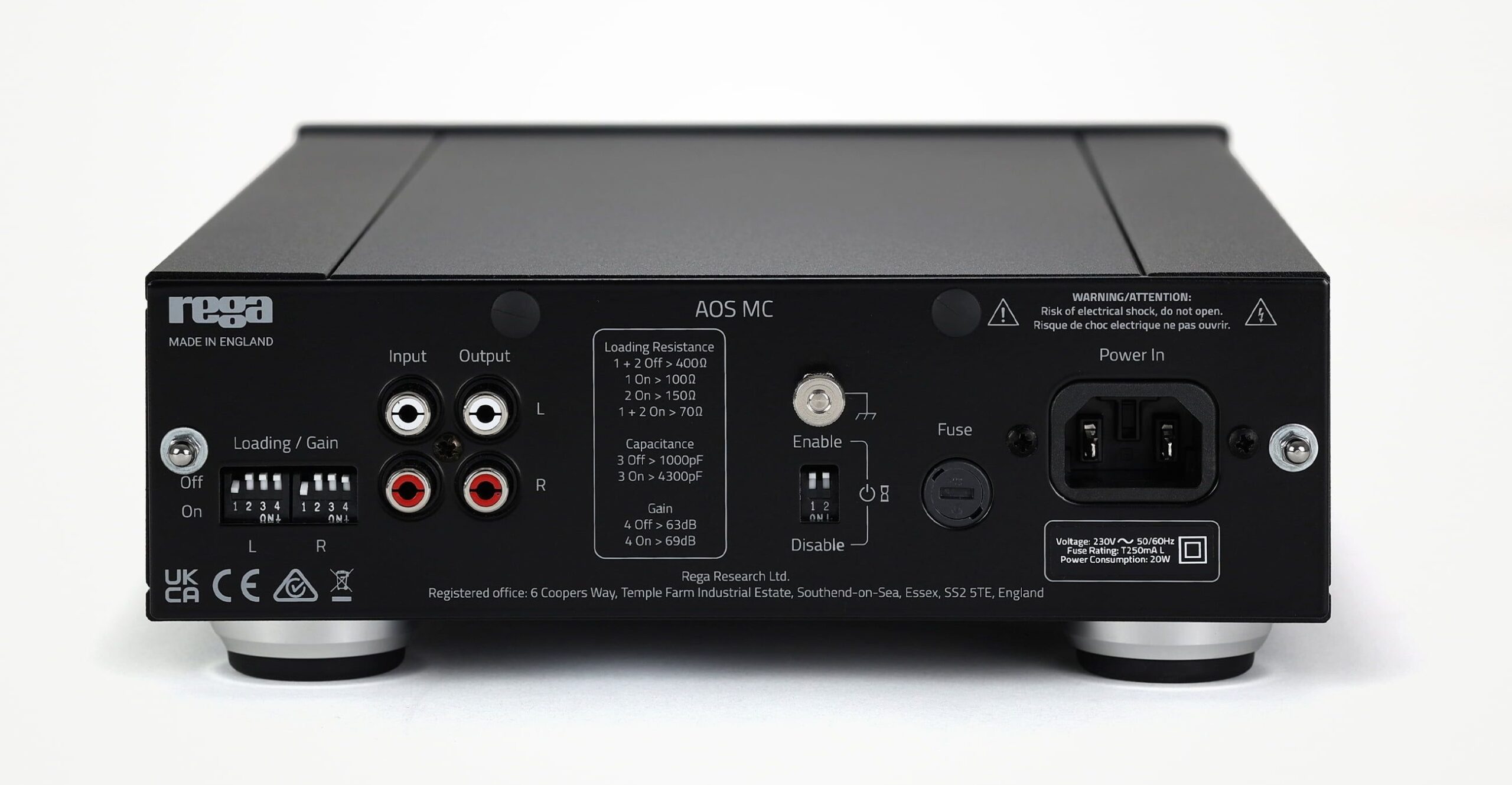
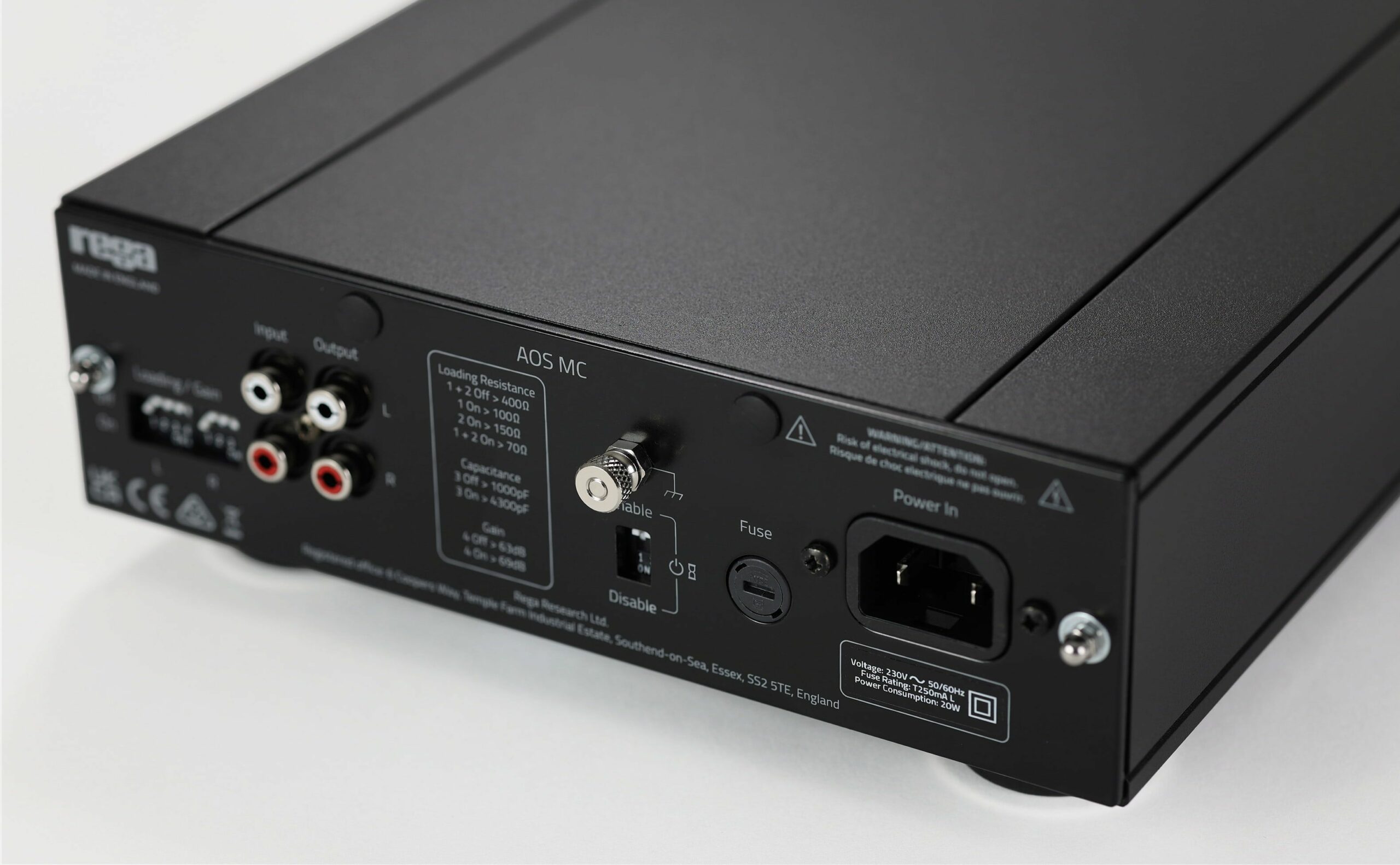
This does not mean the AOS MC is short on adjustability. Instead, its configuration is handled through analogue loading and sensitivity options, including rear-panel control over input sensitivity in 6 dB increments. That arrangement keeps the product focused on the essential tasks of gain, loading and equalization rather than adding display-driven or software-based features.
The benefit is not about novelty; it is about clarity of purpose. A phono stage exists to take the cartridge’s small signal, apply the appropriate RIAA equalization and provide enough gain for the rest of the system. By keeping the architecture analogue and avoiding digital control circuitry, the AOS MC is designed around that core function.
Class A gain stages and careful transistor selection
The AOS MC uses a two-stage amplifier architecture. The first stage is a symmetrical complementary Class A circuit using ultra-low-noise Field Effect Transistors from Linear Systems. These FETs are parallel-connected and configured as a composite pair, with Rega specifying that the devices are carefully selected and matched for optimal performance.
The use of FET transistors is significant because it ensures that no bias current flows through the cartridge coil. In Rega’s explanation, this helps preserve the delicate magnetic geometry of the cartridge. For prospective owners, the practical importance is that the input stage has been designed with the mechanical and electromagnetic nature of MC cartridges in mind, not just with standard voltage amplification in mind.
Rega also notes that the input circuit eliminates coupling components between the cartridge output and the input-stage FET transistors. In principle, fewer elements in this sensitive part of the circuit can mean fewer opportunities for the tiny cartridge signal to be altered before amplification and equalization. The first stage drives the passive high-frequency portion of the RIAA equalization stage.
The second stage is a symmetrical differential Class A circuit with a common-base driver stage. It is also used as an active amplifier in the low-frequency section of the RIAA equalization stage. Together, these stages form a phono amplifier that combines gain with RIAA correction while maintaining a fully analogue architecture.
Adjustable loading for cartridge matching
The AOS MC’s flexibility is centered on cartridge matching. Its MC input allows selection of a resistive input load between 70 and 400 ohms, and a capacitive load between 1,000 pF and 4,300 pF. Those ranges are important because different MC cartridges can have different loading recommendations or behave differently depending on the connected phono input.
This adjustability gives owners and installers a way to configure the phono stage for the cartridge rather than accepting a single fixed input setting. It may be especially useful for vinyl listeners who change cartridges over time, use a tonearm and cartridge combination that benefits from careful setup, or want a phono stage that can remain in the system through future analogue upgrades.
Input sensitivity is adjustable in 6 dB increments from the rear panel. That feature helps the AOS MC accommodate cartridges with different output levels and systems with different downstream gain structures. In practical terms, the phono stage can be set up to provide a suitable output level without relying solely on the volume control range of the amplifier that follows it.
RIAA accuracy and wide documented frequency response
Phono playback depends on accurate RIAA equalization. Records are cut with a standardized equalization curve, and the phono stage must apply the inverse curve during playback. Rega specifies RIAA curve accuracy better than ±0.2 dB between 65 Hz and 70 kHz at a 100 kΩ output load for the AOS MC. That is a notable published figure because it relates directly to how precisely the device performs one of its fundamental jobs.
The claimed frequency response is 17.5 Hz at -3 dB to 100 kHz at -0.2 dB. These figures should be understood as documented specifications rather than listening impressions, but they show that Rega has published performance targets extending well beyond the central audio band. For an owner comparing phono stages on engineering criteria, the presence of explicit RIAA accuracy and response figures is useful information.
The AOS MC also includes a self-regulating servo control designed to compensate for variations in ambient or operating temperature. This is a practical engineering detail in a device using carefully selected analogue circuitry, because thermal conditions can affect electronic behavior. The inclusion of this servo system suggests attention to stability as well as gain and loading.
Usability, standby and system integration
Although the AOS MC is a specialist component, Rega has included usability features that make sense in day-to-day ownership. An automatic standby function puts the unit into sleep mode after a period with no signal. For users who leave their audio system powered for long periods or who prefer not to manage every component manually, that can be a useful convenience.
Importantly, the standby feature can be deactivated via small switches on the rear panel. That gives owners a choice: use the power-saving behavior, or keep the unit operating according to personal preference and system habits. The rear-panel placement of sensitivity and standby controls also reflects the likely setup pattern of a phono stage: adjusted carefully during installation, then left alone once the cartridge and system are configured.
The half-width chassis should also help integration into systems where space near the turntable is at a premium. Phono cables are often kept relatively short, and a compact dedicated phono stage can be easier to position than a full-width component. The AOS MC’s combination of compact enclosure, aluminium shielding and rear-panel adjustability makes it suitable for more considered analogue installations.
Conclusion
The Rega AOS MC is most suitable for vinyl listeners who use, or plan to use, moving-coil cartridges and want a dedicated phono stage with meaningful setup flexibility. Its strongest documented qualities are its Aura-derived analogue circuitry, two-stage Class A architecture, low-noise FET input design, adjustable resistive and capacitive loading, rear-panel sensitivity control, shielded aluminium half-width enclosure and published RIAA accuracy. It is not intended for someone seeking a universal MM/MC box or a feature-heavy digital interface; it is aimed at owners building a focused analogue system around MC cartridge performance, careful matching and a clean signal path.