
Choosing a turntable is not simply a matter of picking the most substantial-looking deck.
The supplied models and related articles show how many parts shape the vinyl experience: the drive system, plinth, platter, tonearm, cartridge, phono stage compatibility, and the scope for future adjustment or upgrades.
For some listeners, the right choice is a complete, ready-to-use record player with a fitted moving magnet cartridge. Others may be better served by a more specialist deck without an onboard phono stage, a modular high-end platform, a replacement tonearm, or even a cartridge upgrade. The tonearm guidance included here is especially important, because accurate tracking and consistent stylus pressure are central to how a record is read. This guide treats each supplied article as a recommendation route rather than forcing every entry into the same box. Some are full turntables, some are tonearms or cartridges, and one is a fundamentals piece that can help buyers understand what matters before spending money.

1. Tonearms for Turntables: Fundamental concepts and various ways to set them up
A tonearm guide helps explain how the cartridge is carried through the record groove and why setup choices matter.
This is the most useful starting point for readers who want to understand why tonearm design matters before choosing a turntable or upgrade.
The article explains that the tonearm is not a passive accessory: it guides the pickup through the groove, helps maintain contact with the record surface, and affects the uniformity of stylus pressure across the musical track.
It also outlines the contrast between tangential designs, which move the cartridge in a linear path, and pivoting tonearms, which are used on nearly all modern turntables. The discussion is particularly valuable because it does not treat the theoretically precise option as automatically simple; tangential arms bring manufacturing complexity, cost, alignment demands, and added drive mechanisms.
Best for: First-time buyers who want the fundamentals before comparing hardware
- Explains why tonearms directly influence playback
- Compares tangential and pivoting approaches
- Clarifies practical drawbacks of linear-tracking designs
- Useful before choosing a deck or arm upgrade
Verdict: Start here if tonearm geometry, tracking, and setup still feel like the hidden part of turntable buying.

2. Cyrus Audio TTP
The Cyrus Audio TTP uses an aluminum base and platter with a digitally controlled DC synchronous motor.
The Cyrus Audio TTP is a turntable from a company better known for digital sources and amplifiers, positioned as a partner for the brand’s Phono Signature phono preamplifier.
Its aluminum base and platter, DC synchronous motor, and specially designed digital control circuit show a focus on stable operation and low vibration.
The article also notes a port for the optional PSX-R2 power supply, with voltage supplied to the motor, making this a deck with a clear system-building angle for existing Cyrus users or listeners who already think carefully about power and phono-stage matching.
Best for: Cyrus system owners and listeners planning a separate phono-stage setup
- Aluminum base and platter
- DC synchronous motor with digital control circuit
- Designed for stable speed with low vibration and flutter
- Connection for optional PSX-R2 power supply
Verdict: Choose the Cyrus Audio TTP if you want a dedicated turntable designed to sit naturally within a Cyrus-led vinyl system.
3. Audio-Technica AT-LP7
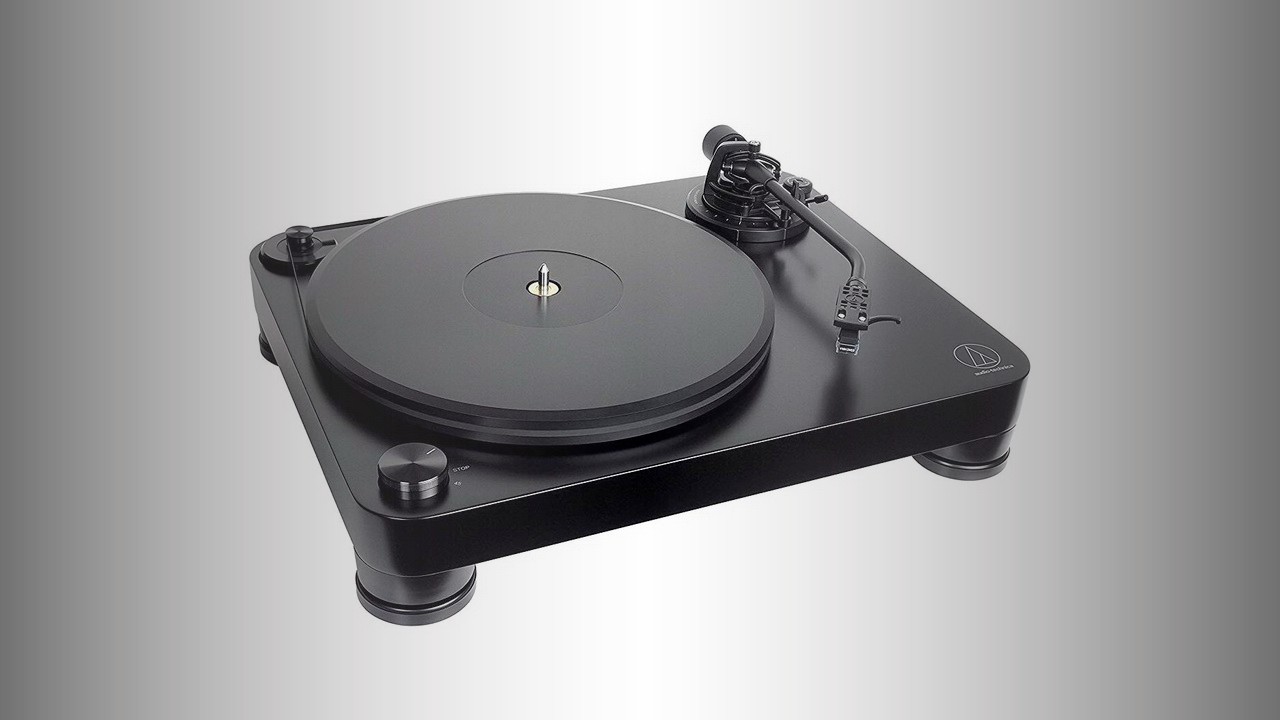
The Audio-Technica AT-LP7 combines a substantial platter, adjustable tonearm, fitted VM cartridge, and switchable phono stage.
The Audio-Technica AT-LP7 is presented as a more substantial development of the earlier AT-LP5, with a heavier platter, a more solid adjustable tonearm, and a chassis made from thick fiberboard.
Its polyoxymethylene platter is driven by an AC motor, with sensors on the platter used to maintain rotation accuracy.
The supplied VM520EB/H moving magnet cartridge, elliptical stylus, AT-HS10 headshell, and switchable onboard phono module give the AT-LP7 broad practical appeal. It is also notable for supporting both moving magnet and moving coil cartridges through the built-in phono stage, while the VM cartridge family allows stylus changes within that line.
Best for: Listeners wanting a serious manual belt-drive deck with cartridge and phono flexibility
- Thick polyoxymethylene platter
- Adjustable tonearm including variable base height
- Supplied VM520EB/H moving magnet cartridge
- Switchable phono module supports MM and MC cartridges
Verdict: The AT-LP7 is a strong choice for buyers who want a complete Audio-Technica package that still leaves room for cartridge and stylus development.

4. Audio Origami Tonearm Collection
Audio Origami’s tonearm range includes multiple models, lengths, mounting choices, and a resonance-management damping system.
The Audio Origami Tonearm Collection is aimed at buyers who already understand the importance of the arm and want a specialist upgrade path rather than a complete turntable.
The range described includes PU8, PU7 ALLOY, and PU7 Titanium models in nine-inch and twelve-inch lengths, with custom lengths also available.
Buyers can select mounting options and arm heads, while the company’s Meta-Material Arm Damping System is designed to manage tube resonance and reduce interference with the internal wiring. The article frames this damping approach as an alternative to conventional materials such as foam or rubber, with the goal of lowering the noise floor and improving clarity from records.
Best for: Turntable owners seeking a specialist tonearm upgrade
- PU8, PU7 ALLOY, and PU7 Titanium models described
- Nine-inch, twelve-inch, and custom length options
- Multiple mounting options and arm heads
- Meta-Material Arm Damping System targets arm-tube resonance
Verdict: Consider the Audio Origami Tonearm Collection when the turntable itself is settled and the next priority is arm matching, damping, and mounting flexibility.

5. Audio-Technica AT-LP7X: A Serious Acrylic-Platter Turntable for Vinyl Purists
The Audio-Technica AT-LP7X pairs a matte-black manual belt-drive design with an acrylic platter and upgradeable VM95 cartridge platform.
The Audio-Technica AT-LP7X is described as a fully manual belt-drive turntable aimed at serious vinyl listeners, with a solid MDF plinth and a thick acrylic platter intended to suppress unwanted resonances and support rotational consistency.
Its J-shaped aluminum tonearm uses a two-axis gimbal bearing system, and the deck comes fitted with an AT-VM95E moving magnet cartridge on an AT-LT10 headshell.
The VM95 platform is an important practical advantage because the stylus can be upgraded within the family without replacing the entire cartridge. For buyers who want a modern manual deck that can evolve gradually, the AT-LP7X offers a clear upgrade logic.
Best for: Manual turntable buyers who want a fitted cartridge and easy stylus upgrade path
- Fully manual belt-drive design
- Solid MDF plinth with thick acrylic platter
- J-shaped aluminum tonearm with two-axis gimbal bearing system
- AT-VM95E cartridge supports stylus upgrades within the VM95 line
Verdict: The AT-LP7X suits listeners who want a purposeful, purist-leaning Audio-Technica deck with a practical cartridge platform from the start.

6. Goldring Ethos SE
The Goldring Ethos SE moving coil cartridge uses silver coils, a low-mass core, and a Vital line-contact diamond stylus.
The Goldring Ethos SE is not a turntable but a moving coil cartridge upgrade for systems ready to justify a specialist pickup.
The article describes it as a special edition of the Ethos design, using silver coils made from high-purity silver, fewer windings, and higher conductivity to reduce internal impedance and effective mass.
Its low-mass iron cross-armature core is intended to improve channel separation, while the Vital line-contact diamond stylus combines low mass with a large contact surface to improve frequency response and reduce coloration and distortion. This is a component for buyers already thinking beyond entry-level cartridge replacement.
Best for: Advanced vinyl systems needing a serious moving coil cartridge upgrade
- Moving coil cartridge design
- High-purity silver coils
- Low-mass iron cross-armature core
- Vital line-contact diamond stylus
Verdict: The Goldring Ethos SE belongs on the shortlist only when the deck, tonearm, and phono stage are ready for a high-grade moving coil cartridge.

7. Rega Planar 2: Low-noise turntable equipped with a RB220 tonearm
The Rega Planar 2 features the RB220 tonearm, Rega Carbon cartridge, glass platter, and rigid laminated MDF plinth.
The Rega Planar 2 is a focused, low-noise belt-drive turntable built around the RB220 tonearm, a low-noise 24-volt motor, and a rigid MDF housing with acrylic lamination.
The RB220 includes an aluminum tube, adjustable tracking force, and automatic anti-skating, while the factory-fitted Rega Carbon moving magnet cartridge makes the deck usable without choosing a cartridge separately.
The platter is made from thermopolished Optiwhite glass and supplied with a felt mat. Manual speed change by moving the belt keeps the design simple, and an optional Performance Pack is available with an upgraded cartridge, belt, and wool mat.
Best for: Buyers wanting a simple, focused belt-drive turntable from a vinyl specialist
- RB220 tonearm with automatic anti-skating
- Factory-fitted Rega Carbon moving magnet cartridge
- Low-noise 24-volt motor
- Thermopolished Optiwhite glass platter
Verdict: The Rega Planar 2 is a straightforward choice for listeners who value a clean manual design, fitted cartridge, and a clear manufacturer upgrade pack.

8. VPI Model One: Innovative turntable boasting advanced motor drive
The VPI Model One centers on a modular motor drive and platter assembly with a solid-aluminum S-shaped tonearm.
The VPI Model One is built around a modular motor drive and platter assembly mounted on a robust aluminum plate with resonance-dampening technology.
The belt-driven motor runs through a two-speed pulley, and an inverted bearing design is used to reduce surface contact between the platter and bearing.
The article places major emphasis on modularity: the motor drive and platter module can be maintained, modified, replaced, or upgraded, with an upgrade path to higher Model specifications as they become available. The supplied VPI S Tonearm Module is a ten-inch, S-shaped, statically balanced solid-aluminum arm with vertical tracking adjustment at the arm base.
Best for: Enthusiasts who want a modular high-end turntable platform
- Modular motor drive and platter assembly
- Resonance-dampening aluminum plate
- Inverted bearing design
- Ten-inch solid-aluminum VPI S Tonearm Module
Verdict: The VPI Model One is most compelling for buyers who see a turntable as a long-term platform rather than a fixed, one-time purchase.
9. Wilson Benesch GMT One
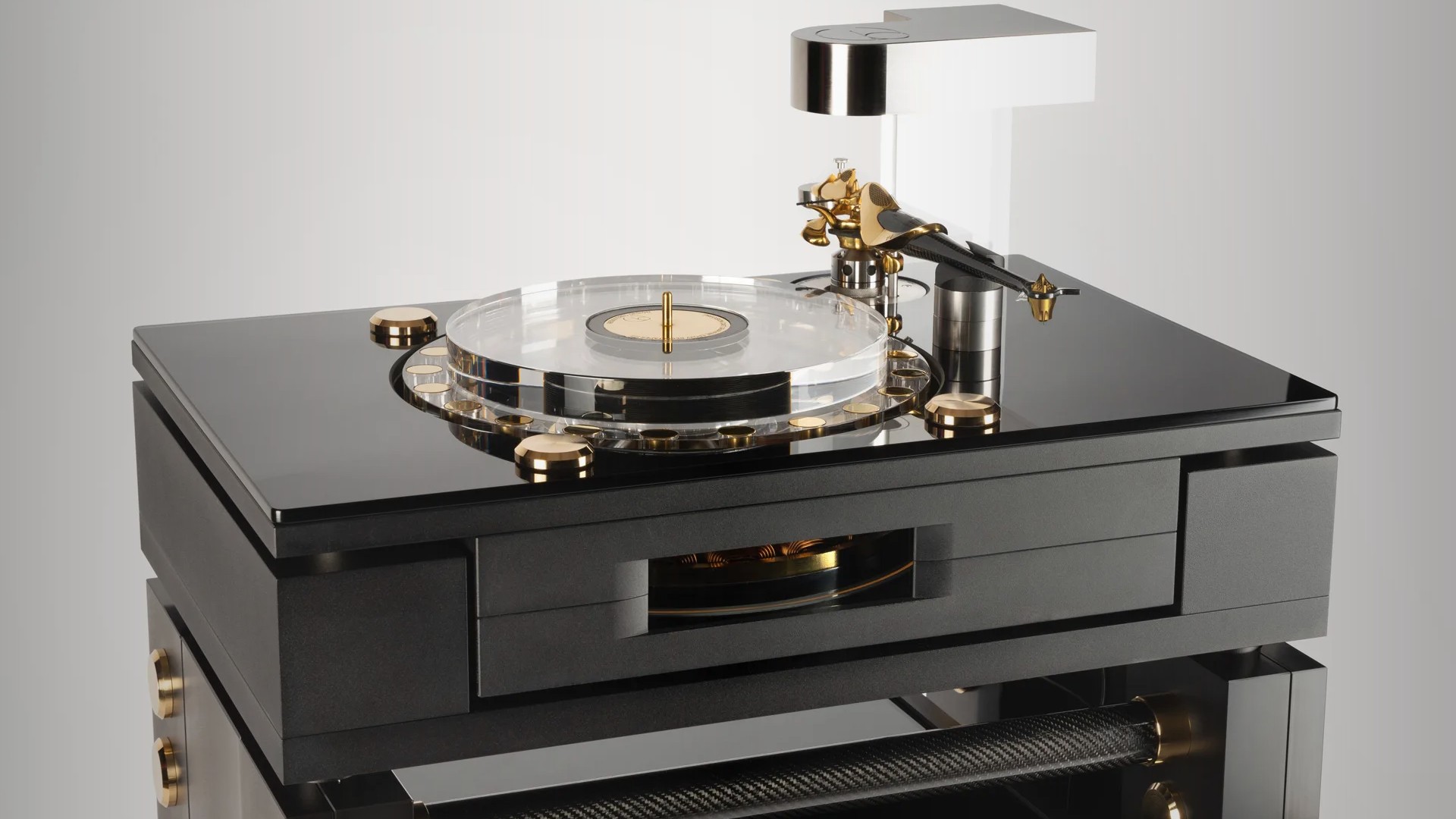
The Wilson Benesch GMT One is built around the Omega Drive magnetic system and a portfolio of proprietary engineering ideas.
The Wilson Benesch GMT One is described as an extremely ambitious luxury turntable built around patented or patent-pending innovations and the company’s GMT and GRAVITON trademarks.
Its defining feature is the Omega Drive, a magnetic drive system using a synchronous motor and described as offering exceptionally low torque ripple.
The article contrasts this approach with conventional belt, roller, and direct-drive systems, positioning the GMT One as a statement design centered on drive accuracy and advanced engineering. This is not presented as a practical mainstream recommendation; it is a specialist object for buyers interested in the outer limits of turntable design.
Best for: Collectors and ultra-high-end buyers interested in advanced drive engineering
- Unique Omega Drive magnetic drive technology
- Synchronous motor with exceptionally low torque ripple
- Over thirty innovations described as patented or patent-pending
- Luxury statement design
Verdict: The Wilson Benesch GMT One is a statement turntable for those seeking rare engineering ambition rather than conventional value or simplicity.

10. Teac TN-5BB
The Teac TN-5BB uses a hybrid vibration-damping chassis, servo-monitored speed control, and balanced outputs.
The Teac TN-5BB is positioned as the brand’s flagship turntable and stands out here for combining balanced outputs with the absence of a built-in phono preamplifier.
Its hybrid frame uses artificial marble, MDF, and Washi paper in a thick, vibration-damping structure, while the motor and arm mechanism are mounted on MDF to help prevent vibration transfer.
Speed is monitored by an optical sensor and adjusted by the Platter Rotation Sensing Servo System. The deck also offers push-button selection for 33, 45, and 78 rpm, and its tonearm was developed in collaboration with SAEC.
Best for: Systems using an external phono stage and potentially balanced signal routing
- Balanced outputs
- No built-in phono preamplifier
- Hybrid frame using artificial marble, MDF, and Washi paper
- Optical speed sensing with servo adjustment
Verdict: The Teac TN-5BB is a strong fit for listeners who want a substantial deck designed around external phono-stage use and balanced connectivity.
Quick comparison
The clearest way to choose among these recommendations is to decide whether you need a complete turntable, a knowledge base, or a specialist upgrade part.
The Audio-Technica, Rega, Cyrus, VPI, Wilson Benesch, and Teac entries are turntables; the Audio Origami and Goldring entries are upgrade components; the tonearm fundamentals article is a decision-making tool before purchase.
| Product | Best for | Verdict |
|---|---|---|
| Tonearms for Turntables: Fundamental concepts and various ways to set them up | Learning how tonearm design affects tracking and setup | Read this before comparing decks if tonearm terminology is unclear. |
| Cyrus Audio TTP | Cyrus-oriented systems with a separate phono-stage mindset | A purpose-built Cyrus turntable with aluminum construction and motor-focused control. |
| Audio-Technica AT-LP7 | A complete manual deck with flexible cartridge and phono-stage options | Combines a fitted VM cartridge, adjustable tonearm, and switchable MM/MC phono module. |
| Audio Origami Tonearm Collection | Owners upgrading the tonearm on an existing turntable | Offers model, length, mounting, headshell, and damping choices for specialist setups. |
| Audio-Technica AT-LP7X: A Serious Acrylic-Platter Turntable for Vinyl Purists | Manual belt-drive buyers wanting an acrylic platter and easy stylus upgrade path | A serious Audio-Technica deck with a VM95 cartridge platform that can grow by stylus change. |
| Goldring Ethos SE | Advanced systems ready for a moving coil cartridge | A specialist cartridge upgrade built around silver coils and a line-contact diamond stylus. |
| Rega Planar 2: Low-noise turntable equipped with a RB220 tonearm | Simple manual vinyl playback with a factory-fitted cartridge | A focused belt-drive package with Rega’s RB220 tonearm and Carbon moving magnet cartridge. |
| VPI Model One: Innovative turntable boasting advanced motor drive | Buyers wanting modular construction and an upgradeable platform | A high-end modular deck centered on its motor drive, platter assembly, and S-shaped tonearm. |
| Wilson Benesch GMT One | Ultra-high-end buyers interested in unconventional drive technology | A luxury statement turntable defined by its Omega Drive magnetic system. |
| Teac TN-5BB | External phono-stage systems needing balanced outputs | A substantial flagship Teac design with hybrid chassis construction and servo speed monitoring. |
Frequently asked questions
Should I choose a turntable with a built-in phono stage?
Choose a built-in phono stage if convenience and simple connection are priorities, as with the Audio-Technica AT-LP7’s switchable onboard module.
Choose a deck without one, such as the Teac TN-5BB, if you already own or plan to choose a separate phono preamplifier and want that part of the system to remain independent.
How important is the tonearm when buying a turntable?
It is central.
The tonearm guides the cartridge through the groove and affects how consistently the stylus maintains contact with the record.
The supplied material repeatedly emphasizes tonearm design, from Rega’s RB220 and VPI’s S Tonearm Module to specialist Audio Origami arms.
Is a fitted cartridge a good idea?
For many buyers, yes.
A fitted cartridge removes one compatibility decision at the start.
The Rega Planar 2 includes a Rega Carbon moving magnet cartridge, the AT-LP7 includes an Audio-Technica VM cartridge, and the AT-LP7X includes an AT-VM95E. More advanced users may instead choose a separate cartridge such as the Goldring Ethos SE.
What should I upgrade first: cartridge, tonearm, or whole turntable?
Start with the weakest part of the current system.
If the deck is stable and compatible, a stylus or cartridge change may be enough.
If tracking, resonance control, or mounting flexibility is the issue, a tonearm upgrade may be more relevant. If drive system, plinth construction, connectivity, or long-term modularity are the limitations, a new turntable is the better route.
How to Make the Right Turntable Choice
Begin by deciding whether you need a complete player or a component-level upgrade.
If you want an approachable complete deck, the Rega Planar 2 keeps the formula clean with a fitted moving magnet cartridge, glass platter, and RB220 tonearm.
If you want more onboard flexibility, the Audio-Technica AT-LP7 adds a switchable MM/MC phono module and a VM cartridge platform. If gradual stylus improvement is a priority, the AT-LP7X is especially logical because its VM95 cartridge family allows upgrades without replacing the whole cartridge. For systems built around separate electronics, look closely at phono-stage strategy. The Cyrus Audio TTP makes sense in a Cyrus-centered setup and includes provision for an optional power-supply upgrade. The Teac TN-5BB is more explicitly oriented toward external phono-stage use, with no built-in phono preamplifier and balanced outputs. Those details matter more than cosmetic finish because they determine how the deck will integrate with the rest of the system. Enthusiasts with established decks should not overlook the upgrade entries. The Audio Origami Tonearm Collection is for listeners who need arm matching, resonance management, and mounting flexibility. The Goldring Ethos SE is a cartridge-level move for systems ready to support a moving coil pickup. These are not universal first purchases; they make most sense when the existing turntable and phono stage are already good enough to reveal the change. At the top end, the VPI Model One and Wilson Benesch GMT One represent very different forms of ambition. The VPI emphasizes modularity, serviceability, and future upgrade paths. The Wilson Benesch GMT One is a luxury statement built around unconventional magnetic drive engineering. Before spending at that level, clarify whether you value practical long-term platform development or the pursuit of a highly distinctive engineering concept. The safest buying advice is to match the turntable to your system rather than to a hierarchy. Confirm cartridge type, phono-stage requirements, speed needs, upgrade plans, and tonearm compatibility. A well-matched modest deck will usually be more satisfying than an ambitious purchase that creates avoidable setup or system-matching problems.



Sound Off
0Join the discussion if you have something to add.