
A dedicated music player can offer a more focused alternative to listening through a phone, with models spanning compact local-library devices, Android players with streaming apps, and ambitious flagships built around distinctive conversion and amplification designs.
The products gathered here stood out for clear reasons, including flexible headphone connections, extensive file support, personalized sound tools, and unusual approaches such as R2R or 1-bit conversion.
Not every source in this selection is strictly portable. The Shanling CD-S100 (23) is a full-size CD player, while the Shanling EA5 is a desktop music center with amplification for headphones and passive speakers. They remain useful points of comparison for listeners deciding whether they actually need battery-powered portability or would be better served by a stationary system. The supplied material focuses on specifications and announced features rather than comparative listening tests. Our recommendations therefore emphasize intended use, connectivity, software, output options, and system design without making unsupported claims about sound quality or day-to-day ownership.

1. HiBy R6Pro MAX: Powerful high-resolution player priced at $999
The angular HiBy R6 Pro Max combines an Android interface with dual ESS DAC chips and a high-output analog stage.
The HiBy R6 Pro Max combines two ESS ES9039MS PRO DAC chips with an analog stage containing eight OPA1612 and two OPA1622 chips.
It supports PCM up to 32-bit/768 kHz and DSD1024, while the stated maximum output reaches 678 mW per channel.
Android 12, a Snapdragon 665 processor, 6GB of RAM, and 128GB of internal storage give it the foundation for installing audio playback applications. That combination makes the R6 Pro Max particularly relevant to listeners who want high-resolution decoding and substantial stated output power without giving up an app-based interface.
Best for: High-resolution playback and Android apps
- Dual ES9039MS PRO DAC chips
- PCM up to 32-bit/768 kHz and DSD1024
- Up to 678 mW per channel
- Android with support for playback apps
Verdict: A well-equipped Android player for listeners who prioritize broad format support, ample internal storage, and strong stated output.

2. Shanling CD-S100 (23): High-performance and versatile CD player
The Shanling CD-S100 (23) is a full-size CD and digital source with a circular front display and several wired connection options.
The Shanling CD-S100 (23) is a stationary CD player rather than a portable music player, but its broad digital facilities make it relevant to anyone considering a home source instead.
CD playback is handled by a Philips CD80 servo system and Sanyo HD850 pickup, with an AKM AK4493 DAC used for digital-to-analog conversion.
Beyond discs, it can receive Bluetooth 5.0 with LDAC, read files through USB-A, and accept high-resolution streams through USB-B up to PCM 32-bit/768 kHz and DSD512. Stereo RCA, optical, and coaxial outputs allow it to serve several roles in a conventional hi-fi system, while control is available through the supplied remote or the Edict Player mobile app.
Best for: Desktop systems built around CDs and digital sources
- Dedicated CD transport hardware
- Bluetooth 5.0 reception with LDAC
- USB-A and high-resolution USB-B inputs
- Analog, optical, and coaxial outputs
Verdict: Not portable, but a versatile home CD player for listeners who also need Bluetooth, USB playback, and multiple output choices.

3. Shanling EA5: Multifunctional music center
The Shanling EA5 brings streaming, file playback, headphone amplification, and passive-speaker power into one desktop component.
The Shanling EA5 is another desktop component rather than a pocket player.
Its closed custom Android system can access streaming services and local music stored on microSD cards, connected drives, or network storage, with remote control available through a phone app.
Its main distinction is the combination of a headphone amplifier rated at up to 570 mW into 32 ohms and an Abletec Class D speaker amplifier rated at 50 watts per channel into 4 ohms. It can also operate as a standalone DAC, preamplifier, integrated amplifier, or Bluetooth receiver and source, giving it considerably broader system duties than a conventional portable player.
Best for: Compact desktop systems with headphones and speakers
- Local, network, and streaming playback
- Headphone and passive-speaker amplification
- DAC, preamplifier, and integrated-amplifier modes
- Bluetooth receiver and source operation
Verdict: A flexible stationary music center for users who regularly alternate between headphones, passive speakers, streaming, and local files.

4. Astell & Kern PD20: World’s First Personalized Sound DAP with Quad DAC & Audiodo Tech
The Astell & Kern PD20 pairs a large FHD+ display with hearing-profile creation and real-time tonal adjustment.
The Astell & Kern PD20 is built around individualized sound adjustment.
Its Personal Sound system, developed with Audiodo, uses a hearing test and the included in-ear eartips to analyze the listener’s hearing and create separate compensation for the left and right ears.
As presented in the source, the manufacturer claims this is the first digital audio player to provide this type of personalized sound profile. Further adjustment comes from the Sound Master Wheel, which provides 160-step control from minus 8.0 dB to plus 8.0 dB across bass, midrange, and treble without stopping playback. The player also has an ESS ES9027PRO Quad DAC configuration, an aluminum enclosure, and a 6-inch FHD+ display.
Best for: Listeners seeking detailed personal sound adjustment
- Hearing-based Personal Sound profiles
- Separate compensation for left and right ears
- 160-step bass, midrange, and treble control
- ESS ES9027PRO Quad DAC configuration
Verdict: A distinctive DAP for users who value hearing-based compensation and accessible tonal control more than a fixed sound profile.

5. Cayin N7: 1-bit digital Hi-Res audio player
The Cayin N7 is centered on a discrete 1-bit DSD conversion system with balanced and unbalanced headphone connections.
The Cayin N7 takes an uncommon approach to portable conversion with a pure 1-bit DSD DAC architecture.
Its DAC, low-pass filter, and headphone amplifier use discrete circuitry within a fully balanced design, rather than relying on a conventional all-in-one conversion stage.
Balanced and unbalanced headphone outputs are provided, broadening compatibility with different cables and headphones. The source also identifies a balanced Class A design for the discrete low-pass filter, reinforcing the N7’s focus on circuit architecture rather than software features alone.
Best for: Enthusiasts interested in discrete 1-bit audio design
- Pure 1-bit DSD DAC architecture
- Discrete DAC, low-pass filter, and amplifier circuits
- Fully balanced system design
- Balanced and unbalanced headphone outputs
Verdict: A technically distinctive portable player whose appeal rests on its discrete, fully balanced 1-bit architecture.

6. iBasso DX180: Sleek and user-friendly portable player
The iBasso DX180 features a 5-inch touchscreen alongside separate balanced and unbalanced headphone outputs.
The iBasso DX180 balances high-resolution support with a familiar Android interface.
Four Cirrus Logic CS43131 DAC chips, a dedicated USB processor, and iBasso’s FPGA Master 2.0 architecture support PCM up to 32-bit/768 kHz and DSD512.
Headphones can be connected through a 3.5 mm unbalanced output or a 4.4 mm balanced output. The stated maximum power is 690 mW per channel from the balanced connection and 281 mW per channel from the unbalanced output. Android 13, a Snapdragon 665 processor, 4GB of RAM, 128GB of storage, and a 5-inch 1080p touchscreen round out a practical specification for app and local-file playback.
Best for: A balanced mix of portability, apps, and wired outputs
- Quad CS43131 DAC configuration
- 3.5 mm and 4.4 mm headphone outputs
- PCM up to 32-bit/768 kHz and DSD512
- Android with 128GB of internal storage
Verdict: A practical Android player offering dual headphone connections, extensive format support, and useful internal storage.
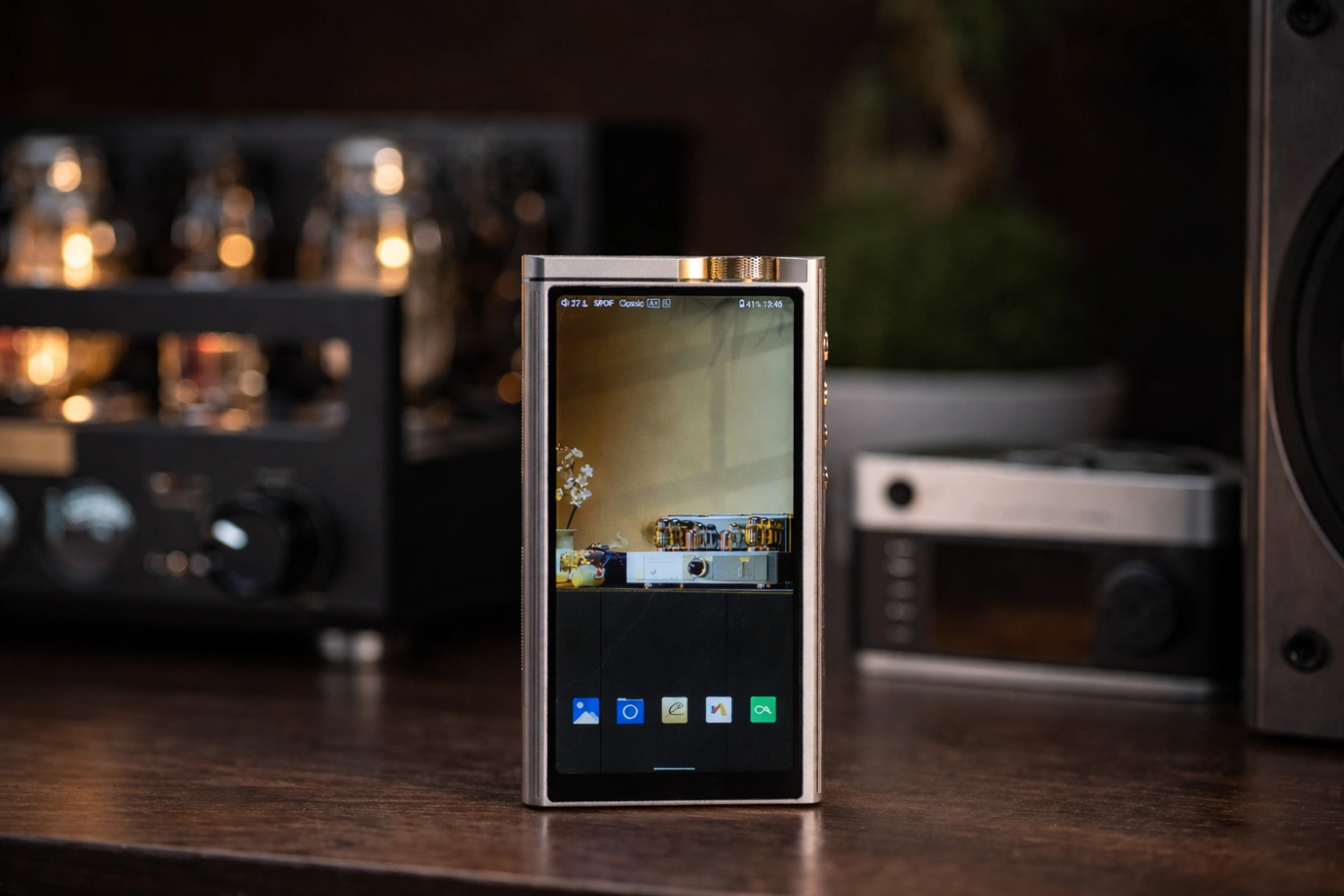
7. This Isn’t Just Another DAP – Cayin N8iii Feels Like Real Hi-Fi in Your Pocket
The Cayin N8iii combines an Android touchscreen platform with selectable Tube Classic, Tube Modern, and Solid State modes.
The Cayin N8iii distinguishes itself through its Triple Timbre amplification system.
Users can select Tube Classic, Tube Modern, or Solid State modes, allowing the amplification path to be changed according to listening preference rather than relying on a single fixed presentation.
The source characterizes Tube Classic as warmer and fuller, Tube Modern as tighter while retaining some tube smoothness, and Solid State as focused on precision, punch, and clarity. Its Android-based platform is designed for streaming and local playback, supported by a Snapdragon 665 processor, 8GB of RAM, and 256GB of storage. The combination is aimed at listeners who want tube and solid-state options within one portable device.
Best for: Listeners who want switchable tube and solid-state operation
- Three selectable amplification modes
- Tube Classic and Tube Modern choices
- Dedicated solid-state mode
- Android platform with 256GB of storage
Verdict: An unusually configurable flagship DAP for those who want to change amplification character without changing players.

8. HiBy RS2: Digital player with Darwin architecture
The compact HiBy RS2 uses Darwin R2R architecture and provides both 3.5 mm single-ended and 4.4 mm balanced outputs.
The HiBy RS2 is a compact local-music player based on HiBy’s Darwin R2R architecture.
Its PureAudio version of HiByOS is intended to prioritize system-level audio processing, making this a more focused proposition than a general-purpose Android player.
Darwin features include R2R array linearity compensation, a 256-tap adjustable FIR filter, harmonic control, and selectable non-oversampling and oversampling modes. The RS2 also supplies 3.5 mm single-ended and 4.4 mm balanced outputs, covering common connections used by wired in-ear monitors and headphones.
Best for: Focused local playback with R2R conversion
- Darwin R2R conversion architecture
- PureAudio version of HiByOS
- Adjustable FIR filtering and harmonic control
- 3.5 mm and 4.4 mm outputs
Verdict: A compact choice for listeners who favor R2R design and adjustable digital processing over a broad app ecosystem.

9. iBasso DX320: Player on two ROHM BD34301EKV chips
The iBasso DX320 uses two ROHM DAC chips and a balanced output rated for substantial voltage and power.
The iBasso DX320 uses two ROHM BD34301EKV DAC chips from the manufacturer’s MUS-IC series.
The supplied information reports a measured 125 dB signal-to-noise ratio, 125 dBV dynamic range, and minus 112 dB THD+N for the player.
Its balanced output is specified at up to 7.1 Vrms, with output power reaching 1,200 mW into 32 ohms. Those figures make output requirements a central reason to consider the DX320, particularly when comparing players for demanding wired headphones rather than sensitive earphones alone.
Best for: Full-size headphones needing substantial output
- Dual ROHM BD34301EKV DAC chips
- Up to 7.1 Vrms balanced output
- Up to 1,200 mW into 32 ohms
- Published player-level noise and distortion measurements
Verdict: A high-output digital player built around dual ROHM conversion and unusually strong stated balanced-output figures.

10. TempoTec Variations V1: Hi-Res Music Player, DAC & LDAC Bluetooth Adapter
The TempoTec Variations V1 combines microSD playback, balanced output, streaming, USB DAC use, and two-way Bluetooth.
The TempoTec Variations V1 combines standalone playback, external DAC operation, and two-way Bluetooth duties in a compact device.
It reads music from microSD cards up to 2TB, supports PCM up to 32-bit/384 kHz and DSD256, and uses two CS43131 DAC chips with a 4.4 mm balanced output.
In receiver mode it can accept LDAC from a phone, while transmitter mode allows playback to compatible wireless earphones. TIDAL, Qobuz, AirPlay, and DLNA support extend it beyond offline libraries, and a 10-band parametric equalizer provides frequency adjustment and presets. An FPGA with two precision crystals is used in the digital section.
Best for: Travel-friendly wired and wireless flexibility
- Player, USB DAC, and Bluetooth adapter functions
- Two-way Bluetooth with LDAC support
- MicroSD capacity up to 2TB
- 10-band parametric equalizer
Verdict: A versatile compact source for users who need local playback, streaming, DAC operation, and Bluetooth transmission or reception in one device.
Frequently asked questions
Should I choose an Android player or a focused music-only operating system?
Android models such as the HiBy R6 Pro Max and iBasso DX180 suit listeners who want to install playback or streaming applications.
A focused platform such as the PureAudio version of HiByOS on the RS2 may be preferable when local-file playback and dedicated audio processing matter more than a broad app selection.
Do I need a 4.4 mm balanced headphone output?
A balanced output is useful only when the headphones or earphones have a compatible cable.
Models including the iBasso DX180 and HiBy RS2 also provide 3.5 mm single-ended connections, so existing cables can still be used.
Output power and headphone sensitivity should be considered alongside connector type.
How much output power should a portable player have?
Sensitive in-ear monitors generally require less power than many full-size headphones, and low noise can be just as important as maximum output.
The supplied specifications range from moderate portable outputs to the iBasso DX320’s stated 1,200 mW into 32 ohms, but a larger number is not automatically necessary for every headphone.
Can a portable player replace a desktop source?
Some can also work as external DACs or Bluetooth adapters, as demonstrated by the TempoTec Variations V1.
A stationary component may still be more suitable when CDs, passive-speaker amplification, or extensive rear-panel connections are priorities; the Shanling CD-S100 (23) and EA5 illustrate those alternatives.
How to choose the right music player
The most useful starting point is not maximum file resolution or the number of DAC chips, but the way the player will fit into a listening routine.
Streaming users should examine the operating system, app support, processing hardware, storage, and network features.
Listeners with large offline libraries should prioritize microSD support, file navigation, battery-oriented portability, and a focused interface. The supplied information does not include battery-life figures, so that factor should be checked separately before choosing a travel player. Headphone matching deserves equal attention. A 3.5 mm output offers broad compatibility, while a 4.4 mm balanced connection can provide access to the player’s higher-output mode when used with a suitable cable. Full-size headphones may benefit from the stronger stated outputs of models such as the iBasso DX320, whereas sensitive in-ear monitors do not necessarily require high power. Published output figures should always be read with their load impedance and connection type. Architecture can then refine the shortlist. The HiBy RS2 emphasizes R2R conversion and focused local playback, the Cayin N7 uses a discrete 1-bit design, and the Cayin N8iii provides selectable tube and solid-state paths. The Astell & Kern PD20 instead concentrates on hearing-based personalization, while the TempoTec Variations V1 prioritizes role flexibility. These are meaningfully different design choices rather than interchangeable specification upgrades. Finally, portability should be defined honestly. A self-contained battery player is appropriate for commuting and travel, but a desktop installation may be better served by the disc facilities of the Shanling CD-S100 (23) or the headphone and speaker amplification of the Shanling EA5. Choosing the correct product category is more important than paying for portable features that will rarely leave the listening desk.



Sound Off
0Join the discussion if you have something to add.