
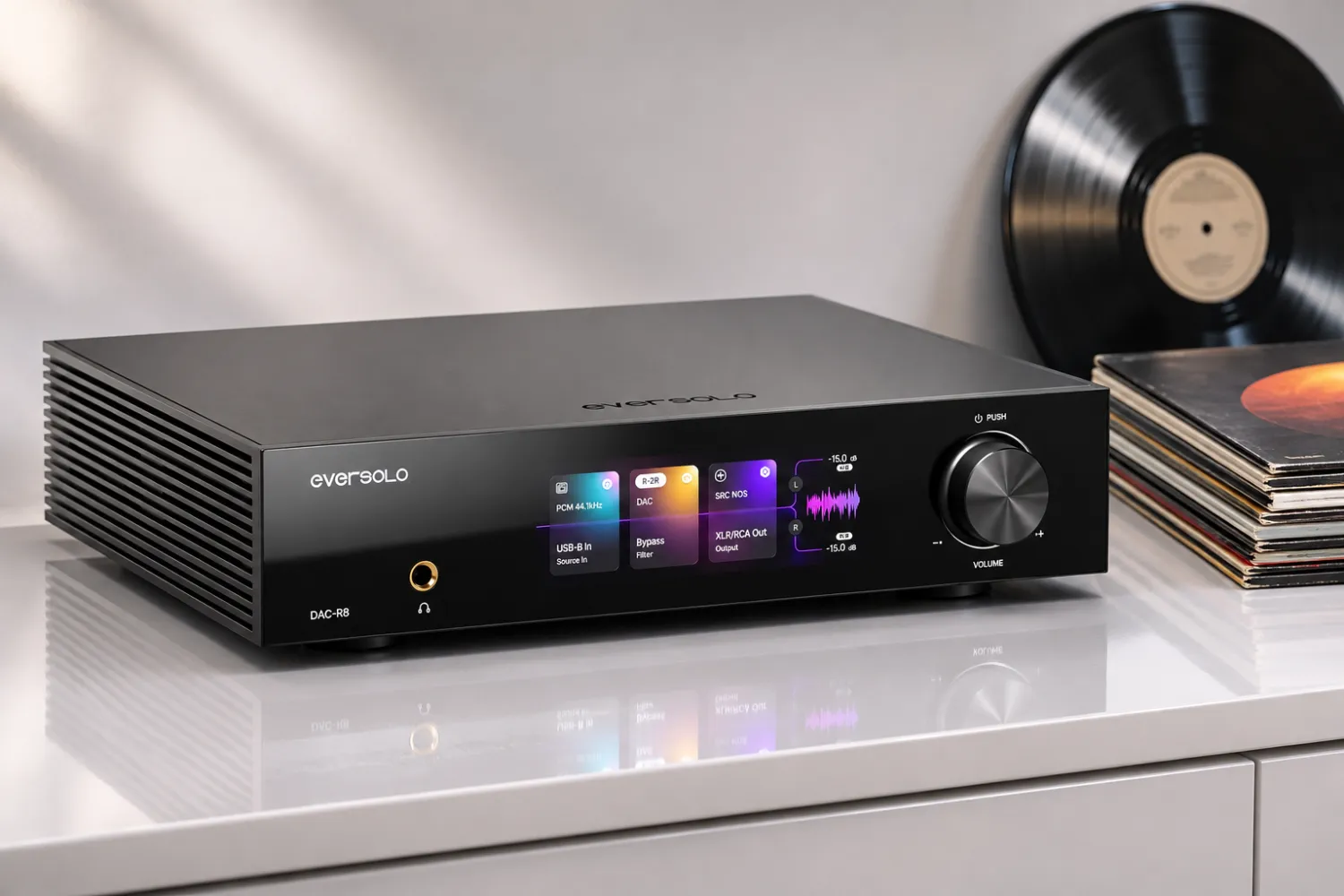
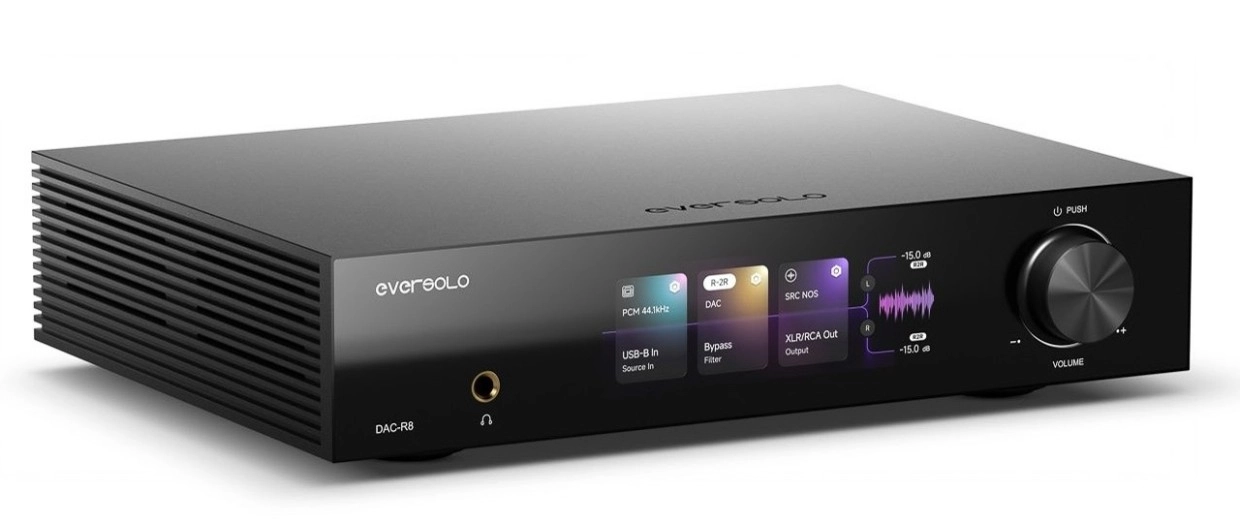
Eversolo’s DAC-R8 takes a different role in the company’s range from a network player: it handles digital-to-analog conversion, headphone amplification and preamplifier duties, but leaves streaming to another component. Its chassis is matched in size and style to the Eversolo T8 network player, making the two natural partners in a separated system. Inside, the DAC-R8 combines an in-house resistor-ladder converter with a second ladder dedicated to analog volume control. A broad selection of digital inputs, headphone output and computer-accessible processing also give it uses beyond a system built around the T8.
A converter designed to work alongside a player
The distinction between the DAC-R8 and the T8 is important when planning a system. The T8 is a network player; the DAC-R8 has no streaming functions or network connectivity of its own. Buyers looking to play music from a network will therefore need a separate source, whether that is the matching Eversolo player or another suitable digital component.
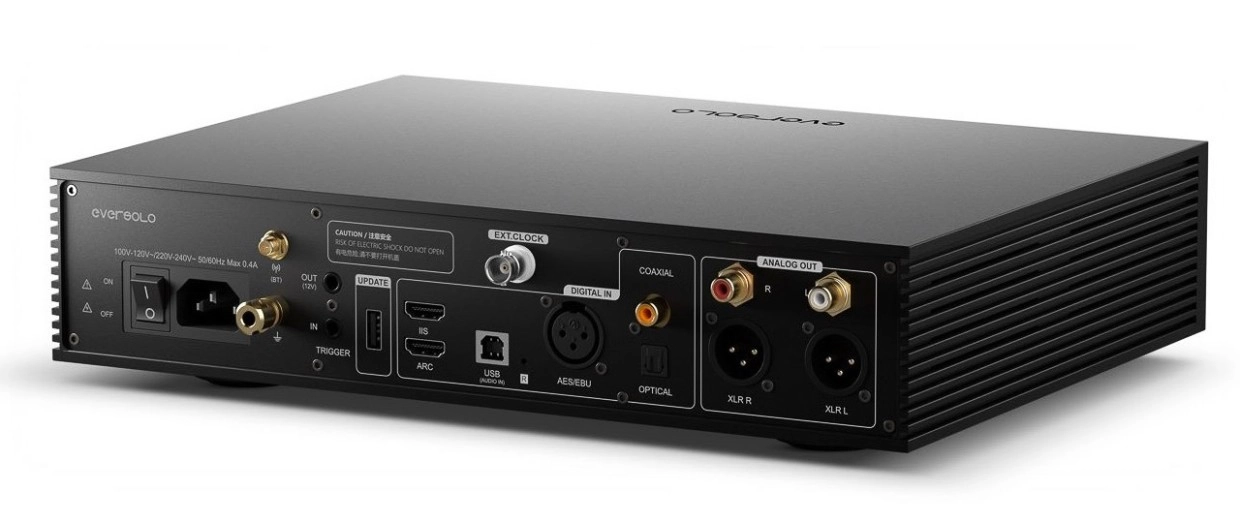
That division also leaves the DAC-R8 free to serve several sources. USB and I2S sit alongside AES/EBU, coaxial, optical TOSLINK and HDMI ARC inputs, while Bluetooth 5.4 provides a wireless option with aptX, aptX HD and aptX Adaptive support. HDMI ARC offers a route for a compatible television’s audio, without turning the DAC into a network device.
The AES/EBU and coaxial inputs are galvanically isolated, a provision Eversolo identifies as a way to prevent hum loops. The wired inputs other than USB and I2S support signals up to 24-bit/192kHz; USB and I2S accept higher-resolution material, up to 32-bit/768kHz PCM and DSD512.
OriginR2R and a choice of conversion modes
At the center of the DAC-R8 is OriginR2R, Eversolo’s name for its internally developed resistor-ladder conversion technology. The company also developed the digital processing and analog output stage in-house, and describes the overall design as fully differential.
PCM decoding uses a 5-bit coarse segment and a 20-bit fine segment, with an FPGA responsible for digital filtering and timing. DSD follows its own one-bit path through the Eversolo network rather than being routed through PCM. Those separate paths give the two formats distinct routes through the converter, although their presence alone does not establish how either will sound.
Listeners can select non-oversampling, or NOS, as well as 2x, 4x and 8x oversampling. Eversolo says a further BEST mode combines the two approaches. The I2S input has eight selectable modes, giving users an adjustment to consider when connecting an I2S source. Clocking comes from an internal 10MHz oven-controlled crystal oscillator, and a rear input accepts an external 10MHz or 25MHz clock.
A second ladder takes care of volume
The DAC-R8’s volume control is a separate R2R network, switched by relays and operating in the analog domain. Eversolo has used a comparable approach in the DMP-A8. Unlike digital attenuation, which can reduce available resolution at low settings, this arrangement adjusts level after conversion. It also avoids relying on a conventional potentiometer, a component that can be subject to wear and channel imbalance.
That volume control supports the DAC-R8’s role as a preamplifier as well as a converter. Its XLR and RCA analog outputs can feed a power amplifier or a pair of active speakers directly, so a system built around digital sources need not necessarily include a separate preamplifier. Users who already have one can instead consider the DAC-R8 as a source component within that system.
Eversolo specifies total harmonic distortion plus noise of 0.000316% at 1kHz and an A-weighted signal-to-noise ratio of 130dB, both measured at the balanced outputs. Power comes from a linear supply with a custom toroidal transformer. These are manufacturer specifications, not independent measurements.
Headphone output and front-panel controls
A 6.35mm headphone socket on the front makes private listening another part of the DAC-R8’s remit. Eversolo rates output at 1 watt into 32 ohms and 0.16 watts into 300 ohms. Those figures provide useful reference points for matching headphones, though they do not by themselves establish compatibility with every model.
There is an unresolved detail around gain settings: the announcement describes three, while the accompanying specifications list only low and high. Anyone for whom a particular gain range is important should check the final documentation before buying.
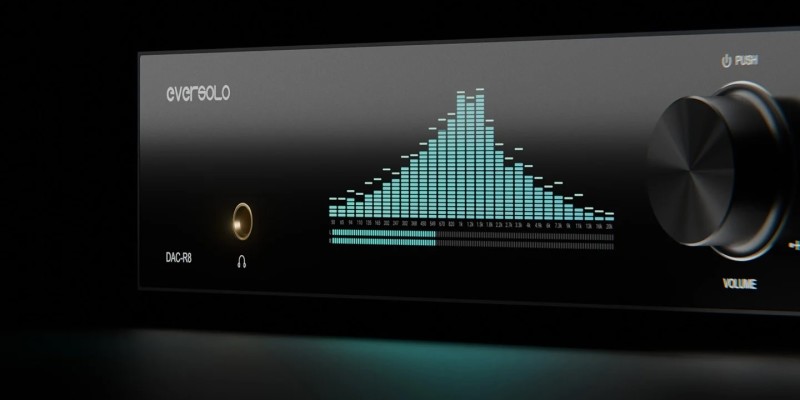
The front panel also carries a 5.2-inch IPS touchscreen. It can display a spectrum analyzer or VU meters, giving the user visual feedback as well as local access to the component. There is no app control, consistent with the DAC-R8’s lack of network connectivity.
Computer-based processing without an app
Connecting a computer over USB opens a browser-based control panel without requiring a driver. From there, users can adjust EQ, FIR filtering, dynamic processing and delay. Each can be set independently for the left and right channels, offering more flexibility than a single set of controls applied identically to both.
That arrangement is useful for owners who want to configure processing from a computer while keeping the audio component itself off the network. It also establishes a limit: the documented editing interface depends on a USB-connected computer rather than a phone app. The supplied information does not detail every parameter or explain how settings are stored, so those are points to verify against the final user documentation.
The DAC-R8 looks best suited to a listener who wants a dedicated digital hub with variable analog outputs, rather than an all-in-one streamer. Paired with the T8, it offers a matched component system; used with a computer, television or other digital source, it can also sit in front of active speakers or a power amplifier while accommodating headphones. Buyers should check their source connections and resolution requirements, particularly if they intend to use I2S or an external clock.


Sound Off
0Join the discussion if you have something to add.