
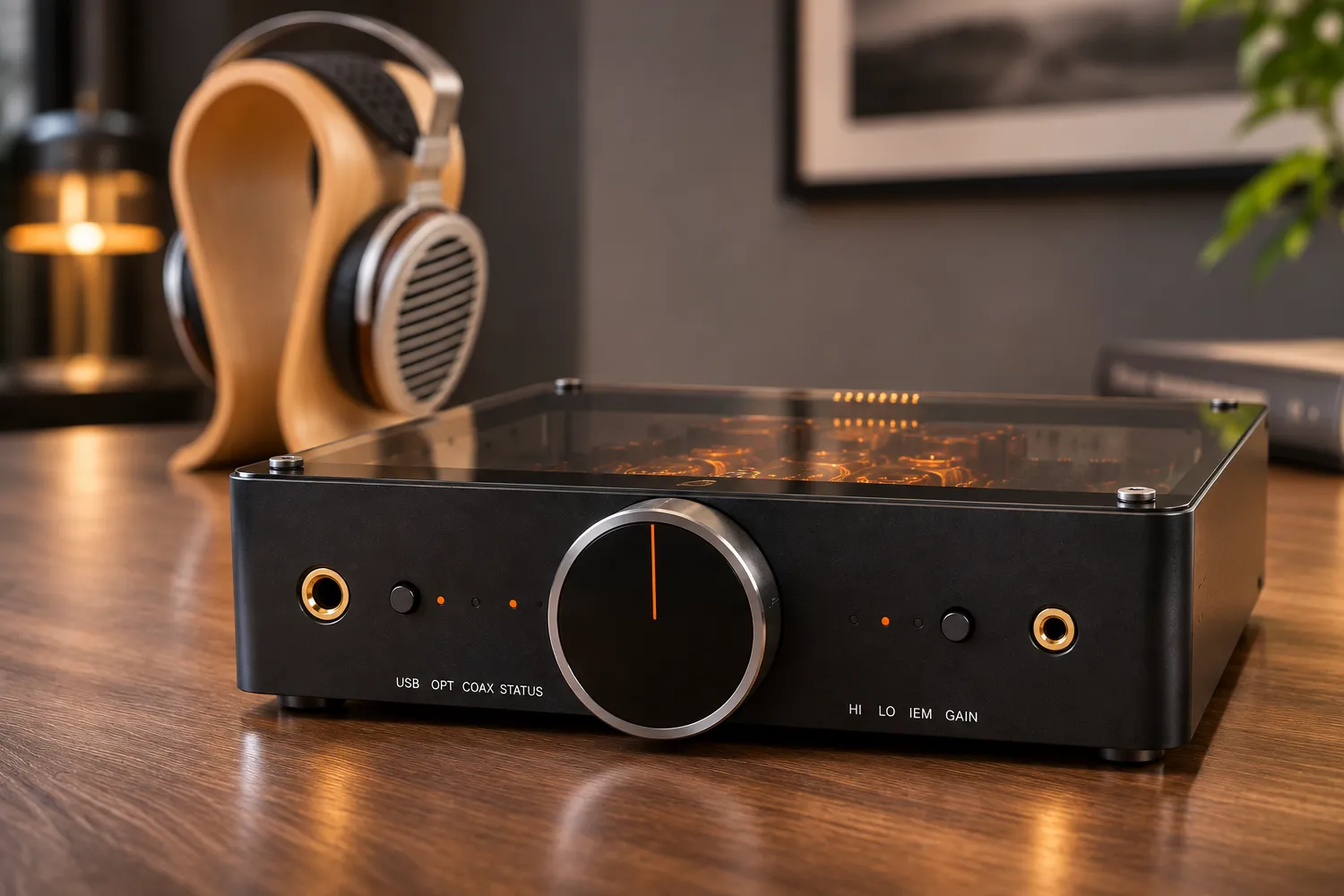
Onkyo is adding a compact desktop component to its range with the HA-70, a DAC and headphone amplifier aimed at listeners who want to use digital sources with more than one type of headphone. Its three gain settings cover the intended needs of sensitive in-ear monitors as well as more demanding high-impedance models, while rear analog outputs give it a role beyond headphone listening. The announcement also marks a return to desktop audio for the brand in its 80th-anniversary year. Expected in spring 2027, the aluminum-bodied unit combines two ESS SABRE converter chips with a fully balanced analog signal path.
One amplifier for different headphone collections
The HA-70's most useful feature for a listener with several pairs of headphones may be its adjustable gain. Onkyo specifies three settings: Ultra Low for sensitive in-ear monitors, Low for low-impedance headphones and High for more demanding high-impedance models. Rather than treating every connected headphone as though it needs the same amplification, the settings provide a way to adapt the amplifier to different types of load.
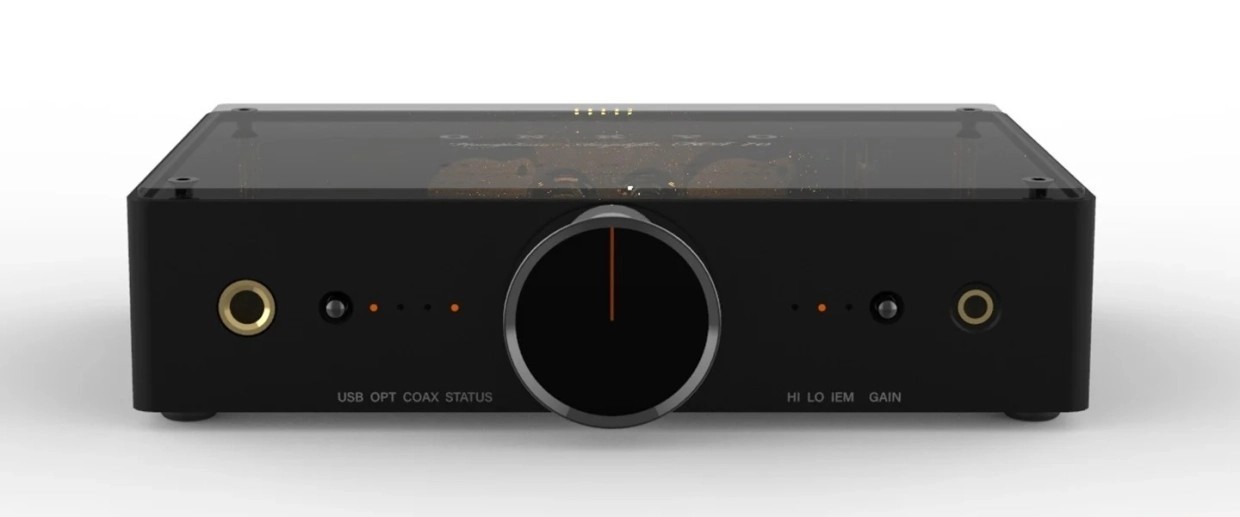
Onkyo states that the unit supports headphones with impedances up to 600 ohms. That figure helps define the intended range, but it does not establish how loudly every headphone will play: impedance alone is not a complete description of a headphone's amplification needs. Output power figures have not been supplied in the announcement, so prospective buyers of particularly demanding models will need more information before judging the match.
At the other end of the range, the dedicated Ultra Low setting gives in-ear monitor users a configuration intended for their more sensitive earphones. The announcement does not provide a noise-floor measurement for that setting, so its practical performance remains to be established.
Two SABRE chips and separate channel stages
Digital-to-analog conversion is handled by a pair of ESS ES9039Q2M SABRE DAC chips. Onkyo describes separate conversion and amplification stages for each channel, together with a fully balanced signal path from the DAC chips to the headphone output. That architecture is a defining part of the HA-70, rather than simply a choice of converter brand.
The separate channel stages are intended to improve channel separation, while the balanced design is intended to reduce noise and distortion. Those are Onkyo's design aims, not independently verified results. The announcement does not include measurements that would show the extent of any improvement, and the circuit description alone cannot establish how the amplifier will sound with a particular pair of headphones.
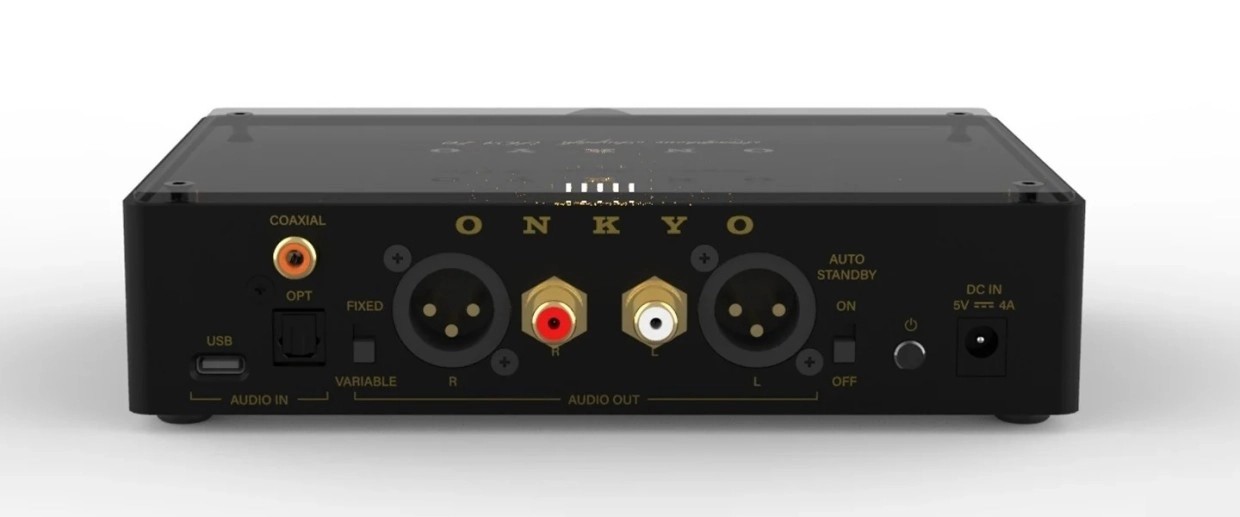
For a buyer, the distinction is still useful: the HA-70 is not just an adapter for adding a headphone socket to a digital source. It combines conversion and dedicated amplification in one enclosure, with attention given to how the left and right channels are handled after the digital signal arrives.
A digital-only front end with room for multiple sources
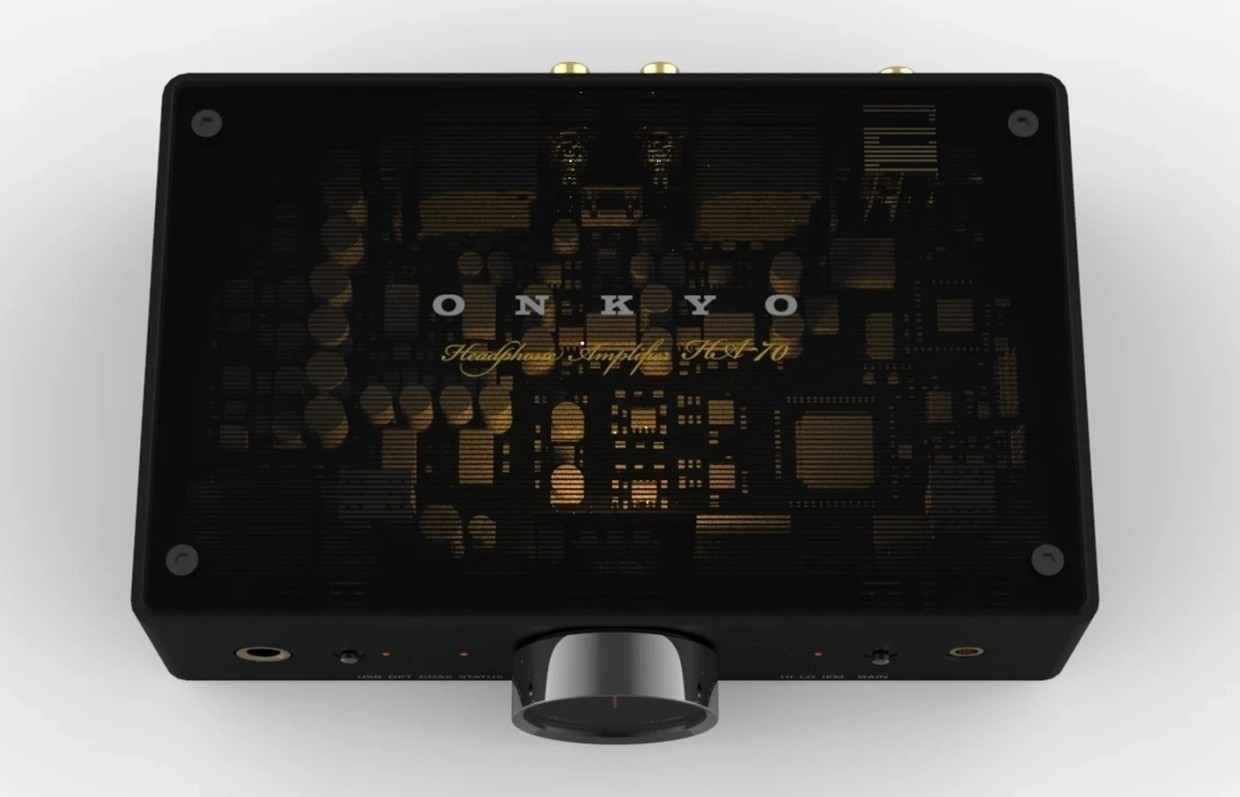
USB-C, optical and coaxial digital inputs define the kind of system the HA-70 is built to serve. A computer is one potential partner for the USB connection, while the other two inputs provide ways to connect equipment with the corresponding digital outputs. The selection makes the unit relevant to a desktop or personal hi-fi setup that uses more than one digital source, rather than only a computer.
There are no analog inputs in the announced specification. That is an important boundary for anyone hoping to use the HA-70 as a headphone amplifier for an existing analog source: its input side is designed for digital signals. Buyers with a mixed collection of digital and analog components should account for that before planning their connections.
An XMOS XU316 USB audio interface supports PCM playback up to 768 kHz and DSD256 via DoP, or DSD over PCM. Those figures indicate support for high-resolution digital audio, although the announcement does not specify equivalent maximum formats for each of the optical and coaxial inputs. Source compatibility should therefore be checked by connection type rather than assumed from the headline USB figures.
Rear outputs extend its role beyond headphones
Alongside the front headphone connections, the HA-70 has RCA and XLR analog outputs on the rear. These allow its conversion stage to feed compatible equipment elsewhere in a system, giving owners a choice of single-ended RCA or balanced XLR connections. For a desk with both headphone listening and a separate audio system, that makes the rear panel relevant to how the unit is integrated.
The supplied details do not establish whether the rear outputs are fixed or variable, or how output switching operates. Those points matter when deciding exactly how to connect the HA-70 to downstream equipment, so buyers should check the final documentation rather than assume it can take on every preamplifier duty.
The aluminum enclosure measures 180 mm wide, 141 mm deep and 46 mm high. That compact footprint suits the desktop role Onkyo describes, while leaving space for the digital inputs and analog outputs that make the device more than a headphone-only endpoint.
The HA-70 appears best suited to a listener building around digital sources who wants a dedicated headphone amplifier without giving up the option of feeding a separate system. Its gain settings address a broad range of intended headphones, but the 600-ohm specification should not be read as a guarantee of ideal performance with every difficult load. Before release, the most useful details to watch for include output power, headphone connector types and the behavior of the rear analog outputs. Onkyo expects the HA-70 in spring 2027; pricing has not yet been announced. Those missing specifications will help determine how well it fits a particular desktop or personal hi-fi setup.


Sound Off
0Join the discussion if you have something to add.