
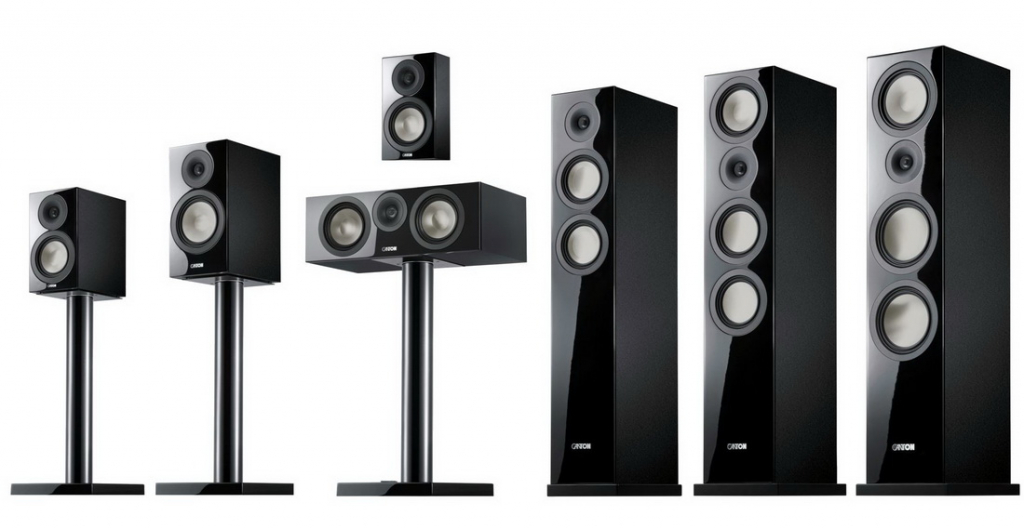
The Canton Chrono 30 is a two-way bookshelf speaker that retains the established visual identity of the Chrono family while introducing less obvious refinements to its enclosure, driver mounting, finishes, and hardware. Its appeal lies not in one headline feature but in the way several practical design decisions have been brought together: a substantial 180mm aluminum woofer, a wide-bandwidth aluminum-manganese tweeter, an aluminum waveguide, an internally revised MDF cabinet, and a clean front baffle with concealed grille attachment. At 360mm tall, the Chrono 30 remains manageable for smaller rooms and living spaces, although its 270mm depth and 8kg listed weight call for more support than a casual desktop speaker. It is a compact model intended to deliver much of the construction philosophy of the wider Chrono range without requiring floorstanding cabinets.
A familiar form with more considered detailing
The Chrono 30’s exterior is deliberately restrained. Canton has kept the series’ recognizable proportions while refining the details around the drivers and front baffle. Screwless aluminum diamond-cut trim rings remove visible mounting hardware from the front, giving the speaker a cleaner and more integrated appearance. The machined edges also provide a subtle contrast with the cabinet finish without turning the speaker into an overtly decorative object.
Those rings are not presented solely as cosmetic additions. Canton uses them to reinforce the driver installation and improve mechanical reliability, particularly when the speaker is operating at higher output levels. That combination of visual tidiness and structural purpose is one of the more attractive aspects of the design: the same component helps finish the enclosure while supporting the drive-unit assembly.
The cabinet receives a structured foil finish, while the front panel is lacquered. This division gives the baffle a distinct visual treatment and helps emphasize the driver layout. An acoustically neutral fabric grille is supplied for owners who prefer a more discreet appearance. Its concealed attachment avoids interrupting the face of the speaker with visible fixing points when the grille is removed. That makes the Chrono 30 adaptable to both equipment-focused rooms, where the drivers may remain visible, and more conventional living spaces where a covered front is preferable.
A substantial aluminum woofer for the cabinet size
Low and midrange duties are handled by a single 180mm aluminum woofer using Canton’s surround-wave arrangement. A driver of this diameter occupies much of the available front baffle, allowing the Chrono 30 to use meaningful radiating area while retaining a standmount format. The aluminum diaphragm is intended to provide a stiff working surface, an important consideration when one driver must cover bass information and continue through the midrange to the 3,000Hz crossover point.
The specified frequency range extends down to 33Hz. That figure should be understood as a manufacturer specification rather than an indication of how the speaker will behave in every room, since placement, room dimensions, boundaries, and partnering electronics all affect low-frequency performance. Even so, it shows that Canton designed the Chrono 30 as a broadly capable stereo loudspeaker rather than a small satellite that necessarily depends on a subwoofer.
Bass-reflex loading is integrated into the revised enclosure and base arrangement. Canton also increased cabinet depth and internal volume within the Chrono generation. These choices give the 180mm driver more internal air volume with which to operate, while the reflex system extends the useful contribution of the enclosure. Owners will still want to allow sensible clearance around the speaker rather than placing it tightly into a confined cubby, especially because bass-reflex speakers interact strongly with nearby walls and furniture.
Wide-bandwidth tweeter with controlled dispersion
High frequencies are reproduced by a 25mm aluminum-manganese tweeter. Canton specifies extension to 40kHz, matching the upper limit of the speaker’s quoted 33Hz–40kHz frequency range. Frequencies at that extreme are not a promise of directly audible output for every listener; the more relevant point is that the tweeter has been engineered with operating bandwidth beyond the conventional audible range.
The tweeter’s aluminum front plate also functions as a waveguide. A waveguide shapes how high-frequency energy leaves the driver, helping Canton manage dispersion and the transition between the tweeter and the larger woofer. This matters because a two-way speaker must combine drivers with very different diameters into a coherent radiation pattern around the crossover region.
With the crossover set at 3,000Hz, the woofer covers the bass and most of the midrange before handing over to the tweeter. The aluminum waveguide is therefore more than a decorative surround: it is part of the acoustic interface between the high-frequency unit, the front baffle, and the room. Its use also complements the diamond-cut woofer ring, giving the two drivers a consistent visual treatment.
Cabinet construction designed around rigidity
The Chrono 30 uses an MDF enclosure with a revised internal structure. MDF remains useful in loudspeaker construction because it can form a dense, consistent cabinet with predictable mechanical properties. Here it is combined with the deeper cabinet profile, increased internal volume, a shaped internal divider, and a one-piece terminal assembly.
These details address different aspects of the enclosure. Internal organization can help support the cabinet and define the air volume in which the woofer operates, while the one-piece connection panel provides a neat, consolidated interface for speaker cable. The overall design suggests that Canton treated the enclosure, driver frames, reflex loading, and base as related parts rather than independent cosmetic and mechanical elements.
The listed dimensions are 190mm wide, 360mm high, and 270mm deep. The narrow front helps keep the speaker visually compact, but the depth is worth noting when planning installation. A shelf must be deep and strong enough to support the cabinet securely while leaving room for cables and ventilation around associated electronics. Dedicated stands may be the more practical solution where space allows. The 8kg listed weight also indicates that stable furniture or appropriately rated stands should be used.
Amplifier matching and system integration
Canton specifies a sensitivity of 86.5dB for 1 watt at 1 meter. This is a useful figure for system planning: the Chrono 30 is not unusually sensitive, so amplifier capability and expected listening distance deserve consideration. Larger rooms, greater seating distances, and sustained higher playback levels generally place more demand on an amplifier than near-field or moderate-level use.
Nominal impedance is quoted at 8 ohms, with a 4-ohm minimum. Prospective owners should therefore check that their amplifier is comfortable driving a load that can fall to 4 ohms. The speaker is rated at 70 watts nominal and 130 watts maximum. Those figures provide a framework for matching, but wattage alone does not describe an amplifier’s behavior; stable delivery into the speaker’s impedance range is also relevant.
Connection is through gold-plated screw terminals. This is a straightforward, durable arrangement that supports secure cable attachment without adding unnecessary complexity. There is no documented active amplification, wireless platform, or network functionality, so the Chrono 30 is intended for a conventional passive system with an external integrated amplifier, receiver, or separate preamplifier and power amplifier combination. That approach leaves the owner free to select electronics and sources according to room size, features, and budget.
Who the Canton Chrono 30 is most suitable for
The Chrono 30 is likely to suit listeners who want a passive stereo speaker with more driver area and cabinet volume than very small bookshelf models, but who do not have the space or preference for floorstanding speakers. Its relatively narrow width should help it fit into domestic environments, while the structured cabinet finish, lacquered baffle, concealed fasteners, and removable fabric grille support either a technical or understated presentation.
It is also appropriate for owners who value system flexibility. Because amplification is external, the speaker can be incorporated into a traditional two-channel setup, used with a suitably capable receiver, or retained while source components and electronics change over time. The 33Hz–40kHz specified range and 180mm woofer suggest that it is designed to operate as a full-range standmount within its intended limits, although owners can still add a subwoofer if their room, listening habits, or system goals call for one.
It may be less suitable for someone seeking an all-in-one wireless speaker, an ultra-compact desktop model, or a cabinet that can be pushed into a shallow shelf without installation planning. Its 86.5dB sensitivity and 4-ohm minimum impedance also mean amplifier matching should not be treated as an afterthought. Stable stands, adequate cabinet clearance, and suitable electronics will help an owner use the Chrono 30 as intended.
Conclusion
The Canton Chrono 30’s strongest documented qualities are its purposeful two-way architecture, large 180mm aluminum woofer, aluminum-manganese tweeter with an integrated waveguide, reinforced MDF bass-reflex cabinet, and carefully concealed front hardware. Its diamond-cut rings, lacquered baffle, structured finish, and fabric grille give it enough visual flexibility for both dedicated hi-fi spaces and shared living rooms. At the same time, its conventional passive design, gold-plated screw terminals, and clearly stated electrical specifications make system planning straightforward. It is best suited to listeners seeking a substantial standmount speaker with traditional amplifier flexibility, clean industrial design, and more cabinet volume than a miniature bookshelf model, provided they can accommodate its depth, weight, and need for appropriately capable amplification.

Sound Off
0Join the discussion if you have something to add.