
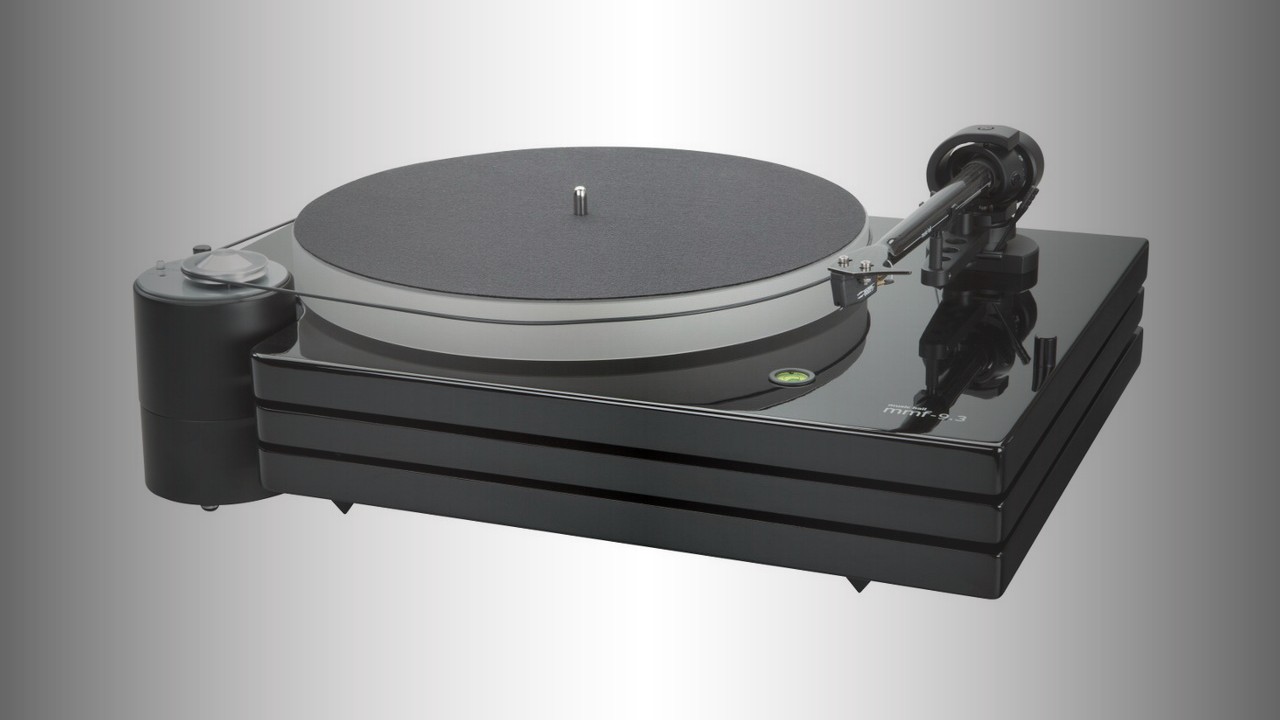
The central idea behind the Music Hall MMF-9.3 is straightforward: keep unwanted mechanical energy away from the stylus. Rather than relying on one especially heavy plinth, Music Hall divides the chassis into three MDF layers separated by compliant isolation pads. The drive motor is mechanically detached from that structure, while the platter, bearing, tonearm, feet, and cartridge have all been selected or arranged with vibration control in mind. At 18 kg, this is a substantial turntable, but its appeal is not based on mass alone. It combines a carefully isolated belt-drive architecture with useful setup adjustments, electronic speed switching, a supplied moving-coil cartridge, and practical accessories including a dust cover and platter mat.
A three-layer approach to vibration control
The MMF-9.3’s most distinctive feature is its three-board plinth. The separate MDF layers are divided by Sorbothane isolation pads, creating mechanical breaks intended to reduce the movement of vibration through the turntable. This is relevant because a phono cartridge responds to extremely small movements at the stylus. Energy arriving through furniture, loudspeakers, the motor, or the turntable’s own structure can therefore be undesirable.
Several layers of high-gloss piano lacquer complete the exterior and are also specified as contributing additional damping. The finish gives the MMF-9.3 a visually unified appearance despite the divided construction, while the stacked profile reveals that its architecture is more elaborate than a conventional single-board deck.
The whole assembly stands on three height-adjustable steel cones, with protective pads included for the supporting surface. A three-point support cannot rock in the same way as an uneven four-foot arrangement, and the adjustable cones allow the platter to be levelled on furniture that is not perfectly horizontal. Music Hall also installs a small circular bubble level on the top panel, between the platter and tonearm, so the owner does not need a separate level for routine setup checks.
A motor kept apart from the sensitive components
The AC motor does not share the main chassis mechanically. It occupies a cutout toward the front-left corner but sits on its own substantial cylindrical base with elastic silicone feet. This layout preserves a cohesive overall footprint while reducing the direct path through which motor vibration could reach the platter and pickup.
The motor is positioned diagonally opposite the tonearm, increasing the physical separation between the drive source and cartridge. A long, square-section belt transfers rotation to the platter. Belt tension can be adjusted by moving the freestanding motor slightly, a simple mechanical solution that avoids integrating the motor rigidly into the plinth.
Speed selection for 33 1/3 and 45 rpm is electronic, using controls located underneath the turntable. That removes the need to reposition the belt manually when moving between LPs and singles. The motor itself is switched on at its housing, where a blue LED provides a clear operating indication. Power comes from an external network adapter, keeping that part of the supply outside the main structure.
Acrylic platter and inverted ceramic bearing
The MMF-9.3 uses a 300 mm acrylic platter that is 25 mm, or approximately one inch, thick and weighs 2.7 kg. Acrylic provides a rigid record-supporting surface, while the platter’s mass contributes rotational inertia. A damping mat is supplied, giving the owner a ready-to-use interface between record and platter rather than requiring an immediate accessory purchase.
The platter rotates on an inverted ceramic bearing. This is another example of the product’s emphasis on the mechanical path from record to chassis: the bearing must support a comparatively heavy platter while allowing stable, low-friction rotation.
Music Hall lists wow and flutter at less than 0.15 percent at 33 1/3 rpm, speed accuracy at plus or minus 0.9 percent, and rumble below -70 dB. These specifications describe the manufacturer’s intended performance parameters rather than independent measurements, but they provide useful context for the engineering priorities behind the drive and bearing system.

A carbon-fiber tonearm with meaningful adjustment
A Pro-Ject 9cc carbon-fiber tonearm is fitted as standard. Its counterweight is positioned to lower the center of gravity toward the level of the cartridge, and the counterweight itself is damped. This arrangement is intended to improve the stability of the arm and cartridge assembly rather than leaving the mass concentrated unnecessarily high behind the pivot.
The arm includes vertical tracking angle and anti-skating adjustments. Vertical tracking angle adjustment is particularly useful when accommodating cartridges of different heights or experimenting with platter mats, while anti-skating allows compensation for the inward force generated as the stylus traces a rotating record. These controls give the MMF-9.3 more long-term flexibility than a turntable designed only around a permanently fixed factory configuration.
At the same time, the supplied arm and cartridge make the package relatively complete. An owner does not have to begin by selecting compatible components from separate manufacturers, yet the available adjustments leave room for careful setup and possible future cartridge changes.
A supplied moving-coil cartridge
The MMF-9.3 is supplied with a moving-coil cartridge featuring a Gyger II stylus. Its listed output is 0.5 mV, with a specified frequency range of 20 Hz to 22 kHz, stereo separation of 25 dB, channel imbalance of 1 dB, and a cartridge weight of 5.5 grams. The stated vertical tracking angle is 20 degrees.
The low 0.5 mV output is important for system matching. Prospective owners will need a phono stage or amplifier input designed to provide suitable gain for a low-output moving-coil cartridge. A conventional moving-magnet-only input may not offer enough gain. The turntable terminates in gold-plated RCA output sockets, making it compatible with the connection format used by most separate phono preamplifiers and suitably equipped integrated amplifiers.
Supplying the cartridge helps define the MMF-9.3 as an integrated record-playing system rather than merely a bare turntable platform. Its moving-coil configuration also means that the phono electronics should be considered part of the purchase and setup plan.

Practical considerations and intended owner
With its dust cover fitted, the MMF-9.3 measures 464 mm wide, 184 mm high, and 337 mm deep. Its 18 kg weight and separate motor arrangement call for a stable, adequately sized equipment shelf. The adjustable cones can correct small levelling errors, but they do not eliminate the need for supportive furniture and sensible placement away from strong acoustic or structural vibration.
The turntable is particularly suitable for an owner who wants a largely assembled analog package while retaining control over alignment-related parameters such as vertical tracking angle, anti-skating, levelling, and belt tension. Electronic switching between the two principal vinyl speeds also makes it convenient for collections containing both 33 1/3 and 45 rpm records.
It is less appropriate for listeners who require 78 rpm playback, as only 33 1/3 and 45 rpm are specified. Its physical size and weight may also be excessive for compact furniture or frequently rearranged systems. Finally, the moving-coil cartridge means buyers should verify phono-stage compatibility rather than assume that any phono input will be suitable. Within those requirements, the MMF-9.3 offers a useful balance between a preconfigured turntable and a platform that still rewards methodical setup.
Conclusion
The Music Hall MMF-9.3 is defined by mechanical separation and thoughtful integration. Its three-layer isolated plinth, freestanding AC motor, long belt, 2.7 kg acrylic platter, inverted ceramic bearing, and three-point adjustable support all address the management of unwanted vibration. The Pro-Ject 9cc carbon-fiber arm adds VTA and anti-skating adjustment, while the supplied moving-coil cartridge, electronic 33 1/3 and 45 rpm selection, bubble level, mat, and dust cover make the package comparatively complete. It is best suited to vinyl listeners with a stable equipment platform and an MC-compatible phono stage who want the convenience of a coordinated turntable package without giving up important setup flexibility.


Sound Off
0Join the discussion if you have something to add.