
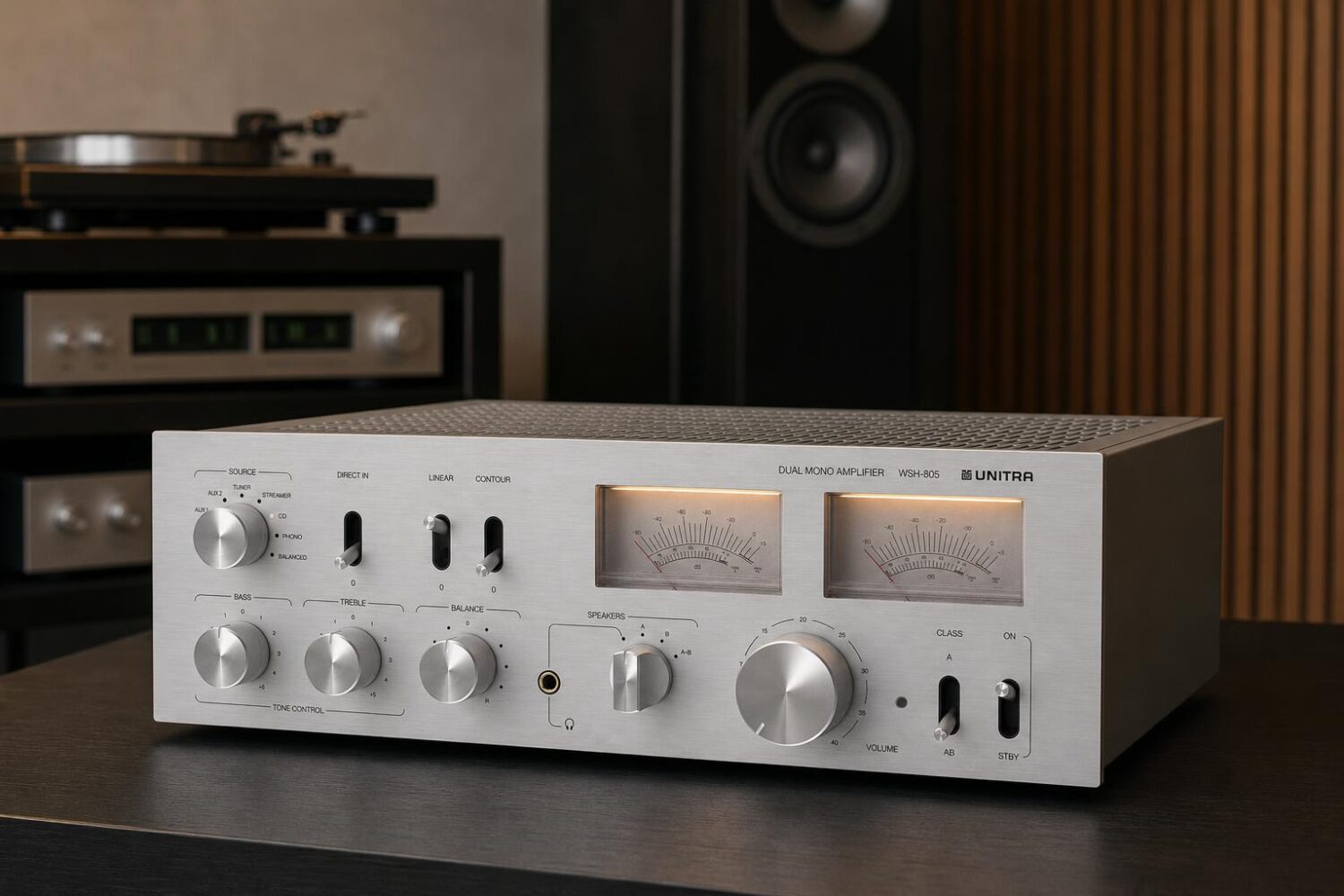
Unitra has combined visual references to its past with a thoroughly modern analog amplifier design in the WSH-805. The integrated model pairs dual-mono construction with switchable Class AB and pure Class A operation, extensive line-level connectivity and support for both moving-magnet and moving-coil cartridges.
A historic influence without vintage circuitry
The WSH-805 takes part of its visual direction from the earlier Unitra WSH-205, connecting the new amplifier to a name with roots in Poland’s Cold War-era consumer electronics industry. The original Unitra collective ceased operations in 1989, while the re-established company now uses that heritage as a starting point for newly engineered products.
That distinction is central to the WSH-805. Although its VU meters, prominent knobs and substantial toggle switches create an unmistakably retro appearance, the internal architecture is not a reproduction of an older amplifier. Unitra has instead developed a dual-mono layout in which the left and right channels have separate basket-type transformers. Both the preamplifier and power-amplifier stages employ current-feedback circuit arrangements, while the power stage uses a fully discrete design.
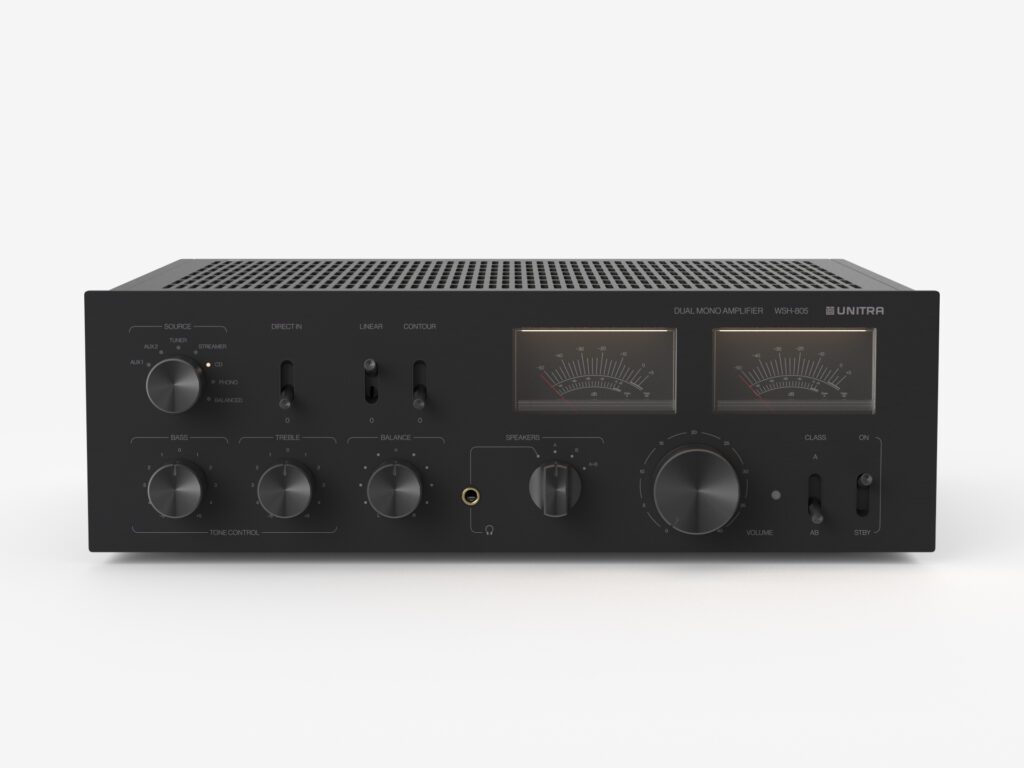
The chassis measures 14 x 44 x 38.5 cm and weighs 18 kg. A black version is also identified, offering a more understated interpretation of the same front-panel layout.
Switchable Class AB and pure Class A modes
In its standard Class AB operating mode, the WSH-805 is rated to deliver 80 watts per channel into 8 ohms and 125 watts per channel into 4 ohms. A front-panel control switches the amplifier into pure Class A operation, reducing output to 8 watts into 8 ohms or 16 watts into 4 ohms.
This selectable arrangement gives owners two operating modes within a single integrated amplifier. Class AB provides the higher output intended for more demanding speakers or louder playback, while Class A is available when its lower power ceiling is appropriate for the connected speakers and listening level.
The operating-mode control is among several two-position switches on the fascia. These controls are motorized, allowing their physical positions to change when the corresponding commands are selected from the supplied remote control. The switches can also be operated directly from the front panel.
Analog inputs include MM and MC phono support
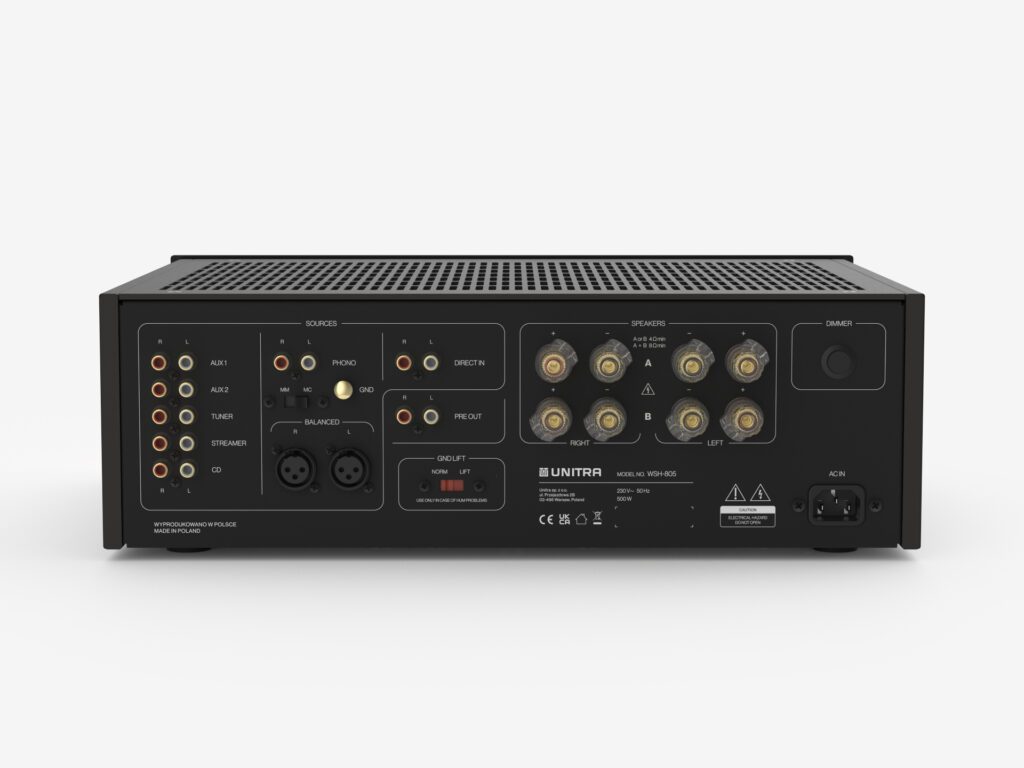
The WSH-805 is an exclusively analog design, with no digital inputs or Bluetooth connectivity. Its line-level input complement consists of five RCA inputs and one balanced XLR input. Tone controls are also included as part of the integrated amplifier’s feature set.
Vinyl playback is handled by an internal phono stage compatible with both moving-magnet and moving-coil cartridges. The moving-coil section has a fixed impedance rather than user-adjustable loading, so cartridge matching will need to be considered when configuring a turntable system.
A direct AV input allows the WSH-805 to be incorporated into a wider entertainment setup, while a stereo RCA preamplifier output provides a connection for an external power amplifier or another compatible component. The front panel also carries a 6.3 mm headphone jack, and speaker connections are made through five-way binding posts.
A modern integrated amplifier in retro form
The WSH-805 is positioned as a full-size integrated amplifier for listeners who want traditional physical controls and a broad range of analog sources. Its combination of an XLR input, multiple RCA connections, onboard phono amplification and an AV input gives it scope to act as the control center of a system without adding digital circuitry.
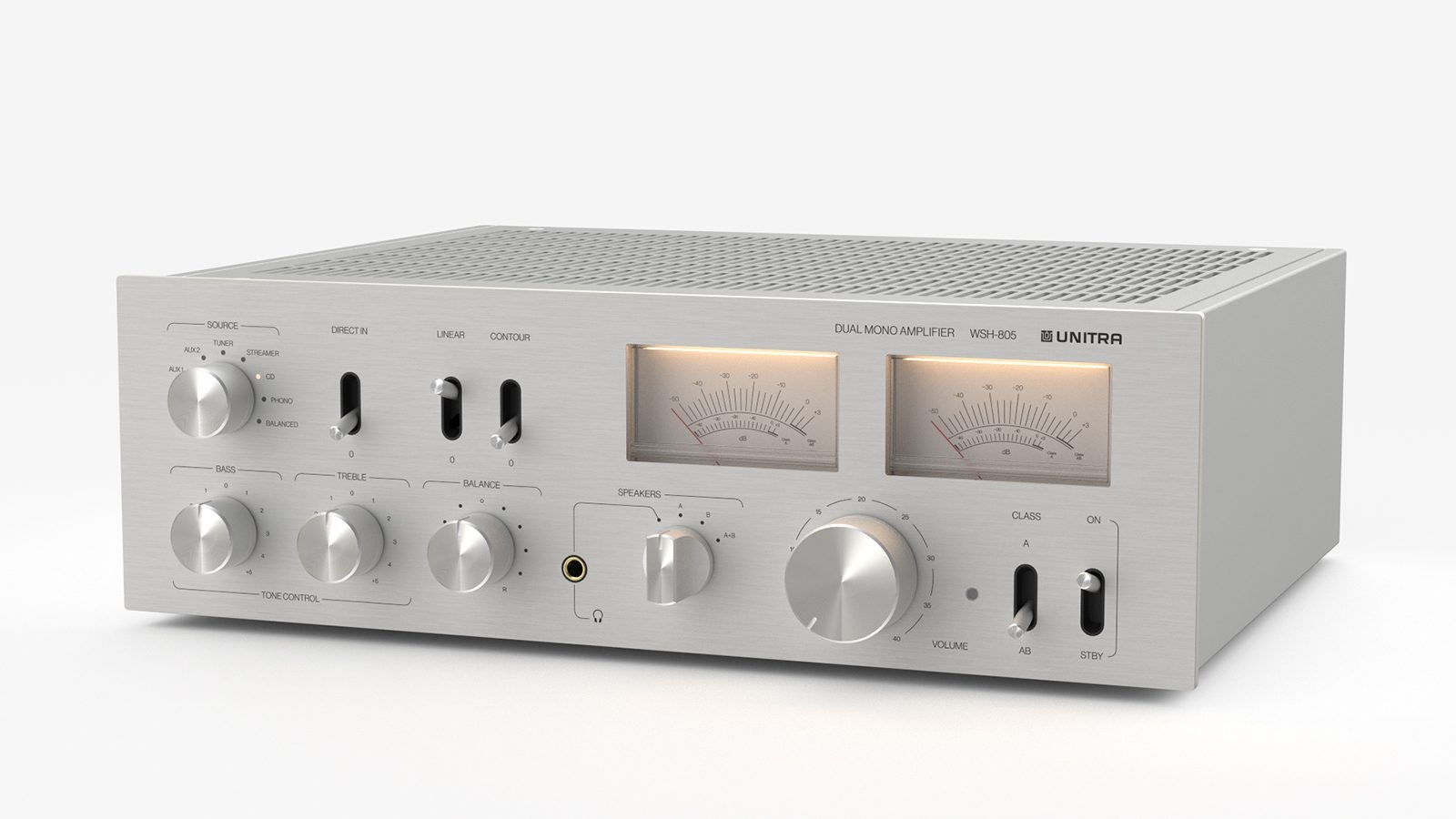
At the same time, its switchable amplifier bias distinguishes it from conventional analog integrated designs. The higher-powered Class AB mode and lower-output Class A setting are supported by the same dual-mono foundation, rather than being divided between separate products.
Unitra includes a remote control with the amplifier. No USD price or specific market-availability information has been provided.
With the WSH-805, Unitra has placed classic styling around a modern dual-mono platform rather than simply recreating a historic model. Its motorized controls, selectable Class A operation and comprehensive analog connectivity give the amplifier a distinctive identity while preserving a deliberately traditional user experience.


Sound Off
0Join the discussion if you have something to add.