
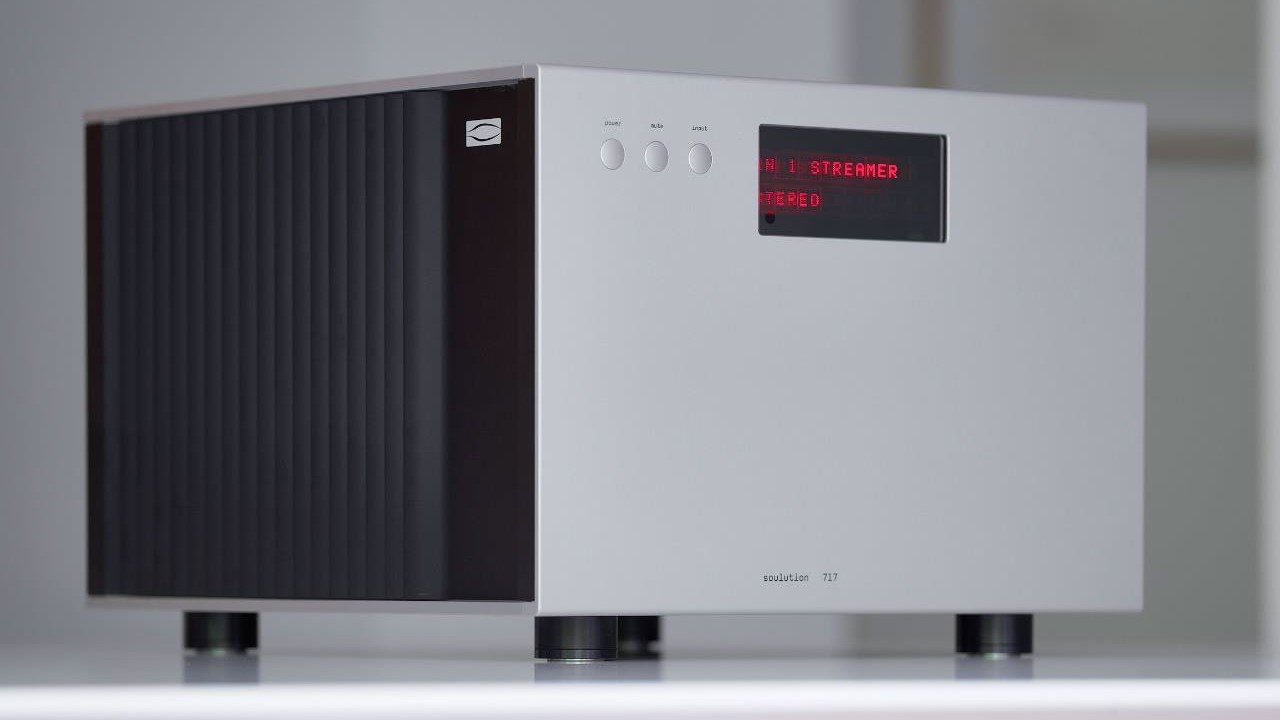
Soulution’s 717 is a two-channel power amplifier designed to accommodate several different system architectures rather than perform only one fixed role. It can provide conventional stereo amplification from a single chassis, operate in a dual-mono arrangement for bi-amping, or combine its channels for bridged mono use. That flexibility gives the 717 relevance both in a straightforward high-end stereo system and in more elaborate installations that may evolve over time.
Its engineering is equally distinctive. Soulution specifies a frequency response extending from 0.1 Hz to 2 MHz at the -3 dB points, a phase shift of 0.2 degrees at 20 kHz and a noise floor below -165 dB across the 20 Hz to 20 kHz range. Those figures describe an amplifier designed around very wide bandwidth, low noise and tightly controlled phase behavior. Alongside that signal-stage engineering, four switching power supplies are mounted directly to the power-amplifier circuit boards to shorten the path between the power source, output stages and speaker connections.
One amplifier, several system configurations
The most immediately useful aspect of the 717 is its configurable two-channel architecture. In its simplest role, it is a stereo power amplifier delivering 150 watts per channel into 8 ohms. Output doubles to 300 watts per channel into 4 ohms and reaches 600 watts per channel into 2 ohms. This progression is relevant to system matching because loudspeaker impedance is rarely constant; the specified outputs show that the amplifier is intended to provide increasing power into lower nominal loads.
Beyond ordinary stereo operation, the 717 can be configured for dual-mono use in a bi-amplified system. Bi-amping assigns separate amplifier channels to different sections of a compatible loudspeaker, potentially allowing an owner to build a more specialized arrangement without changing to an entirely different amplifier platform. The 717’s channels can also be bridged, allowing both channels to work together to drive one loudspeaker.
That range of operating modes makes the amplifier adaptable. An owner might begin with one 717 in a two-channel system and later consider a configuration using separate amplification for each speaker or for different loudspeaker sections. Soulution has therefore treated configuration flexibility as part of the core design rather than limiting the product to a single stereo installation.
A deliberately wide-bandwidth signal path
Soulution’s amplifier topology extends beyond the audible frequency range, with the 717 specified at 0.1 Hz to 2 MHz at -3 dB. Bandwidth of that scale should not be interpreted as an attempt to reproduce audible content at megahertz frequencies. Instead, it indicates that the audio band occupies only a small part of the circuit’s overall operating range.
The associated phase specification provides further context. Soulution quotes a phase shift of 0.2 degrees at 20 kHz, the upper boundary commonly used for the audible spectrum. Taken together, the bandwidth and phase figures describe an amplifier engineered to maintain consistent signal behavior across the audio band rather than approaching a steep frequency cutoff near its upper edge.
The 717 also carries a specified noise floor below -165 dB from 20 Hz to 20 kHz. Such figures depend on stated conditions and should not be treated as a substitute for system-level evaluation, but they clearly identify low noise and low distortion as central design priorities. The input stage is derived from the architecture used in Soulution’s 727 preamplifier, creating an intentional technical relationship between the company’s preamplification and power-amplification components.

Power supplies positioned close to the output stages
The 717 uses four 600 VA switching power supplies, each specified with a 2,100 VA pulse output. Rather than connecting those supplies to the amplifier stages through longer internal wiring runs, Soulution mounts them directly to the printed circuit boards of the power-amplifier stages.
The stated purpose of this arrangement is to reduce contact resistance and create the shortest practical route from the power supplies through the amplifier circuitry to the speaker terminals. This is a meaningful piece of physical design because a power amplifier must move substantial current internally, particularly when operating into lower-impedance loudspeaker loads. Shortening those connections reduces the number and length of interfaces within that high-current path.
Using four supplies also reflects the 717’s emphasis on channel configuration and power delivery. The published information does not assign a separate operational role to each individual supply, so it would be inappropriate to infer the precise internal allocation. What is clear is that the power architecture is distributed and placed close to the circuitry it serves, rather than being treated as a remote section connected by extended cabling.
Balanced connections and component matching
The documented input provision consists of two balanced XLR connections, one for each channel, while the specification also lists one balanced XLR output. This makes the 717 most naturally suited to a system built around balanced interconnects, including a pairing with Soulution’s own 727 preamplifier or another suitably equipped line-stage component.
Prospective owners should consider that connectivity in the context of their existing equipment. The listed specifications do not include unbalanced RCA inputs, digital inputs, source selection or volume control. The 717 is a dedicated power amplifier, so it belongs downstream of a preamplifier or another source component capable of providing appropriate level control and balanced output.
The two-channel format may simplify installation compared with using two separate monoblocks, while still offering routes into dual-mono, bi-amplified or bridged systems. Those more complex arrangements require compatible loudspeakers, suitable upstream components and careful configuration. The flexibility is therefore valuable, but it is most useful when planned as part of the complete system rather than considered in isolation.

Who the Soulution 717 is most suitable for
The 717 is aimed at listeners assembling a high-end separates system who value technical headroom, balanced connectivity and the ability to choose among several amplification layouts. Its specified output into 8-, 4- and 2-ohm loads will be particularly relevant to owners assessing an amplifier for speakers with demanding impedance characteristics, although nominal power figures alone cannot determine compatibility with every loudspeaker.
It also makes sense for enthusiasts who expect their systems to develop. Conventional stereo operation offers a clear starting point, while dual-mono bi-amping and bridged use provide options for a future installation. Owners of compatible multi-terminal loudspeakers may find the bi-amplification capability especially useful, while a pair of 717 amplifiers could support configurations that give each speaker dedicated amplification.
Conversely, the 717 is less naturally aligned with someone seeking an all-in-one amplifier, extensive source connectivity or a system centered on unbalanced RCA components. Its documented feature set concentrates on power amplification rather than integrated convenience. Bridging and bi-amping also add setup complexity, so users wanting the simplest possible installation may find its standard stereo mode the most relevant. The product’s appeal lies not in requiring an elaborate arrangement, but in leaving those options available.
Conclusion
The Soulution 717 combines a focused set of engineering choices with unusually broad configuration options. Its principal strengths are the ability to operate in stereo, dual-mono bi-amplified and bridged modes; power ratings that rise from 150 watts per channel at 8 ohms to 600 watts at 2 ohms; a signal path specified out to 2 MHz; and four switching power supplies mounted directly to the amplifier boards. Balanced XLR connectivity and an input stage related to the Soulution 727 preamplifier further define its place in a carefully assembled separates system. It is best suited to owners who want a dedicated balanced power amplifier with substantial load capability and enough architectural flexibility to support both a conventional stereo setup and more ambitious future configurations.