
Amplifier requirements vary sharply between systems.
A headphone listener needs different connections and power delivery from someone driving passive speakers, while a multi-room installation introduces networking, control and integration considerations.
This selection reflects that breadth, covering headphone amplification, integrated amplifiers, power amplifiers, a line-level preamplifier and distributed audio. Not every source article describes a conventional speaker amplifier. The Topping DX9 combines a DAC with headphone amplification, the Fyne Audio F1-8S is a passive loudspeaker, and the Jadis JS5 and JS2 SL are digital-to-analogue converters with tube-based analogue stages. They remain included in their supplied positions because they can be relevant to building a complete system, but their roles should not be confused with that of an integrated or power amplifier. The strongest choice therefore depends less on rank than on function. Start by deciding whether you need source selection and volume control, a dedicated power stage, headphone output, phono input or multi-zone streaming. Then confirm that the selected component has the connections, control options and speaker-driving ability your system requires.

1. Topping DX9: High-performance DAC/headphone amplifier
The Topping DX9 combines a curved chassis, dual displays and a transparent panel revealing its internal circuitry.
The DX9 is a desktop-oriented digital source and headphone amplifier rather than a power amplifier for passive speakers.
It uses an AKM AK4499EQ four-channel DAC chip and an AK4118AEQ receiver for optical and SPDIF signals, while its discrete NFCA headphone stage is assembled from six amplifier modules.
Separate power stages serve the DAC and headphone sections. Digital support extends to PCM at 32-bit/768 kHz and native DSD512. The curved enclosure, transparent engraved top panel and two displays running Topping’s Aurora interface also distinguish it from more utilitarian headphone components.
Best for: High-resolution digital and headphone systems
- Discrete NFCA headphone amplifier
- Separate DAC and headphone power stages
- PCM 32-bit/768 kHz and native DSD512 support
- Optical and SPDIF reception
Verdict: Choose the DX9 when digital conversion and headphone amplification are the priorities, not when passive speakers need to be driven directly.

2. TRIVUM SC340m: New multi-zone amplifier launched
The compact TRIVUM SC340m provides amplification and network streaming for four separate rooms.
The compact SC340m is built for distributed audio, serving four rooms and delivering 2 x 30 watts to each zone.
Ethernet is its principal source connection, supported by an integrated streaming module with AirPlay, Spotify Connect and TuneIn internet radio access.
Control is available through a free mobile application or a KNX communication bus, and drivers are offered for RTI, URC and Control4 platforms. Two units can be combined for rack installation, making the SC340m particularly relevant to planned home-automation projects.
Best for: Networked multi-room installations
- Four-room amplification
- 2 x 30 watts available per room
- AirPlay and Spotify Connect support
- KNX, RTI, URC and Control4 integration
Verdict: The SC340m is the specialist option for four-zone streaming and automation rather than a conventional single-room hi-fi amplifier.

3. Naim Supernait 3
The Naim Supernait 3 retains the brand’s distinctive front panel with illuminated motorised volume and balance controls.
Naim’s Supernait 3 is an integrated amplifier designed to accommodate turntables, digital sources and headphones without requiring separate control components.
Its built-in phono stage is the most important practical addition for vinyl users, while the Class A preamplifier section also supplies the headphone output.
Internally, each input is independently decoupled to reduce noise and interference. Ultra-low-noise DC supplies feed the input relay, and ceramic heatsinks are used to minimise capacitive coupling between the chassis and output transistors. Motorised volume and balance controls preserve Naim’s established front-panel arrangement.
Best for: Single-box systems with vinyl and headphones
- Built-in phono stage
- Class A preamplifier and headphone output
- Individually decoupled inputs
- Motorised volume and balance controls
Verdict: The Supernait 3 is the most versatile conventional integrated amplifier here for listeners combining a turntable with other line-level sources.

4. Audio Research LS-3: A modern, fully balanced line stage with classic ARC DNA
The Audio Research LS-3 is a fully balanced solid-state line stage with dual-mono power supplies.
The LS-3 is a solid-state line-level preamplifier, so it requires a separate power amplifier.
Its fully symmetrical differential topology uses JFET devices at the input, bipolar transistors for voltage amplification and a pure Class A output stage.
The design is intended to provide low-noise signal control without relying on the tube circuitry commonly associated with Audio Research. A true dual-mono layout gives each channel its own transformer, linear power supply and voltage regulation. That separation makes the LS-3 a focused option for systems in which preamplification and power amplification are deliberately kept in different enclosures.
Best for: Balanced separates-based systems
- Fully balanced differential circuit
- Pure Class A output stage
- True dual-mono construction
- Separate transformer and regulation for each channel
Verdict: The LS-3 suits listeners building a fully balanced solid-state system around a dedicated line preamplifier and separate power stage.
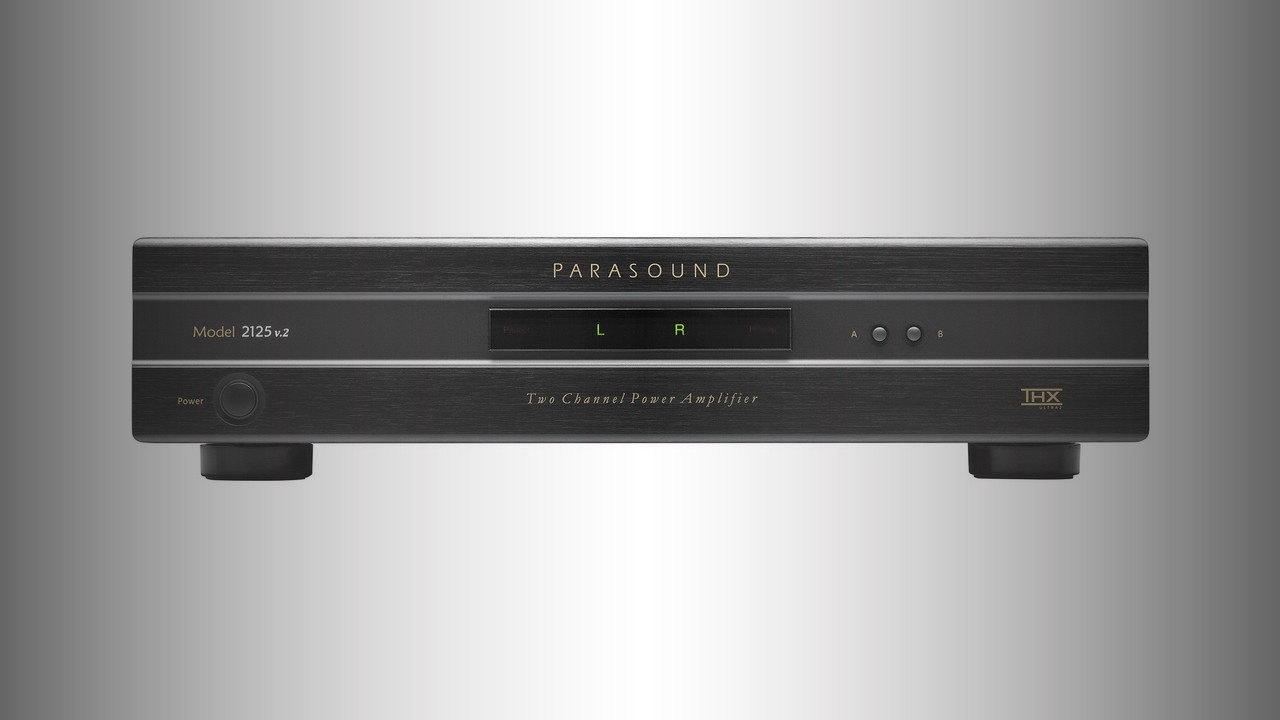
5. Parasound NewClassic 2125 v.2: Entry-level power amplifier
The Parasound NewClassic 2125 v.2 uses a restrained aluminium front panel suited to domestic or rack-mounted systems.
The NewClassic 2125 v.2 is a stereo power amplifier rated at 125 watts per channel into 8 ohms.
Its adjustable high-pass filter offers 20 Hz and 40 Hz settings for systems incorporating a subwoofer, while independent gain controls provide additional flexibility during installation.
It can operate in bridged mode or power two selectable pairs of speakers through A, B or A+B outputs. Optional rack-mounting hardware and THX Ultra 2 certification further underline its installation-oriented character. Because this is a power amplifier, source selection and primary volume control must come from a preamplifier or another compatible upstream component.
Best for: Flexible stereo, subwoofer and installation systems
- 125 watts per channel into 8 ohms
- Selectable 20 Hz and 40 Hz high-pass filter
- Independent channel gain controls
- Bridge and A/B speaker modes
Verdict: The 2125 v.2 stands out for practical configuration options, especially where gain adjustment, filtering or two speaker pairs are required.
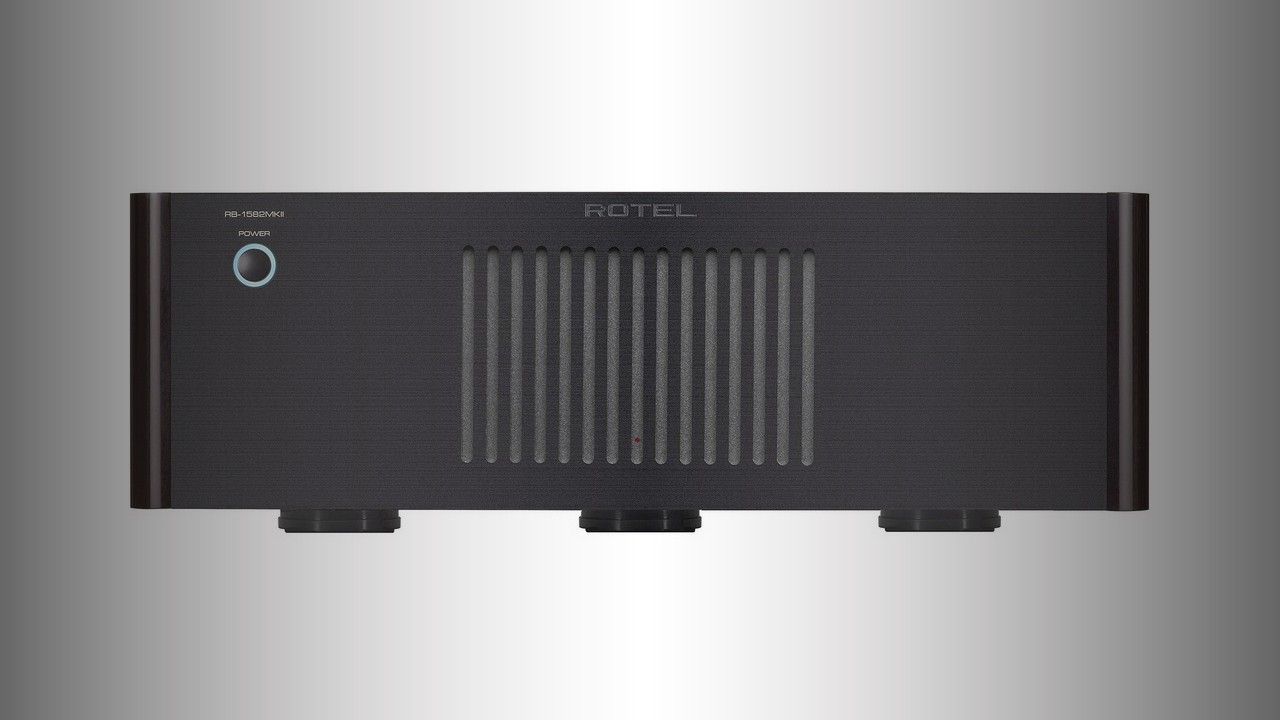
6. Rotel RB-1582 MkII: Accurate and powerful stereo amplifier
The Rotel RB-1582 MkII houses a 200-watt-per-channel stereo power stage in a substantial metal chassis.
The RB-1582 MkII is a dedicated stereo power amplifier delivering 200 watts per channel into 8 ohms.
Its power supply combines a shielded toroidal transformer with four capacitors providing a total stated capacity of 60,000 microfarads, giving the amplifier substantial reserves for demanding musical passages.
Left and right channels follow a dual-mono layout and are mounted on separate heatsinks. Star grounding is used to limit noise and interference, while each discrete output stage contains ten high-current bipolar transistors. Internal sensors monitor operating temperature and output-transistor conditions.
Best for: Systems needing a high-output stereo power stage
- 200 watts per channel into 8 ohms
- Shielded toroidal transformer
- Dual-mono channel layout
- Temperature and output-stage monitoring
Verdict: The RB-1582 MkII is the straightforward high-power choice for a separates system with a suitable preamplifier.

7. PrimaLuna EVO 300
The PrimaLuna EVO 300 belongs to the company’s tube-amplifier range, although the supplied technical description refers to a different EVO model.
This source presents the PrimaLuna EVO 300 as a tube amplifier, but the detailed operating figures in the supplied excerpt explicitly refer to the EVO 400 Integrated.
Those output ratings should therefore not be assigned to the EVO 300 without confirmation.
The material describes PrimaLuna’s Adaptive AutoBias system, which monitors tube condition and adjusts operating parameters in real time, as well as switchable tube settings and speaker-to-headphone operation. Buyers should nevertheless verify the EVO 300’s exact tube complement, output, operating modes and headphone implementation against the specific unit being considered.
Best for: Tube-amplifier buyers willing to verify model details
Verdict: The EVO 300 may interest listeners seeking a tube integrated amplifier, but the source mismatch prevents a confident feature-by-feature recommendation.

8. Accuphase E-800: Amplifier conveying the most subtle and hidden nuances
The Accuphase E-800 is listed as a high-end amplifier, but the supplied source provides no model-specific technical description.
The supplied material concentrates on Accuphase’s history, limited production approach and emphasis on high-fidelity engineering rather than giving usable details about the E-800 itself.
It does not state the model’s power output, circuit class, inputs, control features or system requirements.
That absence makes meaningful comparison with the other amplifiers impossible on the available evidence. Prospective buyers should establish the E-800’s exact specifications and compatibility with their speakers and sources before treating its position here as a purchasing recommendation.
Best for: Accuphase enthusiasts prepared to conduct further research
Verdict: The E-800 cannot be assessed confidently from the supplied excerpt because it contains brand background rather than model-specific information.

9. Fyne Audio F1-8S floorstanding speakers
The Fyne Audio F1-8S is a 30 kg floorstanding speaker built around the company’s 200 mm IsoFlare coaxial driver.
The F1-8S is not an amplifier but a passive floorstanding loudspeaker included here as a potential system partner.
Its 200 mm IsoFlare coaxial driver places a 25 mm magnesium-dome compression tweeter at the centre of the mid-bass cone, an arrangement designed to behave in a point-source-like manner and support phase consistency.
The cabinet measures 1,086 mm high, 335 mm wide and 445 mm deep, with each speaker weighing 30 kg. A metal sandwich plinth incorporates the BassTrax port system and adjustable spikes. Amplifier buyers should confirm suitable electrical matching separately, as the supplied material does not state the speaker’s impedance or sensitivity.
Best for: Readers choosing speakers alongside an amplifier
- 200 mm IsoFlare coaxial driver
- 25 mm magnesium-dome compression tweeter
- BassTrax port system
- Adjustable spikes and substantial metal base
Verdict: The F1-8S is relevant only as a passive speaker partner and should not be mistaken for an amplification component.

10. Jadis JS5 and JS2 SL
The Jadis JS5 and JS2 SL combine digital conversion with tube-based analogue circuitry for connection to a separate amplifier.
Despite the source article’s amplifier-oriented title, the Jadis JS5 and JS2 SL are digital-to-analogue converters rather than speaker amplifiers.
Both use triode tubes in their analogue signal paths, dedicated DAC chips for each channel and multi-stage power supplies.
They provide analogue output to a separate amplifier through RCA or XLR connections. The flagship JS5 uses four dual-triode tubes in its signal path, with two additional pentodes involved in the external power supply. Separate custom-wound transformers serve its digital and analogue sections, while conversion is handled by an eight-channel Sabre ES9038PRO DAC chip. The JS2 SL is described as a simplified model that retains much of the JS5’s circuit approach.
Best for: Digital systems seeking a tube-equipped DAC
- Tube-based analogue signal paths
- Dedicated DAC chips for each channel
- RCA and XLR analogue outputs
- Separate digital and analogue power arrangements in the JS5
Verdict: The JS5 and JS2 SL are source components for feeding an amplifier, not alternatives to an integrated or power amplifier.
Frequently asked questions
Should I choose an integrated amplifier or a separate power amplifier?
Choose an integrated amplifier when you want source selection, volume control and speaker amplification in one enclosure, as offered by the Naim Supernait 3.
A power amplifier such as the Parasound 2125 v.2 or Rotel RB-1582 MkII needs a compatible preamplifier or another component that provides volume control and suitable analogue outputs.
Can a headphone amplifier drive passive loudspeakers?
Not unless the manufacturer explicitly provides speaker-level outputs.
The Topping DX9 is a DAC and headphone amplifier, so it should feed headphones directly or connect at line level to a separate speaker amplifier.
What should I check when matching an amplifier to speakers?
Confirm the speaker impedance, sensitivity and recommended amplifier range, then compare those requirements with the amplifier’s stated output and supported load.
Also consider room size and listening level; do not assume that a high wattage figure alone guarantees compatibility.
When does a multi-zone amplifier make more sense than a stereo amplifier?
A multi-zone model is appropriate when independently controlled audio is required in several rooms.
The TRIVUM SC340m serves four rooms and supports Ethernet streaming, app control and automation platforms, whereas a conventional stereo amplifier is more suitable for one main pair of speakers.
How to choose the right amplifier for your system
Begin with the component’s actual job.
For an all-in-one stereo system, the Naim Supernait 3 combines source control, speaker amplification, a phono stage and headphone provision.
If a preamplifier is already in place, the Parasound NewClassic 2125 v.2 offers extensive installation flexibility, while the Rotel RB-1582 MkII provides the highest stated stereo output among the clearly documented power amplifiers in this selection. Specialist systems require a different approach. The TRIVUM SC340m is designed around four-room distribution and control integration, while the Audio Research LS-3 is a balanced line preamplifier that must be paired with a power amplifier. The Topping DX9 serves digital and headphone listening rather than passive speakers. Likewise, the Jadis JS5 and JS2 SL are DACs, and the Fyne Audio F1-8S is a loudspeaker. Before buying, map every source, output and control requirement on paper. Check whether you need phono support, balanced connections, a headphone socket, network streaming, subwoofer filtering, rack installation or home-automation control. For passive speakers, verify impedance and sensitivity against the amplifier’s documented capabilities. Where the supplied source is incomplete or internally inconsistent, as with the PrimaLuna EVO 300 and Accuphase E-800 entries, confirm the exact model specifications rather than relying on assumptions.



Sound Off
0Join the discussion if you have something to add.