
A digital-to-analog converter can be a simple bridge between a computer and an amplifier, a headphone-listening center, or the digital hub of a full-size hi-fi system.
This selection reflects that breadth, covering compact desktop combinations, balanced standalone converters, R2R designs and a transportable model intended for listening and monitoring.
Architecture is only part of the decision. Available inputs, analog outputs, headphone amplification, format support, signal-processing options and physical size may have a greater effect on day-to-day use than the converter chip alone. Buyers should begin with the sources and amplifiers they already own, then identify which connections and controls are genuinely necessary. The products below are differentiated by their stated designs and capabilities rather than unsupported assumptions about sound. Some prioritize extensive system connectivity, while others add parametric equalization, Bluetooth, dual-mono circuitry, clock outputs or powerful headphone stages.
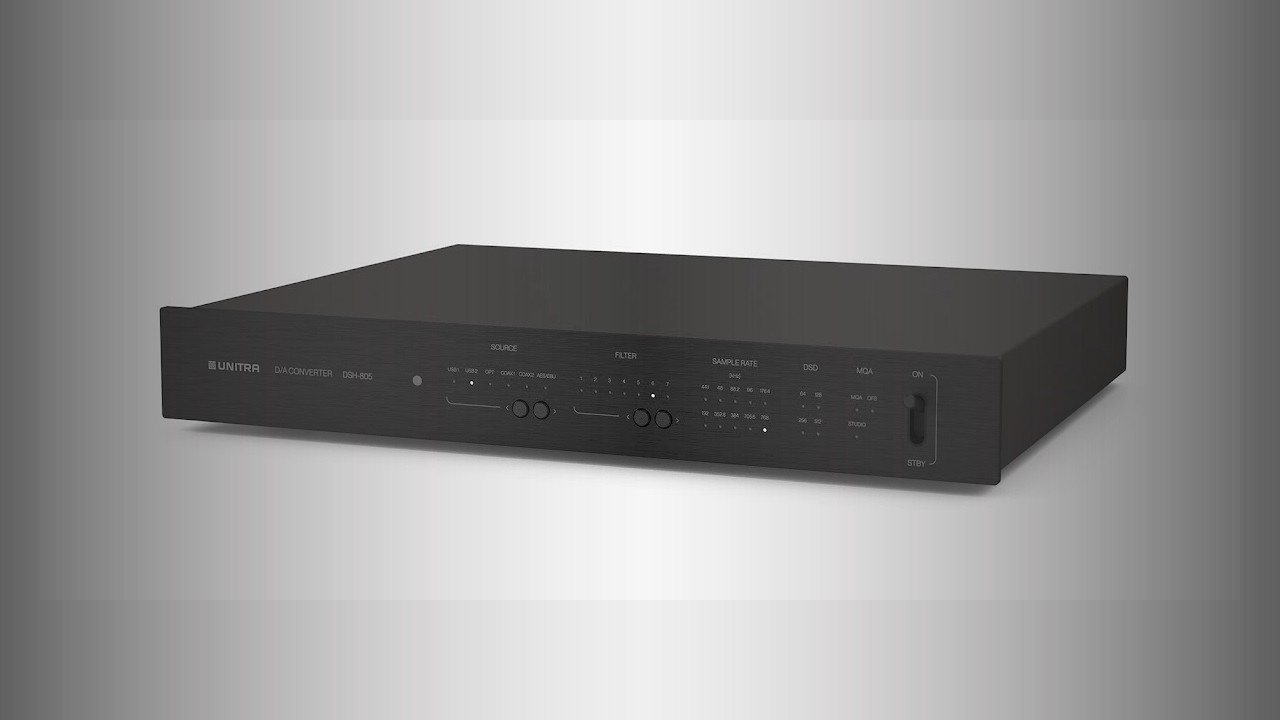
1. Unitra DSH-805
The Unitra DSH-805 features a metal enclosure and brushed-aluminum front panel designed to complement the WSH-805 integrated amplifier.
Unitra’s first standalone DAC is conceived as the digital counterpart to the company’s analog WSH-805 integrated amplifier.
Its ESS SABRE ES9039MSPRO converter uses eight DAC elements, with four assigned to each channel.
The linear power supply provides five independently regulated secondary voltages to separate the digital and analog sections, while a dedicated reference regulator serves the DAC stage. A metal cabinet and brushed-aluminum front panel complete a design intended to match the WSH-805 visually.
Best for: A matching Unitra digital front end
- ESS SABRE ES9039MSPRO converter
- Eight DAC elements arranged four per channel
- Linear supply with five independently regulated voltages
- Separated digital and analog power sections
Verdict: The DSH-805 is a purpose-built standalone converter for listeners who value structured power regulation and integration with Unitra’s WSH-805 amplifier.

2. Topping DX5 II
The Topping DX5 II combines dual ESS converters, a four-channel balanced headphone stage and the Aurora control interface.
The DX5 II combines a desktop DAC and headphone amplifier in a fully balanced architecture.
Two ESS ES9039Q2M chips decode the left and right channels independently, while the four-channel X-Hybrid amplifier is rated to deliver up to 7.6 watts per channel under the stated conditions.
Topping also provides its Aurora user interface and parametric equalization, making this a particularly configurable option for headphone systems.
Best for: Configurable desktop headphone systems
- Dual ES9039Q2M DAC chips
- Fully balanced DAC and amplifier architecture
- Headphone output rated up to 7.6 watts per channel
- Parametric equalizer and Aurora interface
Verdict: The DX5 II brings balanced conversion, substantial stated headphone power and useful equalization controls together in a compact desktop component.

3. TEAC UD-301-X
The TEAC UD-301-X uses separate Burr-Brown DACs and Muses operational amplifiers for its left and right channels.
TEAC takes a traditional dual-mono approach in the UD-301-X, assigning one Burr-Brown PCM1795 DAC and one Muses operational amplifier to each channel.
USB accepts DSD at 2.8 or 5.6 MHz and PCM up to 192 kHz at 24 bits, while optical and coaxial inputs also support PCM up to 192 kHz at 24 bits.
Both RCA and balanced XLR outputs are provided, and optional upsampling can convert incoming signals to 192 kHz.
Best for: Straightforward dual-mono system integration
- Dual-mono PCM1795 conversion
- Toroidal-transformer power supply
- RCA and balanced XLR outputs
- Switchable upsampling to 192 kHz
Verdict: The UD-301-X is a practical choice for systems that need USB, S/PDIF and balanced analog output without unusually high format requirements.

4. Denafrips Terminator PLUS 12Th
The Denafrips Terminator PLUS 12Th provides several I2S connections alongside USB, AES/EBU, optical and coaxial inputs.
The Terminator PLUS 12Th is a balanced R2R converter with non-oversampling operation and an unusually broad set of digital interfaces.
Its inputs include USB-B, AES/EBU, optical, coaxial and several I2S implementations using RJ45 and HDMI connectors.
RCA and balanced XLR outputs support conventional amplifier connections, while two clock outputs allow synchronization with compatible digital equipment. The linear power stage sits beneath the DAC board and is isolated from it by a steel partition.
Best for: Advanced systems with varied digital interfaces
- Balanced R2R NOS architecture
- Multiple USB, I2S and S/PDIF-family inputs
- RCA and balanced XLR outputs
- Two clock outputs for compatible equipment
Verdict: The Terminator PLUS 12Th is tailored to elaborate digital systems that can make use of its R2R design, multiple I2S options and external clock connectivity.

5. TOPPING Centaurus
The TOPPING Centaurus presents playback information and customizable visualizations on its two-inch color display.
Developed with HOLO Audio, the Centaurus uses a fully balanced arrangement of eight resistor networks.
PCM and DSD are handled differently: a traditional R2R scheme processes PCM, while Vector Step Resistance Network technology is used for DSD.
Its three processing choices comprise NOS, oversampling and a Best mode that selects an operating mode automatically. A 10-band parametric equalizer, two-inch color display and touch-controlled Aurora interface extend its flexibility beyond conversion alone.
Best for: Listeners exploring configurable R2R conversion
- Eight balanced resistor networks
- Separate R2R and Vector Step processing for PCM and DSD
- NOS, oversampling and automatic operating modes
- 10-band parametric equalizer
Verdict: The Centaurus stands out by combining a balanced resistor-network design with selectable processing modes and detailed equalization.

6. SMSL RAW-MDA1
The SMSL RAW-MDA1 combines wired digital inputs, Qualcomm Bluetooth and dedicated headphone amplification behind a color display.
The RAW-MDA1 combines two ESS ES9039Q2M converters with a dedicated headphone-amplifier circuit and a broad selection of wired and wireless inputs.
USB, optical, coaxial and Qualcomm Bluetooth 5.1 are supported, with LDAC, aptX HD, SBC and AAC available for wireless playback.
USB 2.0 handles PCM up to 768 kHz at 32 bits and DSD512 with the required driver, while a driverless USB 1.1 mode supports PCM up to 96 kHz at 16 bits. Outputs include RCA, balanced XLR and headphones.
Best for: Mixed wired and wireless desktop sources
- Dual ESS ES9039Q2M converters
- USB, optical, coaxial and Bluetooth inputs
- LDAC and aptX HD support
- RCA, XLR and headphone outputs
Verdict: The RAW-MDA1 is a versatile desktop hub for users who need balanced output, headphone amplification and high-quality Bluetooth codec support in one unit.

7. Vincent DAC-1 MK
The Vincent DAC-1 MK separates the power feeds for its analog and digital sections through a dual-winding transformer.
Vincent’s updated DAC-1 MK uses an ES9038 converter followed by balanced signal processing.
Its USB input accepts DSD and PCM files up to 384 kHz at 32 bits, while optical and coaxial inputs process PCM up to 192 kHz at 24 bits.
The power transformer has separate windings for the analog and digital sections, an arrangement intended to reduce interference between the two parts of the circuit.
Best for: Balanced systems using USB and S/PDIF sources
- ES9038 converter
- Balanced post-conversion signal path
- USB support for DSD and 32-bit, 384 kHz PCM
- Separate transformer windings for analog and digital circuits
Verdict: The DAC-1 MK offers a focused standalone design with balanced processing, modern USB support and separated analog and digital power feeds.

8. Denafrips Terminator II 12Th
The Denafrips Terminator II 12Th houses its dual OCXO clocks centrally and separates the linear power stage from the DAC board.
The Terminator II 12Th is a balanced R2R NOS DAC equipped for complex digital systems.
USB-B, AES/EBU, optical, coaxial and three I2S connection formats are provided, together with RCA and balanced XLR analog outputs.
Its linear power stage uses two O-Core toroidal transformers for the digital and analog sections and is separated from the DAC board by a steel partition. An FPGA processes I2S and S/PDIF signals directly, while two OCXO clocks operate at 45.1584 MHz and 49.152 MHz.
Best for: R2R systems requiring extensive digital connectivity
- Balanced R2R NOS conversion
- Three I2S connection formats
- Separate O-Core transformers for digital and analog sections
- Dual OCXO clocks and two clock outputs
Verdict: The Terminator II 12Th suits listeners building a connection-rich R2R front end with separated power supplies and synchronization facilities.

9. FiiO K19
The FiiO K19 is a desktop DAC and headphone amplifier with USB-C, S/PDIF and HDMI connectivity.
The K19 is designed as a desktop headphone amplifier, DAC and central connection point for personal-audio systems.
Its digital inputs include optical and coaxial S/PDIF, USB-C for connection to computers, USB-C support for storage devices and HDMI.
The source flexibility makes it relevant to desks where computers, removable storage and conventional digital components need to share one audio hub. Two pairs of RCA sockets are among its stated analog-output provisions.
Best for: A multi-source desktop audio hub
- Optical and coaxial S/PDIF inputs
- USB-C connectivity for computers
- Support for USB-C storage devices
- HDMI connection
Verdict: The K19 is differentiated by a wide input selection intended to accommodate computers, storage devices and other digital sources in a desktop headphone system.

10. Questyle Sigma Pro
The transportable Questyle Sigma Pro combines dual-mono conversion, discrete Current Mode amplification and selectable hardware gain.
Questyle positions the Sigma Pro between pocket-size dongles and stationary headphone equipment.
Its dual-mono conversion stage uses two ESS ES9069 chips, while the amplifier employs four fully discrete Current Mode stages.
Multiple hardware gain settings are intended to accommodate sensitive in-ear monitors as well as demanding full-size headphones. An XMOS XU316 controller handles high-resolution PCM, DSD, MQA and MQA-CD, and a dedicated Studio Monitoring mode broadens its intended use beyond recreational listening.
Best for: Transportable listening and monitoring
- Dual-mono ESS ES9069 conversion
- Four discrete Current Mode amplifier stages
- Multiple hardware gain levels
- PCM, DSD, MQA and MQA-CD support
Verdict: The Sigma Pro is suited to users who need more headphone-driving flexibility than a small USB dongle while retaining a transportable format.
Frequently asked questions
Should I choose a standalone DAC or a DAC with a headphone amplifier?
Choose a standalone DAC when an integrated amplifier, preamplifier or separate headphone amplifier already handles volume and amplification.
A combined model such as the Topping DX5 II, SMSL RAW-MDA1, FiiO K19 or Questyle Sigma Pro can reduce box count in a headphone-focused system.
Do I need balanced XLR outputs?
XLR outputs are useful when the receiving amplifier has balanced inputs or when the system layout benefits from a balanced connection.
They are not automatically necessary for every installation; RCA remains appropriate when that is the input provided by the amplifier.
What should I check before buying an R2R DAC?
Confirm that its operating modes and connections fit the rest of the system.
The listed R2R models differ in NOS and oversampling options, equalization, I2S formats and clock facilities, so the architecture alone should not determine the purchase.
How important are maximum PCM and DSD specifications?
They matter only when the source and music library use those formats and rates.
Optical and coaxial inputs often support lower limits than USB, so check the capability of the specific input you plan to use rather than relying on the highest number in the specification list.
How to Choose the Right DAC for Your System
Begin by listing every source that will connect to the DAC.
A computer may require USB, a CD transport may use coaxial or optical S/PDIF, and more specialized digital equipment may need AES/EBU, I2S or clock synchronization.
Confirm the exact connector and supported format for each input, because a DAC’s maximum USB capability does not necessarily apply to its optical or coaxial connections. Next, consider what follows the DAC. RCA outputs cover many integrated amplifiers and powered speakers, while XLR outputs are relevant to balanced amplifiers and longer cable runs. If headphones are central to the system, look beyond the presence of a headphone socket: gain choices, available output and suitability for the intended headphone load are more important. Models with integrated amplification can simplify a desktop, but a standalone converter may be the cleaner choice when suitable amplification is already available. Processing features should solve a real requirement. Parametric equalization can help tailor a headphone or speaker setup, and selectable NOS or oversampling modes offer control over how compatible DACs process the signal. Bluetooth is convenient for shared or casual sources, whereas clock outputs and multiple I2S formats are aimed at more specialized systems. Buying the most elaborate feature set is unnecessary when those connections will remain unused. Finally, treat converter chips and architecture as design information rather than a complete verdict on performance. Power supply implementation, analog circuitry, controls, connectivity and compatibility all contribute to how successfully a DAC fits a system. The strongest choice is the model that accepts every required source, connects properly to the downstream equipment and provides an interface that remains practical in everyday use.



Sound Off
0Join the discussion if you have something to add.