


Java Hifi’s latest product expansion is less about a single headline specification and more about a coherent approach to system design. The New Zealand manufacturer is extending its Carbon Edition idea beyond integrated amplifiers, adding carbon fiber versions of its preamplifiers and power amplifiers, while also refreshing the integrated amplifier lineup and introducing a new R2R ladder USB DAC based on Analog Devices chips. The result is a broader Java ecosystem built around vibration control, upgraded connection hardware, flexible amplifier power options, and a more technically ambitious digital stage.
Carbon fiber moves beyond the integrated amplifier
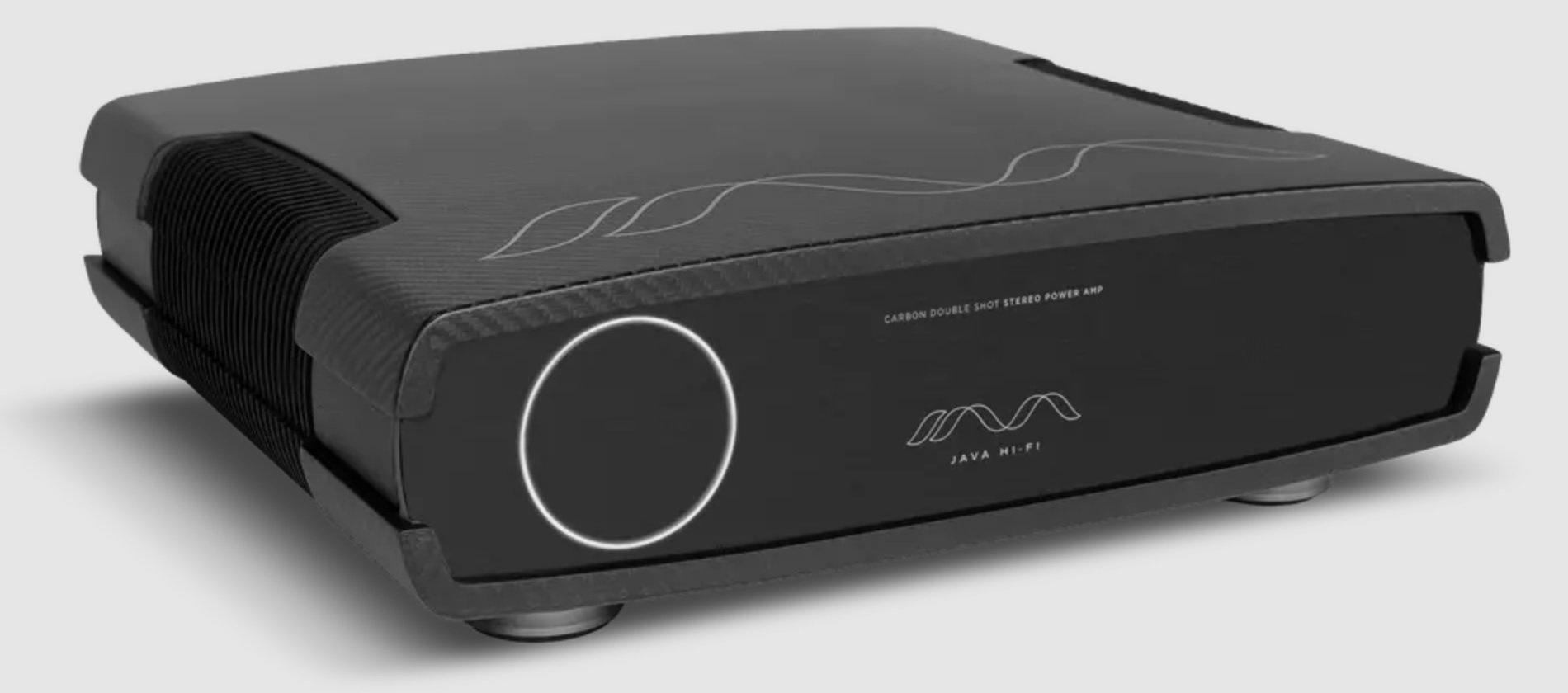
The most visually distinctive element in Java Hifi’s new products is the carbon fiber outer casing. The company had already applied this construction to its Carbon Edition integrated amplifiers, which became a significant part of its portfolio after their introduction in January 2024. Customer interest in matching Carbon versions of the company’s preamplifiers and power amplifiers has now led Java to extend the concept across more of the range.
This matters for two reasons. First, it gives owners who prefer separated components a way to build a visually and mechanically consistent Java system rather than being limited to integrated amplifiers. Second, Java is not treating the carbon fiber enclosure as a cosmetic change only. The cabinet is specified as 9 millimeters thick and is intended to provide vibration damping while also reducing the influence of radio-frequency interference and electromagnetic interference on the internal circuitry.
In audio electronics, the enclosure is part of the engineering environment. It determines how well the circuit is protected from external mechanical and electrical influences, and it also affects how easily products can be integrated into domestic spaces. Java’s use of carbon fiber gives the amplifiers a distinctive identity while tying that look to practical goals: damping, shielding, and structural rigidity.
Upgraded hardware where signal and power leave the chassis
Java has also specified upgraded connection hardware for the Carbon preamplifiers and power amplifiers. ETI Research Silver RCA connectors are used, and the GaN FET amplifier models receive ETI Research Kryo speaker terminals. These are not the kind of features that change how an amplifier is operated day to day, but they are important at the point where a component meets the rest of the system.
RCA sockets and speaker binding posts are mechanical interfaces as much as electrical ones. They are repeatedly used during installation, cable changes, and system adjustments. Better-quality connectors can support secure cable fitment and long-term reliability, which is especially relevant for owners who expect their amplifiers to remain in service across multiple system configurations.
The inclusion of Kryo speaker terminals on the GaN FET amplifier models is also notable because power amplifiers place higher current demands on their output hardware than source components or preamplifiers. Java’s decision to highlight these terminals suggests attention to the complete signal path, from the internal amplification circuitry to the loudspeaker connection point.
Vibration isolation as a system-level design choice
Another important addition is the use of IsoAcoustics Gaia IV feet. Java specifies these feet to improve vibration isolation for printed circuit boards and other internal components. This is consistent with the broader Carbon concept: the company is addressing mechanical energy through both the chassis and the product’s contact with the supporting surface.
For prospective owners, this is useful because not every hi-fi system sits on an ideal rack or in an acoustically isolated room. Many systems share space with furniture, suspended floors, loudspeakers, and everyday domestic vibration. By incorporating dedicated isolation feet at the component level, Java is building a degree of vibration management into the product rather than leaving it entirely to aftermarket accessories.
This approach may particularly appeal to listeners who want a tidy, integrated installation. Instead of adding separate isolation platforms or experimenting with third-party footers, the Carbon models arrive with a defined mechanical solution that is part of the manufacturer’s intended design.
New integrated amplifier choices for different power needs
Java is also expanding its integrated amplifier range with two models that sit on either side of existing power configurations. The Single Shot 400 doubles the output of the current Single Shot integrated amplifier, moving from 200 watts into 8 ohms to 400 watts into 8 ohms. For buyers who like the Single Shot format but want more rated power, that creates a clearer upgrade path within the same family.
The Double Shot 200 takes a different approach. It retains the fully balanced configuration of the Double Shot integrated amplifier but delivers 200 watts into 8 ohms rather than the 400 watts into 8 ohms of the existing Double Shot. The documented purpose is to provide that balanced architecture at a lower price point, although no USD price is specified.
Together, these models give Java’s integrated amplifier lineup more granularity. Some owners prioritize available power, particularly for demanding loudspeakers or larger rooms. Others may value a fully balanced design but not need the highest-power version. By offering both the Single Shot 400 and Double Shot 200, Java is making the range easier to match to different system requirements without forcing every buyer toward the same amplifier topology or output level.
A new R2R DAC built around Analog Devices AD1865 chips
The digital side of Java’s updated range is represented by a new R2R ladder USB DAC. This model replaces the company’s previous Burr-Brown-based DAC and uses two Analog Devices AD1865 chips. The AD1865 is an 18-bit, non-oversampling DAC chip, and Java’s implementation supports file playback up to 768 kHz.
The move to an R2R ladder design is significant because it gives Java a digital source option with a different technical character from many modern DAC architectures. Non-oversampling R2R converters are often chosen by designers who want a relatively direct conversion process, and Java’s decision to use dual AD1865 chips places the DAC within a long-running tradition of discrete-style ladder conversion thinking, even though the conversion elements here are built around established Analog Devices silicon.
The new DAC is also controlled by a proprietary linear power controller. Power supply design is central to digital-to-analog conversion because the DAC must manage both sensitive analog output behavior and high-speed digital data. Java’s mention of a dedicated linear power controller indicates that the company is treating the power stage as a core part of the DAC architecture rather than a secondary support circuit.
Why MSB adjustment matters in an R2R converter
Java includes MSB adjustment as standard on the AD1865 DAC. MSB stands for most significant bit, and in a ladder DAC it has a major influence on linearity because it represents the largest value step in the conversion process. Small errors around this transition can affect how smoothly the DAC moves through low-level signal changes, particularly around the zero point.
By precisely adjusting the MSB, Java aims to improve DAC linearity and remove residual distortion at a sensitive part of the conversion process. For owners, the important point is not the adjustment itself as a user feature, but what it says about the implementation. R2R DAC performance depends heavily on precision, calibration, and analog execution. Including MSB adjustment suggests that Java is paying attention to the practical realities of ladder conversion rather than relying only on the reputation of the chip.
Balanced digital architecture in the Double Shot models
The Double Shot models receive a further DAC-related refinement: a dedicated DAC circuit board for each channel in a fully balanced configuration. Java states that this arrangement is intended to eliminate crosstalk and improve measured performance.
This is a meaningful design choice for owners building a balanced system. Separating the DAC circuitry by channel can help maintain channel independence from the digital conversion stage onward, aligning the source section with the balanced architecture of the amplifier. It also reinforces the idea that the Double Shot models are not simply higher-output versions within the range; they are positioned around a more elaborate internal layout.
For system builders, this can simplify decision-making. If the rest of a setup is oriented around balanced operation, the Double Shot architecture provides a more consistent signal path. If a system is simpler or power requirements are lower, the broader Java range now offers alternatives without requiring the same fully balanced, dual-DAC-board configuration.
Conclusion
Java Hifi’s expanded Carbon range is strongest where industrial design and engineering priorities overlap. The 9mm carbon fiber housings, IsoAcoustics Gaia IV feet, upgraded ETI connection hardware, and expanded amplifier power options all point toward products intended for long-term system integration rather than superficial model updates. The new AD1865-based R2R USB DAC adds a more distinctive digital pathway, with non-oversampling conversion, MSB adjustment, and balanced dual-board implementation in the Double Shot models. These products are most suitable for listeners building a Java-centered system, owners who value vibration control and refined construction, and buyers who want a choice between integrated, pre/power, and DAC-equipped configurations without leaving the same design family.


Join the discussion
Share your thoughts, listening impressions or product experience.