

A dedicated portable music player can keep local libraries, streaming services and serious headphone hardware separate from the distractions and limitations of a phone.
The category now ranges from tiny, purpose-built players to Android flagships with sophisticated conversion stages, powerful amplification and access to music apps.
Choosing between them starts with how you listen. Some models emphasize pocket-friendly dimensions and straightforward file playback, while others add balanced headphone connections, streaming, USB DAC operation or interchangeable amplifier modules. More elaborate circuit designs may appeal to enthusiasts building a high-end portable system, but they are not automatically the right answer for someone who values simplicity and low weight. The selections below cover those distinct approaches. Each recommendation is based on the stated hardware and functions in the supplied product information, with particular attention paid to operating system, connectivity, output options and intended use.

1. Shanling M6 Ultra: 4DAC player
The Shanling M6 Ultra uses four AK4493SEQ DAC chips and a Snapdragon 665 processor in an Android-based portable player.
The Shanling M6 Ultra combines an open Android 10 platform with a Snapdragon 665 processor, making it one of the more flexible choices for listeners who want a modern app-capable player.
Its defining audio feature is a four-chip AK4493SEQ DAC arrangement designed around a fully balanced signal path.
Shanling also revised the amplifier section for the Quad-DAC configuration, with output rated at up to 720mW into 32 ohms. This mix of Android usability and substantial balanced audio hardware makes the M6 Ultra a versatile step up from a basic file player.
Best for: Android flexibility with balanced audio hardware
- Open Android 10 operating system
- Four AK4493SEQ DAC chips
- Fully balanced signal architecture
- Up to 720mW into 32 ohms
Verdict: The M6 Ultra is a strong fit for listeners seeking an app-friendly Android player built around a distinctive four-DAC balanced design.

2. Astell&Kern A&ultima SP4000: Flagship DAP Featuring Octa Audio Architecture
The Astell&Kern A&ultima SP4000 employs an Octa audio architecture with paired AK4191 processors and AK4499EX DACs.
Astell&Kern positions the A&ultima SP4000 at the summit of its portable-player range, with an Octa audio circuit architecture at the center of its design.
Its signal path pairs each AK4191 digital processor with an AK4499EX analog DAC in a 1:1 arrangement, creating a true Quad-DAC implementation.
Separating digital delta-sigma processing from analog conversion is intended to reduce interference and improve signal separation. This is the specialist option for buyers whose priorities begin with elaborate internal audio architecture rather than compactness or simplicity.
Best for: A no-compromise flagship signal architecture
- Octa audio circuit architecture
- True Quad-DAC implementation
- Separate digital and analog processing
- 1:1 processor-to-DAC arrangement
Verdict: The SP4000 is aimed at enthusiasts who want Astell&Kern’s most advanced portable circuit design and a physically separated digital-to-analog processing path.

3. iBasso DX340 DAP: Flagship Portable Player with Discrete 1-Bit DAC and Modular Amps
The iBasso DX340 combines a discrete 1-bit DAC, FPGA Master 3.0 processing and a modular amplifier platform.
The iBasso DX340 stands out through a discrete 1-bit DAC configuration, FPGA Master 3.0 processing and an amplifier design with upgrade potential.
Its dual operating systems serve two different listening styles: Mango OS provides a focused playback environment, while Android 13 supports streaming services and other apps.
Format support extends to PCM at up to 32-bit/768kHz and native DSD512. For enthusiasts who want to adjust or expand a portable setup over time, the modular amplifier approach is a meaningful point of differentiation.
Best for: Enthusiasts who value modular amplification
- Discrete 1-bit DAC configuration
- Modular amplifier design
- Mango OS and Android 13
- PCM 32-bit/768kHz and native DSD512 support
Verdict: The DX340 combines a discrete conversion design, two operating environments and modular amplifiers for listeners who want room to adapt their player.

4. ONIX Overture XM5: High-end portable player unveiled
The ONIX Overture XM5 pairs an ESS ES9039PRO DAC with a focused music system and multiple home or portable operating modes.
The ONIX Overture XM5 takes a deliberately focused approach, using a simple Ingenic X2000-based music system instead of a full smartphone-style operating environment.
An ESS ES9039PRO DAC and TPA6120A2 amplifiers form its main audio platform, with output stated at more than 1W into 32 ohms.
Local microSD playback is joined by Tidal, DLNA and AirPlay streaming. The XM5 can also operate as a USB DAC and amplifier, provide digital output to another USB DAC, or serve as a standalone DAC in a larger system, giving it broader utility than its pure-music interface might suggest.
Best for: Focused playback with system-level versatility
- ESS ES9039PRO DAC
- More than 1W into 32 ohms
- Local microSD and network playback
- USB DAC and digital-output functions
Verdict: The Overture XM5 suits buyers who prefer a distraction-free music interface but still need powerful amplification, streaming and DAC functionality.

5. HiBy R2: Compact player with huge ambitions
The compact HiBy R2 runs HiByOS and supports local files, Tidal, internet radio and audio recording.
The HiBy R2 is an entry-level player built around HiByOS on a Linux platform.
Despite its compact positioning, it supports local playback, Tidal, internet radio and e-book functions, while dual microphones allow it to work as an audio recorder.
Its ES9218 audio chipset handles PCM up to 32-bit/384kHz and DSD128, and four-times MQA unfolding is also supported. A zinc-alloy chassis with curved edges completes a package intended for buyers who want broad functionality without moving into a large Android player.
Best for: An accessible, compact introduction to dedicated players
- Compact zinc-alloy chassis
- Tidal and internet radio support
- PCM 32-bit/384kHz and DSD128 playback
- Dual microphones for audio recording
Verdict: The HiBy R2 packs streaming, recording and high-resolution file support into an entry-level player with a compact metal body.

6. Shanling H2: Portable Bluetooth DAC/amplifier based on CS43198
The Shanling H2 combines a CS43198 DAC, USB and Bluetooth inputs, and microSD playback in a compact body.
The Shanling H2 sits between a traditional player and a portable DAC/amplifier.
It can play local music from a microSD card, with library access handled through Shanling’s Eddict Player smartphone app, while USB and Bluetooth inputs let it work with external sources.
Conversion is handled by a 32-bit Cirrus Logic CS43198 DAC, paired with an eight-core XMOS XU208 USB processor for native DSD and 32-bit PCM signals. Its compact body and integrated volume wheel make particular sense for listeners who want to supplement a phone or laptop without giving up standalone file playback.
Best for: Phone and laptop users who also want local playback
- CS43198 DAC chipset
- USB and Bluetooth inputs
- MicroSD local playback
- Compact design with integrated volume wheel
Verdict: The Shanling H2 is a flexible portable DAC and amplifier that adds microSD playback rather than trying to replace a full touchscreen DAP.

7. Onix Tocata XM2: Compact Audiophile DAP Supporting PCM 768 kHz and DSD512
The Onix Tocata XM2 features a 3-inch OLED screen, physical controls and both single-ended and balanced headphone connections.
The Onix Tocata XM2 combines compact dimensions with a broad selection of wired and wireless features.
It uses a 3-inch OLED touchscreen alongside physical controls, and accepts microSD cards with capacities up to 2TB.
Tidal, dual-band Wi-Fi, DLNA, AirPlay and two-way Bluetooth 5.2 cover its network and wireless duties, while USB DAC operation adds flexibility at a desk. Its CS4308P DAC supports a fully balanced circuit, feeding separate 3.5mm single-ended and 4.4mm balanced outputs; the latter is rated at up to 800mW into 32 ohms in high gain.
Best for: Compact playback with extensive connectivity
- 3.5mm and 4.4mm headphone outputs
- Up to 2TB microSD support
- Tidal, DLNA and AirPlay connectivity
- Two-way Bluetooth 5.2
Verdict: The Tocata XM2 is a well-connected compact DAP for listeners who want balanced output, streaming and a large removable music library.
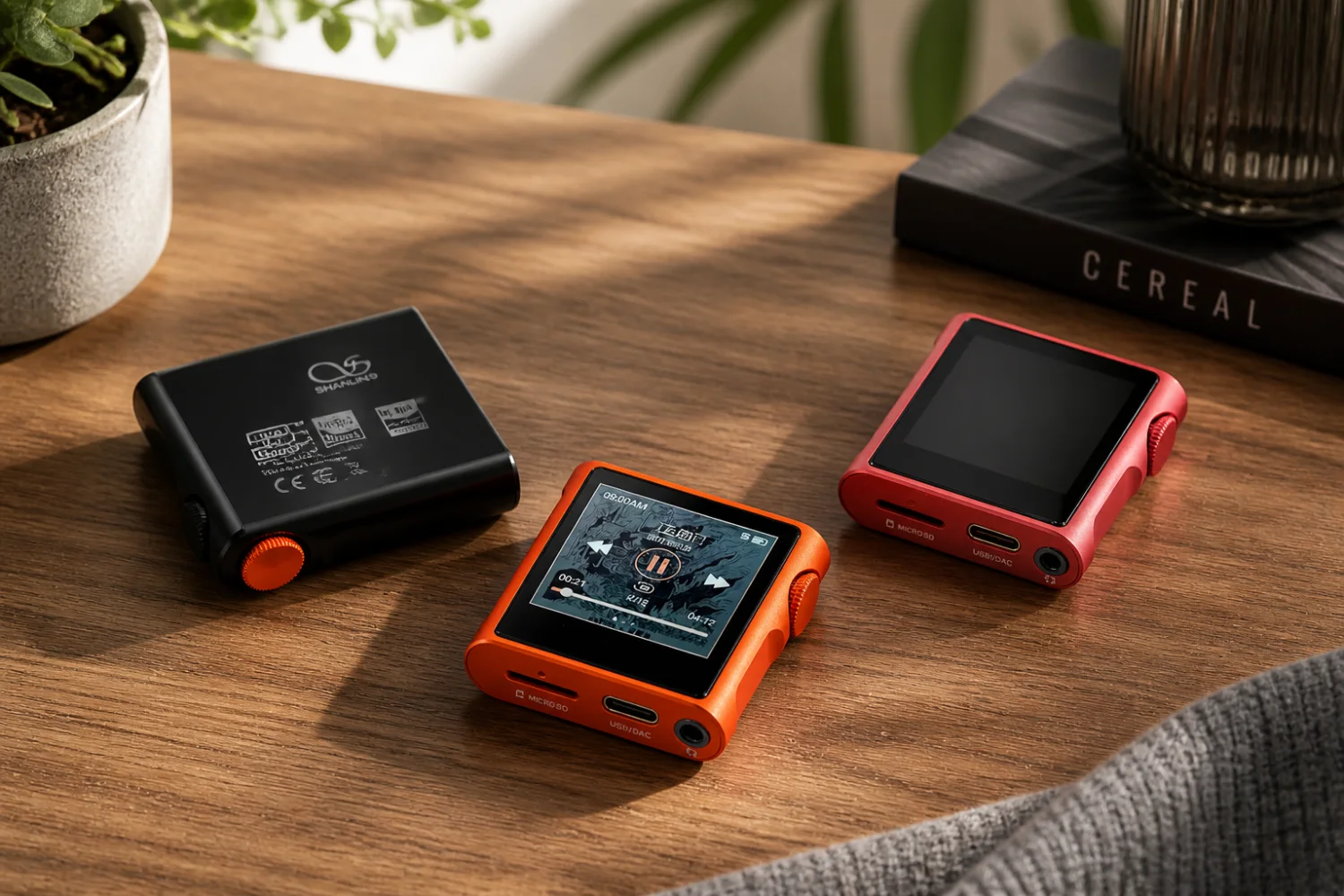
8. Shanling M0 Pura turns pocket hi-fi into something seriously powerful
The Shanling M0 Pura places a 1.54-inch touchscreen and dual CS43131 DACs inside an ultra-compact player.
The Shanling M0 Pura prioritizes minimal size without limiting itself to basic audio hardware.
Its 1.54-inch touchscreen runs Shanling’s lightweight MTouch OS, providing a focused alternative to a full Android interface.
Dual Cirrus Logic CS43131 DACs handle conversion, while balanced playback is available through the 3.5mm connection when used with a 3.5mm-to-4.4mm adapter. Output is rated at 250mW into 32 ohms, making this a notably capable option for buyers who want a player that takes up very little pocket space.
Best for: Maximum portability without a smartphone-style interface
- Ultra-compact format
- Dual CS43131 DACs
- Lightweight MTouch operating system
- 250mW output into 32 ohms
Verdict: The M0 Pura brings dual-DAC hardware and balanced playback to listeners who want one of the smallest possible dedicated players.

9. HiBy R1: Ultra-compact player designed for audiophiles
The HiBy R1 uses a 3-inch IPS touchscreen, a translucent compact case and a Cirrus Logic CS43131 DAC.
The HiBy R1 balances pocket-friendly proportions with a larger interface than many miniature players.
Its 3-inch, 800-by-480 IPS touchscreen displays HiByOS and album artwork, while a translucent case, multiple color choices and a strap mount reinforce its portable focus.
A Cirrus Logic CS43131 DAC supports PCM up to 32-bit/384kHz and DSD256, and the operating system handles the major lossless formats. This is a practical choice for listeners who want a small player but would rather not navigate their library on a very small screen.
Best for: Compact use with a clear touchscreen interface
- 3-inch IPS touchscreen
- CS43131 DAC
- PCM 32-bit/384kHz and DSD256 support
- Integrated strap mount
Verdict: The HiBy R1 is an appealing middle ground between ultra-miniature players and larger DAPs, pairing easy touchscreen navigation with broad lossless-file support.

10. HiBy R8 II: flagship Hi-Res player with Class A amplification
The HiBy R8 II combines a stainless-steel chassis, a 5.9-inch display and switchable Class A or Class AB amplification.
The HiBy R8 II is a substantial flagship built around the company’s Darwin-MPA architecture and a 16-channel current-output DAC.
Its headphone amplifier can switch between Class A and Class AB operation, allowing the user to prioritize the preferred amplification mode or longer battery life.
HiByOS based on Android 12 runs on a Snapdragon 665 processor and is presented on a 5.9-inch 1080p display. A stainless-steel chassis, Alcantara rear panel and 12,000mAh battery underline that this is intended as a full-scale transportable player rather than the lightest pocket option.
Best for: Flagship amplification and a large-screen interface
- Switchable Class A and Class AB amplification
- Darwin-MPA 16-channel DAC architecture
- Android-based HiByOS
- Large 12,000mAh battery
Verdict: The HiBy R8 II is designed for listeners who accept extra size in exchange for switchable amplifier operation, a large display and ambitious internal audio hardware.
Frequently asked questions
Should I choose an Android player or a dedicated music operating system?
Choose Android if access to a wider range of streaming apps is central to your listening.
A focused system such as HiByOS, MTouch OS, Mango OS or the ONIX interface can provide a simpler experience centered on local files and supported music services, but app availability varies by player.
Do I need a balanced headphone output?
Not necessarily.
A standard 3.5mm output is suitable for many headphones and earphones, while a balanced connection can provide a separate circuit path and, on some players, more available output.
Confirm that your headphone cable has the correct plug and never assume that similarly sized connectors are wired the same way.
How much amplifier power should a portable player have?
Match the player to the headphones or earphones you intend to use rather than choosing the largest output figure.
Sensitive in-ear monitors need good volume control and low noise, while harder-to-drive headphones may benefit from players with higher stated output or selectable gain modes.
Can a portable music player also improve laptop or phone listening?
Some models can.
Players and hybrids with USB DAC, Bluetooth input or digital-output functions can work with a laptop, phone or separate audio system.
Check the available inputs, outputs and control method carefully, because devices such as the Shanling H2 operate differently from full touchscreen Android players.
How to choose the right portable music player
Begin with your music source.
If most of your library lives on microSD cards, check the supported card capacity, file formats and whether the interface makes a large collection manageable.
Streaming listeners should confirm that their preferred service is supported directly; the presence of Wi-Fi alone does not guarantee access to every app or platform. Full Android players generally offer greater app flexibility, whereas streamlined operating systems can be faster to navigate and less distracting. Next, consider the headphones you will use. Look at the available connector types, stated output into a relevant load and any gain options. Balanced output can be useful, but only when you have a compatible cable and a genuine need for the additional connection. Owners of sensitive in-ear monitors should also value fine volume adjustment and quiet operation, while demanding full-size headphones may justify a more powerful player such as the ONIX Overture XM5 or a modular design such as the iBasso DX340. Portability involves more than whether a device can fit in a bag. The Shanling M0 Pura and HiBy R1 emphasize compactness, while large-screen flagships such as the HiBy R8 II prioritize interface size, battery capacity and elaborate amplification. Hybrid products such as the Shanling H2 make more sense when a phone or laptop remains the primary source. Finally, avoid paying for complexity that does not serve your listening habits. A sophisticated DAC architecture, switchable amplifier mode or modular output stage can be valuable in a carefully matched system, but straightforward controls, dependable local playback and the right headphone connection often matter more in daily use. Decide which functions are essential before comparing higher-end circuit designs.


Join the discussion
Share your thoughts, listening impressions or product experience.