Marantz AV7706: A Processor-First Approach to Serious Home Theater
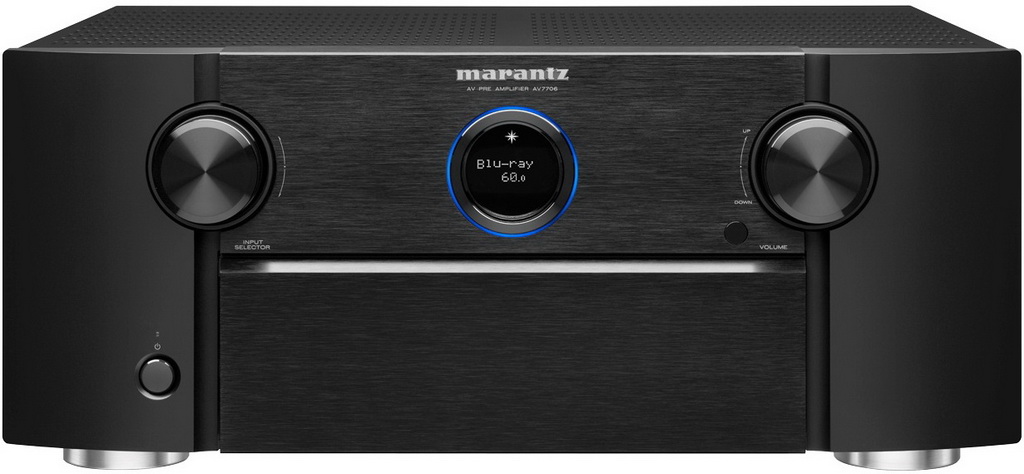
The Marantz AV7706 takes the control, decoding, video, streaming, and room-correction duties of a modern high-end AV platform and leaves amplification to dedicated external power amps.

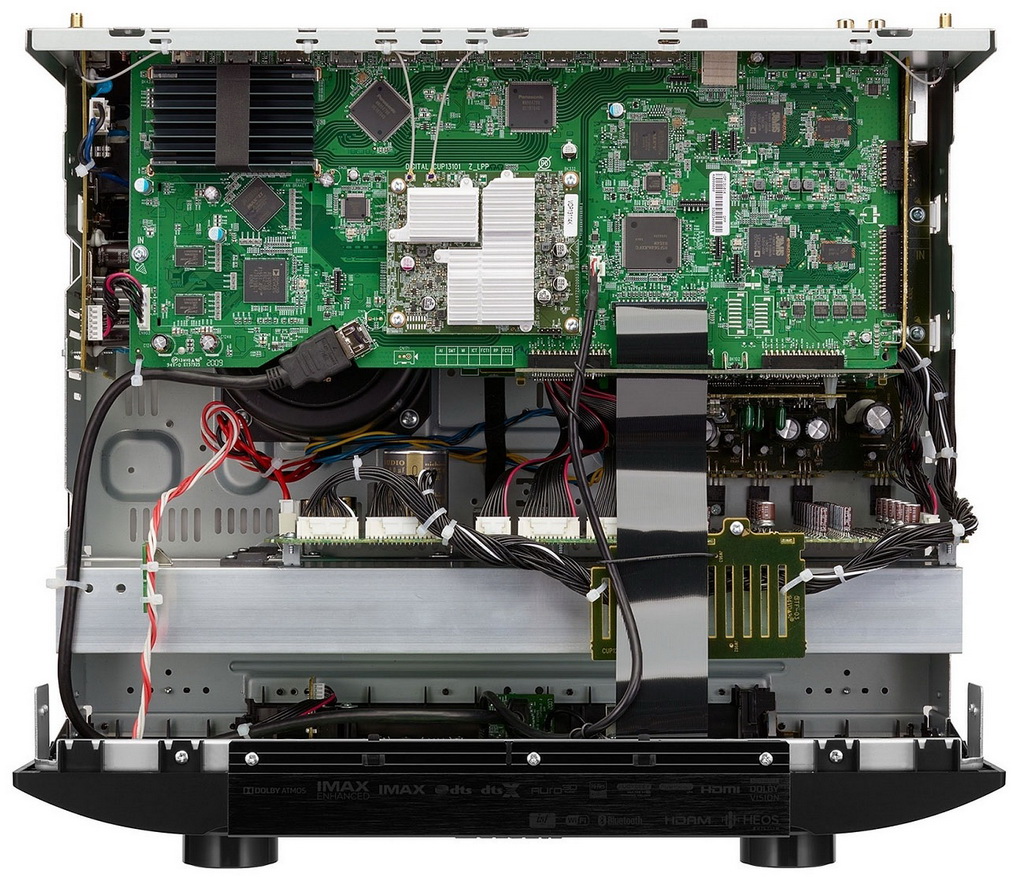
The Marantz AV7706 is an AV processor for listeners and home-theater builders who want separation between signal processing and power amplification. Rather than integrating amplifier channels into the same chassis, it provides decoding, video switching, digital-to-analog conversion, room correction, streaming, and system control, then sends line-level signals to external amplifiers. That design choice is central to its appeal: it gives owners the flexibility to choose amplification that suits their speaker layout, room size, and upgrade plans while retaining a full-featured surround processing hub.
A preamp/processor built around external amplification
The AV7706 is closely related in function to Marantz’s SR7015 AV receiver, but it omits built-in power amplifiers. For some systems, that is exactly the point. By removing onboard amplification from the equation, the processor is intended for installations where separate power amplifiers handle the demanding job of driving speakers. Marantz specifically points to companion multichannel amplifiers such as the MM8077, MM7055, and MM7025 as natural partners, but the AV7706’s preamp outputs also make it adaptable to a wide range of external amplification arrangements.
This approach can matter in several practical ways. A processor-based system can be scaled around the number of channels actually required, whether that means a single multichannel amplifier, a combination of five-, seven-, and two-channel models, or separate amplification for specific speaker groups. It also separates the upgrade cycles of processing and amplification. Owners who already have suitable power amps can keep them in service, while those building a larger theater can choose amplification according to speaker sensitivity, placement, and room needs.
11.2-channel architecture with balanced and unbalanced outputs
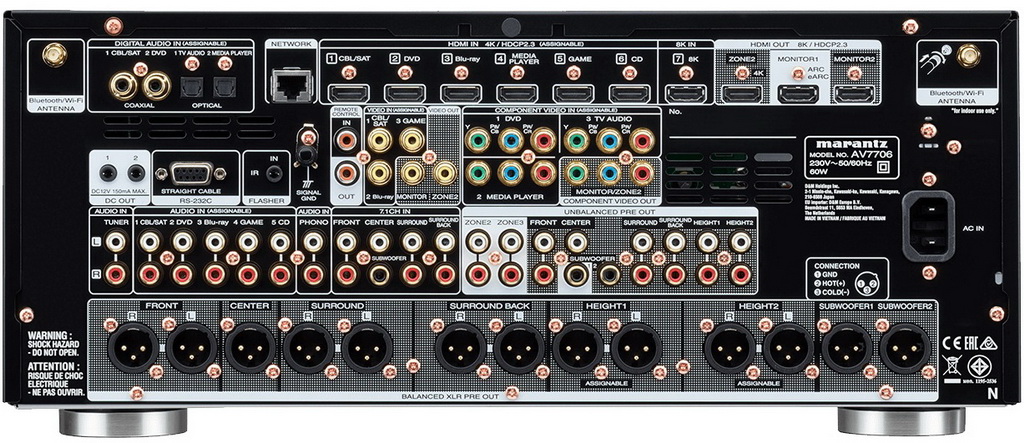
At the heart of the AV7706 is an 11.2-channel preamp configuration, with both RCA and XLR outputs for all 11.2 channels. The inclusion of balanced XLR outputs is an important design feature for many custom and enthusiast installations, particularly where longer cable runs are needed between the processor and power amplifiers. Unbalanced RCA outputs are also provided, maintaining compatibility with conventional home-theater amplifiers and legacy systems.
The line-output stage is supported by a dedicated HDAM sound card. Marantz’s HDAM modules and current-feedback circuitry are used here in place of more generic output-stage design, with the stated aims of higher slew rate, wider frequency range, improved channel separation, and stronger dynamics. The published specifications include a 10 Hz to 100 kHz frequency range in Direct mode via analog connectors, a 105 dB signal-to-noise ratio through analog line jacks in Direct mode, and 0.005 percent distortion from 20 Hz to 20 kHz in Direct mode. Output voltage is listed as 1.2 V via RCA and 2.4 V via XLR.
Surround formats for immersive theater layouts
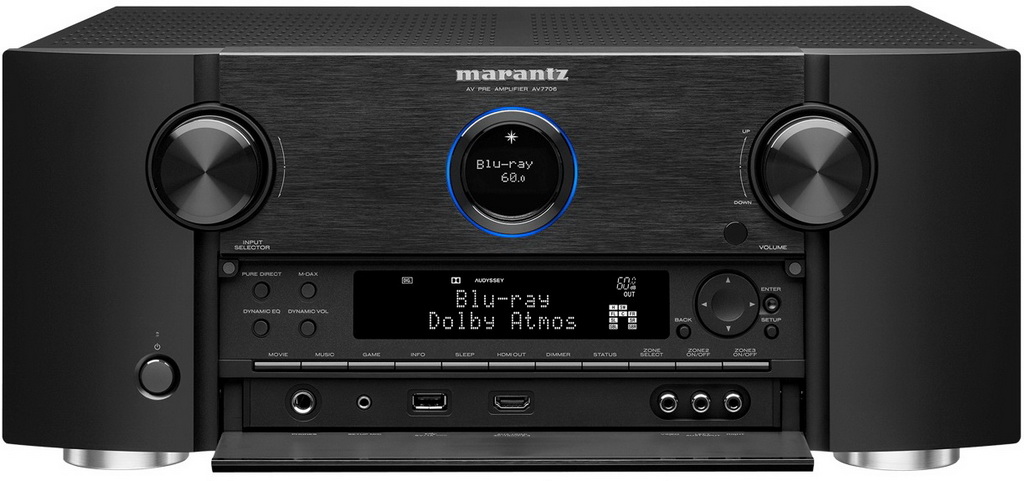
The AV7706 is built for contemporary immersive audio formats. It supports Dolby Atmos and DTS:X up to 7.1.4 when used with the necessary external amplification, along with Auro-3D, DTS Virtual:X, DTS Neural:X, Dolby Surround, Dolby TrueHD, Dolby Digital Plus, DTS-HD, DTS-ES, DTS 96/24, and DTS Express. It is also IMAX Enhanced certified for decoding and processing.
For a prospective owner, this range of format support is useful because it keeps the processor relevant across disc-based movie collections, streaming services, and immersive speaker layouts. A 7.1.4 system, for example, allows traditional bed channels, dual subwoofer outputs, and four height channels to be managed from one processor. The Griffin Lite dual DSP platform handles the processing requirements, while Pure Direct and Direct modes are available for users who want a more signal-focused playback path when appropriate.
Digital conversion and hi-res audio support
Each channel uses an AKM AK4458 32-bit DAC, with 11 DAC channels specified. The processor supports playback of high-resolution audio formats over USB and local network, including FLAC HD, ALAC, and WAV up to 24-bit/192 kHz, plus DSD. The detailed format list includes MP3, WMA, AAC, FLAC, FLAC HD, ALAC, WAV, and DSD, with gapless playback supported for FLAC, WAV, ALAC, and DSD. The source material lists DSD support through LAN and USB, with DSD up to 5.6 MHz in the specifications and DSD up to 11.2 MHz also noted in the product description.
This breadth of file support makes the AV7706 more than a movie processor. It can serve as a hub for local music libraries, network audio playback, and USB-connected media. MDAX2 compressed-audio enhancement is included for lower-resolution material, while the availability of gapless playback is particularly relevant for live albums, classical works, and concept albums where uninterrupted sequencing matters.
8K HDMI, gaming-focused features, and video flexibility
The HDMI section is one of the AV7706’s strongest practical features. It provides eight HDMI inputs, including one on the front panel under the cover, and three HDMI outputs, including one with eARC and one for Zone 2. The HDMI inputs support 8K 60/50 Hz and 4K/120 Hz video, HDCP 2.3, HDR10, Dolby Vision, HLG, BT.2020, 4:4:4 Pure Color, 3D, and 21:9 video. HDR10+ is also listed among the supported technologies.
For gaming and modern display integration, the processor supports features such as ALLM, VRR, QMS, and QFT. These are designed to help with automatic low-latency mode, variable refresh rates, faster media switching, and quick frame transport when source devices and displays also support them. The eARC connection allows audio from a compatible TV to be returned to the main system, simplifying use with smart TV apps and connected sources. HDMI pass-through in standby is also supported, as is scaling from analog and HDMI sources to HDMI output at 1080p, 4K, and 8K 60/50.
Room correction and bass-management tools
Audyssey MultEQ XT32 is provided for automatic speaker calibration and room correction, with support for the Audyssey MultEQ Editor App for finer adjustment of calibration settings. This is a meaningful inclusion in a processor intended for multichannel systems, because speaker placement, room boundaries, seating location, and subwoofer integration can all have a major effect on the final setup.
The AV7706 also includes Audyssey Dynamic EQ, Dynamic Volume, LFC, and Sub EQ HT. Dynamic Volume is designed to even out volume level changes, which can be useful when watching broadcasts or programs with loud advertising breaks. Dynamic EQ is intended to maintain tonal balance and bass presence at lower listening levels. LFC is designed to reduce the extent to which low frequencies disturb adjacent rooms. Sub EQ HT helps coordinate two subwoofers, an important feature for owners using dual-sub layouts to improve bass coverage across seating positions.
Streaming, wireless audio, and app-based control
The AV7706 includes dual-band Wi-Fi, Bluetooth 4.2 + EDR, AirPlay 2, and HEOS wireless multiroom support. Through HEOS, users can stream from local network sources and supported services including Deezer, Spotify Connect, TuneIn, Amazon Music, and TIDAL. This makes the processor a system centerpiece not only for disc players, consoles, and set-top boxes, but also for everyday streaming and multiroom audio.
Control options include the supplied remote, the Marantz AVR Remote app for iOS, Android, and Amazon Kindle Fire tablets, IP control, and Amazon Alexa voice control when used with an Amazon Echo device. For more complex installations, RS-232C, trigger outputs, IR input, system bus connections, and two additional zones are included. The Setup Assistant system further supports day-to-day usability during installation and configuration.
Conclusion
The Marantz AV7706 is best suited to home-theater owners who want a dedicated surround processor rather than an all-in-one AV receiver. Its strongest documented qualities are its 11.2-channel architecture, RCA and XLR preamp outputs, HDAM-based line stage, AKM DAC implementation, broad immersive-format support, Audyssey MultEQ XT32 room correction, 8K/4K HDMI feature set, and HEOS-based streaming ecosystem. It will make the most sense for systems using separate power amplifiers, especially larger immersive layouts where flexibility, connectivity, bass management, and installation control are as important as the processor itself.