
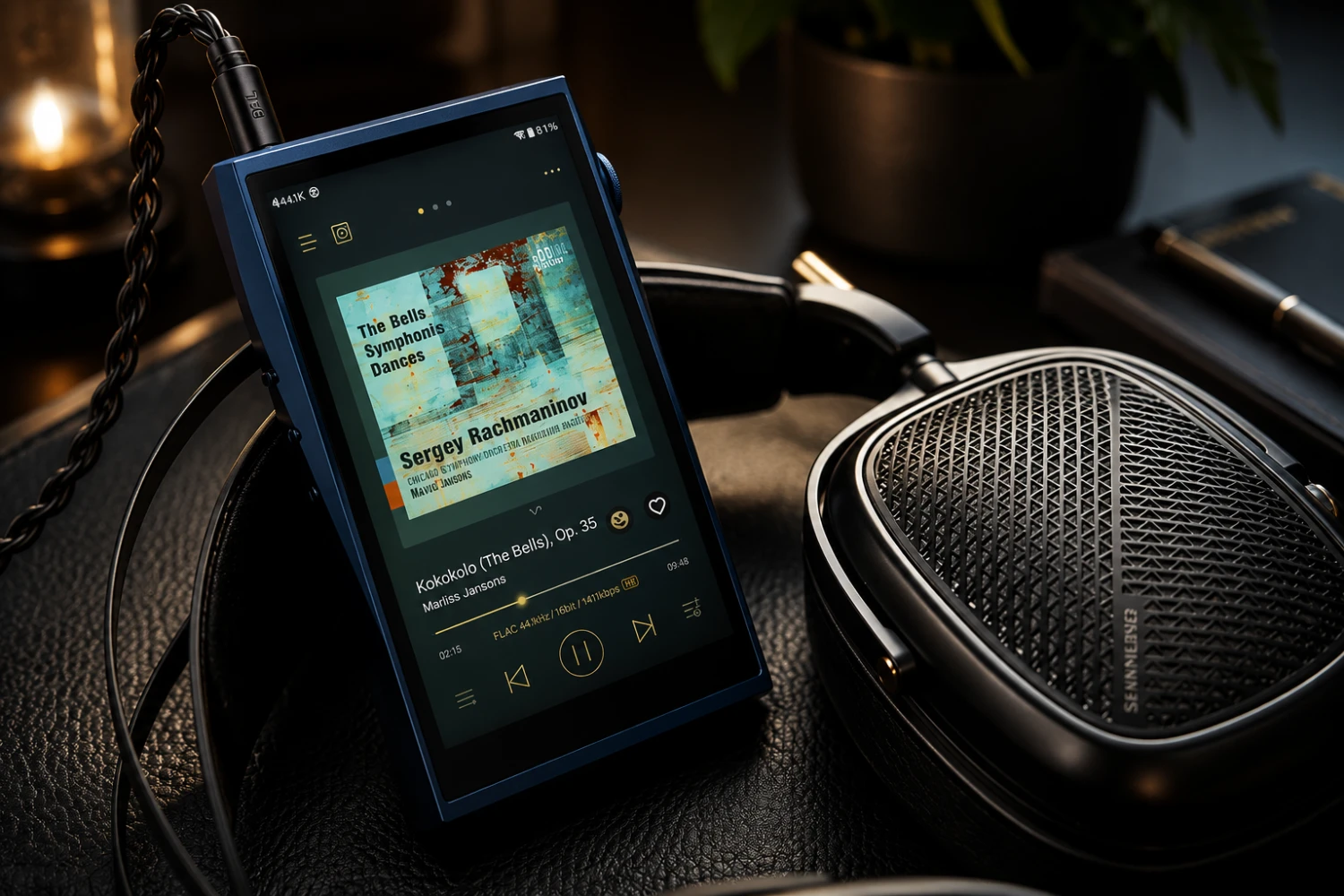
Shanling has announced the M7T Master, a refined edition of its M7T portable hi-res music player. The new model is positioned as an interim update rather than a full platform change, retaining the core architecture of the original while introducing targeted changes to the audio circuit and balanced output stage.
An Evolution of the Shanling M7T
The M7T Master builds on the established Shanling M7T, a portable digital audio player aimed at listeners who want a dedicated hi-res source rather than relying on a smartphone or general-purpose device. Shanling describes the Master version as a generational midpoint update, meaning the main platform and component selection remain familiar, while the implementation has been revised in key areas.
That approach keeps the M7T Master close to the original model in concept. It is still a compact, high-resolution player built around a mixed digital and analog design, but the updated version focuses on changes inside the audio path rather than a wholesale redesign of the device. The company says the aim was to preserve the direct character of the M7T while giving the presentation a fuller and calmer balance.
Dual AKM DAC Architecture Remains
At the heart of the Shanling M7T Master is the same digital conversion arrangement used in the standard M7T. The player continues to use two AK4498EX DAC chips from Asahi Kasei, paired with an AKM AK4191, which serves as a dedicated digital filter and delta-sigma modulator.
This separates parts of the digital processing and conversion chain in a manner consistent with AKM’s multi-chip approach. Shanling has not presented the M7T Master as a move to a new DAC platform; instead, the update keeps the conversion hardware intact and concentrates on implementation details elsewhere in the signal path.

Vacuum Tubes and Revised Internal Wiring
The M7T Master also retains the pair of miniature JAN6418 vacuum tubes found in the M7T design. Their inclusion remains one of the more distinctive aspects of the player, combining modern portable digital playback with a tube-equipped analog stage.
For the Master edition, Shanling has adjusted the amplifier section and introduced conductors made from ultra-high-purity copper inside the audio circuit. According to the company, these changes are part of the effort to refine the player’s voicing while keeping the underlying platform recognizable to existing M7T users.
Shanling’s stated tuning direction is not a radical departure. The company says the original model’s neutral and straightforward sonic character has been maintained, with the Master edition intended to sound more saturated, substantial and relaxed. As always with such claims, the practical result will depend on headphones, output choice and listener preference.

More Powerful Balanced Output
Another change highlighted for the M7T Master is a more powerful balanced output. Shanling has not detailed additional output specifications in the supplied announcement, but the stronger balanced stage is presented as one of the principal hardware-level differences between the Master edition and the original M7T.
For portable players, balanced output capability is often important for users of more demanding in-ear monitors or headphones, provided the pairing is appropriate. In this case, Shanling is emphasizing the upgrade as part of the revised amplifier path rather than as a standalone feature change.

Positioning and Pricing Context
The M7T Master is not being positioned as a replacement built around a new operating platform or an entirely new digital engine. Instead, it appears intended for buyers who were already considering the M7T but want the latest version with the revised audio circuit and stronger balanced output.
Shanling states that the recommended pricing for the Master edition remains in line with the standard M7T. No USD price was included in the supplied announcement, so Stereoindex is not listing a numerical price for the player at this stage.

With the M7T Master, Shanling has chosen a focused update path: keep the dual AKM conversion architecture and tube-equipped design, then refine the internal audio circuitry and balanced output. For listeners following Shanling’s portable players, it is a notable revision of the M7T rather than a ground-up new model.


Sound Off
0Join the discussion if you have something to add.