Marantz AMP 10: Sixteen-Channel Power for Ambitious Home Theaters
The Marantz AMP 10 brings 16 channels of Class D amplification, balanced connectivity and flexible configuration to large, processor-based home theater systems.
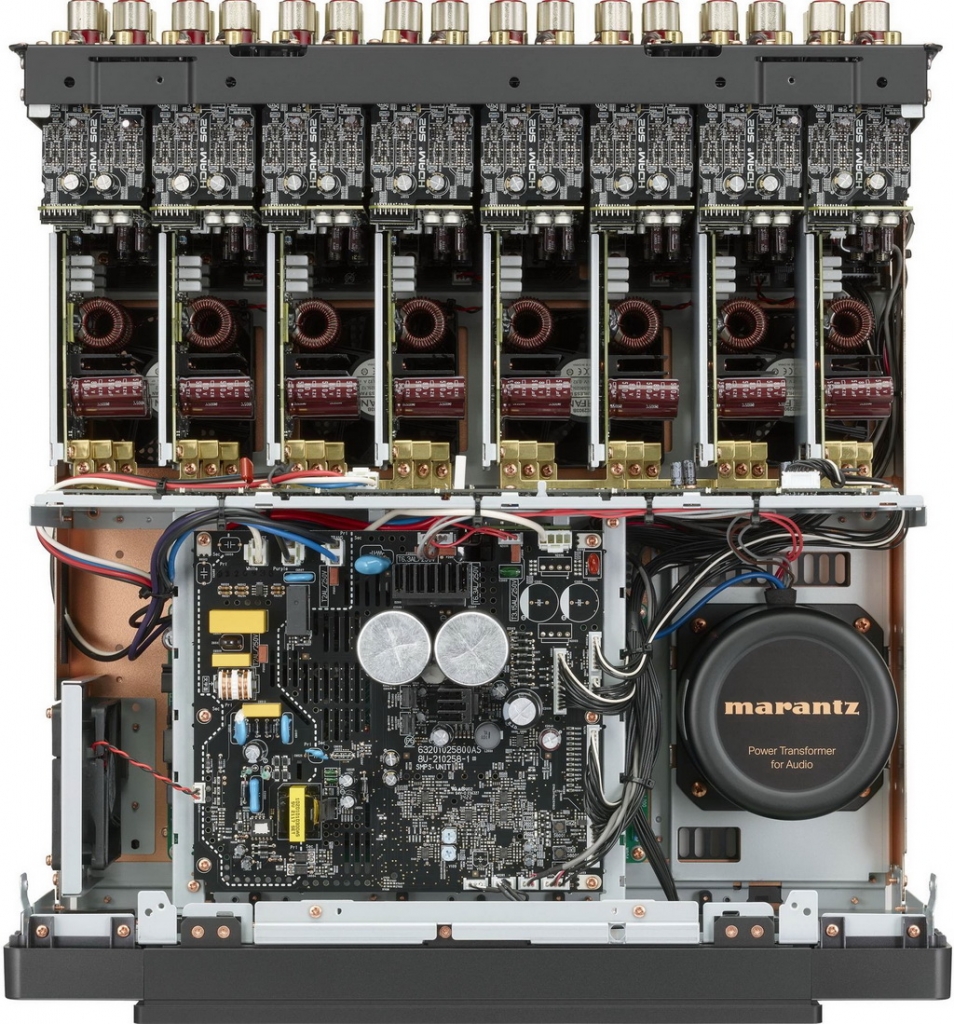
Large home theaters place unusual demands on amplification. A system may need to drive front, center, surround, height and additional speaker channels while remaining manageable to install and straightforward to expand. The Marantz AMP 10 addresses that challenge by placing 16 channels of Class D power amplification in a single, coordinated component. Its headline output specification is 200 watts per channel, supported by current-feedback amplification and Marantz HDAM technology. It is conceived as the natural power-amplifier partner for the company’s AV 10 home theater processor, creating a clear division between signal processing and speaker amplification. The result is a product aimed not at casual living-room systems, but at enthusiasts and custom installations where channel capacity, connection options and long-term flexibility are central priorities.
Sixteen channels in one coordinated amplifier
The defining feature of the AMP 10 is its channel count. Sixteen amplification channels provide the foundation for a substantial multichannel speaker layout without requiring a collection of separate stereo or multichannel power amplifiers. Consolidation can simplify equipment-rack organization, cabling and control, particularly in theaters using numerous surround and overhead speakers.
That capacity also gives system designers room to work. Rather than building an installation around the limitations of a modest channel count, an owner can plan a more elaborate speaker configuration within a single amplifier platform. Selectable amplifier modes and flexible speaker assignment are intended to help adapt those channels to the room and the chosen layout.
The specification makes the AMP 10 relevant to systems that may evolve over time. An owner might not use every available channel immediately, but the additional capacity can reduce the need to replace the main amplifier when more speakers are added later. That is an important practical consideration in a permanently installed theater, where changing rack components and rerouting cables can be disruptive.
Class D power with Marantz amplification technology
Marantz uses a Class D output stage in the AMP 10. In a component containing 16 power-amplifier channels, that architecture is a logical design choice because it allows substantial amplification capability to be accommodated in one chassis. The amplifier is nevertheless a sizeable product, measuring 188 x 422 x 488 mm and weighing 19.8 kg, so it still calls for a suitably strong shelf or equipment rack and appropriate space around the chassis.
The stated 200-watt-per-channel output gives the AMP 10 the power specification expected of an amplifier intended for demanding multichannel installations. As always with a power amplifier, prospective owners should match it carefully to the impedance, sensitivity and power-handling requirements of their speakers rather than considering wattage in isolation.
Current-feedback amplification and Marantz HDAM circuitry are central to the design. These technologies connect the AMP 10 to Marantz’s broader amplifier engineering approach instead of treating it simply as a generic bank of Class D modules. The published operating specifications include a frequency range from 5 Hz to 70 kHz, a signal-to-noise ratio of 110 dB and total harmonic distortion of 0.05 percent. Those figures help define the amplifier’s technical operating envelope, although they should not be interpreted as a substitute for considering the complete system and installation.
Balanced and unbalanced connection options
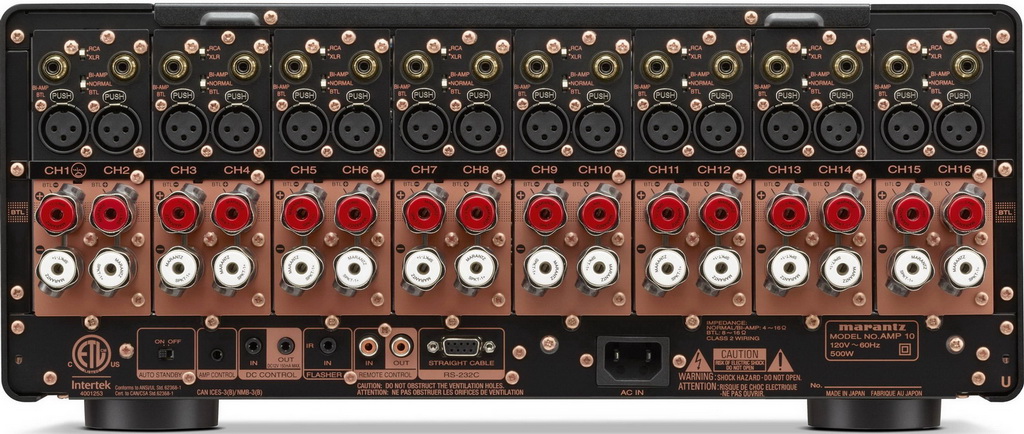
The specified analog input complement comprises eight RCA inputs and eight balanced XLR inputs. Providing both connection types gives an installer useful freedom when integrating the AMP 10 with a processor and arranging the equipment rack. RCA is widely used and convenient for conventional home audio cabling, while balanced XLR connections are often preferred in more complex installations or where longer cable runs are required.
Balanced connectivity can be especially valuable when a processor is located some distance from the amplifier or when many interconnects must be routed together. The practical benefit is not that XLR is automatically superior in every system, but that it offers another integration option for installations where cable management and resistance to unwanted interference are important considerations.
The AMP 10 also includes two RCA line outputs. Together with its selectable amplifier modes and broad input provision, these outputs contribute to a design intended to accommodate systems that may be reconfigured or expanded. That matters in a high-end theater, where sub-systems, additional amplification or revised speaker layouts may be introduced during the life of the installation.
Designed as the AV 10’s amplification partner
Although the AMP 10 can be understood as a standalone multichannel power amplifier, its clearest role is alongside the Marantz AV 10 processor. In that pairing, the processor manages home theater decoding, configuration and system control, while the AMP 10 supplies the power needed by the loudspeakers. Keeping those responsibilities in separate components gives owners a modular path: processing and amplification can be considered independently when the system is installed or updated.
This separation is particularly appropriate for ambitious theaters. Surround formats, control requirements and source equipment can change, while a well-specified power amplifier may remain useful across multiple system revisions. The AMP 10’s generous channel count and analog connectivity are therefore as much about system architecture as immediate output power.
Room correction and speaker setup remain part of the wider processor-led system rather than the fundamental task of the power amplifier. Marantz identifies Audyssey MultEQ XT as part of the configuration proposition, allowing the complete theater to be adjusted for speaker placement and the characteristics of the room. For a prospective owner, the key point is that the AMP 10 is designed to participate in a coordinated Marantz theater rather than operate as an all-in-one receiver.
A visual design suited to visible installations
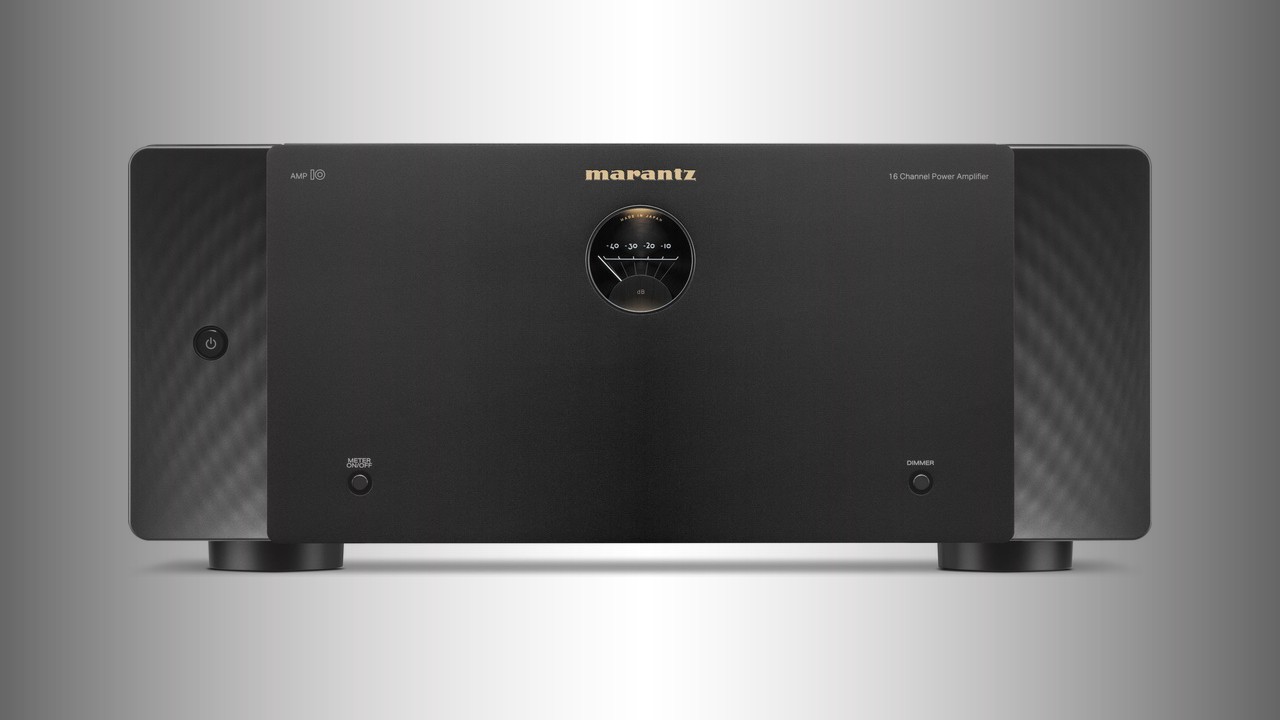
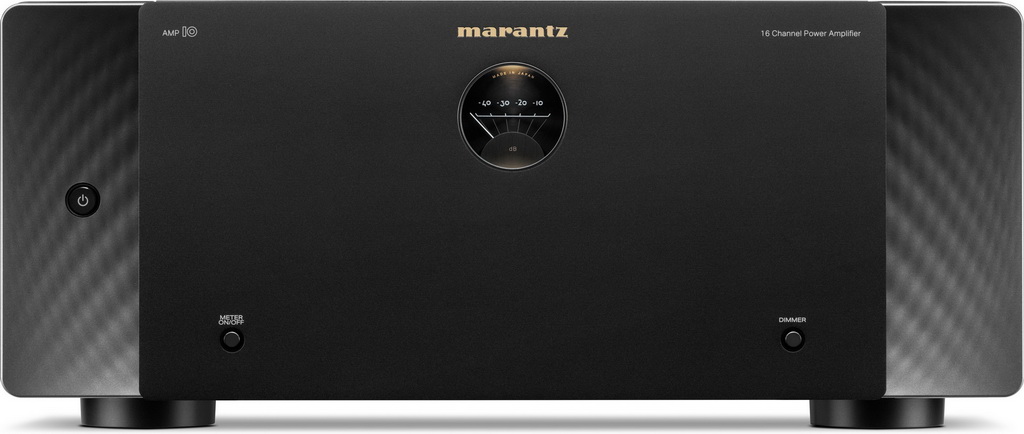
Power amplifiers are often hidden in equipment rooms, but the AMP 10 has been styled to match Marantz’s Cinema Series components when placed on display. Its front panel includes the brand’s circular level indicator, framed by a restrained fascia with subtle side illumination. The use of premium materials and coordinated proportions gives the amplifier a visual relationship with the AV 10.
This design continuity can matter in a dedicated cinema or media room where electronics remain visible. Matching components create a more coherent installation than a rack assembled from unrelated chassis designs. At the same time, the understated front panel avoids burdening the user with an array of controls that are unnecessary once a power amplifier has been configured.
Energy use is specified at 500 watts in operation and 0.2 watt in standby. The low stated standby figure is useful for a component likely to remain connected continuously, although installation planning should still account for operating power, ventilation and the combined electrical requirements of the entire theater.
Who the Marantz AMP 10 is most suitable for
The AMP 10 is best suited to owners planning a large, separates-based home theater with many speaker channels. It is an especially natural candidate for an AV 10 system, as the two products were designed to perform complementary processing and amplification roles. Custom installers may also value the ability to obtain 16 channels from one matching chassis, along with the choice of RCA and XLR connections.
Its flexibility will appeal to enthusiasts who expect their theater to grow. Spare channels, selectable operating modes and line outputs provide options when revising speaker placement or introducing additional components. The amplifier’s design and front-panel treatment also make sense for installations where the hardware is visible rather than concealed in a remote rack.
It is less obviously suited to a simple stereo system, a small surround setup or anyone seeking an all-in-one receiver with source switching and processing built in. Its 19.8 kg weight and nearly 49 cm depth also demand careful rack planning. Prospective owners should confirm physical clearance, ventilation, processor compatibility and speaker requirements before treating the high channel count as the sole reason to choose it.
Conclusion
The Marantz AMP 10 is built around a clear and useful proposition: provide 16 channels of substantial Class D amplification in one purpose-designed component for advanced home theaters. Its 200-watt-per-channel headline rating, current-feedback topology, Marantz HDAM circuitry, balanced XLR and unbalanced RCA inputs, selectable amplifier modes and expansion-oriented connections support installations where flexibility matters as much as raw channel count. Its visual match with the AV 10 further strengthens the case for a coordinated Marantz separates system. For owners building a large multichannel theater—and for installers who need extensive amplification without assembling several unrelated power amps—the AMP 10 offers a focused combination of capacity, connectivity and long-term system adaptability.