
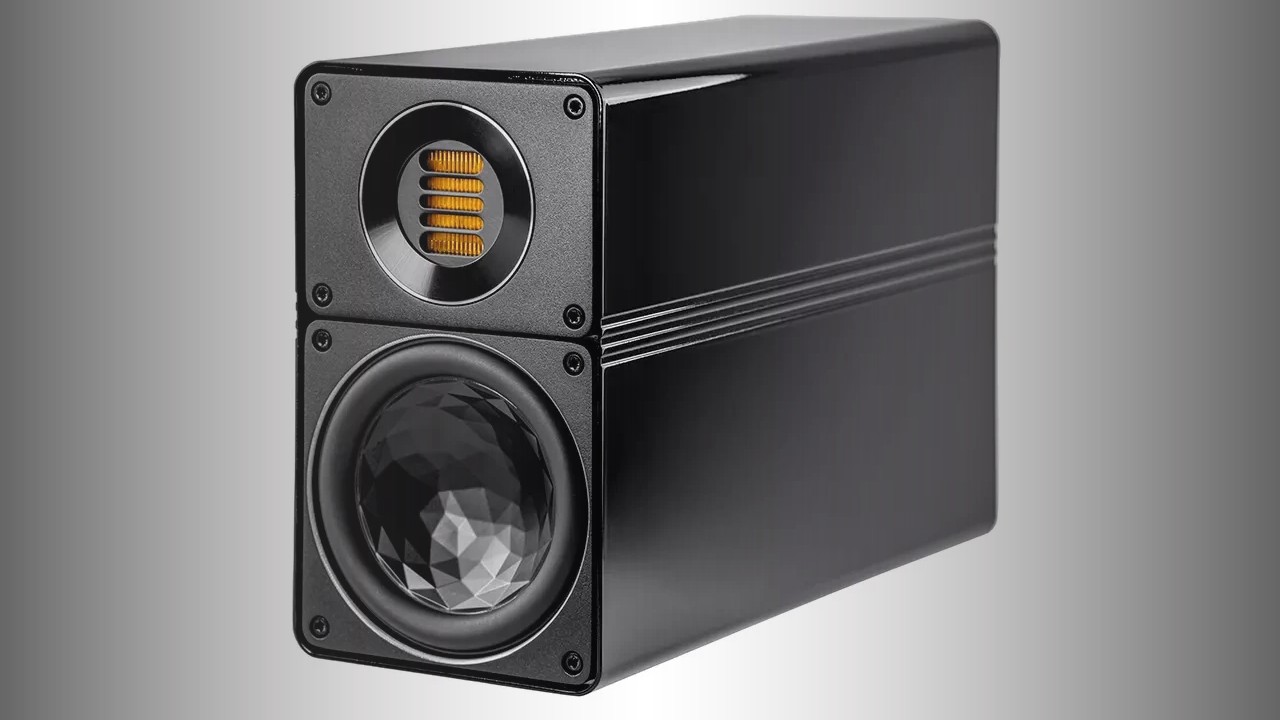
The ELAC Elegant BS 312.2 is a compact bookshelf loudspeaker built around several distinctly ELAC ideas: a proprietary high-frequency driver, a metal-cone low/midrange unit, and a rigid aluminium enclosure rather than a conventional wooden cabinet. It belongs to the company’s Elegant series, and its appeal lies in the way it packages serious loudspeaker engineering into a form that remains visually restrained and domestically manageable. Rather than treating the bookshelf format as a compromise, the BS 312.2 uses materials, driver development, crossover parts, and connection flexibility to make the most of a small enclosure. For prospective owners, the most interesting aspects are not only the quoted frequency range of 42 Hz to 50 kHz, but also the design choices behind that specification: the JET 6 tweeter, the enhanced 115mm AS-XR low/midrange driver, the aluminium bass-reflex cabinet, and the option to bi-wire or bi-amp through dual terminal sets.
A compact speaker built around ELAC’s JET 6 tweeter
The headline engineering feature of the Elegant BS 312.2 is ELAC’s newly developed JET 6 tweeter. Made in Kiel, Germany, this proprietary ribbon tweeter introduces a revised foil layout and a changed front panel. Those details matter because a tweeter’s diaphragm geometry, moving mass, and interface with the baffle all influence how consistently it can reproduce high frequencies and how it disperses energy into the room.
ELAC’s description of the JET 6 refers to selective mass variation in motion, with the goal of achieving a linear amplitude response extending into the ultrasonic range. The specified upper limit of the speaker is 50 kHz, which goes beyond the conventional audible band. While that does not automatically define what a loudspeaker will sound like in a given system or room, wide high-frequency extension can be relevant to phase behavior, driver headroom, and the way the tweeter is engineered to operate comfortably within the audible range.
The tweeter is also described as minimizing total harmonic distortion. For a potential owner, the practical point is that ELAC has not simply carried over an existing high-frequency unit; it has revised one of its signature technologies for this model. In a compact two-way loudspeaker, the tweeter has to work seamlessly above the crossover point, and here that handover occurs at 3.2 kHz. The JET 6 is therefore central to the BS 312.2’s identity, not just an added premium feature.

Upgraded 115mm AS-XR driver for the low and mid frequencies
Below the JET 6 tweeter, the Elegant BS 312.2 uses an enhanced low/midrange driver featuring ELAC’s 115mm AS-XR cone with a crystal-shaped aluminium dome. This is another characteristic ELAC design choice, combining a compact driver size with a rigid, visibly technical cone construction. In a small bookshelf loudspeaker, the low/mid driver carries a large share of the workload: bass output, vocal fundamentals, midrange information, and the transition up toward the tweeter all depend on its behavior.
The revised driver includes a larger voice coil and an additional magnetic ring. ELAC presents these updates as improving efficiency and thermal stability. That is meaningful because voice-coil heat and magnetic control are central to how a driver behaves when asked to play dynamically over time. Better thermal stability can help a driver maintain more consistent behavior under load, while efficiency improvements can make the speaker a more predictable partner for appropriate amplification.
The BS 312.2’s published operating range extends down to 42 Hz, which is notable for a compact bookshelf design, though placement, room acoustics, and amplifier matching will still be important in real installations. The speaker’s nominal impedance is 4 ohms, with a stated minimum of 3.2 ohms at 280 Hz, and sensitivity is specified at 87 dB. These figures suggest that buyers should pair the speakers with an amplifier comfortable driving 4-ohm loudspeakers rather than assuming that any low-powered amplifier will be equally suitable.

An aluminium bass-reflex cabinet with a clear engineering purpose
One of the most distinctive aspects of the Elegant BS 312.2 is its all-aluminium bass-reflex enclosure. Many bookshelf speakers use MDF or other wood-based materials, often with internal bracing to control cabinet resonances. ELAC takes a different route here, using aluminium to create what it describes as a virtually resonance-free enclosure.
The importance of cabinet behavior should not be underestimated. A loudspeaker cabinet is not merely a box that holds the drivers; it can store, reflect, and release unwanted energy if not controlled. ELAC states that the aluminium construction allowed the company to omit internal baffles, reducing the number of sound-reflecting surfaces inside the enclosure. The intended benefit is to let sound spread more freely within the cabinet structure and avoid additional internal surfaces that could complicate the speaker’s behavior.
This approach also contributes to the BS 312.2’s visual and tactile identity. An aluminium cabinet with black or white piano lacquer finish gives the speaker a different character from many fabric-wrapped or wood-veneered compact speakers. It is modern, precise, and architectural without requiring a large footprint. For listeners who want a hi-fi loudspeaker that looks intentionally engineered rather than decorative, that may be an important part of the appeal.

Crossover and internal parts chosen for consistency
The crossover inside the Elegant BS 312.2 uses air-core coils, metal oxide resistors, MKP film capacitors, and Van den Hul cables. These are not cosmetic details; they are part of how the speaker divides the audio signal between the low/midrange driver and the tweeter. The crossover frequency is specified at 3.2 kHz, so the quality and stability of the components around that point are important to the speaker’s integration.
Air-core coils are often used to avoid saturation effects associated with certain core materials, while MKP film capacitors are commonly selected in loudspeaker crossovers for stability and low loss. Metal oxide resistors are valued for reliability in crossover applications. The inclusion of Van den Hul cabling further shows that ELAC is paying attention to the internal signal path, not only to the externally visible drivers and cabinet.
For a prospective owner, the takeaway is that the BS 312.2 is conceived as a complete system. The drivers, enclosure, crossover, and terminals are all part of the same design equation. That does not make listening-room setup irrelevant, but it does indicate a speaker designed with attention to the less visible elements that can affect long-term consistency.

Connection flexibility for conventional, bi-wired, or bi-amped systems
The Elegant BS 312.2 is fitted with two sets of premium screw-type speaker terminals. This allows conventional single-wire connection with suitable links, or bi-wiring and bi-amping for users whose amplifiers and cabling support those configurations. Not every owner will need this flexibility, but its presence makes the speaker easier to integrate into more ambitious systems.
Bi-wiring separates the cable runs feeding the high-frequency and low-frequency sections of the crossover, while bi-amping uses separate amplifier channels for those sections. The source information does not specify a particular performance result from either approach, so it would be inappropriate to promise an improvement. Still, for system builders who prefer to experiment with amplifier channels, cable arrangements, or future upgrades, the dual-terminal layout is a useful provision.
The electrical specifications also deserve attention. With 87 dB sensitivity, 4-ohm nominal impedance, and a 3.2-ohm minimum, the BS 312.2 should be considered a speaker for amplifiers with proper current capability. Owners using integrated amplifiers, power amplifiers, or network amplifiers should check that their equipment is rated for 4-ohm loads. This is especially relevant if the speakers are expected to play at higher levels or in larger rooms.

Design, finish, and placement considerations
The Elegant BS 312.2 is offered in black and white piano lacquer finishes. These two options keep the visual identity simple and versatile: black for a more discreet or traditional hi-fi appearance, white for contemporary interiors where the speaker should appear lighter and more architectural. The aluminium enclosure and high-gloss finish also position the model as an object intended to be seen, not hidden.
Although described as a bookshelf speaker, a product of this kind will often be used on dedicated stands rather than placed directly inside a shelf. ELAC offers the LS60 branded stands as an option for the model. Stands can help place the drivers at a suitable height and give the cabinet room to operate as intended, particularly for a bass-reflex design. The optional stand route also reinforces the speaker’s role as a compact main speaker in a two-channel system, not merely a background music accessory.
The relatively small driver size and compact format make the BS 312.2 interesting for rooms where floorstanding speakers would dominate visually or physically. At the same time, the published low-frequency extension to 42 Hz suggests that ELAC intends the speaker to operate as a serious full-range compact loudspeaker within realistic limits. As always, placement near walls, room size, and amplifier control will influence how the speaker behaves in practice.
Who the ELAC Elegant BS 312.2 is most suitable for
The BS 312.2 is most suitable for listeners who want a compact loudspeaker with premium engineering rather than a large cabinet. Its strengths are particularly relevant to two-channel systems in living rooms, studies, apartments, and dedicated small-to-medium listening spaces where design, build, and placement flexibility matter. The combination of aluminium enclosure, piano lacquer finish, and optional matching stands makes it appealing for owners who care about how a system integrates visually into a room.
It is also a logical candidate for users who value ELAC’s driver technologies. The JET 6 tweeter, AS-XR aluminium low/mid cone, and carefully specified crossover components are the product’s core attractions. Buyers interested in bi-wiring or bi-amping will appreciate the dual terminal sets, while those planning a straightforward single-amplifier setup can still use the speaker conventionally.
The model may be less suitable for buyers who require very high sensitivity, who intend to use low-current amplification, or who need the physical scale of a floorstanding loudspeaker for a large room. Its 4-ohm nominal impedance and 3.2-ohm minimum mean amplifier matching should be approached thoughtfully. It is also not aimed at those looking for a budget bookshelf speaker; at $2,700, its proposition is based on materials, engineering, finish, and compact high-end execution rather than lowest possible cost.
Conclusion
The ELAC Elegant BS 312.2 stands out as a compact bookshelf loudspeaker with a clearly defined engineering character. Its newly developed JET 6 ribbon tweeter, upgraded 115mm AS-XR low/midrange driver, aluminium bass-reflex cabinet, quality crossover parts, and dual speaker terminals all point to a design focused on precision, rigidity, and system flexibility. The black and white piano lacquer finishes and optional LS60 stands add a refined installation path for rooms where a smaller speaker is preferred. For prospective owners, its strongest documented qualities are the combination of advanced driver technology, resonance-conscious enclosure construction, flexible connectivity, and premium compact form. It is best suited to listeners building a serious two-channel system around capable 4-ohm-compatible amplification and who want a speaker that is technically distinctive without requiring the space of a floorstanding design.



Sound Off
0Join the discussion if you have something to add.