
Cambridge Audio EVO 150: A Compact Streaming Amplifier Built Around Real System Flexibility
The Cambridge Audio EVO 150 is designed as a serious all-in-one stereo hub, combining 150W Class D amplification, high-resolution streaming, an ESS Sabre DAC, HDMI ARC, MM phono input, and adaptable industrial design in one compact chassis.

The Cambridge Audio EVO 150 sits in a particularly useful category of modern hi-fi: the compact integrated amplifier that is also a network player, DAC, TV audio hub, phono stage, headphone-capable Bluetooth device, and system control center. Its appeal is not simply that it combines functions, but that it does so with an unusually broad range of inputs and outputs, a mature streaming platform, and a design that can be adapted visually to different rooms. For listeners who want a capable stereo system without building a large rack of separate components, the EVO 150 is a thoughtfully specified alternative.
A front panel designed for daily use
The EVO 150 makes a strong first impression through its front panel layout. A 6.8-inch color information display occupies much of the fascia, giving the unit a visual identity closer to a modern network component than a conventional amplifier. In practical terms, that large display can make source selection, playback status, album information, and menu navigation easier to follow from across a room.
The other major control element is the large rotary-push controller. Cambridge Audio uses it not only for volume but also for input selection and menu navigation, which keeps the front panel clean while preserving direct physical control. Small vertically arranged buttons between the display and control knob handle playback and key operating modes. This balance between screen-based feedback and tactile controls is important: an all-in-one amplifier should not force the owner to reach for a phone for every basic operation.
The EVO 150 also includes removable side panels. Wooden panels are supplied for a warmer, more furniture-like presentation and are intended to nod toward Cambridge Audio’s early amplifier heritage, including the P40 from 1968. For a more contemporary look, the included Richlite side panels offer an alternative made from recycled paper. That detail matters because an all-in-one system is often placed in a living space rather than hidden in an equipment rack.
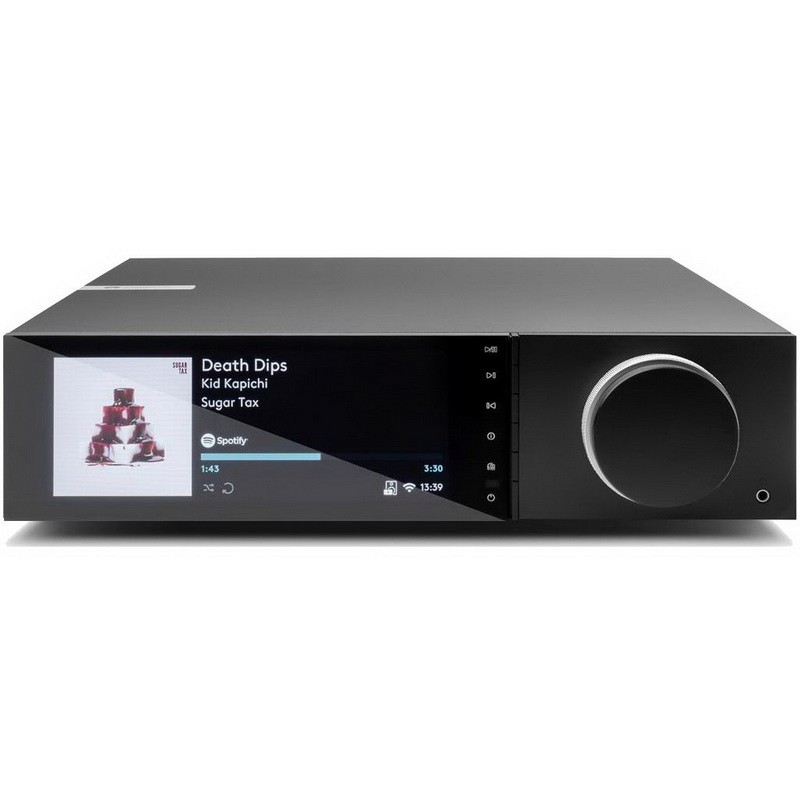
150 watts of Hypex Ncore amplification in a compact chassis
The number in the EVO 150’s name refers to its rated output of 150 watts per channel into 8 ohms. Cambridge Audio achieves this within a compact and relatively light enclosure by using Hypex Ncore Class D amplifier modules. Class D topology is central to the product’s concept: it allows substantial output power without the size, heat management, and heavy power supply demands typically associated with large traditional amplifiers.
For a prospective owner, this matters in two ways. First, the amplifier is not restricted to small desktop or nearfield use; its documented power rating suggests it is intended for a broad range of passive loudspeakers, including standmount speakers and many floorstanding designs. Second, the compact 31.7 x 8.9 x 35.2 cm chassis makes it easier to place in domestic spaces where a full-width stack of components may be impractical.
The inclusion of two pairs of speaker terminals also adds flexibility. The source material notes selectable dual speaker outputs, which can be useful for owners who want to connect two speaker pairs or configure their system in a way that benefits from separately addressable outputs. As always with speaker matching, impedance, sensitivity, room size, and listening habits still matter, but the EVO 150 is clearly designed as more than a low-power lifestyle amplifier.

High-resolution digital conversion and format support
At the digital heart of the EVO 150 is an ESS Sabre Reference ES9018K2M DAC. The unit supports PCM audio up to 32-bit/384 kHz and DSD up to DSD256. It also includes full MQA decoding, which is relevant for users of services and libraries that include MQA-encoded material.
The broad file compatibility is another strength. Supported formats include WAV, FLAC, ALAC, AIFF, DSD, WMA, MP3, AAC, HE AAC, AAC+, and OGG Vorbis. This is valuable because many music collections are not uniform. A long-term listener may have lossless files, legacy compressed files, downloaded high-resolution albums, and DSD material stored across computers, NAS drives, and USB storage. The EVO 150 is specified to handle a wide variety of those sources without requiring an additional DAC or network bridge.
The USB-B input allows connection to a computer as a digital source, while USB-A supports playback from external USB storage. The presence of both types is significant: one serves users who treat a laptop or desktop as a music transport, while the other supports a more self-contained setup using drives or flash storage.

StreamMagic and network integration
The EVO 150 uses Cambridge Audio’s StreamMagic platform, which gives it a central role in a modern networked audio system. Network connection can be made wirelessly via dual-band Wi-Fi or through an Ethernet RJ45 port. The wired connection is specified at 100 Mbps, which is sufficient for audio streaming, including high-resolution playback within the unit’s supported parameters.
The streaming ecosystem is extensive. The EVO 150 supports UPnP, AirPlay 2, Chromecast built-in, internet radio, Spotify Connect, TIDAL, Qobuz, MQA, and Roon Ready operation. This range matters because different households use different playback habits. Some listeners rely on a dedicated music library over UPnP or Roon; others prefer to cast directly from a phone; others use a streaming service app and select the amplifier as the playback device.
Control is available through Cambridge Audio’s StreamMagic mobile app, through Roon when used within that ecosystem, or through compatible streaming apps that can address the EVO 150 as an output. This reduces dependence on a single control method and makes the amplifier easier to integrate into homes where multiple people may use different phones, tablets, computers, or services.

Connectivity that goes beyond streaming
One of the EVO 150’s most attractive qualities is that it treats streaming as only one part of the system. On the analog side, it provides a balanced XLR input, unbalanced RCA line inputs, and a moving-magnet phono input. The MM phono stage is especially important for listeners who want to keep a turntable in the same compact system without adding an external phono preamplifier.
Digital inputs include two optical inputs, one coaxial input, USB-B, USB-A, Ethernet, and HDMI ARC. HDMI ARC is a particularly useful inclusion for real-world living rooms, because it allows a TV to feed audio to the stereo system through a connection that is familiar to many users. Instead of relying on soundbars or TV speakers, the EVO 150 can become the amplifier for both music and television sound in a two-channel setup.
The outputs also show careful planning. RCA pre-outs allow the EVO 150 to feed an external power amplifier if the owner later changes system architecture. A dedicated subwoofer output supports a 2.1-channel arrangement, useful for rooms or speakers that benefit from low-frequency reinforcement. Bluetooth 4.2 with aptX HD is included for wireless playback up to 24-bit/48 kHz, and Bluetooth can also be used for connecting wireless headphones, adding another layer of convenience for private listening.

A system hub rather than a single-purpose amplifier
Many integrated amplifiers serve one main role: accept sources and drive speakers. The EVO 150 is more ambitious. It can be the core of a system that includes passive speakers, a turntable, a TV, a computer, a USB drive, network storage, streaming services, wireless playback devices, a subwoofer, and potentially an external amplifier. That breadth makes it suitable for users who want a serious stereo system but do not want the visual or practical complexity of multiple boxes.
The inclusion of a color display, physical controls, app control, Roon support, and broad service compatibility also reflects how people actually use music systems today. A single listening session might move from a streaming service to a local high-resolution file, then to TV audio, then to vinyl. The EVO 150 is specified to accommodate that pattern without frequent cable changes or additional switching hardware.
Its market position is therefore not defined only by wattage or file resolution. The more distinctive point is integration: Cambridge Audio has combined a powerful amplifier section, mature network playback, high-resolution DAC capability, traditional analog inputs, HDMI ARC, and adaptable design into one component.

Who the Cambridge Audio EVO 150 is most suitable for
The EVO 150 is best suited to listeners who want to build a compact but capable stereo system around passive loudspeakers. It is especially relevant for people who use several source types: streaming services, local network libraries, a TV, a computer, and perhaps a turntable with a moving-magnet cartridge. For those users, the product’s wide connectivity can reduce the need for separate streamers, DACs, phono stages, and input switchers.
It is also a good conceptual fit for living-room systems where appearance and footprint matter. The large display, compact dimensions, and interchangeable side panels make it easier to treat the amplifier as part of the room rather than as hidden technical equipment. The HDMI ARC input reinforces that living-room role by making TV integration straightforward.
It may be less appropriate for buyers who prefer a fully modular separates system from the beginning, need moving-coil phono support without an external stage, require features not listed in the specification, or want to choose every digital and amplification component independently. Likewise, users with very specific loudspeaker demands should still consider normal system-matching factors. The EVO 150’s strength is not that it replaces every specialized component for every listener, but that it brings a unusually complete set of documented capabilities into one manageable unit.
Conclusion
The Cambridge Audio EVO 150 is compelling because it combines several genuinely useful roles without losing sight of everyday usability. Its documented strengths include 150 watts per channel of Hypex Ncore Class D amplification, an ESS Sabre DAC with high-resolution PCM and DSD support, StreamMagic network playback, Roon Ready operation, MQA decoding, HDMI ARC, MM phono input, balanced analog input, subwoofer and preamp outputs, Bluetooth with aptX HD, and a large front display. Add the interchangeable side panels and compact chassis, and the result is an all-in-one amplifier aimed at listeners who want a clean, flexible, modern stereo system built around passive speakers, streaming, TV integration, and a mix of digital and analog sources.