AmazingWave X20 Pro: A Flexible R2R DAC With Preamp Practicality
The AmazingWave X20 Pro combines high-resolution digital decoding, R2R conversion, balanced and single-ended outputs, and front-panel volume control in a compact aluminum chassis designed for flexible hi-fi system integration.

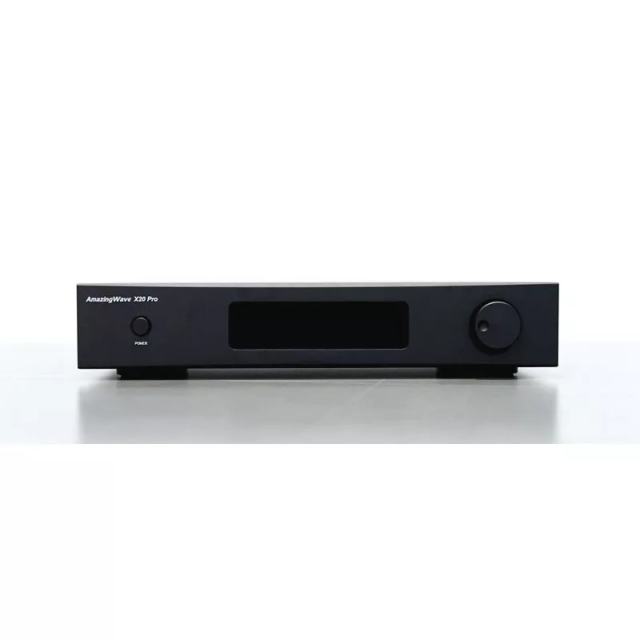
The AmazingWave X20 Pro is positioned as more than a conventional digital-to-analog converter. It is a compact DAC built around broad digital input support, R2R conversion, balanced and single-ended analog outputs, and a front-panel volume control that allows it to operate as a preamplifier in suitable systems. That combination makes it interesting for listeners who want a single digital hub capable of working with multiple sources while reducing the need for a separate line-stage component. Its feature set is not just about format support; the design also places visible emphasis on power supply engineering, chassis construction, user feedback, and system flexibility.
A DAC Designed to Sit at the Center of a Digital System
The most immediately useful aspect of the AmazingWave X20 Pro is its wide range of inputs. The unit accepts coaxial, optical, USB, HDMI IIS, and Bluetooth connections, giving it the flexibility to accommodate several types of digital sources. A computer or music server can connect by USB, a disc transport or streamer may use coaxial or optical, and compatible digital transports can use the HDMI IIS input. Bluetooth support with aptX-HD and LDAC also adds a wireless option for situations where convenience is important.
For a prospective owner, this breadth matters because a DAC often becomes the long-term anchor of a system. Sources tend to change over time: a laptop may be replaced by a dedicated streamer, a television or media device may be added, or a wireless source may become useful for casual listening. A DAC with multiple digital pathways can adapt to those changes more easily than a single-input design.
The X20 Pro’s output options are similarly practical. It provides RCA single-ended outputs as well as balanced XLR outputs. RCA remains the default connection for many integrated amplifiers and preamplifiers, while XLR is valuable for systems built around balanced preamps, power amplifiers, or active loudspeakers. Having both output formats avoids forcing the owner into one connection standard and gives the DAC a broader range of possible system roles.
Preamp Functionality Adds System Simplicity
A defining feature of the AmazingWave X20 Pro is the inclusion of volume control on the front panel. This allows the DAC to function as a preamplifier, at least in digital-source systems where the user does not require analog inputs. For many modern listeners, the main sources are computers, streamers, digital transports, and wireless devices. In that context, a DAC with volume control can simplify the signal chain by feeding a power amplifier or suitable active speakers directly.
This approach can be attractive for several reasons. It reduces component count, saves rack space, and can make day-to-day operation more straightforward. Instead of managing a separate DAC and preamplifier, the user can select a digital input and adjust listening level from the same device. The source material describes the X20 Pro as using an OLED display on the front panel to provide clear indications, which is important in a product intended to handle multiple inputs and variable output control.
The preamp capability should be understood in context. The documented feature is volume control enabling preamplifier use; the supplied information does not describe analog input switching, home-theater bypass, remote control, gain settings, or other preamp-specific functions. As a result, the X20 Pro appears best suited to systems centered on digital sources, rather than installations requiring full analog preamp flexibility.
R2R Conversion and Digital Processing Architecture
Inside the AmazingWave X20 Pro, the conversion stage is described as using a 24-bit R2R resistive array for analog output. R2R DACs use a ladder of precision resistors to convert digital data into an analog signal, a design approach that remains of interest to many hi-fi enthusiasts because it differs from the more common delta-sigma architecture used in many modern DAC chips. The presence of a 24-bit R2R array gives the X20 Pro a distinct technical identity within a crowded DAC market.
The digital processing stage uses FPGA/CPLD technology. In practical terms, FPGA and CPLD devices allow manufacturers to implement custom digital logic for handling and decoding incoming audio data. This can be relevant in a DAC that supports multiple input types and high-resolution formats, because the digital control stage must manage different data streams reliably before conversion takes place.
The source information also notes an integrated control and calibration system intended to enhance sound precision, with components selected and matched for reliability. While no independent performance figures are provided, this emphasis suggests that AmazingWave is treating the R2R stage not as a decorative specification but as part of a controlled signal-processing architecture. For buyers specifically looking for an R2R-based DAC with modern input support, that combination is one of the X20 Pro’s more distinctive qualities.
High-Resolution Format Support for Modern Libraries
The AmazingWave X20 Pro supports PCM from 44.1 kHz to 768 kHz and DSD from DSD64 to DSD512. This covers standard CD-derived material, high-resolution PCM files, and a wide range of DSD content. For many users, the practical benefit is confidence that the DAC can accept most mainstream high-resolution audio libraries without needing file conversion before playback, assuming the connected source and software are compatible.
It is important not to overstate format support as a guarantee of audible results. High sample-rate compatibility is a capability, not a listening verdict. Still, for owners who have built collections around high-resolution downloads, archival recordings, or DSD files, broad format handling can make the product easier to integrate. It also gives the X20 Pro room to accommodate future source upgrades that may output higher-rate PCM or DSD streams.
Bluetooth support further broadens the unit’s usability. The inclusion of aptX-HD and LDAC gives the wireless side of the product more serious codec support than basic Bluetooth alone. While a wired connection is typically the preferred route in many dedicated hi-fi systems, wireless access can be useful for guests, secondary listening, playlists from mobile devices, or times when convenience matters more than configuring a dedicated playback chain.
Power Supply Design as a Core Engineering Focus
The power supply is one of the more detailed areas in the X20 Pro’s published specification. The unit uses two specially designed toroidal transformers made from oxygen-free copper, with multilayer magnetic insulation. The stated purpose is to minimize noise levels and improve stability. In audio electronics, power supply implementation can affect how consistently circuits operate, particularly in products that combine digital processing, conversion stages, and analog output sections in one chassis.
The X20 Pro also uses a Sigma22 power supply system, described as offering high voltage regulation accuracy, energy efficiency, and stable audio signal transmission. Voltage regulation matters because digital and analog circuits require stable operating conditions. In a DAC, the analog output stage, clocking and control circuitry, and digital processing sections all benefit from clean and well-managed power distribution.
The product’s 25 W power consumption, AC 110V/220V compatibility, and 3.9 kg weight give some additional context. This is not a pocket-sized desktop dongle or a purely portable device; it is a component intended for a permanent place in a home audio system. Its weight and internal transformer arrangement suggest a more substantial component than its relatively compact 350 × 250 × 60 mm dimensions might imply.
Compact Aluminum Build and Front-Panel Usability
The AmazingWave X20 Pro uses a robust aluminum alloy casing with a minimalist visual design. In a hi-fi component, chassis design has both aesthetic and practical importance. A clean enclosure helps the product blend into a range of systems, from desktop audio setups to full-width component racks, while aluminum alloy construction provides a sense of structural purpose appropriate to a dedicated audio component.
At 350 mm wide, 250 mm deep, and 60 mm high, the X20 Pro is smaller than many traditional full-size components. That footprint may be useful for listeners who want high-end digital functionality without dedicating a large shelf space to the DAC. Its low height can also make it easier to place near streamers, headphone amplifiers, compact power amplifiers, or other digital components, provided normal ventilation and cable access are maintained.
The OLED display is a meaningful usability feature. A product with coaxial, optical, USB, HDMI IIS, Bluetooth, RCA, XLR, and variable output functionality needs a clear way to communicate status. A front display can make input confirmation and operation more transparent, especially in systems where several digital devices are connected at once. Combined with the volume control, the front panel makes the X20 Pro feel less like a hidden utility box and more like an active control component.

Who the AmazingWave X20 Pro Is Most Suitable For
The X20 Pro is most suitable for listeners building a system around digital sources who want one component to handle conversion, input flexibility, and volume control. It may appeal to owners of power amplifiers or active loudspeakers who do not need a traditional analog preamplifier but still want balanced XLR or RCA outputs. It is also a logical candidate for users with mixed source types: a computer on USB, a transport on coaxial or optical, a compatible HDMI IIS source, and occasional Bluetooth playback from a mobile device.
It may be less appropriate for users who need multiple analog inputs, phono support, extensive home-theater integration, or a fully specified analog preamplifier. The documented strengths of the product are digital connectivity, R2R conversion, high-resolution support, power supply attention, and variable output control. Buyers whose systems are built mainly around turntables, tape machines, tuners, or other analog sources would likely need additional equipment.
For enthusiasts specifically interested in R2R DAC architecture, the X20 Pro’s combination of a 24-bit R2R resistive array, FPGA/CPLD digital processing, DSD512 and PCM 768 kHz support, balanced outputs, and preamp operation gives it a distinctive profile. It is not presented here as a universal solution for every system, but as a focused digital component with enough flexibility to serve several modern hi-fi roles.
Conclusion
The AmazingWave X20 Pro stands out through its combination of broad digital input support, 24-bit R2R conversion, FPGA/CPLD processing, high-resolution PCM and DSD compatibility, balanced and single-ended outputs, and front-panel volume control for preamp-style use. Its aluminum chassis, OLED display, compact dimensions, and carefully described power supply design reinforce its role as a serious home audio component rather than a simple accessory. The strongest fit is for digitally focused listeners who want a flexible DAC that can also act as the control point in a streamlined system built around power amplification or active speakers.