
A digital-to-analog converter can be a pocket-sized link between a phone and headphones, a transportable DAC and amplifier for more demanding setups, or the switching center of a full home system.
This selection reflects that breadth rather than treating every DAC as interchangeable.
The portable choices stand apart through their output connections, decoding support, amplifier design, gain options, and physical construction. The home components place greater emphasis on system integration, dedicated conversion architectures, analog preamplification, input flexibility, and substantial enclosures. Specifications alone should not determine the choice. Start with where the DAC will be used, which digital sources must connect, whether a headphone amplifier is required, and whether your headphones use 3.5mm or 4.4mm termination. The products below are presented in the supplied order, with distinctions based only on their documented designs and capabilities.

1. Questyle M15C: Portable Lossless DAC with Headphone Amplifier
The compact Questyle M15C combines an aluminum-alloy enclosure with 3.5mm unbalanced and 4.4mm balanced headphone outputs.
The Questyle M15C is a compact DAC and headphone amplifier built around a Cirrus Logic CS43198 converter.
It accepts PCM up to 32-bit/384kHz and DSD256, while separate 3.5mm unbalanced and 4.4mm balanced outputs accommodate two common headphone connections.
Manual standard and high gain modes provide a useful adjustment for headphones with different sensitivity and impedance requirements. Its aluminum-alloy body measures 61.9 by 27.9 by 12mm, reinforcing its portable focus. Android, Windows, and macOS compatibility is documented, while iOS use requires the LTC02 Lightning adapter.
Best for: Portable use across multiple operating systems
- PCM up to 32-bit/384kHz and DSD256 support
- 3.5mm and 4.4mm headphone outputs
- Standard and high gain modes
- Compact aluminum-alloy enclosure
Verdict: A compact and adaptable option for listeners who want dual headphone outputs, selectable gain, and broad device compatibility.

2. Naim DAC-V1: A must-have classic for any audiophile
The Naim DAC-V1 is conceived as a home digital decoding and switching component rather than a pocket-sized DAC.
The Naim DAC-V1 represents the home-system side of this selection, where an external DAC can serve as both the primary digital decoder and a switching point for computer-based music sources.
Its context is particularly relevant to listeners using a PC as a digital transport for stored high-resolution files.
The design also draws on technologies developed for Naim's premium DAC work. The supplied material does not provide a complete connection list or detailed decoding limits, so its appeal here rests on system-oriented digital conversion rather than a specification comparison with newer portable models.
Best for: Computer-centered home audio systems
- Designed for a system-oriented external DAC role
- Suited to computer-based digital playback
- Draws on Naim's premium DAC development
Verdict: A system-focused Naim DAC for listeners building their digital playback around a computer or other dedicated transport.

3. Hidizs S8 Pro Robin: Portable balanced DAC and headphone amplifier
The Hidizs S8 Pro Robin provides 3.5mm unbalanced and 4.4mm balanced connections alongside its dual-CS43131 architecture.
Hidizs equips the S8 Pro Robin with two Cirrus Logic CS43131 chips in a symmetrical dual-DAC architecture.
It supports PCM up to 32-bit/384kHz and DSD256, with a 3.5mm output rated at 80mW per channel into 32 ohms and a 4.4mm balanced output rated at 160mW per channel into the same load.
Five digital filters provide a degree of playback adjustment, while Cirrus Popguard technology is intended to suppress unwanted power-on and power-off noise. Published figures also distinguish its balanced and unbalanced performance, including 0.0006 percent harmonic distortion and a 128dB signal-to-noise ratio through the balanced output.
Best for: Portable listeners who want filters and balanced output
- Dual CS43131 conversion architecture
- 3.5mm and 4.4mm outputs
- Five selectable digital filters
- Balanced output rated at 160mW per channel into 32 ohms
Verdict: A feature-rich portable DAC and amplifier with dual conversion chips, two headphone connections, and useful filter selection.

4. Tanchjim Luna: DAC/Headphone amp boasting 2 CS43198 chips from Cirrus Logic
The CNC-machined aluminum Tanchjim Luna is available in standard and illustrated Asano versions, with both 3.5mm and 4.4mm outputs.
The Tanchjim Luna uses two Cirrus Logic CS43198 DAC chips with individual amplification for each channel.
Its decoding support reaches 32-bit/768kHz PCM and DSD256, and both 3.5mm single-ended and 4.4mm balanced headphone connections are fitted.
Tanchjim also separates device volume adjustment from output signal level to provide smooth, nearly lossless control. Construction is notably considered: the CNC-machined aircraft-grade aluminum enclosure is paired with a supplied silver-coated, single-crystal-copper cable that separately shields its digital and power lines. A standard version and a graphically decorated Asano edition are available.
Best for: Portable systems needing high-rate PCM support
- Dual CS43198 DAC chips
- PCM up to 32-bit/768kHz and DSD256 support
- 3.5mm and 4.4mm outputs
- Shielded silver-coated copper cable included
Verdict: A carefully constructed portable DAC and headphone amplifier distinguished by dual DAC chips, two output formats, and unusually extensive PCM support.

5. Luxman DA-06: DAC equipped with two optical and two coaxial inputs
The Luxman DA-06 places its controls and LED display on a shaped aluminum front panel within a resonance-conscious metal chassis.
The Luxman DA-06 is intended to become the central digital conversion component in a home audio system.
Two optical and two coaxial inputs make it relevant to systems with several conventional digital sources, while its support for modern high-resolution file playback includes PCM-oriented formats and DSD material.
Luxman houses the electronics in a non-magnetic metal chassis designed to protect against external interference. Massive supports are used to limit mechanical resonance, and the shaped aluminum front panel carries the operating controls and an LED display. This is a substantial system component rather than a headphone dongle.
Best for: Home systems with several optical or coaxial sources
- Two optical and two coaxial inputs
- Non-magnetic metal chassis
- Front-panel controls and LED display
- Supports PCM and DSD-oriented digital playback
Verdict: A home-focused Luxman converter whose multiple conventional digital inputs and substantial chassis suit a permanent hi-fi installation.

6. T+A DAC 8 DSD: Compact and powerful DAC
The T+A DAC 8 DSD fits dedicated PCM and DSD conversion, analog preamplification, and a headphone amplifier into a compact aluminum chassis.
The T+A DAC 8 DSD combines digital conversion, an entirely analog preamplifier section, and a headphone amplifier specified for high-impedance headphones.
DSD signals up to DSD512 are handled by T+A's discrete True 1-bit DSD converter, while PCM processing uses four separate DACs per channel.
A precision clock generator and separate power circuits for the digital and analog sections further define the internal design. Although this is a home component, its square footprint is relatively contained at 270mm per side and 95mm high. The rigid aluminum housing uses 6mm top and bottom plates with die-cast side and front profiles.
Best for: Compact home systems needing DAC and preamplifier functions
- Discrete True 1-bit DSD conversion up to DSD512
- Four PCM DACs per channel
- Completely analog preamplifier section
- Headphone amplifier for high-impedance headphones
Verdict: A technically ambitious home DAC that combines separate PCM and DSD architectures with analog preamplification and headphone drive.

7. SMSL D10: High performance portable USB DAC
The SMSL D10 pairs a textured aluminum body and transparent window with side volume controls and dual headphone outputs.
The SMSL D10 is a USB DAC and headphone amplifier based on two Cirrus Logic CS43131 chips.
It decodes PCM up to 32-bit/384kHz and DSD256 and can connect to computers, phones, and other compatible USB sources.
Both 3.5mm single-ended and 4.4mm balanced headphone outputs are present. Published output ratings reach 500mW into 16 or 32 ohms, then decrease progressively for higher-impedance loads. Side-mounted volume controls simplify adjustment, while a textured aluminum body and transparent window expose part of the internal layout.
Best for: Portable USB setups requiring substantial published output
- Dual CS43131 DAC chips
- PCM up to 32-bit/384kHz and DSD256 support
- 3.5mm and 4.4mm headphone outputs
- Rated at up to 500mW into 16 or 32 ohms
Verdict: A versatile USB DAC and amplifier with dual outputs, straightforward controls, and clearly documented power across a broad impedance range.

8. Rotaxis Core64: A No-Compromise R-2R DAC for Pure Analog Sound
The Rotaxis Core64 centers on a ring-arranged, 24-bit passive resistive ladder that the manufacturer calls its PulseAxis architecture.
The Rotaxis Core64 takes a markedly different approach from the delta-sigma converters found elsewhere in this selection.
Its 24-bit passive resistive ladder uses ring-shaped PulseAxis resistor arrays, which Rotaxis says are arranged to reduce electromagnetic interference, thermal drift, and crosstalk.
The company also describes a timing-focused design without feedback, noise reduction, delta-sigma modulation, noise shaping, or conventional digital-filter processing. Its ladder is clock-accelerated at a base frequency of 11.2MHz with a sub-frequency around 100MHz. These are manufacturer-described architectural choices rather than comparative listening or independent measurement findings.
Best for: Enthusiasts specifically seeking an R-2R architecture
- 24-bit passive resistive-ladder architecture
- Ring-arranged PulseAxis resistor arrays
- No feedback or noise-reduction processing
- Alternative to conventional delta-sigma conversion
Verdict: A specialist DAC whose appeal lies in its unconventional passive ladder and timing-led design rather than mainstream feature comparisons.

9. Aune Yuki SE: Portable DAC that doubles as a headphone amplifier
The Aune Yuki SE uses a compact enclosure around an ES9280AC Pro converter and a discrete 16-transistor amplifier stage.
The compact Aune Yuki SE combines an ESS ES9280AC Pro DAC with a discrete amplifier stage formed from 16 transistors across four channels.
This differs from portable designs that rely on an integrated fixed gain chip and gives Aune greater scope to tune the amplification stage.
A dual-layer circuit board separates the digital input and analog amplifier sections, while two AS318 low-jitter crystal oscillators form its internal femtosecond clocking arrangement. Decoding reaches 32-bit/768kHz PCM and DSD512. Output is rated at 90mW into 30 ohms, with published noise and harmonic-distortion figures of 2.9 microvolts and 0.00050 percent respectively.
Best for: Portable listeners interested in discrete amplification
- Discrete 16-transistor gain stage
- PCM up to 32-bit/768kHz and DSD512 support
- Separate digital and analog circuit-board layers
- Dual low-jitter crystal oscillators
Verdict: A compact DAC and amplifier distinguished by its discrete four-channel gain stage and separated digital and analog circuitry.
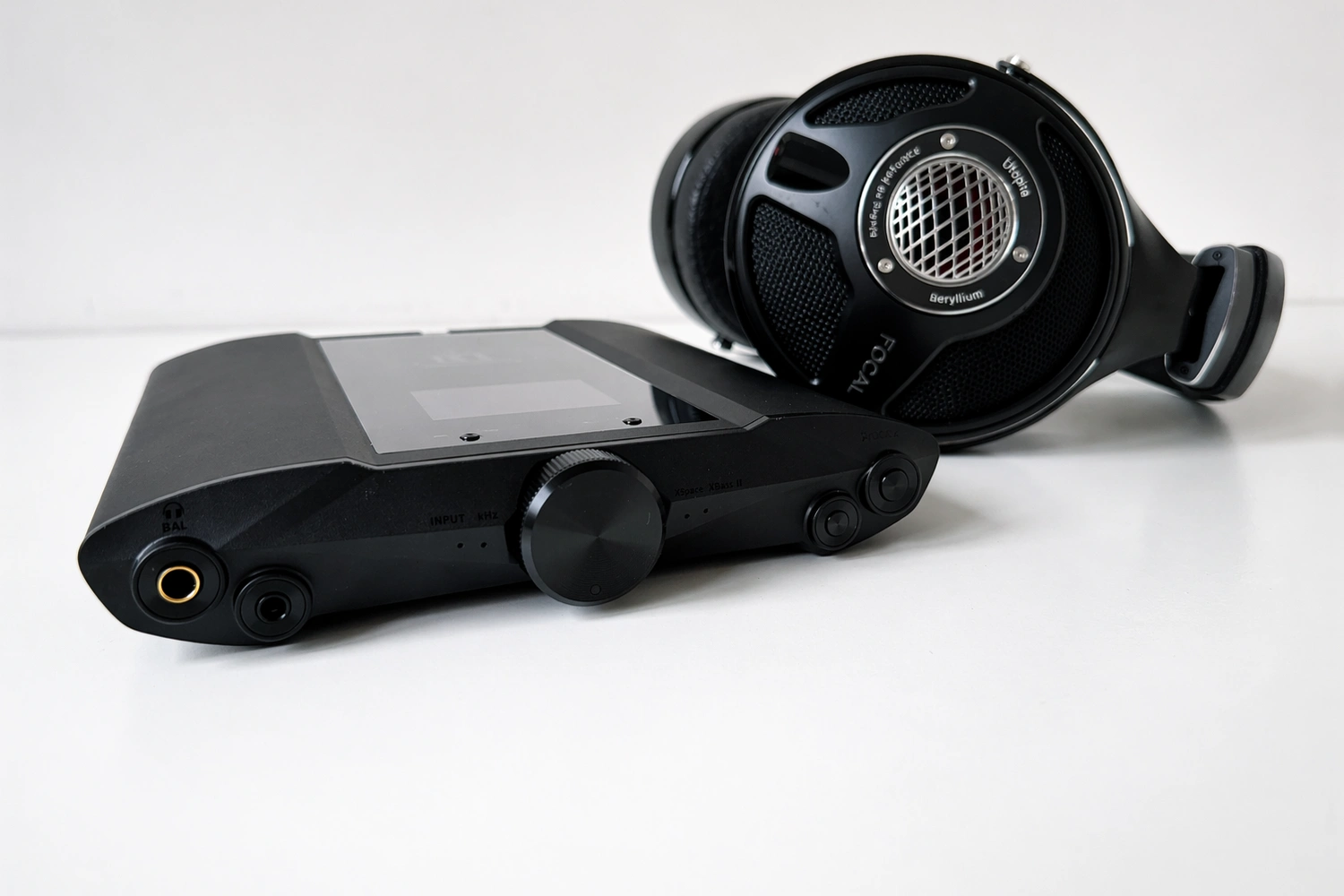
10. iFi iDSD Valkyrie Review: A True Flagship DAC Amp for Demanding Headphones
The iFi iDSD Valkyrie is a substantial battery-powered DAC and amplifier supplied with a carrying case, cables, adapters, optical connectivity, and external power supply.
The iFi iDSD Valkyrie occupies the space between portable DACs and full-size desktop equipment.
It is battery powered and transportable, but its dense aluminum-and-glass construction and substantial form make it a different proposition from a pocket dongle.
Tactile controls include a volume wheel designed for precise adjustment. The supplied package is unusually comprehensive, containing a carrying case, USB-C cables, adapters, optical connectivity, an iFi SilentPower iPower X supply, and a wooden presentation case. Its positioning and physical design make the most sense for listeners who need a serious DAC and headphone amplifier that can travel without prioritizing minimum size.
Best for: Transportable headphone systems where pocket size is unnecessary
- Battery-powered transportable design
- Solid aluminum-and-glass construction
- Precise tactile volume control
- Extensive cable, adapter, case, and power-supply bundle
Verdict: A substantial battery-powered DAC and amplifier that favors desktop-like construction and connectivity accessories over dongle-scale portability.
Quick comparison
These DACs divide naturally into portable models, transportable headphone components, and permanent home-system converters.
Compare them first by intended setting and connection requirements; maximum sample rates and internal architecture are secondary unless they correspond to material and equipment you actually use.
| Product | Best for | Verdict |
|---|---|---|
| Questyle M15C | Portable use across multiple operating systems | Compact dual-output design with selectable gain and broad documented device support. |
| Naim DAC-V1 | Computer-centered home audio systems | System-oriented external conversion informed by Naim's premium DAC development. |
| Hidizs S8 Pro Robin | Portable listeners who want filters and balanced output | Dual-CS43131 design with five filters and higher rated power from its balanced connection. |
| Tanchjim Luna | Portable systems needing high-rate PCM support | Dual-CS43198 portable model with 768kHz PCM support and a shielded supplied cable. |
| Luxman DA-06 | Home systems with several optical or coaxial sources | Substantial home DAC with two optical and two coaxial inputs. |
| T+A DAC 8 DSD | Compact home systems needing DAC and preamplifier functions | Combines discrete DSD conversion, multi-DAC PCM processing, analog preamplification, and headphone drive. |
| SMSL D10 | Portable USB setups requiring substantial published output | Dual-output USB model rated at up to 500mW into 16 or 32 ohms. |
| Rotaxis Core64 | Enthusiasts specifically seeking an R-2R architecture | A specialist passive resistive-ladder design positioned as an alternative to delta-sigma conversion. |
| Aune Yuki SE | Portable listeners interested in discrete amplification | Compact ESS-based DAC with a discrete 16-transistor, four-channel gain stage. |
| iFi iDSD Valkyrie | Transportable headphone systems where pocket size is unnecessary | Battery-powered flagship-style component with substantial construction and a broad accessory package. |
Frequently asked questions
Should I choose a portable DAC or a home DAC?
Choose a portable model when the main source is a phone or laptop and headphone listening is the priority.
A home DAC is more appropriate when you need several fixed digital sources, a substantial chassis, preamplifier functions, or permanent integration with an amplifier and speakers.
The iFi sits between these categories as a battery-powered but comparatively substantial transportable component.
Do I need a 4.4mm balanced headphone output?
Only if your headphones have a compatible balanced cable and the DAC's balanced output provides a useful benefit for that load.
The Questyle, Hidizs, Tanchjim, and SMSL models offer both 3.5mm and 4.4mm connections, but the presence of a balanced socket alone does not determine overall suitability.
How important are PCM and DSD maximum rates?
Confirm that a DAC supports the formats in your actual library, but do not choose solely by the highest published number.
The models here range from PCM support up to 384kHz or 768kHz and DSD support up to DSD256 or DSD512; those limits matter only when your source software, connection, and files can use them.
How do I judge whether a DAC can drive my headphones?
Compare the DAC amplifier's output rating at an impedance close to that of your headphones, then consider headphone sensitivity and any gain controls.
Ratings at different loads are not directly interchangeable.
The Questyle provides standard and high gain, the Hidizs publishes separate balanced and unbalanced ratings, and the SMSL specifies output across several impedances.
How to Choose the Right DAC for Your System
Begin with the source.
A phone-centered system benefits from a compact USB DAC with confirmed operating-system support, while a home setup may require optical and coaxial inputs for streamers, disc players, televisions, or other digital components.
Do not assume that a portable USB model can replace a home switching hub, or that a full-size component makes sense for daily travel. Next, decide whether headphone amplification is necessary. If it is, match the published output information to the impedance and sensitivity of your headphones and note whether gain adjustment is provided. Also verify the physical plug: 3.5mm is widely used, while 4.4mm requires compatible balanced termination. A higher balanced-output rating can be useful, but it should not override practical compatibility. Internal architecture can refine the shortlist. The Hidizs, Tanchjim, SMSL, and Questyle models use Cirrus Logic conversion, the Aune combines an ESS converter with discrete amplification, the T+A provides distinct PCM and discrete DSD paths, and the Rotaxis pursues a passive resistive ladder. These differences are meaningful design distinctions, but they should be weighed alongside inputs, controls, size, and system role rather than treated as automatic indicators of sound quality. For straightforward mobility, the Questyle M15C offers broad platform support and selectable gain. The Hidizs S8 Pro Robin adds filters and clearly differentiated balanced power, while the SMSL D10 supplies extensive output ratings. The Tanchjim Luna and Aune Yuki SE emphasize more specialized circuit design. Home listeners should look toward the Naim DAC-V1, Luxman DA-06, or T+A DAC 8 DSD according to their input, preamplifier, and headphone requirements. The Rotaxis Core64 is the architectural outlier, and the iFi iDSD Valkyrie is the transportable choice for anyone willing to trade pocket convenience for a more substantial component.



Sound Off
0Join the discussion if you have something to add.